正在加载视频...

视频加载失败

$QUBIC The 3 Performance Scenarios (2026 Projections) Currently, Qubic is floating with a market cap around $100M to $150M. Compared to AI giants like Bittensor ($TAO) which have already hit multi-billion dollar valuations, the upside potential is mathematically massive. 1. The "Fundamental Catch-up" Scenario (Probability: High) • Target: Reaching...

10,602 次观看 • 6 个月前 •via X (Twitter)

0 条评论

暂无评论

原始帖子的评论将显示在这里

相关视频

What I’m about to say about $QUBIC is INSANE!! Every cycle of hype and crisis in the world brings a new critical need. We’ve already seen it with: - DeFi (banking without banks) - Metaverse (new forms of human interaction) - RWA (tokenization of real-world assets) - Privacy (ZKP, Monero, etc.) - Stablecoins (digitized dollar) - AI (LLMs and automation) - Quantum Technology (post-classical computing) And now: Computational Energy + Decentralized AGI The next incalculable frontier is energy for data processing. Whoever turns mining power into abundant, real-use compute infrastructure will dominate the next cycle. Sovereign nations will no longer accept depending exclusively on American (or Chinese) Big Tech for critical AI, defense, and intelligence. Digital sovereignty has become a matter of national security. $QUBIC is perfectly positioned for this. Through Aigarth (its evolutionary “AI Garden”), the network runs on Useful Proof-of-Work: miners’ energy (CPU/GPU) isn’t wasted on useless hashes - it trains and evolves a decentralized AGI in real time. It’s becoming the world’s largest dedicated decentralized supercomputer. While nations seek alternatives to avoid becoming hostages to monopolies, QUBIC delivers accessible, resilient, and sovereign AGI - any country can run its own decentralized intelligence without relying on vulnerable centralized data centers. An adoption explosion is coming. QUBIC has the potential to become one of the most valuable assets on the planet by solving compute abundance + computational sovereignty. Other projects will try to follow (we already see echoes in ideas from figures like Elon Musk about open AGI). But by the time they wake up to the mathematical, structural, and philosophical problems QUBIC has been tackling for years, the network will be light-years ahead. This is not just price speculation. It’s a real-utility asset - proof of those who truly understand the future of distributed computing. Remember Palantir? At its 2020 IPO, valuation was ~$22B. Today it sits in the $340–365 billion range after exploding with AI + defense contracts. The lesson? AI applied to security and intelligence creates insane value. But there’s a serious problem: **centralized data centers are easy targets. We saw this clearly in the recent Middle East conflicts (2026): Iranian attacks on AWS, Oracle, and other data centers in the Gulf exposed the fragility of concentrated infrastructure. Anything that can be physically destroyed or cut off by sanctions/cyberattacks compromises national sovereignty. QUBIC is different: a globally distributed network powered by decentralized hashpower - extremely hard to “turn off.” An AGI resilient by design. Perfect for nations seeking true technological independence. QUBIC goes far beyond its whitepaper. It’s a civilizational thesis: abundant, sovereign, future-aligned computing. Those who understand this early aren’t just positioning financially - they’re positioning historically. #QUBIC #Aigarth #DecentralizedAI #UsefulPoW ---

BCharles

13,781 次观看 • 3 个月前

The world just paid $2 trillion for a rocket company that lost $4.9 billion last year. And the rockets are not why it lost the money. They are the only part making any. SpaceX went public Friday, the largest IPO in history. Up 19%, a $2 trillion valuation, Elon Musk the first trillionaire. Then you open the filing. Three businesses sit inside it. Starlink, the satellites, brought in $11.4 billion, 61% of all revenue, and $4.4 billion in profit. It is the only piece that earns a dollar. The rockets that land themselves run a small loss reinvesting in Starship. And the AI arm, Grok plus the app once called Twitter, folded in this February, lost $6.4 billion in a single year on $12.7 billion of spending. Read that again. The satellites pay for everything. The AI loses more than the satellites make. And the AI is the part the market fell in love with. It gets bolder. The prospectus claims a total market of $28.5 trillion, the largest any company has ever put in a filing. Larger than the GDP of the United States. That is the number underwriting a $2 trillion price tag built on a division bleeding $6 billion a year. Now the structure. About 4% of the company trades. That sliver sets the price for all of it. Musk is locked up for 366 days and holds roughly 80% of the votes. The public bought a company they cannot steer, priced on the one segment losing the most. This is the whole year in one ticker. The profit is satellites. The story is AI. The market bought the story. The rockets were never the risk. The risk is a $2 trillion price resting on the one bet that has yet to make a cent.

Shanaka Anslem Perera ⚡

721,741 次观看 • 1 个月前

🍖WHAT TO UNDERSTAND ABOUT $BONE 🍖 With the launch of Shibarium, Bone which serves as the gas fee , is expected to see a significant surge in price. Here's why: 1. Increased Demand: #Shibarium's introduction will lead to a surge in overall usage and adoption within the Shiba ecosystem. As more transactions occur on the blockchain, there will be a higher demand for Bone as users need it to pay for gas fees. This increased demand for Bone will likely drive its price upwards. 2. Essentiality and Utility: Bone becomes a vital asset within the Shiba ecosystem as the designated currency for gas fees. Its primary function in facilitating transactions and interacting with the network establishes its intrinsic value and necessity. As Shibarium adoption grows, the demand for Bone will increase, potentially leading to a surge in its price. 3. Limited Supply: If the supply of Bone remains fixed or grows at a slower rate compared to its increasing demand, scarcity will come into play. The limited availability of $Bone, combined with its growing utility, can contribute to its price explosion. 4. Network Effect: Shibarium's traction will create a network effect where the value of Bone increases as more participants join the ecosystem. As the user base expands, the demand for Bone rises, creating a positive feedback loop that can drive up its price. 5. Investor Confidence: The successful launch of Shibarium will likely instill confidence in investors, attracting more attention and potential investment to the ecosystem. Positive sentiment, along with the platform's technological advancements and utility, can contribute to the price appreciation of $Bone. #Shibarium operates as a Layer 2 solution, reducing gas fees significantly and enhancing scalability. This scalability improvement allows for a larger volume of transactions at a lower cost. The combination of reduced gas fees and increased transaction capacity creates a favorable environment, further fueling the potential price explosion of Bone.

𝐋𝐔𝐂𝐈𝐄

34,471 次观看 • 3 年前

Exciting News Alert: Catalyst Joins opBNB Network! 🚀 Hold onto your hats, because Catalyst is back in action, stirring up the world of cross-chain liquidity! We're thrilled to unveil our latest expansion: Catalyst now supports the opBNB network and BNB Chain. This means smoother and more efficient transactions across all chains are now within reach through Catalyst. Let's dive in! 🌊 Catalyst Meets opBNB Our mission to drive interoperability takes another big step as Catalyst teams up with Binance to launch on its domains. The opBNB Testnet deployment will initially support cross-chain swaps with BNB Chain. But wait, there's more! In the coming weeks, more chain connections will be added. Connecting the BNB Chain ecosystem to Catalyst's network is where the magic begins. 🪄 Get ready for a blockchain match made in heaven! Catalyst's prowess in cross-chain liquidity meets opBNB's optimization of the BNB Chain ecosystem. Picture this: high-throughput applications on BNB Chain, supercharged by Catalyst's seamless cross-chain capabilities. It's not just a partnership; it's a gateway to unlocking BNB Chain's full potential! 🚀 opBNB is a Layer-2 superstar built to amplify BNB Chain's might. Powered by the OP Stack, opBNB boasts a block size of 100M, ensuring stable and pocket-friendly gas fees. Whether you're diving into decentralized exchanges, gaming, or everyday transactions, opBNB's got your back with exceptional performance. 🌟 One of opBNB's standout features is its seamless compatibility with the EVM. For developers already well-versed in the EVM world, this means a smooth transition to building and deploying applications on the opBNB network. It's all about making life easier for the crypto community! 🛠️ Catalyst's cross-chain AMM expertise perfectly aligns with opBNB's quest for optimized Layer-2 solutions. The result? Effortless, cost-effective, and high-throughput transactions that benefit users, developers, and the entire BNB Chain ecosystem. Talk about a win-win! 💡 opBNB-Specific Mission Awaits Ready to embark on a thrilling journey within the opBNB Testnet? Whether it's swapping, yield generation, or portfolio management that tickles your fancy, Catalyst on opBNB has got you covered. Get set to explore a world filled with endless possibilities! 🌐 We've crafted an opBNB-specific mission on Catalyst Missions. Completing this mission isn't just rewarding – it also opens doors to the Catalyst community, granting you points and on-chain credentials for a deeper connection. Time to dive in and level up! 🚀 🔗 The integration of Catalyst: Lynx Testnet with the opBNB network is a game-changer. It's a leap toward redefining cross-chain liquidity solutions. Ready to explore endless cross-chain potential? Undertake the opBNB-specific mission and be part of crafting the future of decentralized finance with Catalyst. 🌌

Catalyst

72,222 次观看 • 2 年前

Jeff Bezos just told you exactly how to price AI. Nobody listened. Bezos: “AI is real and it is going to change every industry. In fact it’s a very unusual technology in that regard in that it’s a horizontal enabling layer.” Horizontal enabling layer. Three words that reprice the entire technology sector. The iPhone was a vertical. One product. One new market. Electricity was a horizontal. One substrate that rewired every market on Earth. Wall Street is pricing AI like it is the next iPhone. Bezos is telling you it is the next electrical grid. Right now, thousands of companies are trying to sell AI as a product. A feature. A tool. A subscription tier. Every single one of them will be priced to zero. You do not sell a horizontal layer. You do not compete with it. You build on top of it or you disappear beneath it. For a century, entire industries survived on one thing. Complexity. The friction of navigating law, medicine, logistics, finance. That was the moat. If you could not memorize the maze, you could not compete. A horizontal layer does not navigate the maze. It dissolves the walls. Electricity did not compete with the candle industry. It erased the need for one. The most dangerous part of a horizontal shift is how quiet it is. It moves underneath the economy. The surface looks normal. Revenue still holds. Every day you operate on the old substrate, you accumulate a debt you cannot see and cannot repay. The internet repriced distribution. AI is repricing cognition itself. When intelligence becomes a utility that runs through the walls of every company on Earth, the premium on human expertise does not erode. It evaporates. This is not a disruption. Disruptions replace products. This replaces the ground you are standing on.

Dustin

540,824 次观看 • 3 个月前

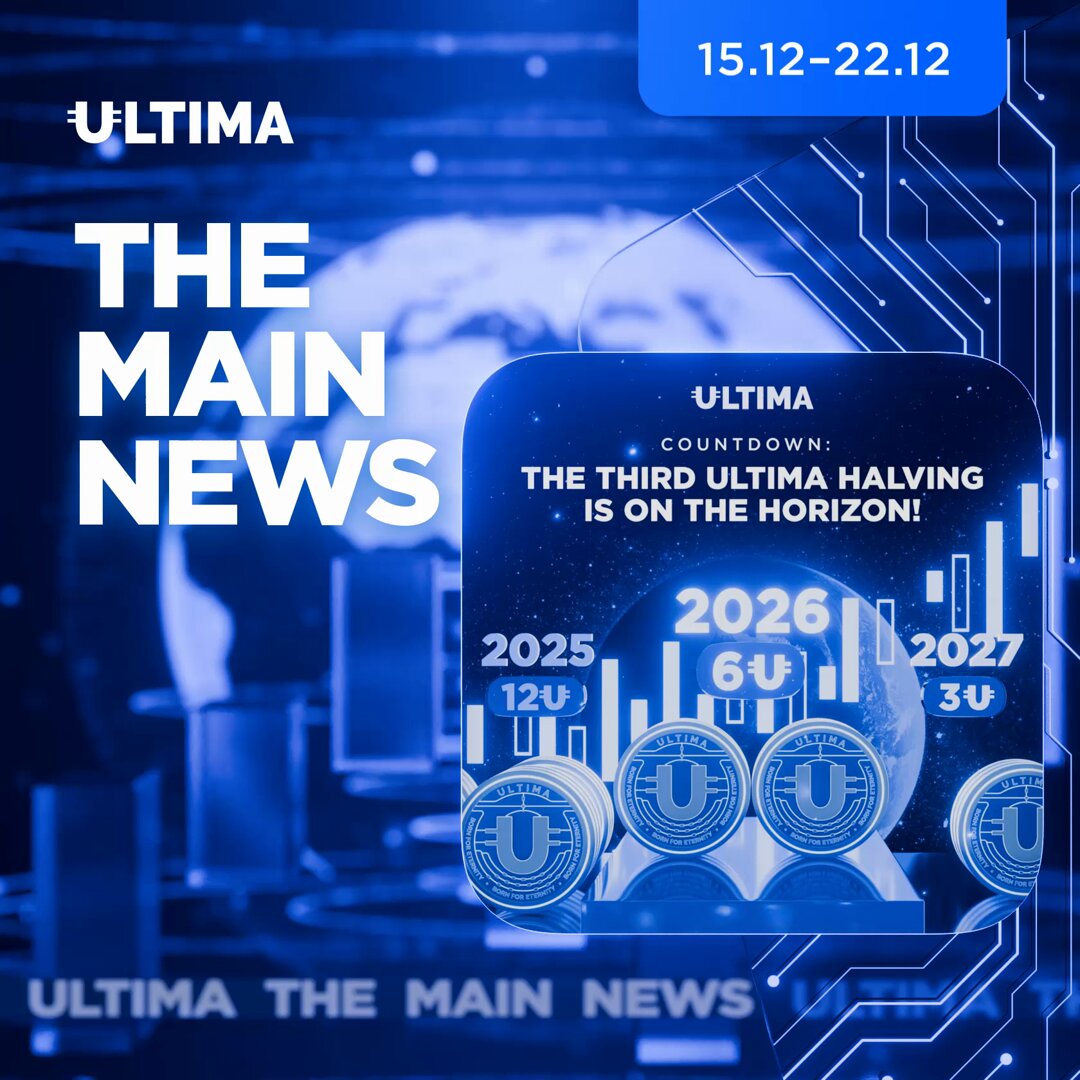
🌐 News of the Week from the Ultima Ecosystem ▶️ COUNTDOWN: THE THIRD ULTIMA HALVING IS ON THE HORIZON! In January 2026, the third ULTIMA halving will take place — a key event that will set a new vector for development and growth not only for the ULTIMA coin, but for the entire ecosystem! After the halving, fewer ULTIMA coins will enter the market. The reduction in supply will increase scarcity, which in the long term may become a powerful driver of growth. Now is the time to act and accumulate as much ULTIMA as possible! 🚀 ▶️ UPDATE: MANUAL ULTIMA FREEZE FOR 1 MONTH — A STEP TOWARD A NEW STAGE OF GROWTH! In honor of the upcoming holidays, the manual freeze period for ULTIMA coins has been reduced from 3 months to 1 month! In addition, all freezing fees have been canceled. This is an important step toward stabilizing the ULTIMA price and supporting steady long-term growth. Frozen ULTIMA are temporarily removed from circulation, creating scarcity — and scarcity is a key factor in value growth! By freezing ULTIMA coins FOR FREE, you participate in the pool and receive daily rewards in ULTIMA! Act now and get the most out of splitting technology! ▶️ MIGRATION OF PERFORMANCE FROM ULTIMA TRADING TO UTRADING: TRANSFER RULES The migration of performance from ULTIMA Trading to UTrading has been completed! All users who have bots on have been credited with performance on the platform — with no additional actions required! In this guide, you’ll learn the rules used for the automatic transfer, the conditions applied to first- and second-version bots, and how much performance you ultimately received: 🔹 Wishing you a productive week!

Ultima_Ecosystem

22,256 次观看 • 7 个月前

I genuinely think the Terafab is going to end up being one of the biggest moves ever made in human history to secure the future of AI... and I think most people still don’t fully see what Elon is trying to do here. The signs are clear to me. This is Tesla, xAI, and SpaceX essentially hinting to us that they are not going to wait on the world to give them the compute the team needs. They are going to build it themselves at a scale no one has ever attempted. When you really break it down, it gets a bit nutty. This is going to be a fully vertically integrated chip factory that will be producing over 1 terawatt of AI compute per year. This is NEXT LEVEL BIG. Today, AI is limited by chips. You can have the best models, the best engineers, the best everything... but if you don’t have enough compute, you will eventually hit a wall. Elon told us, the world can only supply a tiny fraction of the chips his companies will need. So this is the solution. Terafab puts everything under one roof like design, manufacturing, memory, packaging, testing, which means that they can build chips very fast.. like really fast. I'm talking about 100-200 billion custom AI chips per year at full capacity. Chips designed specifically for: • Tesla cars and Optimus robots • xAI models • Space-based compute You see, while other companies and CEOs are thinking Earth, Elon is planning for AI in space. Around ~80% of the compute is expected to go orbital, powered by solar energy bc Earth simply doesn’t have enough electricity. The U.S. grid is only about ~0.5 terawatts, while space has basically UNLIMITED energy if you can capture it. And this is the steps to get it: Starship launches → space compute → solar-powered AI → feeds back into everything to Earth. Bro... Elon and his companies are playing at a whole different level... And this is why I keep telling people that the Terafab is going to be the secret ingredient that will be the real unlock for everything: • Robotaxis at scale • Billions of Optimus robots • Massive AI models running 24/7 • Future off-world, other planet infrastructure Without these chips, none of this can happen... but with the Terafab, all of this becomes possible. That’s why Elon is calling it “the final missing piece.” I agree.

Teslaconomics

25,494 次观看 • 4 个月前

The market heavily discounted BasedAI, pricing in execution risk for what’s arguably the most ambitious AI x blockchain project ever. Now? Mainnet is live. 𝔹rains are minting. The bulk of the risk is behind us. A bridge built together with the first major exchange partner is set to go live soon. And very soon, self evolving Creatures will begin competing in the Brain Arena — solving problems, building strategies and evolving 𝔹asedAI with every pulse. This isn’t just another AI agent plugged into X or a protocol to launch such simple automations. 𝔹asedAI is a fully decentralized EVM compatible Layer 1 network where AI isn’t a feature — it’s the fabric. The network learns, builds, and evolves on its own! ⚡ 𝔹rains: Tokenized intelligence you can stake, activate, and build with. Not tools — ecosystems of intelligence. ⚡ The Nexus: A 3D neural interface like no other. Zoom, rotate, and dive into 𝔹asedAI’s living network. Trace its evolution, feel its pulse, and shape its future in real time. ⚡ Dynamic scarcity: Inflation slashed -20% post-launch. As the network grows and more 𝔹rains come online, emissions scale proportionally, creating a dynamic inflation model. When fewer 𝔹rains are active, inflation remains low — similar to how BTC mining adjusts difficulty based on network size. Pepecoin burns required to mint 𝔹rains add scarcity and sustainability to the model. "At $190M, $BASED isn’t just undervalued — it’s a heist waiting to be realized. Risk? Down bad. Reward? Way up. PLUG IN.

Bill Printer

15,531 次观看 • 1 年前

CoinMarketCap AI Is Live: What Does It Really Change ? 🌱 In the fast paced world of crypto, information is power but its often scattered, delayed, or hard to trust. CoinMarketCap newly launched CMC AI aims to fix that by offering real time insights with no friction. ✨ Real Time Q&A on Coin Pages 🌱CMC AI is now integrated into major coin detail pages, generating automatic Q&As every 30 minutes. During periods of volatility, it updates dynamically, helping users understand price movements with short and structured explanations. No login required, no delays. 🌱However, while this speeds up the process, its not a substitute for deeper analysis. It answers the “what” and “why,” but not always the “what’s next.” ✨What’s Coming Next? 🌱CMC AI is just getting started. According to its roadmap, several new features are on the way • Homepage Integration: A quick view of market trends and opportunities, without clicking into individual coins. • Live Chart Analysis: AI will add context to price moves by linking them to news, sentiment, and social media. • Token Comparison Tool: Users will be able to compare tokens like BTC vs SOL across utility, performance, and tech specs. • Portfolio Insights: One click portfolio analysis with rebalancing suggestions and market outlooks. • Cross Device Continuity: Start an AI conversation on desktop and continue it seamlessly on mobile. ✨A Tool Not a Strategy 🌱 CMC AI brings speed and clarity, two things crypto investors often lack. But it’s still just a tool. It won’t make decisions for you. It helps guide your thinking not replace it. 🌱 The smartest way to use it? Treat it as a compass, not a map. It can point you in the right direction, but the journey is still yours. 🌱 CMC AI represents a step forward in how users interact with crypto data. It filters the noise, shortens research time, and brings useful context closer to the user. But like any shortcut, it works best when you already understand the long route.

Loji

37,459 次观看 • 1 年前

AI just hit a wall that no amount of money can move. The planet itself. There is not enough power, water, or land on Earth to build the data centers the AI race now demands. So the most valuable bet in artificial intelligence is no longer a chip company or a model. It is a rocket company. The plan is to leave. In January, SpaceX filed with the FCC to launch up to 1 million solar-powered data center satellites into orbit. In February it bought xAI, the maker of Grok, folding an entire frontier AI lab into a rocket company in the largest corporate merger ever recorded. On June 8 it unveiled the AI1, a compute satellite with a 70-meter wingspan, wider than a Boeing 747, powered by the sun, cooled by the vacuum of space, and wired to the ground through Starlink. Four days later it went public in the largest IPO in history, near 1.77 trillion dollars, touched 2.1 trillion on its first day, raised close to 86 billion, and made one man the first trillionaire alive. Now read the direction of that merger, because it is the whole story. A rocket company bought the AI lab. Not the reverse. For three years everyone assumed the constraint on AI was chips, or data, or talent. It is none of them anymore. It is energy and heat and dirt. The head of Anthropic said his company grew faster than the exponential, 80 times in a single year, and that is exactly why it ran out of compute. The answer was not to build more data centers in Virginia. It was to leave the atmosphere, where the sun never sets and a solar panel does five times the work. The moat in artificial intelligence is no longer the model. It is the launch. And the first rent is already being paid. A rival lab, Anthropic, is reported to be sending roughly 1.25 billion dollars a month to Musk for compute. Google near 920 million. If intelligence moves to orbit, the company that owns the only affordable road there becomes the landlord of the next layer of the internet, the way one bookstore became the landlord of the cloud. The merger is the proof of concept. The IPO is the war chest. Those monthly checks are the lease. Here is the part the price tag does not want you to read. Close to a trillion dollars of that valuation rests on orbital data centers that do not yet exist, and on a chip factory, Terafab, that SpaceX's own public filing calls a general framework with no binding deal, one that may not achieve commercial viability. Musk said it on camera. This is not a promise. The largest IPO ever written is priced on a future the filing itself cannot verify. The other side is just as real. Compute in orbit costs about four times what it costs on the ground today, and the curve may not cross for fifteen years. The machines that print the chips are backordered for years. Shedding heat in a vacuum at this scale has never been done. Musk's timelines have a long history of meaning later. And Bezos is racing the same orbit with a constellation of 51,600 satellites of his own. But strip it all away and the trade underneath is one sentence. Earth has run out of room for intelligence, and whoever owns the road off the planet owns whatever gets built next. Call it the most expensive science fiction ever sold, or the first time the map of the internet pointed up.

Shanaka Anslem Perera ⚡

54,373 次观看 • 1 个月前

$IREN "we haven't disclosed the specific amount of GPUs" 1. 🤮 reminds me of $NBIS 2. Setting a terrible precedent here for future deals 3. Making it purposely difficult, to not let analysts properly value your 2027 revenue 4. Increasing the polarized view on IREN by the market However: "approximately 60MW of air-cooled Blackwells" 1. You typically don't talk about gross capacity in a deployment like this 2. If it would be gross capacity, the GPU hour rate at IT level would be crazy high (at PUE 1.2, $680m / 50 = 13.6m/MW) 3. At 60MW IT load, and ~14kW draw at DGX server level, we can get to ~4,286 DGX systems with 8 GPUs per. 4. Based on this we can conclude that 60MW of IT load can run approximately 34k DGX B300. 5. 34k DGX B300 at $680m/yr, would represent a GPU hour price of $2.28 Now this is the problem with not disclosing your GPU quantity. You purposely make your business model look bad, because by approach, you get to a GPU hour price that would imply a payback period of 4 years, where only the last year of the contract is 100% margin. But of course, we can also take "the glass is half full" approach. IREN has ordered 50K B300s from Dell. They have 2 purchase orders for this, 1 between Dell Canada and IE CA Leasing Ltd for 4 phases, and 1 between Dell USA and IE US Hardware 1 Inc (amended from IE US Hardware 4 Inc on April 27, 2026). The order for Canada is divided in 4 phases, and are going to Mackenzie for 80MW of gross capacity, which happens to be 4 buildings of 20MW. The order for Childress is divided in 2 phases, and are going to DC35 and DC36, (as depicted in the earnings presentation) and those are 50MW gross. The purchase price of the order for Childress was $1.2B, and for Canada it was $2.3B If we go with 50,000 B300s for a total of $3.5B then $1.2 would represent 34.285% of the 50,000 GPUs, or 17,140 B300s rounded down. For this calculation I will consider that $IREN will deploy 17,140 GPUs in 50MW gross capacity in DC35 and DC36 of block 3 in Childress.. That would imply at 1.2 PUE, IREN can run 17,140 B300s in 41.67MW IT load. Now by that ratio, they can run 24,680 GPUs in 60MW IT load — a massive difference with 34k units through the Nvidia DGX reference calculation. If common sense is applied, you can still get to 2 completely different outcomes, that show a difference of more than 9k GPUs. The GPU hour rate at 24.68k GPUs would be $3.145 per B300, as MASSIVE difference from the earlier calculated $2.28. Sure, the DGX system may be a factor here. And I'm sure that the reality is somewhere in the middle. But I personally hate this as an investor, to be unable to calculate profitability on unit economic basis. After all, contracts are signed on a $/GPU hour basis. Why hide this from your investors? Not being able to calculate payback periods, unable to calculate ROIC. And most importantly, we cannot properly assess the $NVDA deal on a contract basis. I really hope the payback period of this contract is not 4 years. I want the glass to be half full, but by starting to censor the purchases, IREN is taking a step in the wrong direction. Not a fan of this.

Frans Bakker

148,167 次观看 • 2 个月前

Why is the market selling off today? (Save this). The semi selloff right now is being driven by a mix of macro fear, profit taking and investors questioning how quickly all of this AI spending will actually pay off, not because demand for AI infrastructure suddenly disappeared. The market is basically trading this chain reaction, the ongoing US Iran escalation pushes oil higher, higher oil keeps inflation elevated, sticky inflation keeps Treasury yields high and that increases the risk of the Fed staying hawkish or even hiking again. That is a terrible setup for semis because many of these companies are valued on the massive earnings investors expect them to generate years from now. When yields rise, those future earnings become worth less today which is why the highest multiple AI and semiconductor names usually get hit first. (I don't think there will be a hike this year). This is also why everything is moving together right now. Nvidia, Micron, Nebius, SanDisk, Broadcom and Applied Optoelectronics are all completely different businesses, but institutions are not separating memory, networking, optics, compute and cloud infrastructure at the moment. They are reducing exposure to the entire AI trade, taking profits in the names that have already run the most and moving into a more defensive position potentially ahead of the Fed. There is also growing pressure around hyperscaler capex. Microsoft, Meta, Amazon and Google are still spending enormous amounts on GPUs, data centers, networking and power but the market is starting to ask when all of that spending will actually turn into revenue and free cash flow. Investors are no longer satisfied with hearing that AI capex is growing. They want proof that the returns are arriving fast enough to justify the valuations already priced into the entire AI ecosystem. That creates a weird situation where hyperscaler capex can continue rising while semiconductor stocks still fall. The market is not asking whether AI spending is growing anymore but rather asking whether it is growing fast enough to beat the expectations already baked into these stocks. Crowded positioning is another major factor. Semis and AI infrastructure stocks have been some of the biggest winners in the market so institutions are sitting on huge profits and many funds own the exact same names. When macro risk increases, investors usually sell the most liquid winners first. That does not mean demand for memory, optics or custom chips suddenly collapsed but rather means investors are locking in gains and reducing risk. Tariffs add another layer because even when they are not directly placed on chips, they can still raise the cost of servers, electrical equipment, cooling systems, construction materials and the overall data center buildout. That makes AI infrastructure more expensive while also adding another source of inflation. Then you have Jensen Huang’s letter to the White House this morning about open weight AI models, which I think is one of the most important long term developments here. Nvidia, Meta, Microsoft, Palantir and several other companies are pushing Washington not to place broad restrictions on open weight AI. OpenAI and Anthropic were notably absent because open models are much more of a threat to their business models. OpenAI and Anthropic benefit from a world where a few closed frontier labs control the best models and companies have to pay them through subscriptions and APIs. Open weight models weaken that advantage because businesses can download a model, customize it for their own use and run it on their own infrastructure or through a neocloud. That is bad for OpenAI and Anthropic because it puts pressure on pricing, margins and the idea that they will control the intelligence layer of the economy but it is very good for the AI ecosystem as a whole over the long run. But the question is what does this mean for all the OpenAI and Anthropic commitments? so that's adding to the fear as well. But with that being said open models make AI cheaper and more accessible. Instead of AI being controlled by a few giant labs, thousands of startups, universities, governments and regular businesses can deploy models themselves. That spreads AI adoption across the entire economy and creates a much larger infrastructure opportunity and that is exactly why Jensen cares. Nvidia does not need OpenAI or Anthropic to win. Nvidia just needs more people using AI. Whether the model comes from OpenAI, Anthropic, Meta, Mistral, Kimi or some startup nobody has heard of yet, it still needs GPUs, memory, networking, data centers and electricity. So open weight AI could actually weaken the model companies while making the infrastructure layer much bigger. More open models mean more companies running inference. More inference means more GPUs. More GPUs mean more HBM, optical transceivers, switches, data centers and power. That is bullish for Nvidia Nebius, Micron, Broadcom , Marvell and Applied Optoelectronics over the long run. So my take is that the current semi selloff is being driven mostly by macro uncertainty, higher oil, rising yields, Fed fears, tariffs, crowded positioning and questions around the return on hyperscaler capex. The underlying AI infrastructure thesis has not suddenly broken. We are not broadly seeing hyperscalers cancel GPU orders, slash capex, abandon data center projects or report that AI demand has collapsed. What has changed is the valuation investors are willing to pay while the macro environment remains unstable. The market is lowering the price it is willing to pay for semiconductor growth but is not necessarily saying that growth is gone. And while Jensen’s open weight push may be bad for OpenAI and Anthropic, it could be one of the best things possible for the AI ecosystem over the long run because it creates more models, more developers, more competition and ultimately much more demand for the infrastructure underneath all of it. Nothing about the AI thesis has changed for me, so I will be going shopping and taking advantage of this sale while the market is selling everything together. I am an analyst at Milk Road Pro, and if you want to see exactly what I am buying, you can join for just $1 using the link below.

Melvin

178,943 次观看 • 8 天前

Three of the biggest companies in the world are going public at the same time. The market has never seen anything like this. And this is how major bubbles peak. SpaceX is targeting a June 2026 IPO raising up to $75 billion at a $1.5 trillion valuation, the largest IPO in human history, bigger than Saudi Aramco's $29 billion raise in 2019. OpenAI is filing with the SEC targeting September 2026, raising at least $60 billion at a $1 trillion valuation. The company is losing $14 billion this year alone and won't be profitable until 2029. Anthropic just raised $30 billion in February 2026 at a $380 billion valuation. Its valuation has increased 15x in just 14 months. It is now preparing what could be a $900 billion private round before going public. Combined, these three IPOs could pull $200 billion from global capital markets. That is real. That is unprecedented. And here's the real risk. OpenAI is projected to lose $44 billion cumulatively before reaching profitability. Anthropic's valuation has risen 15x in 14 months on the same underlying business. Both companies are being priced for perfection at a moment when the first companies to actually deploy their products at scale are blowing their AI budgets and cancelling licenses. The real liquidation pressure from these IPOs doesn't even arrive at listing day. It arrives 180 days later when lock-up periods expire and early investors and employees can finally sell. That is when the real rotation happens. The S&P 500 concentration risk is genuine. The Magnificent 7 now represent 36% of the entire index, higher than the dot-com peak in 2000. If any of these companies disappoint, the index follows. That is not a conspiracy. That is basic math. Three historically unprecedented IPOs. $44 billion in projected OpenAI losses. An AI capex cycle that must deliver ROI. Lock-up expirations six months after listing. That combination is what you must pay attention to, as it often break cycles.

Crypto Rover

69,887 次观看 • 2 个月前