Loading video...

Video Failed to Load

Go Home

Radiance field reconstruction (Gaussian splatting) quality is getting a big step up. NVIDIA AI just released Physically-Plausible Image Signal Processing (PPISP) for Radiance Field Reconstruction. Apache 2.0 and coming to both gsplat and 3DGRUT. Code: Article: Authors: Isaac Deutsch, Nicolas Möenne-Loccoz, Zan Gojcic, Gavriel State NVIDIA AIDev

49,604 views • 6 months ago •via X (Twitter)

0 Comments

No comments available

Comments from the original post will appear here

Related Videos

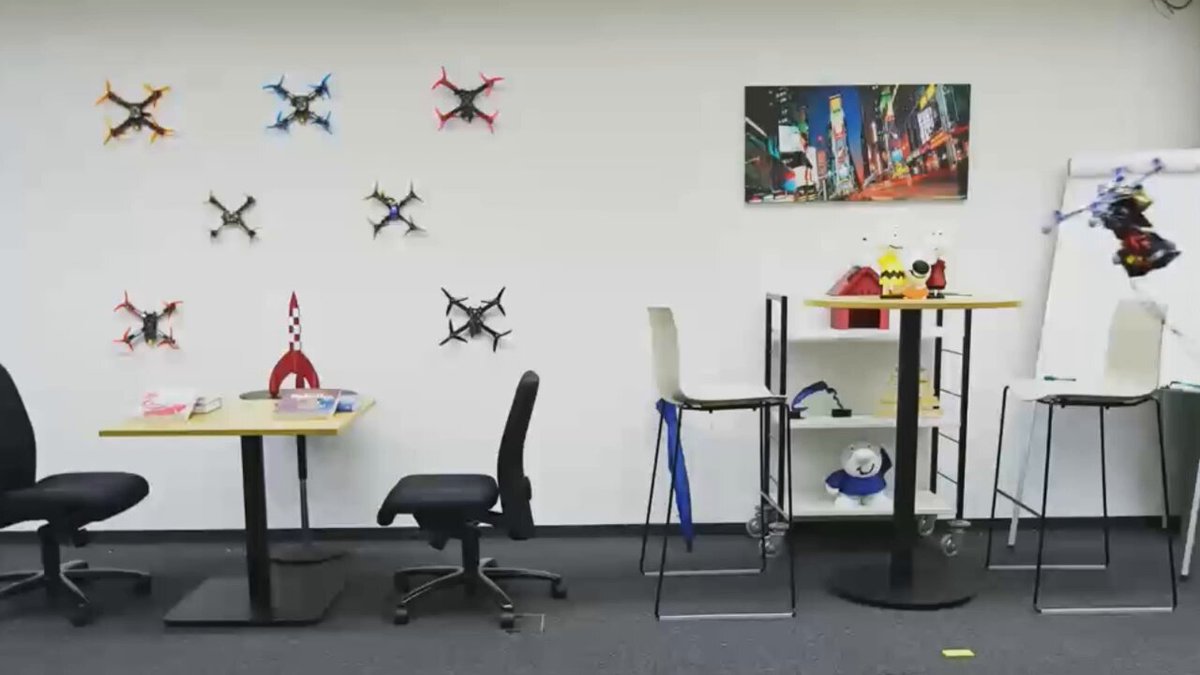
We are excited to share our work “Event-Aided Sharp Radiance Field Reconstruction for Fast-Flying Drones” published in IEEE Transactions on Robotics IEEE Transactions on Robotics (T-RO), which tackles sharp radiance field reconstruction under agile drone motion, where RGB frames are heavily motion-blurred and pose priors become unreliable! 4 years in the making! Code & dataset released! PDF: Code & Dataset: Full Narrated Video: High-speed flight is essential for time- and battery-constrained missions (e.g., inspection, exploration, search & rescue). However, fast motion corrupts visual data with severe motion blur and introduces drift/noise in visual-inertial odometry, making NeRF-based 3D reconstruction particularly brittle. We propose a unified framework that leverages asynchronous #EventCamera streams together with motion-blurred frames to reconstruct high-fidelity radiance fields from agile drone flights. Our key idea is to embed event-image fusion directly into radiance field optimization while jointly refining a shared, continuous-time camera trajectory initialized from event-based VIO. This enables us to recover sharp radiance fields and accurate trajectories without ground-truth supervision during training. We validate our method on synthetic data and on real sequences captured by a drone flying up to 2 m/s. Despite severe blur and noisy pose priors, our method preserves fine scene details and achieves a performance gain of over 50% on real-world data compared to state-of-the-art methods. Kudos to Rong Zou and Marco Cannici! Marco Cannici Reference: Rong Zou*, Marco Cannici*, Davide Scaramuzza Event-Aided Sharp Radiance Field Reconstruction for Fast-Flying Drones IEEE Transactions on Robotics (T-RO), 2026 NCCR Robotics European Research Council (ERC) AUTOASSESS UZH IfI University of Zurich UZH Science Prophesee SynSense UZH Space Hub

Davide Scaramuzza

12,006 views • 5 months ago

FAU Erlangen-Nürnberg presents TRIPS Trilinear Point Splatting for Real-Time Radiance Field Rendering paper page: Point-based radiance field rendering has demonstrated impressive results for novel view synthesis, offering a compelling blend of rendering quality and computational efficiency. However, also latest approaches in this domain are not without their shortcomings. 3D Gaussian Splatting [Kerbl and Kopanas et al. 2023] struggles when tasked with rendering highly detailed scenes, due to blurring and cloudy artifacts. On the other hand, ADOP [R\"uckert et al. 2022] can accommodate crisper images, but the neural reconstruction network decreases performance, it grapples with temporal instability and it is unable to effectively address large gaps in the point cloud. In this paper, we present TRIPS (Trilinear Point Splatting), an approach that combines ideas from both Gaussian Splatting and ADOP. The fundamental concept behind our novel technique involves rasterizing points into a screen-space image pyramid, with the selection of the pyramid layer determined by the projected point size. This approach allows rendering arbitrarily large points using a single trilinear write. A lightweight neural network is then used to reconstruct a hole-free image including detail beyond splat resolution. Importantly, our render pipeline is entirely differentiable, allowing for automatic optimization of both point sizes and positions. Our evaluation demonstrate that TRIPS surpasses existing state-of-the-art methods in terms of rendering quality while maintaining a real-time frame rate of 60 frames per second on readily available hardware. This performance extends to challenging scenarios, such as scenes featuring intricate geometry, expansive landscapes, and auto-exposed footage.

AK

45,459 views • 2 years ago

[SIGGRAPH 2025] Photoreal Scene Reconstruction from an Egocentric Device Contributions: 1. We address the importance of employing visual-inertial bundle adjustment (VIBA) that accounts for the rolling-shutter behavior of the RGB camera. This provides a continuous camera trajectory to model pixel movement in neural reconstruction. Our experiments demonstrate that using VIBA consistently improves the novel view quality in Gaussian Splatting by +1 dB in PSNR. 2. We introduce a rasterization-based image formulation pipeline that addresses common artifacts in physical image formation, including rolling shutter, lens shading, exposure, and gain compensation. Our approach is distinct in that we represent image poses as posed pixel arrays sampled from a continuous trajectory, rather than assigning a single camera pose per image, and preserve the merit of Gaussian rasterization. Unlike existing methods that require ray-tracing Gaussians, e.g., [Moenne-Loccoz et al. 2024], our formulation is applicable to general-purpose rasterization-based Gaussian splatting. When applied to 3D Gaussian Splatting (3DGS) [Kerbl et al. 2023], our approach can further enhance reconstruction quality by +1 dB. We outperform existing baselines and demonstrate a substantial quality improvement in handling complex scenes observed by egocentric devices. 3. To reduce the effect of blur from rapid head motion in darker indoor scenes, we propose a strategy of deliberately underexposing input videos during capture, inspired by HDR+ [Hasinoff et al. 2016]. We demonstrate that we can reconstruct high-quality, noise-free scene radiance from noisy, dim input videos, and further render sharp, blur-free videos at a higher dynamic range.

MrNeRF

15,244 views • 1 year ago

3D scanning and rendering is moving so fast - got my splats up and running and I'm mind blown getting ~100fps for this complex 3D scene ⬇️ 🤯 1. WAY faster than NeRF: For comparison, NeRFs would takes around 10 seconds per frame (!) Instead I'm zipping around with FPV controls without breaking a sweat - though I do crash a few times towards the end of the video lol 2. Old Meets New: Gaussian Splatting is cool in that it fuses classical graphics and deep learning techniques. Like NeRFs, this is still a radiance field - just without the slower (ne)ural rendering part. 3. Explicit Representation: Instead you represent a 3D scene as a collection of ellipsoidal "splats" called gaussians. Each gaussian has a position, size, and color. Rendering in real-time is done by projecting into the image plane and alpha blending. 4. Photorealistic Effects: Gaussian splatting use spherical harmonics to represent the view-dependent effects and lighting - allowing surfaces to change color when viewed from different angles, enabling greater photorealism. It doesn't use a neural network, but the training loop is similar to deep learning. 5. Enables Direct Editing: But it's not just speed - with Gaussian Splatting you also get 3D editing support! So you can select, move, and delete stuff, even relight stuff. This type of editing has been more tedious to do with NeRFs and their implicit black box representations. 📲 More tests cooking! Much more to unpack here including simpler explanations. If you enjoyed this post, you might enjoy my feed: Bilawal Sidhu

Bilawal Sidhu

337,090 views • 2 years ago

Jensen is using Nebius to fight the hyperscalers and this is why they will be a $1T hyperscaler (Save this) According to a new Schedule 13G filing, Nvidia beneficially owns 22.25 million Class A shares of Nebius, made up of 1.19 million shares held directly and 21.07 million shares tied to pre-funded warrants acquired back in March 2026. That warrant stake traces back to a $2 billion deal Nvidia struck with Nebius on March where Nvidia bought pre-funded warrants for roughly 21 million shares at an exercise price of essentially zero, structured to work almost like an upfront equity check. Nvidia is currently restricted from exercising or selling any of those warrant-backed shares until September 11, 2026, so this stake has been locked up and largely out of the news cycle until the filing just brought it back into view. That deal came bundled with a much bigger strategic partnership. Alongside the investment, Nvidia and Nebius announced a plan to build out more than 5 gigawatts of Nvidia-powered AI cloud infrastructure by the end of 2030, giving Nebius early access to Nvidia's next-generation Rubin platform, Vera CPUs, and BlueField storage systems well ahead of most competitors. This stake fits a pattern Jensen Huang has been running for a while now. Huang reportedly hates a world where hyperscalers control all the compute, since Google TPUs and Amazon Trainium getting stronger is the one outcome that actually threatens Nvidia long-term. That's why Nvidia keeps putting money into neoclouds like Nebius and CoreWeave and backstopping their GPU clusters, effectively betting on a wide field of players rather than letting three or four hyperscalers dominate the entire compute layer. A GPU sold to Nebius costs Nvidia the same as a GPU sold to Google today, but five years out, every neocloud that survives and scales is one more customer that isn't building its own competing chip and one more reason inference keeps running on open, non-hyperscaler infrastructure instead of a closed ecosystem Nvidia doesn't control. That's the real bull case for Nebius becoming a trillion dollar hyperscaler in its own right. It already has $27 billion locked in from Meta, $17.3 billion from Microsoft, direct equity backing from Nvidia and priority access to Nvidia's next generation chip roadmap before most competitors get it, giving it the capital, the customer base, and the hardware edge all at once, exactly the combination Nvidia needs someone to have if it wants a real fifth hyperscaler standing up against Google, Amazon, Microsoft, and Meta. I remain extremely bullish on Nebius, follow me Melvin for more infrastructure plays and make sure to check out the link below for more!

Melvin

75,069 views • 14 days ago

Mistral AI Releases Leanstral 1.5: An Apache-2.0 Lean 4 Code Agent Model Solving 587 of 672 PutnamBench Problems Most AI theorem proving is a language model generating a proof in one shot, with a verifier bolted on at the end to check it. That's autocomplete with a grader — and Mistral just drew a clear line between that and an actual proof agent. They released Leanstral 1.5 — a 119B MoE with 6.5B active parameters, trained as a code agent that lives inside the Lean 4 compiler loop: propose a proof, read the compiler's goals and errors, refine, repeat until it compiles or the budget runs out. Verification isn't the eval here. It's the training signal. Here's what's actually interesting: → Test-time scaling behaves like a dial: PutnamBench Pass@8 climbs 44 → 244 → 493 → 587 solved as the per-attempt token budget moves 50k → 200k → 1M → 4M → 587/672 on PutnamBench at ~$4 per problem, versus an estimated $300+ for Seed-Prover 1.5 high (a 10 H20-days-per-problem budget) → Saturates miniF2F: 100% on both validation and test sets → Two RL environments in training — a multiturn prover, and a raw-filesystem code agent that edits files, runs bash, and queries the Lean language server for live goals and types → Not just math: an Aeneas (Rust → Lean) pipeline flagged 11 genuine bugs across 57 repos, 5 previously unreported — including an integer overflow in datrs/varinteger when (value + 1) hits Std.U64.MAX Apache 2.0 weights, free API endpoint Full analysis: Model weights: Project: Technical Details: Mistral AI Mistral AI for Developers Sophia Yang, Ph.D.

Marktechpost AI

56,695 views • 1 month ago

Fast Company just published a great piece on World Labs , Fei-Fei Li , Marble, and the idea that spatial intelligence / world models may be one of the next big shifts in AI. I was happy to be quoted in the article, but I also wanted to share more context about my own experience with World Labs and Marble, and why this direction is especially interesting to me. My starting point: volumetric capture — For the past few years I’ve been exploring and using volumetric capture and reconstruction (photogrammetry, NeRFs, 3D Gaussian Splats) mostly capturing locations around Montreal. Alleys, museums, urban interiors. I love every step of it: the capture itself, the pipeline, and what can be done with the output. Turning real spaces into real-time explorable systems. I do this personally, sharing explorations here, and professionally as chief technologist, and co-founder of Dpt. Physical reality + generative manipulation — In my work I’m especially drawn to mixing physical reality with generative and digital manipulation: using physical interfaces (light, clay, ink, ... ) to drive generative AI pipelines, building mixed reality prototypes that reshape your surroundings, or starting from real captured spaces and transforming them using tools like Marble. Like many people, I saw the World Labs announcement on Twitter in September 2024, and Marble when it surfaced in early December. But by then, I already had a sense something was coming. The first conversation — As someone deep into volumetric capture and radiance fields, I obviously knew about Ben Mildenhall and his pioneering work on NeRF. To my surprise, Ben reached out to me in late June 2024. He’d been following some of my experiments and wanted to chat about my process and workflows and how I was using this “stuff” creatively. At that point he didn’t share what he was building, but we had a genuinely great conversation about radiance fields, AI, and my work. He was curious about the creative perspective, not just the technical one. When the World Labs announcement dropped a few months later, it all made sense. I understood what Ben had been working on, and why the creative angle mattered to them. Then in August 2025, he invited me to try the Marble beta, and I’ve been experimenting with it since. Experimenting with Marble — The first thing I used Marble for was materializing scene and world concepts during ideation at the studio, and seeing if and how it could fit into our production pipeline. In parallel, I dove into a series of experiments focused on world manipulation: starting from real captured spaces and transforming them using Marble. I’d already been exploring that idea using img2img diffusion with ControlNet on NeRF renders, real-time video streams, and even mixed reality using headset camera feeds. But Marble brings something different. It generates persistent, spatially cohesive 3D worlds that can be rendered in real time across a wide range of devices. That’s a real shift. Experiment 01: Parallel Realities — The first experiment, Parallel Realities, starts from a volumetric capture of a real location, reconstructed as 3D Gaussian Splats. Using Marble, I generate an alternate version of that same space, something informed by the original architecture: abandoned, nature-reclaimed, alternate era. Then, using Spark (World Labs’ 3D Gaussian Splatting renderer for THREE.js) I make both realities coexist in the same spatial coordinate system. From there, I use a portal UX mechanic to let the user step between the real reconstruction and the Marble-generated version. Experiment 02: Hidden Depth The second experiment, Hidden Depth, does not transform a space as much as expand it. A captured location has a visual boundary (a mural, a doorway, a dark corridor) and Marble generates what exists beyond it. For example: a Montreal alley has a painted mural; step through it and you’re inside a world informed by what is actually depicted there. World Labs showcased part of this work here: And in their Spark 2.0 post: The project page is here: Why this matters to me — Being able to start from a real 3D Gaussian Splat scene and manipulate it with Marble opens up a lot of ideas. The 3DGS pipeline is becoming an increasingly compelling foundation for exploration, experimentation, and storytelling. What matters most to me right now is more control. The more I can steer the generated scene or world, the more useful the tool becomes. I want more features like the already existing multiple input images and Chisel, the blockout-based approach. I would like better local control, the ability to expand a generated world more and more while preserving coherence, and the ability to directly import 3D Gaussian Splat scenes to be used as a starting point. I want more ways to shape the result, not just a “prompt and hope” approach. — It is exciting to see this field moving from research and demos toward actual creative workflows.

Hugues Bruyère

69,960 views • 1 month ago

📢📢 𝐀𝐯𝐚𝐭𝟑𝐫 📢📢 Avat3r creates high-quality 3D head avatars from just a few input images in a single forward pass with a new dynamic 3DGS reconstruction model. Video: Project: Our core idea is to make Gaussian Reconstruction Models animatable. We find that a simple cross-attention to an expression code sequence is already sufficient to model complex facial expressions. We then incorporate position maps from DUSt3R and feature maps from Sapiens to facilitate the prediction task. While DUSt3R's position maps act as a pixel-aligned initialization for the Gaussians' positions, the Sapiens feature maps help the cross-view transformer to match corresponding image tokens in the 4 input images. One major challenge in creating a 3D head avatar from smartphone images comes from inconsistent facial expressions when the subject could not remain perfectly static during the capture. We eliminate this static requirement by simply showing our model input images with different facial expressions during training. This technique makes our model robust to inconsistent input images later on. Finally, we show that despite the model has been trained with 4 input images, one can even create a 3D head avatar when only a single image is available. To achieve this, we employ a pre-trained 3D GAN to lift the single image to 3D and then render the 4 input images for our model. This allows us to create 3D head avatars from single images and even highly out-of-distribution examples like AI generated faces, paintings or statues. Great work by Tobias Kirschstein from his internship at Meta with Javier Romero, Artem Sevastopolsky, and Shunsuke Saito

Matthias Niessner

74,763 views • 1 year ago

BREAKING: Michael Burry just compared Nvidia to the company that lost 90% of its value in the dot-com crash and took 25 years to recover. "I stand by my analysis. I am not claiming Nvidia is Enron. It is clearly Cisco." Here's the most recent warning from the investor who called the 2008 crash: Michael Burry built his reputation on one trade. He saw the housing market collapse before anyone else and bet against it. "The Big Short" made him famous. Now he's looking at Nvidia. And he says it looks like Cisco in March 2000. That comparison is not a casual insult. Cisco was the most valuable company in the world at the peak of the dot-com bubble. Its valuation crossed $500 billion. Then the bubble burst. The stock fell roughly 90% from its 2000 peak. Its market cap collapsed to about $60 billion by 2002. And it took roughly 25 years for the stock to climb back to where it started. An entire generation of investors waited a quarter century just to break even. That is the company Burry is comparing Nvidia to. Now here is the number that triggered the warning. In Nvidia's fiscal 2026 results, the company disclosed its purchase obligations. These are the commitments Nvidia makes to its suppliers to lock in future manufacturing capacity. A year ago, that figure sat at $16.1 billion. This year it jumped to $95.2 billion. Total supply obligations now sit at roughly $117 billion. Nvidia is committing $117 billion to build capacity for demand that has not arrived yet. Burry's argument is simple. A company does not lock in $117 billion in supplier commitments unless it is betting the demand keeps climbing. If that demand slows even slightly, Nvidia is holding billions in obligations it cannot unwind. And that is exactly what happened to Cisco. Cisco overcommitted to supplier capacity expecting roughly 50% annual growth. Then tech spending slowed. The inventory piled up. The stock cratered. Burry is not calling Nvidia a fraud. He is not saying it is the next Enron. He is saying it could be the market's Cisco. The single stock that becomes the symbol of an AI spending unwind that drags everything down with it. And the dot-com comparison carries weight because of what happened to the broader market. When that bubble burst, the Nasdaq 100 fell 77%. The S&P 500 dropped 49%. It was not just one stock. It was the whole market. Now here is the other side of the argument. Nvidia's supporters say the Cisco comparison is too simple. Because Cisco was riding hype. Nvidia is riding actual revenue. Nvidia reported fiscal 2026 revenue of $215.9 billion, up 65% year over year. Data center revenue alone hit roughly $193.7 billion, up 68%. Record quarterly data center revenue of $62.3 billion in the fourth quarter, up 75%. These are not promises. These are realized sales, booked and collected. The bulls argue that pricing power and margins this strong do not exist inside a pure bubble. In their view, Burry is warning about a future slowdown that has not shown up in a single quarterly report. So the debate splits into two clean halves. The bears say the $117 billion in commitments makes Nvidia dangerously sensitive to any demand slowdown. The bulls say the revenue is real, the growth is accelerating, and the buildout is justified by the orders already on the books. Both sides are looking at the same company. Both sides are looking at the same numbers. They just disagree on what those numbers mean. And there is a second force pulling at this market that has nothing to do with Nvidia's earnings. A wave of mega-IPOs is reportedly coming. SpaceX. OpenAI. Anthropic. Some estimates suggest the market may need to absorb close to $200 billion in fresh equity supply. That creates a quieter question underneath the Burry debate. Even if AI demand stays strong, capital is finite. When the next wave of private giants goes public, money has to come from somewhere. And the easiest place to pull it from is the stock that already tripled. The real test is not whether Burry is right or wrong today. It is whether demand growth, margins, and contract utilization keep matching the $117 billion that Nvidia and its entire ecosystem are committing right now. If the demand keeps climbing, the commitments look like foresight. If it stalls, they look like Cisco. The man who saw the last crash before anyone else just put a name on the risk. A company that was once worth over $500 billion, then lost 90%, then made its investors wait 25 years to get back to even. The numbers say Nvidia is booking record revenue. The same numbers say Nvidia is committing $117 billion to a future nobody can see. One of those facts ages well. The other one is the entire question.

Insider Trackers

285,182 views • 2 months ago

Trump just pulled off one of the smartest dealmaking moves in tech history. And Nvidia + China are both getting played. Let me explain... December 2025: Trump announces Nvidia can sell H200 chips to China. BUT the US government takes 25% of every sale. Not a 25% tariff. 25% OF THE REVENUE goes to US Treasury. Jensen Huang celebrates. Stock rallies. January 14, 2026: Commerce Department publishes the REAL terms. Chips manufactured in Taiwan have to TRANSIT through the US for "third-party verification." When they enter US soil? 25% tariff gets applied. So Nvidia pays 25% tariff to import their own chips. THEN Trump takes 25% of the sale price when they ship to China. Nvidia's getting hit TWICE. The math is crazy: H200 costs $30k to make. Nvidia sells for $50k. 25% tariff entering US = $10k to government 25% of sale to China = $12.5k to government Total to US: $22.5k per chip Nvidia's margin: Drops from 70%+ to maybe 15% Chinese companies ordered 2 MILLION H200 chips for 2026. But Nvidia only has 700,000 in inventory. $22,500 × 700,000 chips = $15.75 BILLION to US Treasury. From ONE deal. With ONE company. Now here's where it gets insane... China isn't actually approving these imports. Chinese state media called H200 chips "unsafe." Cyberspace Administration is blocking purchases except for "exceptional circumstances." So Trump negotiated a deal where: - Nvidia thinks they're getting China market access - China's government is quietly blocking the imports anyway - US Treasury collects billions on the few that do get through - Trump gets to claim he's "tough on China" AND "supporting American business" This move kinda makes sense if you think about it. Supreme Court is about to rule Trump's IEEPA tariffs are illegal. That's the $130 billion refund bomb. Trump needs NEW revenue sources to replace tariff income when that ruling drops. So he invents a completely new structure: Not a tariff (court can't overturn). A "licensing fee" (executive authority). On chips that are "national security sensitive" (unchallengeable). This is the blueprint for Tariffs 2.0. When Supreme Court kills IEEPA authority Trump just pivots to "licensing fees" on every strategic export. Can't challenge it as a tariff because it's not a tariff. It's a "condition of export approval." The semiconductor industry just became Trump's test case. And Nvidia walked right into it because Jensen spent 6 months lobbying for "market access." Meanwhile China's playing the long game: They're not approving H200 imports. They're forcing their companies to use domestic chips (inferior but improving). Accelerating DeepSeek-style efficiency research. Building AI models that work on weaker hardware. In 2-3 years, when Chinese chips catch up, they won't need Nvidia at all. And Trump's "$15.75 billion windfall" becomes $0. But by then he'll have established the legal framework to extract licensing fees from every other strategic export. Everyone thinks Trump's negotiating strategy is "chaos." But look at what he actually accomplished: Created legal precedent for non-tariff trade fees that survive Supreme Court challenges. That's not chaos. That's calculated. What happens next: Supreme Court rules (next 2 weeks). Trump loses on IEEPA tariffs. $130B refund chaos begins. Trump immediately announces "licensing fee" structure for 10 other export categories. Uses Nvidia deal as proof it "works." Markets freak out as every exporter realizes their margins are about to get crushed. China continues blocking H200 imports while building domestic alternatives. Nvidia's stock craters when 2026 guidance shows China revenue never materialized. And Trump goes into 2027 with a completely new trade policy framework that's legally unchallengeable. Everybody's focused on the tariffs. Nobody's watching the licensing fees. This is actually genius.

Ricardo

44,349 views • 6 months ago

NVIDIA quietly built two desktop boxes that delete a $25,000/year AI subscription bill You don't rewrite your stack, you don't rent another data center, you just plug both into the wall and switch one line of code One looks like a deck of cards, the other like a hardback novel, together they replace ChatGPT Plus, Claude Pro, Cursor Pro, the OpenAI API meter, and every cloud GPU you were renting for fine-tunes It's built on the same CUDA stack the data center runs, which means once you migrate one workflow the rest follow on the same code path The reason NVIDIA shipped this is simple The bigger you scale on cloud AI, the harder you get taxed, and a one-person operator paying $2,100/month is producing exactly $0 of asset value at the end of every month And their solution is to skip the rental meter entirely, push inference back onto your desk, and let you loop agents overnight without watching a number tick on someone else's invoice This is much cheaper, faster, and pays itself back in 6 weeks for anyone already running AI for work But there is still a question nobody has answered yet, what happens when the next frontier model drops and your local 70B falls 6 months behind mid-quarter Also, technically a stack of four of the big box runs a 1.6 trillion parameter model on a desk for under $12,000 Even a fraction of that compute is more than most people will ever need in a year Bookmark this, it's worth coming back to when you have time 👇

ZEUS⚡️

65,369 views • 2 months ago

Jensen Huang is investing in every photonics company he can find and the reason why tells you everything about where AI is headed (Save this). Lip-Bu Tan, the CEO of Intel says, when he looks for investment opportunities, he looks for the bottleneck and right now, the bottleneck is the interconnect, the pipes that move data between chips inside an AI data center. That is why he backed Credo Semiconductor, Astera Labs and Celestial AI on the optical side. Here is the simple version of what the interconnect bottleneck actually means. Think of an AI data center like a city, the GPUs are the buildings where all the work happens but for those buildings to function, you need roads connecting them, fast roads that can carry enormous traffic without congestion. And those roads are now the single biggest constraint on AI performance. As clusters scale to hundreds of thousands of GPUs, traditional copper wiring is hitting its physical limits and that is where this entire sector comes in. Credo Semiconductor (CRDO) is the most direct pure play on this theme, Credo makes high speed cables and optical chips that connect GPUs inside data center racks. Their revenue tripled in fiscal 2026 to $1.3 billion, growing 272% year over year at its peak and four of the world's largest hyperscalers each individually account for more than 10% of Credo's revenue. Astera Labs (ALAB) solves the connection problem between different chip types. Astera makes the PCIe and connectivity chips that manage data flow between GPUs, CPUs, and memory without errors or slowdowns. Their revenue grew 93% year over year to $308 million in Q1 2026 alone. The optical companies are where the longer-term and potentially larger opportunity lives. Copper has physical limits, you can only push electrical signals so far before the signal degrades, the heat spikes and power consumption explodes. The solution is light, fiber optic connections that move data using photons instead of electrons which is faster, cooler and far more energy efficient. Jensen Huang made this clear at Computex 2026 because copper works as long as physically possible but at greater distances and larger scale, optics takes over. Coherent (COHR) is the most established optical company in this space. Coherent makes the lasers, transceivers, and optical components at the foundation of all fiber optic communications. Nvidia signed a multibillion-dollar purchase commitment and invested $2 billion directly into the company and their customer order books are already extending out to 2028. Marvell (MRVL) is the most comprehensive bet across the entire connectivity stack. Marvell makes chips for optical networking, PCIe switching and custom AI silicon. Jensen Huang called Marvell the next trillion dollar company at Computex 2026 and backed it with a $2 billion Nvidia investment. Marvell also acquired Celestial AI, the exact company Lip-Bu Tan backed for $3.25 billion, gaining photonic fabric technology delivering 16 terabits per second of bandwidth. Lumentum (LITE), Corning (GLW), and Ciena (CIEN) round out the major public names. Lumentum received a $2 billion Nvidia investment for laser and photonics components. Corning known mostly for phone glass received $500 million from Nvidia for optical connectivity work and is up over 100% year to date. Ciena runs the optical networking systems between data centers and is seeing analyst price targets raised on the back of the AI optics boom. Every time a hyperscaler spends a billion dollars on Nvidia GPUs, the surrounding infrastructure, cables, switches, transceivers, optical components has to be upgraded to match. The smarter the GPU gets, the more the interconnect matters. Nvidia has committed at least $6.5 billion to photonics companies in the past 4 months alone and the companies building the roads between the GPUs may end up being just as valuable as the companies building the GPUs themselves. Follow me Melvin for more AI, semis and the next big market themes.

Melvin

152,383 views • 1 month ago

🚀Announcing NeRSemble 3D Head Avatar Benchmark v2 Version 2 of the NeRSemble 3D Head Avatar Benchmark systematically evaluates several aspects of 3D head avatar creation. Our goal is to drive progress toward more realistic, robust, and generalizable avatar methods. 🔬Benchmark Tasks The NeRSemble Benchmark v2 features three core challenges: - Dynamic Novel View Synthesis - Monocular FLAME-driven Avatar Creation (updated) - Single-view 3D Face Reconstruction (new) 👉Explore the online leaderboard and submission system: 🆕What's new? 1. New Task: Single-view 3D Face Reconstruction Given a single portrait image, reconstruct an accurate 3D mesh either showing the input expression or a fully neutral one. Unlike prior benchmarks, the NeRSemble benchmark emphasizes diverse and challenging facial expressions, better reflecting real scenarios. For technical details, see the Pixel3DMM paper. 2. Updated task: Monocular FLAME-driven Avatar Creation We have improved the FLAME tracking that is used for both avatar creation from the monocular videos and avatar driving on the hidden test sequences. The updated benchmark task has: - more stable torso tracking - more expressive lip closures during speech - Improved mouth tracking for challenging facial expressions We hope that these improvements to the benchmark help drive the field forward. 🏆 CVPR 2026 Workshop & Prizes The NeRSemble benchmark will be featured at the CVPR 2026 Workshop on Photo-realistic 3D Head Avatars. Participants in the new and updated tasks have the opportunity to win: - 🎁RTX 5080 GPUs (sponsored by NVIDIA) - 🎤15-minute oral presentation at the workshop ⏰ Submission Deadline - May 26, 2026 Reach out to the amazing Tobias Kirschstein and Simon Giebenhain for more details :)

Matthias Niessner

29,954 views • 3 months ago

This is a big update! visionOS 2.4 Beta is now available and I’m genuinely excited! The public release hits in April, but here’s the rundown of what’s available in visionOS 2.4 Beta today: • Apple Intelligence is coming to Vision Pro! All those rumors that said the first model wouldn’t get it. Dead wrong. We’re getting Image Playground to whip up fun images, Genmoji for custom emojis, and my personal favorite, Writing Tools. This is just the start of Apple Intelligence on Vision Pro and I’m excited to see where it takes us. • Guest User feature! Hand your Vision Pro to someone, and your nearby iPhone or iPad pings with an 'Allow Guest User' option. You pick their apps from your device, kick off View Mirroring with AirPlay to see what they’re seeing, and guide them through the experience. It’s clean, easy, and something many of us have been asking for. • A new Spatial Gallery app! Apple’s curating a stunning lineup of spatial photos, videos, and panoramas from artists, filmmakers, and brands like Cirque du Soleil and Porsche. Can’t wait to dive into that. • A new Vision Pro app for iPhone! Browse and queue up apps or games to download, discover spatial content from Apple TV and Spatial Gallery, and grab handy tips—all from your iPhone. It’ll roll out with iOS 18.4 wherever Vision Pro’s sold. I think it’ll be super useful. visionOS 2.4 is a big step up and it’s another strong signal that we have a lot to look forward to with spatial computing from Apple. We are just getting started.

Justin Ryan ᯅ

83,414 views • 1 year ago

google just released 15 AI tools that are completely FREE and can save thousands of $$$ every single monthly. all open-source. MIT licensed. save this in your bookmark." 1️⃣ pomelli ( builds your entire brand identity from just your website URL, then generates on-brand social posts, campaigns, and images. a free jasper + a junior brand marketer. no watermark, no gen cap in beta. 2️⃣ stitch ( describe an interface, get production-ready HTML/CSS/Tailwind + a figma export. google's free figma killer. 350 designs a month without paying a cent. 3️⃣ opal ( build no-code AI mini-apps and multi-step workflows just by describing them in plain english. basically a free n8n with Gemini baked in. no usage caps. 4️⃣ antigravity ( agentic IDE that plans, edits across files, and builds full apps from a single prompt. the "cursor-killer," free tier runs Gemini 3 Pro + Claude Sonnet 4.5. 5️⃣ mixboard ( canva x pinterest for AI. generate and remix images into moodboards, then edit right on the canvas with plain language. free while in beta. 6️⃣ disco ( turns your messy open browser tabs into custom interactive AI apps. competitor tabs become a comparison matrix, travel tabs become an itinerary. zero code. 7️⃣ notebookLM ( upload PDFs, videos, and notes, get instant summaries, mind maps, quizzes, even a podcast of your own material. replaces notion AI + perplexity + readwise. 8️⃣ Learn Your Way ( turns any topic into a personalized, AI-built course. immersive text, audio lessons, mind maps, and quizzes adapted to how you actually learn. free tutoring. 🔟 Google AI Studio ( prototype and ship AI apps in seconds with a free API key and a 1M-token context window. replaces the openai playground + paid API credits. 1️⃣1️⃣ Jules ( assign it a github issue, it spins up a VM, writes a plan, makes the changes, and opens a PR. a free devin. 15 tasks a day. 1️⃣2️⃣ Gemini CLI ( claude-code in your terminal. reads your codebase, runs commands, ships PRs. genuinely open source (Apache 2.0) and free. 1️⃣3️⃣ Code Wiki ( point it at any public github repo, get a living, self-updating wiki with architecture diagrams and a Gemini chat, every section hyperlinked to the code. 1️⃣4️⃣ Firebase Studio ( AI cockpit for your backend and cloud logic. heads up: existing users only, google is winding it down, so don't start a new project here. 1️⃣5️⃣ Gemini Code Assist ( free github copilot: 180k code completions a month + AI code reviews in VS Code, JetBrains, and github. the free tier that actually out-specs copilot. Follow me and turn on 🔔 post notifications.

m0h

80,746 views • 8 days ago