Loading video...

Video Failed to Load

Go Home

[RECAP] Comrade President Thabo Mbeki cited Eskom as a clear example of counter-revolutionary sabotage, explaining that internal monitoring systems warning of dwindling coal supplies were deliberately ignored from November 2007. This engineered neglect triggered the January 2008 load-shedding crisis, after which an emergency was declared, bypassing procurement rules and...

23,244 views • 8 months ago •via X (Twitter)

0 Comments

No comments available

Comments from the original post will appear here

Related Videos

TIMELINE- THE RISE OF IPPs in SOUTH AFRICA. ▫️2008 Brian Dames became the chief officer of Eskom Generation. ▫️2009 Patrice Motsepe says Eskom electricity is too cheap and that was preventing independent power producers. ▫️2010 Brain Dames became CEO of Eskom. ▫️ 2011 first bid window for solar and wind projects to be funded by eskom. ▫️2012 Globeleq established HQ in Cape Town. Globeleq is the leading IPP company in Africa and is owned by the UK government. ▫️2012 Cyril Ramaphosa returns to frontline politics and is elected deputy president of the ANC. ▫️2014: 121 hours of load shedding recorded. ▫️ March 2014 Brian Dames resigns from Eskom ▫️Sept 2014 Brian Dames joins African Rainbow Minerals and Energy owned by Patrice Motsepe. ▫️ Dec 2014 Cyril Ramaphosa assigned to oversee the turnaround of Eskom in what was labelled the “war room.” ▫️2015 : 858 hours of load shedding ▫️ 2017: Cyril Ramaphosa wins ANC conference. ▫️ 2018: Cyril Ramaphosa becomes president of South Africa. 🔑 Pravin Gordhan appointed minister of Public Enterprises- overseeing Eskom. ▫️2018: 127 hours of load shedding ▫️2019: 528 hours of load shedding ▫️2020: 859 hours of load shedding ▫️2021: 1099 hours of load shedding ▫️2021: IPP bid window 5 ▫️ 2021 Ikamva Consortium - secured 12 of the 25 projects on offer. 🔑 info : The Ikamva Consortium includes Oslo-listed Aker Horizon's Mainstream, South African billionaire Patrice Motsepe's Africa Rainbow Energy & Power, local firm H1 Holdings and Globeleq, which the development finance institutions of Britain and Norway owns. ▫️2022 The National Energy Regulator of South Africa (Nersa) has awarded an electricity trading license to Remgro’s The Energy Exchange. Remgro is owned by Johann Rupert. ▫️2023: R41 billion spent by Eskom on IPPs which represents 27% of expenditure. Ipp’s only generated 8% of the power in 2023. 🔑 info: Between 1988 and 2007, electricity tariffs increased by 223%, whilst inflation over this period was 335%. ‼️From the 2008 there was a clear and sharp inflection point for electricity tariffs in South Africa. ‼️‼️‼️‼️ From 2008 to 2022, electricity tariffs increased by 653%, whilst inflation over this period was 129%. Thus, electricity tariffs increased four-fold (or quadrupled) in real money terms in 14 years. “Connect the dots” - Pravin Gordhan

Africa Research Desk

2,009,648 views • 2 years ago

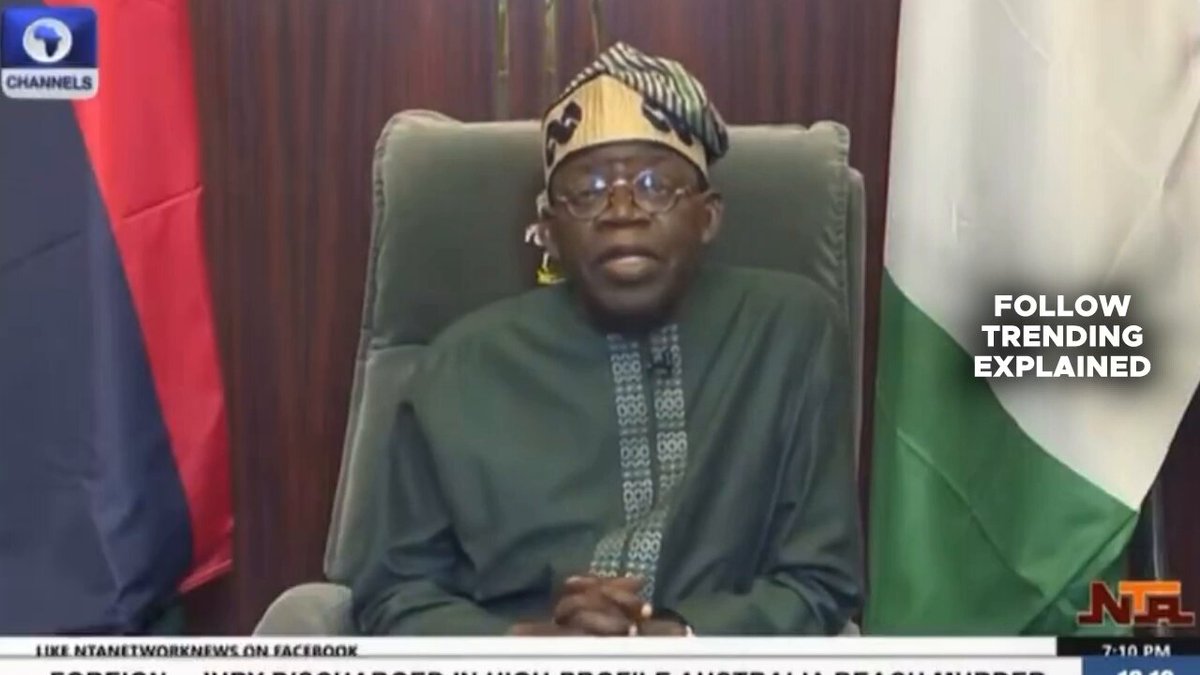
State of Emergency is trending because President Tinubu has declared it in Rivers State, due to rising tensions and explosion of pipelines. Meaning that Gov. Sim Fubara, Deputy Ngozi Odu and the entire rivers assembly has been suspended for six months, both Wike’s and Sim’s. Tinubu stated that, the governor was unable to control the initial explosion. Therefore leaving the state vulnerable, forcing him to invoke Section 305(5) of the 1999 constitution. This doesn’t mean Sim has been removed. It’s just protocol for the President to use other means to restore peace to the state. After which, the suspended authority will be restored. In 2004 President Olusegun Obasanjo declared state of emergency in Plateau state, suspended Governor, Mr. Joshua Dariye and the House of Assembly for six months, and installed a military administration. In the year 2006, again Olusegun Obasanjo declared State of Emergency in Ekiti State, where he removed Governor Peter Ayodele Fayose and his Deputy, Mrs. Abiodun Olujimi and replaced them with retired Army General, Tunji Olurin for a period of six months. In the 2013 event, President Goodluck Jonathan declared state of emergency in Adamawa, Yobe and Borno States due to Boko Haram, but he didn’t suspend democratic structures. State of Emergency is a softer measure, in comparison to Martial Law. However, the president didn’t mention his plans for temporary administration. Note that, the NASS led by Akpabio still has to approve it, otherwise it will be overruled which isn’t happening. Also, the State of Emergency can be renewed for another six months. For the explosion. Random reports from Rivers are alleging that militants have no hands in the explosion. Alleging that Fubara had been on site to restore order and understand the situation, and Ijaw people are not involved. Fingers continue to point to Wike, alleging internal sabotage. Nigerians don’t think the situation is worthy of a State of Emergency. Arguing that, states where lives are lost daily to bandits and herdsmen did not get this kind of attention. But a state where no one has died, and the tension is only cold between Fubara and Wike, is where the President decides to give premium priority. As things stand, all attempts at impeachment are on hold until further notice. Now, there are reports of military movement in Rivers administrative areas. • Move your estate to Vendr Utilities. For hassle free vending, remote management and AI assist. Manage and Vend water, electricity (gen/nepa) independently, with transperency. Take full control of your estate with Vendr. —No hidden fees, no overcharges, just seamless management! Inquire now: Vendr Utilities || iOS • Web • Android || [email protected] ||

Trending Explained

60,799 views • 1 year ago

This tweet breaks down the distinction between basic administration and revolutionary struggle, debunking the myth of the "Zuma Revolution" with the hard facts. Debunking the Zuma "Revolutionary" Myth. Jacob Zuma was not a revolutionary. We must distinguish between basic governance and revolutionary transformation. If you measure success by RDP houses and road repairs, you are confusing a Municipal Manager with a Revolutionary. A true revolutionary is measured by the structural shift of wealth. 🇿🇦 On the core struggles, the return of Land and control of mineral resources, Zuma’s record is a spectacular failure. He spoke the most about transformation but, as Adv. Ngcukaitobi notes, he actually cut the budget for Land reform. Delivery slowed to a crawl compared to the Thabo Mbeki era. Under his watch, mineral rights weren't returned to the people, they were shifted from old capital to a new, "Gupta-linked" elite. That isn't a revolution, it’s just a change of ownership at the top while the masses remain landless. Building roads and "matchbox" RDP houses are basic state functions, every government does this. A revolutionary changes urban land patterns so the poor live near economic hubs. Zuma left the apartheid geography of our cities perfectly intact. Debunking the "Top 10" Claims: • Infrastructure: Projects like Gautrain and Medupi were planned/funded under Mbeki. Zuma’s contribution? Massive corruption-led cost overruns. • Grants: Rising grants is a sign of a failing economy. It’s a sign people can't find work and are stuck on state crumbs. • BEE: Became "tenderpreneurship" for the politically connected, not a broad black industrial class. • Repo Rate: Set by the independent Reserve Bank. Zuma actually threatened this stability when he fired Nene (Nenegate). • Education: He dropped the "Free Education" populist grenade on his way out with zero funding model. • Load Shedding: He didn't end it, he postponed it by "running the diesel" and skipping maintenance, bankrolling Eskom’s collapse and the current crisis. • SOEs: The Zondo Commission proved SAA, Transnet, and Denel were systematically hollowed out by State Capture. Zuma’s supporters measure him by "service delivery" because if they used "revolutionary change" as a yardstick, they’d admit he delivered zero. He gave the people "matchboxes" while his associates took the billions meant for the Land. #LandReform. #ZumaVsMbeki. #SouthAfrica. #StateCapture.

Andile Gogoda

39,764 views • 8 months ago

Abati is trending because Arise TV’s Reuben Abati has dared Akpabio to impeach Tinubu for disrespecting the constitution. Abati stated that, Tinubu solely decided to make himself the Dictator of Rivers State, suspending the governor, the deputy and the legislative. Which is totally illegal in the 99 constitution. By which, Tinubu commited an impeachable offense, removing Sim Fubara and installing a military administrator in charge of Rivers State without NASS approval. He argued that, Tinubu cited Section 305. But failed to recognize Section 188 which stated that, only the NASS and AGF can remove an elected official. — Not the President. That’s why when Goodluck Jonathan declared a state of emergency over insecurity in three northern states, including Borno, Adamawa and Yobe., he didn’t suspend the government. Unlike Obasanjo who did it in Ekiti and Plateau, although illegally, which doesn’t make right. Obj legal adviser then, argued that they acted based on the 1961 constitution, not 1999. Abati insisted, Tinubu commited an impeachable offense by acting against the Nigerian constitution. But APC folks, believe Abati is misinterpreting the laws because he worked under Goodluck Jonathan as his Senior Adviser on Media. Actually, for short.. According to the constitution, Abati is right. The president cannot remove an elected official, Obasanjo doing it was illegal. Also, the conditions for a State of emergency to be declared, were not fully met. Since it was an “emergency”, when the President declared SOE, to suspend the officials, he should have recommended it to the Senate who should have approved it almost instantly, since it was an “Emergency”. But, the Senate did not approve the SOE. Which they have two days, and 10 days to do. Essentially invalidating every sense of “Emergency” in the State. Again, validating that there was no cause to suspend the Governor, Deputy or Legislative. If the senate doesn’t approve the SOE in 9 days, the SOE won’t stand. Today, NASS didn’t talk about the SOE, they moved it to tomorrow, Thursday. Albeit, President Tinubu has sworn in Navy Chief, Admiral Ibokette Ibas, as the administrator for Rivers State. And according to reports, Rivers FAAC allocations will be released to him. This was blocked by Supreme Court, pending Fubara’s re-presentation of the budget. Pres. Tinubu will make laws for Rivers, through the FEC. — Illegal. Follow Trending Explained for daily explanations!

Trending Explained

78,556 views • 1 year ago

Former South African president Thabo Mbeki made some serious mistakes during his presidency, and the two glaring ones were HIV and AIDS policy and Zimbabwe. I would also add his failure to properly groom or allow a successor before the 2007 Polokwane conference. But every time I listen to South African leaders speak, he still stands above all the presidents South Africa has had after Nelson Mandela. Mandela was in a league of his own and served a unique historical purpose during a particular era, so I do not even place him in this comparison. But when you compare Thabo Mbeki, Jacob Zuma and Cyril Ramaphosa, I genuinely enjoy listening to Mbeki because his arguments are backed by facts, empirical evidence, research, economic analysis, scholars and international journals. Whether one agrees with him or not, he constructs arguments intellectually. Listening to this discussion in the video reminded me again that he was a great leader who nevertheless had major flaws, and unfortunately those flaws often overshadow many of the positive things he achieved for the South African economy. I mentioned HIV and AIDS. I mentioned Zimbabwe. I mentioned the failure to groom a successor. I also think one of his major mistakes was the refusal to invest adequately in Eskom at the time when warnings were already being raised about future electricity generation problems. But when you then look at the presidencies of Jacob Zuma and Cyril Ramaphosa, it becomes a completely different picture. Mbeki’s approach to Zimbabwe was ideological. Zuma, for all his own problems, is probably the only South African president who can genuinely say he at least attempted to engage Zimbabwe politically in a meaningful way. But Ramaphosa’s relationship with Zimbabwe appears deeply compromised by business and political interests, at worst corrupt. And when you assess the three presidencies rationally, especially from an economic management perspective, the figures speak for themselves. South Africa’s economic growth reached around 5% to 6% during parts of the Mbeki era, levels the country has struggled to reach since. The problem today is that many people analyse these leaders emotionally instead of rationally. Economic performance is measured through figures, and those figures are publicly available. So every time I listen to Thabo Mbeki speak, I enjoy listening to him because of the depth, structure and intellectual discipline of the way he makes his arguments.

Hopewell Chin’ono

97,755 views • 4 months ago

STATE HOUSE PRESS STATEMENT No Link Between VP Shettima’s Remarks At Book Launch And Certain Online Reports The Office of the Vice President has noted with serious concern the gross misrepresentation of remarks made by His Excellency, Senator Kashim Shettima Senator Kashim Shettima, Vice President of the Federal Republic of Nigeria, during the public presentation of the book “OPL 245: The Inside Story of the $1.3 Billion Oil Block” by Mohammed Bello Adoke (SAN), held at the Yar’Adua Centre, Abuja, on Thursday, July 10, 2025. Certain online news outlets and individuals have distorted the Vice President’s comments in pursuit of a mischievous agenda, twisting his account of how the administration of former President Goodluck Jonathan considered removing him from office—then as Governor of Borno State—at the height of the insurgency in the North East region. This sensational reporting, which strips the Vice President’s remarks of their proper context, ventures into fiction by drawing false equivalence between his personal experience and the state of emergency declared in Rivers State, as well as the subsequent suspension of Governor Siminalayi Fubara by His Excellency, President Bola Ahmed Tinubu Bola Ahmed Tinubu, GCFR, President and Commander-in-Chief of the Armed Forces of the Federal Republic of Nigeria. We wish to state categorically that Vice President Shettima’s comments were made within the context of acknowledging the author’s professional conduct during his tenure as Attorney General of the Federation—a tribute to his public service record. His remarks were historical references to events during the Jonathan administration and were intended as a discourse on Nigeria’s constitutional evolution. They served to highlight how complex federal-state tensions have been managed through legal mechanisms and the country’s progress in that regard. For the avoidance of doubt, President Tinubu did not remove Governor Fubara from office. The constitutional measure implemented was a suspension, not an outright removal. This action, along with the declaration of a state of emergency, was taken in response to the grave political crisis in Rivers State at the time. The situation was unprecedented, with the State House of Assembly complex under demolition and the Governor facing a looming threat of impeachment by aggrieved members of the legislature. No objective observer can deny that this decisive intervention by the President brought stability and calm to Rivers State. This situation is not comparable to that of the North East under the Jonathan administration, where violent non-state actors were directly challenging the sovereignty of the Nigerian state, demanding unified action by both federal and state authorities to confront terrorism. In contrast, President Tinubu acted strictly within constitutional limits and in consultation with relevant stakeholders to preserve democratic institutions and restore order in Rivers State. Nigeria’s laws provide a clear framework for addressing such matters. Section 305(3)(c) of the Constitution authorises extraordinary measures when there is “a breakdown of public order and public safety in the federation or any part thereof to such extent as to require extraordinary measures to restore peace and security.” The situation in Rivers State clearly met this constitutional threshold, with persistent politically motivated violence, systematic attacks on federal institutions, and near-complete paralysis of governance—conditions intolerable in any democratic society. According to credible security reports, these acts even escalated into attacks on national assets. President Tinubu acted with constitutional fidelity. His proclamation invoking Section 305(2) was ratified by an overwhelming bipartisan majority in the National Assembly, as required by Section 305(3). This cross-party consensus in suspending the government of Rivers State, led by Sim Fubara, reflects a shared understanding among our elected representatives that the situation had reached a point of constitutional necessity, requiring immediate federal intervention. Clearly, without mincing words, the action of President Tinubu in suspending Mr Fubara and others from exercising the functions of office averted the Governor’s outright removal. To conflate suspension with removal is misleading. Therefore, interpreting Senator Shettima’s remarks as commentary on current events is either a wilful misrepresentation or a deliberate neglect of constitutional context. The Vice President, speaking extemporaneously, focused on the importance of public officials documenting their stewardship and on the enduring principle of accountability in public service. His historical references were made to illustrate the principled stands taken by past public servants, as well as his personal ties to Mohammed Bello Adoke and former Speaker Aminu Waziri Tambuwal. His remarks were not in any way a criticism of President Tinubu’s actions, which the Vice President and the entire administration fully support and stand by without reservation. Vice President Shettima stands in loyal concert with President Tinubu in implementing these difficult but necessary actions to safeguard our democracy. We urge media organisations and political actors to desist from the destructive practice of wrenching statements from context in order to fabricate nonexistent conflicts. Stanley Nkwocha Senior Special Assistant to the President on Media & Communications (Spokesman of the Vice President) 11th July, 2025

Stanley Nkwocha

13,237 views • 1 year ago

In the last couple of weeks, there has been a lot of talk about who is and who should be in charge of the “Unified Command” that looks after the law and order as well as security in the state of Manipur. This issue is being raised 16 months after the crisis began in May 2023! But barely a week after Mr Kuldiep Singh was appointed in May, 2023 as the Chairman of the Unified Headquarters/Command, I had flagged off the issue of Article 355 to Karan Thapar. I had told him about the subversion of the federal structure by the Modi led Govt. of India through a de facto and illegal act of exercising power over the state government. And that this subversion has rendered Shri Biren’s government as a “proxy government” and “a façade”. Not only that, I have also hinted about the “game” of keeping “Biren as the enemy” to help perpetuate the conflict and that if he were to be removed, that “game (would be) gone” as well! That the violent crisis which should have been brought under control in a couple of weeks has not happened so far points to that “game”. Since this interview (9 June, 2023), I have consistently raised this issue on many occasions, by asking “who’s in charge of the law and order” in Manipur, and reminding that the Govt of Manipur is a “proxy” for the Govt of India. And that Shri Biren is a “willing scapegoat”, someone who has protected and shielded Modi-Shah from any criticism or responsibility pertaining to this terrible tragedy in Manipur. In fact, he has defended the duo openly and unabashedly in many instances! Fact is, as I have insisted throughout the crisis so far, the “inaction of the GoI” itself is an “action” that has aggravated and prolonged the crisis, and therefore it must take the major responsibility.

A. Bimol Akoijam

21,357 views • 2 years ago

We've had no load shedding for over six months and everyone's wondering how the problem got fixed "so quickly" when we've been saddled with load shedding for 17 years 🤯 I'll tell you one thing about Mteto Nyati, he's a really nice guy when you meet him but you can feel the fire in his eyes when he talks about our country and Eskom 🔥 A few weeks ago, I attended the launch of Bruce Whitfield' new book called "The One Thing". Bruce decided to use this precious time to interview Mteto. What struck me most was how seriously Mteto took his role of Eskom Chairman. I know that might sound strange but if you consider how long we all had to endure load shedding, and when you look at how SOE's have been run in general, no wonder everyone is so skeptical. That is, until you hear Mteto speak on the topic and more importantly, you feel the intensity with which he speaks. I guess everyone is wanting to better understand the "secret recipe" that has brought load shedding to an unexpected end. Here's how I understood the process: ✅ Mteto and his fellow board members took the role seriously and therefore, it all started with intent. They also took a few weeks to try understand what the problems were from a first principles perspective. ✅ They decided the biggest issue was the problem statement they inherited. They had to change this before doing any work. Vision and strategy before execution. ✅ Mteto and the board went back to basics. They engaged with government on policy that would allow them to work with original equipment manufacturers, they went out of their way to serve Eskom leaders rather than the other way around, and the stuck to their plan despite the noise. There were many other take-aways from the night but the point is, here we are with no load shedding for six months. By every metric, the turn around has been almost miraculous, except it's not. If you EVER want an example of why leadership matters, look no further than the turnaround at Eskom. It genuinely starts at the top and we should protect leaders like Mteto at all costs. PS. Both Bruce and Mteto will be speaking at the Suits & Sneakers Main Event on 13 November which is taking place is exactly three weeks from now. Just come join us and be part of something lekker. And you can buy Bruce's new book on the day:

Mark Sham

14,440 views • 1 year ago