Загрузка видео...

Не удалось загрузить видео

На главную

Recent devastating wildfires across Spain inspired me to build this real-time wildfire evacuation simulator using Three.js. The system combines GeoTIFF elevation data with WebGL shaders & semi-Lagrangian advection to model fire spread using wind fields, terrain slope & rate-of-spread algorithms. It calculates optimal evacuation routes with A* pathfinding &...

11,402 просмотров • 11 месяцев назад •via X (Twitter)

Комментарии: 0

Нет доступных комментариев

Здесь появятся комментарии из оригинального поста

Похожие видео

A bag for life? In an airplane emergency evacuation, you should not bring your carry-on luggage. This is not a suggestion. It is a life-saving principle. Here’s why: 1. It slows down the evacuation. An evacuation is designed to be completed in 90 seconds or less. Every second matters. Opening overhead bins, pulling bags out, and maneuvering them down the aisle creates congestion and blocks exits. 2. It endangers other passengers. A narrow aisle becomes impassable when even a few people stop to retrieve luggage. Those behind may be trapped in smoke, fire, or toxic fumes with no way forward. 3. It can damage evacuation slides and rafts. Cabin baggage can puncture or tear slides. If a slide fails, an entire exit becomes unusable. That directly reduces survival chances for everyone on board. 4. It increases the risk of injury. Bags can strike people in the face, hit children, or cause passengers to fall while exiting. In a high-stress environment, even small obstacles become dangerous. 5. It shows disregard for crew authority. Cabin crew are trained to shout commands like “Leave everything!” for a reason. In some cases, they are trained to physically remove bags from passengers if necessary because the risk is that serious. Now consider two real-world scenarios: The 2019 crash of Aeroflot SSJ-100 Flight 1492 The aircraft made an overweight emergency landing in crosswind and windshear conditions after lightning strike and loss of key electrical systems. It bounced three times. On the third impact, the main landing gear collapsed, punctured the wing, and caused a major fuel spill and fire. Only 37 of the 78 occupants survived. Forty-one died. The final report blamed several passengers for retrieving cabin baggage from overhead bins during evacuation. While difficult to quantify exactly, it almost certainly slowed the process in a rapidly worsening fire. In a post-crash fire, seconds determine survival. On 2 January 2024, a Japan Airlines Airbus A350 was engulfed in flames after a runway collision in Tokyo. The cabin quickly filled with smoke, and the fire intensified outside. All passengers followed crew instructions and left their baggage behind. All 379 passengers and crew evacuated successfully. No fatalities. No serious injuries. The difference was discipline and strict adherence to instructions. If passengers are determined to take baggage, there is very little cabin crew can realistically do in the chaos. That is why passenger behaviour is critical. So let’s settle this: No bag is worth a life. Not yours. Not someone else’s. In an evacuation, leave everything behind and get out.

Turbine Traveller

52,433 просмотров • 4 месяцев назад

Ahmedabad Crime Branch is making use of technical measures to avoid any stampede kind of situation. Anti stampede visual analytics,using reference area and crowd movement, head count algorithm. Anti-stampede algorithms on CCTV cameras are a crucial advancement in crowd management, leveraging AI and image processing to prevent dangerous situations in densely populated areas. Here's a breakdown of their usage: How they work: Real-time monitoring: AI-powered CCTV cameras continuously analyze video streams in real-time. Crowd density estimation: Algorithms calculate the number of people in a given area. This can involve: Pixel-based analysis: Converting images to black and white and counting "black pixels" (representing people). Object detection: Using machine learning models (like Mask R-CNN) to identify and count individuals, often by detecting heads or torsos. Thresholding: Pre-defined "threshold values" for crowd density are established. When the detected density crosses these thresholds, it triggers an alert. Anomaly detection: Beyond just density, these algorithms can identify unusual crowd behaviors such as: * Sudden surges in movement. * Unusual clustering patterns. * Fallen individuals. * Aggressive movements. Alerting authorities: Upon detecting a potential stampede risk, the system sends immediate alerts to security personnel or control rooms via LCD displays, GSM messages, or other communication channels. Predictive analytics: Some advanced systems use time-series prediction models to forecast crowd behavior and dynamics based on historical and real-time data, helping anticipate potential bottlenecks or overcrowding. Reinforcement learning: Algorithms can learn from past incidents to suggest optimal crowd flow routes and alternative evacuation paths during emergencies. Benefits: Proactive prevention: The primary benefit is the ability to detect and warn of potential stampedes before they occur, allowing authorities to take preventative measures. Real-time insights: Provides immediate and accurate data on crowd density and movement, far surpassing manual observation. Enhanced safety: Significantly improves safety in public spaces by reducing human error and enabling swift responses to risks. Optimized resource allocation: Helps in better deployment of security personnel and resources to areas with high crowd density. Improved efficiency: Automates a labor-intensive task, freeing up human operators for more complex decision-making. Data for future planning: The collected data can be analyzed to improve crowd management strategies for future events. Challenges: Accuracy limitations: While advanced, AI algorithms can still face challenges with: Occlusion: People blocking each other, making accurate counting difficult. Varying conditions: Changes in lighting, weather, and camera angles can affect accuracy. Bias in training data: Can lead to false positives or inaccurate detections. Computational complexity and cost: Developing and deploying such systems can be expensive due to the need for high-resolution cameras, powerful processing units, and sophisticated algorithms. Data privacy and ethical concerns: The extensive use of CCTV and AI raises concerns about individual privacy and potential misuse of data. Integration with existing infrastructure: Integrating new AI-powered systems with older CCTV networks can be complex. Human intervention still crucial: While AI can alert, human responders are still essential for effective intervention and crowd dispersal. As seen in the Kumbh Mela example, even with AI alerts, a lack of ground personnel can limit effectiveness. Defining thresholds: Determining appropriate crowd density thresholds for different environments and cultural contexts can be challenging. Real-world applications: Large public gatherings: Religious festivals (like the Kumbh Mela in India, which has used AI for crowd management), concerts, sports events, and political rallies. Transportation hubs: Railway stations, airports, and bus terminals to manage passenger flow. Shopping malls and commercial centers: To monitor crowd density during peak hours and special events. Stadiums and arenas: For managing ingress, egress, and crowd movement during events. Tourist attractions: To prevent overcrowding at popular sites. Overall, anti-stampede algorithms on CCTV cameras represent a significant leap forward in ensuring public safety, offering a powerful tool for proactive crowd management. However, their successful implementation requires careful consideration of technological limitations, ethical implications, and the continued need for effective human intervention. Ahmedabad Police અમદાવાદ પોલીસ Vijay Patel | Megh Updates 🚨™ | Akash Anand | | #BengaluruStampede | #Stampede

Janak Dave

339,717 просмотров • 1 год назад

I built a Three.js rendering study inspired by Tiny Glade’s painterly aesthetic, and got it running at 120fps in the browser. Over the past few weeks, I’ve been studying how stylized games achieve that soft, handcrafted look in real time. Tiny Glade was a huge inspiration, and I wanted to use the browser as a constraint: no compute shaders, no native GPU access, and single-threaded JavaScript. As part of this study, I implemented: - GPU-driven instanced brick walls with procedural noise jitter and elastic build animations - Tree, bush, and flower rendering with billboard card expansion, wind sway, and grow animations - Procedural grass with terrain conformance and interactive push deformation - Animated water with layered noise, interactive ripples, and Fresnel-based reflections - Procedural terrain with slope-aware triplanar materials, dirt paths, and rocks - A 7-pass post-processing stack with TAA, bloom, depth of field, painterly filtering, ACES tonemapping, 3D LUT color grading, and film grain The hardest part wasn’t writing any single shader. It was making all of these systems work together at high frame rates inside WebGL, where every millisecond counts and performance problems compound quickly across animation, materials, post-processing, and scene management. Some techniques in this study were inspired by analyzing Tiny Glade’s rendering approach, while others were original implementations built from scratch from visual reference. That contrast taught me a lot: recreating an effect is one challenge, but designing your own shaders and systems to achieve a similar feel is a very different one. This is a private educational rendering study. Some temporary placeholder content is being used during the research phase, and any public or production version would use original or properly licensed assets. Huge credit to Pounce Light for the incredible art direction and rendering work in Tiny Glade: Three.js #gamedev #webgl #threejs #rendering #graphics #realtimerendering #shaderdev

Ibrahim Boona

58,625 просмотров • 3 месяцев назад

The Truth About Canadian FIRES! Philosopher Stefan Molyneux lays out the Truth About the 2026 Canadian wildfires by showing they hit remote boreal forests from lightning and dry weather, spread fast through wind and embers, and are hard to fight because of a lack of roads and difficult terrain. He discusses prescribed burns and honest management over blaming climate change or wasting money on endless suppression. Sources: Full slideshow with notes: 0:00:00 Canada Wildfire Crisis 0:02:39 Fire Causes and Spread 0:05:47 Wildfire Costs 0:06:58 Forest Terms and Firebombers 0:09:56 Failed Fire Management 0:11:46 Prescribed Burns 0:14:48 Trade-Offs Matter 0:16:46 Private Sector Solutions 0:19:54 Burn Costs and Ownership 0:22:55 Managing Remote Fires 0:24:07 U.S. Assistance Tensions 0:26:50 Climate Claims Challenged 0:30:31 Fire Origin Questions 0:33:16 Glyphosate Debate 0:34:12 Smoke Health Effects 0:34:59 PM2.5 Air Quality 0:36:16 Freedom as Solution GET FREEDOMAIN MERCH! SUBSCRIBE TO ME ON X! Follow me on Youtube! GET MY NEW BOOK 'PEACEFUL PARENTING', THE INTERACTIVE PEACEFUL PARENTING AI, AND THE FULL AUDIOBOOK! Join the PREMIUM philosophy community on the web for free! Subscribers get 12 HOURS on the "Truth About the French Revolution," multiple interactive multi-lingual philosophy AIs trained on thousands of hours of my material - as well as AIs for Real-Time Relationships, Bitcoin, Peaceful Parenting, and Call-In Shows! You also receive private livestreams, HUNDREDS of exclusive premium shows, early release podcasts, the 22 Part History of Philosophers series and much more! See you soon!

Freedomain - with Stefan Molyneux, MA

13,811 просмотров • 4 дней назад

🛑 NEW YORK JUST CROSSED A LINE Are we part of a Culture of Life, or a Culture of Death? Just now, Glenn Beck delivered one of the most profound and heartbreaking messages I’ve heard in a long time. And what he said needs to be heard by every single American. Every parent. Every doctor. Every pastor. Every governor and our President Donald J. Trump Donald J. Trump. The New York Legislature just passed a bill that allows assisted suicide with NO waiting period. That means if someone is told on Monday they have cancer—or is simply battling depression—they can request death… and receive a lethal prescription the next day. No mandatory health evaluation. No mental health safeguards. No time for second thoughts. And it gets worse. 🩸 The death certificate will not even say the person died from assisted suicide. 📉 That means New York is erasing the truth—erasing the data, hiding the numbers, hiding the spiritual cost of our despair. They are literally legislating lies into our vital records. This isn’t compassion. This is madness dressed as mercy. Let me be clear: “You must choose—Life or Death. Blessings or curses. Oh, that you would choose life, so that you and your descendants might live!” — Deuteronomy 30:19 🔻For over 50 years, New York has led the way in normalizing death. First abortion. Now euthanasia. And all under the false flag of "choice" and "autonomy." But when a society replaces support, love, and sacrifice with poison pills and silence... we are no longer a moral nation. This is not healthcare. This is spiritual suicide. A real civilization doesn't abandon its sick, its elderly, its depressed, its disabled, or its burdened. It cares for them. Especially when it's hard. Especially when it's inconvenient. That’s what love looks like. Dr. Lydia Dugdale, from Columbia Presbyterian Hospital, said it best: “Instead of investing in the infrastructure of support for the lonely, the depressed, the disabled and the poor, we just offer them a prescription for death and call it autonomy. But it’s nothing but abandonment.” This is the bitter fruit of decades of pro-choice messaging: We told women they needed abortion to be free. Now we're telling the sick and the weary they need suicide to be dignified. This is not dignity. It’s despair. They call it “medical aid in dying.” But God calls it a culture of death. Make no mistake—this is the same spirit that: Excuses mob violence in the name of “compassion” Defends criminal acts from illegal immigrants under the banner of “justice” Justifies infanticide and now welcomes assisted suicide as “healthcare” We are watching the moral collapse of the American soul in real time. But there is a remnant. And we must rise. To every patriot in New York: Call Governor Kathy Hochul and demand she veto this bill. To every believer across America: Stand up for the sanctity of life—from the unborn, to the mentally ill, to the elderly and infirm. 🕊️ Jesus Christ did not die so we could abandon the weak. He died so we could offer hope—even in suffering. He was despised, rejected, acquainted with grief. And by His wounds, we are healed. (Isaiah 53) “Even when they are suffering, even when they are vulnerable, even when they are a burden—life is still worth it.” — Dr. Lydia Dugdale 🛐 PRAY for New York. PRAY for America. PRAY for a return to a culture of life. 🔔 Do not grow weary. We are not hopeless as long as we stay in the fight.

Francois Leclerc

17,154 просмотров • 1 год назад

I've been digging into startup ideas that are obvious in hindsight but somehow still unbuilt And I've got a cash-flowing startup idea for you today... 84% of solo female travelers report feeling unsafe, yet every major travel platform still prioritizes thread counts and breakfast reviews over the basic question: "Can I walk back to my hotel at night?" Women are planning trips by scrolling Reddit threads from 2019, cross-referencing TikToks, and getting safety advice from male backpackers who've never experienced the same risks. It's insane that this is still the state of travel tech in 2025 and going into 2026. Solo female travel is exploding with 71% of solo travelers are now women, searches are up 131% YoY yet they're using tools built for a different era and different concerns. The solution: a map-based safety layer where verified female travelers rate neighborhoods on metrics that actually matter. Green zones for "walked alone at midnight, felt fine." Red zones for "multiple harassment reports." Real data on lighting, staff responsiveness, actual safety. Kinda like what Pieter Levels built with Hoodmaps but in a new category. Distribution is 400K+ member travel Facebook groups, and paying micro travel influencers to create content about it. Monetization is $30/month memberships + $500/month hotel safety certifications. The demand is screaming at you from every travel forum. Why I like the idea: - makes the world a better place - possible to vibe code - proven biz model - creators in the space open to sponsorship at reasonable prices - prob not a venture backable product but still opportunity for someone who is interested in cash flow - Probably gets acquired by Expedia or something down the road if you nail PMF. In today's episode of The Startup Ideas Podcast (SIP) 🧃 (are you following?) this startup idea broken down with... 1 trend im paying attention to 1 news item im paying attention 1 startup framework I love 1 AI product I'm interested in using hope it gets the creative juices flowing and is 100% free all i ask is you don't just bookmark this tweet, but you go out and build i want to see you win. this is the greatest time in history to be building. happy building.

GREG ISENBERG

71,068 просмотров • 8 месяцев назад

This is about to be the most personal and honest advertisement that you have ever seen. For me, 2026 has been a pretty terrible year so far. It started with me breaking my thumb, my wrist and my leg. My leg needed metal plates, multiple screws and the tibia and fibula wired together. Sometime afterwards following the surgery I had a pulmonary embolism, blood clots travelling from my leg up to my lungs. It nearly took my life. This might sound strange but I have never been scared of death because I have always tried to live my life to its fullest. However now I'm a father, thinking of leaving my loved ones behind was truly terrifying. I was worried about all the things I didn't say yet, all the things I didn't teach. I made a recovery. I still have a way to go but I'm getting there, getting stronger and fitter by the day. It wasn't due to my health but I decided to make some good changes too. I stopped drinking, gave up smoking some time ago, barely touch sugar these days, eat a little more healthy than before along with more exercise. I was saving myself from depression. I was feeling good. Things were looking positive. Then after 8 years of working with a company, I got made redundant and lost my job. For most of my adult life I worked for some of the biggest companies in the world doing consultancy work, solving their core issues, managing departments, nuking and recreating processes ensuring they run efficiently. I had a choice. Keep working for companies selling things people don't need. Or do something different. Try to do something that genuinely helps people, that has a real and positive impact on the world, and at the same time work as hard as I have worked through all my life, but this time do it for myself, my family and for a good cause. I decided to create a company called HomeSafeEducation, and this is why and what we do. We teach children to read, to count, to pass exams. But we rarely teach them how to stay safe online, or teach them about body safety, or what to do if something does not feel right. These are some difficult topics when speaking to a child. We send teenagers into the world with qualifications but without the practical knowledge to navigate it confidently. We watch our parents age without ever having a conversation about scams, advance planning, or digital confidence. We offer a range of packages that provide people the means to gift something special to their families, themselves or the people they care about. Self protection, self confidence and the knowledge to make informed decisions at every stage of life. Whether this is for your young son, daughter, niece or nephew teaching them stranger danger or what to do in emergencies, teaching Street Smart information to teenagers, teaching your daughter how to be safe on nights out before leaving for university, or gifting a package to your friend before they go travelling so they can stay safe. You can gift to yourself to learn how to spot signs of issues that your children are experiencing or to learn how to communicate better with them and how to show understanding. Maybe you do it for a loved one reaching the later years in life to keep up with information to avoid being scammed. I built this platform because I wanted that knowledge to exist in one place, written properly, for every age group. Not watered down avoiding serious topics, but said in a way that's age appropriate and relevant so it can be taught to anyone. Not full of fear. Just honest, practical education that treats every person, whether they are five or seventy-five, as someone capable of learning and making good decisions. Every course is written to empower. Every lesson ends with something you can actually use. Every quiz reinforces what you or your loved ones have learned. Every song, for the packages that include them, is written and produced in-house because I believe learning should be memorable, not miserable. I have worked around the clock to create something special. A place where you can find information for your family, yourself or your friends. A place where that information can be easily learned and kept with them forever. I believe everyone reading this either needs this themselves or knows someone who does, and I invite you to come and take a look at what I have built. Go and take a look at the package page and see what we offer, check out the music and see how and what we teach. The rest of the music is genuinly extremely enjoyable. You can see some samples besides the packages. It was a big risk in deciding to go down this route, and it would mean the world to me if you could share this post to help me on my new venture. I have truly poured my heart into making this into something with real value for people. I hope you find this useful. You can find the website link in the comment below this post so you can go and take a look.

Bricktop_NAFO

12,753 просмотров • 3 месяцев назад

Hell froze over: announcing FormKit for React. Secretly framework-agnostic since inception, today we’re open sourcing the most popular Vue form library…for React. Why is this a big deal? 1. Forms are still hard. We (the creators of FormKit) thought form libraries were no longer necessary, given the trajectory of coding agents. It turns out we were wrong, and we learned this the hard way. Need repeating conditional fields nested 3 layers deep inside a dynamic component, with accessibility, validation, internationalization, and backend error placement? Turns out coding agents aren’t great at that. It’s table stakes for FormKit. 2. Single component. This matters more than you would think, but FormKit doesn’t ship lots of different components each with its own props. Instead, it has a single one: and unified props. This was done to provide a better DX to human engineers. It makes it easy to spot when a given component was part of the form’s data structure vs a presentational component. It turns out this matters even more to coding agents than humans. No matter where your coding agent is, whenever it sees “FormKit” it immediately knows “oh, that’s part of the form’s data”. 3. No plumbing. FormKit doesn’t require any manual data collection, event listening, or state tracking. It does all this for you on a heavily tested, framework agnostic, self-assembling graph. The only code your agent needs to write is declarative templates and submission handlers that respond to the state. 4. Dense colocation. FormKit’s syntax happens to be ideal for coding agents; nearly everything you need to know about a given input is *on* the input: Colocation dramatically improves the efficacy of coding agents. 5. DOM. FormKit, unlike most form frameworks in React, renders the actual DOM. This also increases colocation and best practices, meaning your coding agent is far more likely to produce consistent and high-quality output that looks and acts the way its supposed to. 6. Schema. FormKit’s own inputs are not written using Vue or React — instead, FormKit has its own render schema — think of it like an AST for the DOM — and you can modify it on the fly. It’s not very human-friendly to write, but it turns out most models are already pretty well trained on FormKit’s schema. Want your inputs to look a bit different on one form than another? No problem, your coding agent can easily make those changes *without* modifying the JSX structure at all. Oh, and any inputs you create for Vue work with React and vice versa. 7. Plugins. FormKit leans into the unstructured tree graph hard. The graph doesn’t just collect data, it also passes down configuration and plugins. Want one form to work a bit differently than another one? No problem — just add a plugin to the top of that form or group and its children will all receive that feature. You can even mass assign props and configuration this way. Of course, FormKit has been solving these exact issues for a long time, but it wasn’t until we started using it on our own projects with coding agents that we realized what a huge advantage it is. With so many people using coding agents with React, it made sense to unveil FormKit for what it has always been — a completely framework-agnostic form framework that happens to unlock your coding agents. ➡️

Justin Schroeder

11,549 просмотров • 3 месяцев назад

The Canadian government is making the wildfire crisis worse by spreading false information that N95s provide the best protections & that protections against the toxic gases do not exist. That combined with the failure to share info on respirators used by the RCMP & Canadian Armed Forced wildland firefighters with provinces, the firefighting community or public looking for whatever the best protections means we lack the tools to protect those that need it the most on days like today. While CBC David Thurton 🇹🇹🇨🇦 released the news article & video below detailing the RCMP’s new wildfire smoke policies is from 2018, it is incredibly relevant today. It details how the federal government stopped using N95s & upgraded all its RCMP officers to elastomeric respirators equipped with multi gas filters after widespread lung damage & other occupational disease occurred among its officers using N95s at a single major wildfire event. It also acknowledges that while federal police officers will be effectively protected thanks to these enhanced protections going forward, many of the officers using N95s instead of elastomerics are expected to have shorted lifespans. This 2023 RCMp video on wildfire logistics repeatedly promotes the importance of their officers using elastomeric respirators. Katie Nicholson CBC covered the federal government’s use of elastomeric respirators in 2023 when discussing the need to provide better respiratory protection than N95s to provincial wildland firefighters yet nothing has effectively changed. This problem is so misunderstood that CBCManitoba released this article in April detailing how the Manitoba government & the wildland firefighter union had been working together for years to find something better than an N95 but had yet to find it. In comparison, Australian news organizations have long reported on how elastomeric respirators are so popular among its wildland firefighters at preventing cancers & other occupational diseases that the few firefighters still being given an N95 are often choosing to buy their own elastomeric respirator. In the U.S., Hannah Dreier The New York Times reported on how the U.S. government’s failure to follow Australia, Greece, and even Canada’s decisions in providing it wildland firefighters with elastomeric respirators resulted in widespread cancers among wildland firefighters in their 20s & widespread cardiovascular disease deaths in their 30s. While Prime Minister of Canada Mark Carney promotes that the Canadian government is working to reduce cancers among wildland firefighters, these failures have likely been a major contributor to a higher rate of cancer. Widespread accumulative exposure from the urban interface fires along with more frequent & larger fires while wearing an N95s or bandanas instead of an elastomeric respirator is to be expected as this U.S. government guide details. Ontario has had 100,000 elastomeric respirators sitting in warehouses since June 2020 yet its wildland firefighters using bandanas as respiratory protection. The Canadian Red Cross & other organizations helping with evacuations could use this stockpile to protect everyone in these communities including first responders. Cdn Lung Association could use it to protect vulnerable individuals in communities with toxic air to help reduce the strain on the health care system by using these. Ontario Provincial Police officers helping communities evacuate deserve to be know that a respirator they can find at their local hardware could save their life. The federal government’s top experts have made it clear that the solution to wildfires is elastomeric respirators & here is what they’ve said for the record. Public Safety Canada David Fisman Peter Tabuns @petertabuns.bsky.social SudburyStar OHCOW JP Hornick.

Nicolas Smit

27,894 просмотров • 8 дней назад

🚨 So, where is US inflation heading now? 🇺🇸 Markets called it “lower than expected”. But here in the Truflation community, we knew better. It was -exactly- what we expected. But how did we know? 📽️ This video breaks it down—clear as day—showing you how we track inflation and what we expect in the coming months. At Truflation, we process tens of millions of data points daily to update our real-time inflation indicator. Every single day, we: ✅ Ingest fresh data ✅ Categorize & validate it ✅ Upload it to the blockchain ✅ Deliver it directly to you This relentless approach allows us to detect inflation trends an average of 45 days before the BLS prints their numbers. But let’s clear up a common misconception: We are not trying to replicate the BLS absolute values. We have our own methodology to measure inflation 📝—one that we firmly believe reflects REAL inflation. However, because government decisions are based on outdated government data, when we predict BLS CPI prints, we adjust our model in a specific way… How do we predict BLS CPI so accurately? ⛔️We apply a penalty to our own data—yes, essentially, we simulate a scenario where our real-time insights don’t exist. We strip away our immediate access to fresh data and align our weightings with those of the BLS. The result? Our BLS CPI predictions have been extremely accurate—over the past 10 months, our forecasts have had an average deviation of just 0.02% (excluding January, when the BLS changed weightings). 🎯 And while we are happy to know that our community and premium subscribers use our leading indicator for everything from Bitcoin trades and US treasury bonds to FX markets, one thing still amazes us: 🇺🇸 The biggest economy in the world spends over a billion dollars on an institution (BLS) that uses an outdated methodology—just to base one of the world’s most critical decisions (monetary policy changes) on its lagging numbers. Meanwhile, a team of 18 people (myself included—the Truflation intern 🙂), working with less than 1% of that budget, is beating them by almost two months. Why? We can only speculate... But one thing is certain: 🔹 We will always keep exposing real inflation. 🔹 We will always keep spreading the TRUF. Thank you for your support. 🤝 And to those saying prices are only going up… 🚨 Yes, prices are still rising. Lower inflation does NOT mean lower prices. It simply means that prices are increasing at a slower rate. The damage of the past five years of compounded inflation is still being felt—your groceries, rent, and everyday expenses are still far more expensive than they were. And that’s exactly why tracking real-time inflation matters—so we know where we’re heading and no one lies to us. Truflation Team 🫡🇺🇸

Truflation

293,449 просмотров • 1 год назад

Everyone is sleeping on Meta's SAM 3 release. But it's actually a big deal. Here's why: Companies spend millions paying humans to label images and videos frame by frame. A single autonomous driving dataset? Months of work, hundreds of annotators, millions in cost. Without labeled data, you can't train custom models. Without custom models, you're stuck with generic solutions. This is why most companies never move past pilots. SAM 3 breaks this cycle. First let's look at the evolution: SAM 1 segmented objects when you clicked on them. Revolutionary, but one object at a time. SAM 2 added video tracking with memory. Game-changing, but you still manually prompted every object. SAM 3 changes everything with text prompts. Type "yellow school bus" and it finds ALL of them in your image or video. Not just one. Every instance across thousands of frames. Now here's where people get confused: "Can't I just use GPT-5 or Gemini for this?" No, and here's why that's a terrible approach. Large multimodal LLMs are great for reasoning, but they're slow and expensive for production visual tasks. You're paying API costs per image, waiting seconds for responses, getting inconsistent results. SAM 3 runs in 30 milliseconds on a single GPU for 100+ objects. That's 100x faster, and you own the infrastructure. More importantly, SAM 3 gives you precise pixel-level masks, not descriptions. Try asking an LLM to segment every defective part on a manufacturing line in real-time. It won't work. SAM 3 does this effortlessly. The real breakthrough is their data engine. Meta built an AI-human hybrid system that's 5x faster for complex annotations. They trained SAM 3 on 4 million unique visual concepts - 50x more than existing benchmarks like LVIS. SAM 3 is trained on 4 million unique visual concepts, it handles everything: - Text-based concept search - Interactive refinement with clicks - Video tracking across frames - Zero-shot detection of new concepts The model is open source. Weights, code, and benchmarks are on GitHub. If you're building computer vision applications, this is the foundation model to evaluate. The annotation time savings alone will pay for integration costs within weeks. Find the relevant links in the next tweet!

Akshay 🚀

46,404 просмотров • 8 месяцев назад

🚨9/11 2.0 is coming! Pakistan’s Joint Chief of Staff, General Sahir Shamshad, issued a warning that should have shaken every capital of the world. Yet the world stays silent, refusing to see what is now unfolding in plain sight. Afghanistan has once again become the epicentre of global terrorism, a command hub reborn, rearmed & reconnected under new leadership. Saif al-Adl & Hamza bin Laden, two names that now carry the weight of a coming storm, are systematically recasting Afghanistan into the operational heart of al-Qaeda’s next chapter. Where Ayman al-Zawahiri led through ideology, Adl & Hamza lead through action. Together, they have unified the Taliban, the Haqqani Network, TTP, BLA, BLF & remnants of ISIS affiliates under one command structure disciplined, coordinated & focused. From Kandahar’s safe houses to Tora Bora’s tunnels, training camps are active, new fighters are being indoctrinated from around the world & funds are flowing through the TTA (US money) & cross border smuggling. The blueprint for this new campaign is precise and ruthless. Al-Adl’s 2024 doctrine, “This is Gaza: A War of Existence, Not a War of Borders,” is more than rhetoric, it is a global battle plan. It calls for mass recruitment, resource mobilisation & the fusion of regional conflicts into one transnational offensive. Afghanistan is now the launching ground for a new wave of asymmetric warfare designed to break states from within. 9/11 2.0 isn’t a threat, it’s a prepared strategy for large scale devastation. It’s built to hit at the same time across multiple cities in the US, Europe & Asia, using suicide bombings, vehicle attacks, drone swarms & cyber strikes to blind emergency services & spread chaos. Al-Qaeda operatives are on the move, using encrypted apps & AI-driven propaganda to recruit online. Afghan networks now coordinate funding & logistics for a 2 front campaign, sleeper cells targeting Western countries & recent attempts to activate cells in Gilgit‑Baltistan & Azad Kashmir, in coordination with #India have also been made. The #US southern border is under infiltration by jihadist operatives, signaling a direct threat to homeland security. Across Europe, the danger is equally grave, with sleeper cells embedded within migrant flows, ready to be activated. Arrests in #Germany, #Sweden & #France confirm these networks are not only active but coordinated & resilient, operating largely under the radar. The goal is simple & brutal, overwhelm first responders, spark mass panic & break governments ability to act. If parts of this plan succeed, casualties & disruption would dwarf recent terror waves. The US with Nato countries would almost certainly retaliate hard, striking Afghanistan & turning the country into a new battlefield a response that would spread instability, displacement & violence across Asia Pacific, M.E & Central Asia. Pakistan stands at the frontline of this storm due to its geopolitical position & geographic terrain, which allows these groups to move freely along the #Pakistan-#Afghanistan border. The recent surge in terrorist activity, combined with complex operational planning, shows that AQ is in full control of the unified terrorist front. General Shamshad’s warning is not a prophecy, it is a statement of fact. The indicators are visible, the plans are moving & the world’s complacency is their greatest weapon. Pakistan stands awake in a world still asleep. If this warning goes unanswered, the next wave of fire will not stop at the mountains of Afghanistan, it will sweep across continents, leaving the world in the same shock & disbelief that followed September 11, but on an even larger, more devastating scale.

Taymur Malik

61,824 просмотров • 9 месяцев назад

The Great Equalizer: How I Iterated Through 90+ Strategies to Automate My Financial Freedom ninety strategies sounds like a death wish but it is actually the only way to find your edge in a market designed to liquidate you. most traders are out here gambling with their rent money while the big players are using automated systems to harvest their liquidations. i know this because i spent hundreds of thousands of dollars on developers for apps thinking i could never code myself. i was getting wrecked by over trading and watching my accounts hit zero while i slept. code became the great equalizer for me because it removed the emotion that was killing my bankroll. i decided to learn to code live so i could iterate to success and now i have fully automated systems trading for me instead of getting liquidated by every wick. i just saw someone lose ten million dollars in a single month because they were trading by hand and got addicted to the screen. you have to understand that if you are not automating you are the exit liquidity for someone who is. the reality of advanced futures trading is not about finding one holy grail bot that prints money forever. it is about research and back testing until you find a strategy that has a statistical advantage. one of the most slept on concepts is variable risk scaling where you actually change your position size based on how volatile the market is. instead of just betting the same amount every time you increase your size when volatility is low and scale back when the market starts moving like crazy. this keeps you in the game during the draw downs that usually wipe people out. most people do the opposite and revenge trade with bigger size when they are losing which is the fastest way to the cemetery. i used to think i needed to be the smartest guy in the room to make this work but i realized i just needed to be the most disciplined with my risk parameters. there is a secret hidden in funding rates and basis trading that most retail traders never even look at. while everyone else is trying to guess if bitcoin is going to the moon or the floor you can actually make consistent money through funding rate arbitrage. you basically buy the asset in the spot market and simultaneously sell it in the futures market when the funding rate is high. you just sit there and collect the interest payments from the gamblers who are over leveraged on the other side. it is basically free money if you can manage the fees and keep your execution precise. i used to ignore these low yield plays because i wanted the big home runs but those home runs usually came with massive strikeouts. now i look for these carry trades as a way to keep the equity curve moving up and to the right while others are sweating over every price change. most traders fail because they use lagging indicators and expect them to predict the future with one hundred percent accuracy. the truth is that even the best trend following strategies like the golden cross or moving average crossovers only have about sixty five percent accuracy. you have to combine these with filters like the average directional index or relative strength index to make sure you are not just buying a fake breakout. a lot of people get chopped up in sideways markets because they do not have a trend strength filter to tell them to stay out of the trade. i learned to use multiple time frames to confirm my breakouts because if the one hour and the four hour charts are not saying the same thing then the trade is probably a trap. you have to be a searcher looking for those golden nuggets of alpha buried in mountains of data. i used to think that machine learning and genetic algorithms were just buzzwords that did not actually work for trading. then i realized that the 1990s tech trap is real and if you are still using basic indicators without any optimization you are decades behind. genetic algorithms are wild because they simulate natural selection to find the best parameters for your strategy through trial and error. you can actually build an environment where your bot learns from its own mistakes and optimizes its decision making process over time. i spent so much time thinking i was not smart enough to do this but once i started iterating live i found that the machines are much better at following rules than i ever was. code is the only way to compete with the high frequency firms that are looking for any tiny mispricing in the order book. slippage and bad execution will eat your profits faster than a bad trade ever could if you are not careful. most people just hit the market buy button and pay the spread and the fees without a second thought. you should be using smart order routing and limit orders to capture the bid ask spread instead of paying it to the market makers. i started using time weighted average price execution to spread my larger orders out over time so i did not move the market against myself. it is these tiny details in execution that separate the professional quants from the people who are just playing around. i had to learn this the hard way after losing a fortune on bad entries and exits that could have been avoided with a few lines of code. the ultimate goal of all of this is to build a compounding machine that grows your capital while you are living your life. you have to automate the reinvestment of your profits so that your position sizes grow as your account grows without you having to manually adjust anything. i like to use automated compounding algorithms that take a portion of my wins and put them back into the systems that are performing the best. this creates a snowball effect where your returns start to accelerate as the base capital increases. it took me years to realize that i did not need to be at the desk for eighteen hours a day to make life changing money. i just needed to build a system that was smarter and more disciplined than my own human brain. cross asset skew and volatility surface arbitrage are where the real quants play when the market gets efficient. you can look for mispricings between highly correlated assets like bitcoin and ethereum and trade the spread between them. when one asset gets overvalued relative to the other you short the leader and long the laggard until they revert back to the mean. this is a much safer way to trade because you are not betting on the direction of the market but rather the relationship between two assets. i spent a lot of money trying to guess the next big move before i realized that trading the relationship between assets was much more consistent. iteration is the only way to find these winks in the market that the average trader is completely blind to. it is a cold world in finance and most people are out here trying to step on your neck to get ahead. i believe that sharing this knowledge is important because code is the only thing that can give a regular person a fighting chance against the institutions. i started from zero and learned everything through failing and losing money until i finally figured out how to automate. now i spend my time building and testing instead of worrying about the next liquidation candle. you have to decide today if you want to keep being the exit liquidity or if you want to start building your own systems. the tools are all there and the data is accessible if you are willing to put in the work and stop negotiating with yourself. successful trading is not about being lucky it is about being prepared and having a system that can handle any market regime. whether the market is in a bull run or a total crash your bots should know exactly what to do based on the rules you have coded into them. i use risk weighted allocation to make sure that my capital is always moving toward the strategies with the highest sharp ratio and the lowest volatility. this keeps the portfolio stable even when the crypto market is going through its typical insane swings. i finally found peace in this game because i know that my automated systems are following the math while everyone else is following their feelings. code is the great equalizer and it is time for you to start using it to protect your future and build your empire there are over ninety strategies you can test and most of them will not work for your specific style but you only need one or two to change your life. i have built a fat list of ideas from research and i spend every day back testing and refining them to stay ahead of the curve. do not let the fear of coding stop you from taking control of your financial destiny because i am living proof that anyone can learn. i would rather spend my time iterating to success than getting liquidated by some random news event that i could not predict. the journey from losing hundreds of thousands to fully automated success was long but it was the best investment i ever made. keep your heart open and lead with love in this game and i promise the universe will start passing you those golden nuggets of alpha you have been searching for

Moon Dev

11,126 просмотров • 5 месяцев назад

This made me incandescent with rage. Kristin Cavallari has millions of followers across multiple platforms. She has a skincare line; she's obviously beautiful. These three factors lend her some credibility to certain people, and using that influence to spread dangerous misinformation is unacceptable. The YouTube video of this interview has many comments thanking her for the information—people stating that they're sharing her interview with others. Horrible. This man, Dr. Ryan Monahan, is not a medical doctor, much less a medical dermatologist. His bio says he received his “master's and Doctoral degrees in Eastern Medicine at Emperor's College in Santa Monica.” Ryan laments that people have spent most of their time in the sun for centuries until the past 100 years. Ryan, lots of things have changed thanks to science. People also used to have a life expectancy of 30 years old. The consensus is unequivocal: wearing sunscreen with a high SPF on all exposed areas daily, regardless of the weather and how much time you spend outdoors, is the best way to protect your skin. This does not mean wearing sunscreen should give you a false sense of confidence; protecting your skin from unnecessary exposure is still important. Wearing sunscreen daily will also improve the quality and evenness of your skin. To cover some of the insane misinformation in this video clip: The notion that you can "train" your skin to tolerate more sun by gradually increasing exposure is false and minimizes the dangers of UV exposure. There's no safe way to build a "base coat" to protect from UV radiation. The idea undermines the real risks of chronic sun exposure, including skin cancer. Study after study over many years also shows that even with sunscreen, your body can still synthesize enough vitamin D. Coconut oil will not protect you from the sun; what is this, the 80s?! Suggesting that antioxidants like astaxanthin can replace sunscreen is scientifically unfounded and dangerous. And those sunspots they talk about? Sunspots are a euphemism for damage from the sun! Something you would have *less* of if you wore sunscreen! Kristin Cavallari Ryan Monahan

Yashar Ali 🐘

5,334,121 просмотров • 2 лет назад

⚡️ MS is not a “disease,” and not even a true “disorder.” So what is it? 🤔 🧠 Multiple Sclerosis isn’t your immune system attacking you; it’s your brain losing time with nature, misfiring in circuits that were never meant to fire. When the body forgets the rhythm of sunlight, it mistakes its own signals for danger ⚠️. The immune system then shows up, not to destroy, but to clean up the debris of a body that’s lost its timing. 🆘 MS is your body sending an SOS signal. It’s not breaking. It’s broadcasting. It’s your cells crying out, “I’ve lost the signal… reconnect me to the light.” Once you understand what I’m about to share, you’ll know how to decode the message. 📚 Before we go deeper, learn these key terms 👇 1️⃣ PAM-C = Pineal – Amygdala – Mesencephalon – Cerebellar complex. It’s the brain’s core electrical hub linking light, emotion, balance, and movement. It’s like: your circadian control tower; an antenna translating light and magnetism into brain timing and rhythm. 2️⃣ Myelin 🧬 A fatty, conductive coat that wraps around your nerves, like the rubber insulation around a wire. It keeps the current ⚡️ fast and clean. Without it, signals leak, weaken, or fire in the wrong place. 3️⃣ Redox 🔋 Your body’s electron balance; the charge inside your mitochondria. You raise redox with: 🌅 Sunrise light 🐟 DHA-rich seafood 🧊 Cold exposure (CT) 🦶 Grounding 🥗 Local seasonal food 📵 Low EMF 🌑 Darkness after sunset 4️⃣ Amygdala 💥 A small almond-shaped part of the brain that feels emotions and scans for safety. It’s your body’s 🔔 fire alarm. When it loses sync with sunlight and magnetism, it rings nonstop; keeping you in constant stress 🧩 What’s really going on in MS In MS, the PAM-C loses coherence; it can’t read environmental frequencies like sunlight or Earth’s magnetic field. When that happens: 🧭 The brain loses timing between its regions 🧬 The immune system becomes confused ⚡️ Myelin starts to degrade because redox collapses The PAM-C becomes ground zero for circadian chaos. 🌞 What causes PAM-C failure 🌅 No sunrise light = pineal dysfunction (melatonin off, timing lost) 💡 Blue light at night = amygdala overstimulation (chronic stress loop) 📡 nnEMF exposure = voltage disruption in the mesencephalon(the midbrain like the “traffic light” 🚦 that connects your thinking brain to your body 🐟 Low DHA or no grounding = cerebellum desynchronization(your movement coach 🧘‍♀️ that keeps balance, rhythm, and coordination) When timing collapses, electrical harmony turns into frequency noise, and the immune system reacts to the confusion. And then Demyelination happens. 🫠 Demyelination is what happens when your brain’s insulation melts; and the electrical rhythm with nature is lost. Signals leak, timing fails, and the immune system steps in to clean the wreckage. It’s not war -> it’s an emergency repair. 🧬 MS = PAM-C Desynchronization When this control system loses redox balance, the brain’s electrical architecture collapses; leading to demyelination, fatigue, and immune misfires. 🌅 How to rebuild it? ✅ See the sunrise every morning = resets pineal and amygdala timing ✅ Do cold exposure (CT) 🧊 = strengthens redox & myelin repair ✅ Ground daily 🦶 = restores Earth’s magnetic input to the midbrain ✅ Eat seafood rich in DHA 🐟 = rebuilds neural insulation ✅ Keep true darkness at night 🌑 = regenerates melatonin & mitochondrial charge ✅Minimize your nnEMF. Remember: you can’t heal in the same environment that made you sick. ⏳ How long does it take? It depends on how serious you are about living what you know. The more we align with sunlight, magnetism, and real food, the faster coherence returns. MS is not an autoimmune disease. It’s a timing collapse between light, water, and magnetism; a loss of electrical rhythm inside the brain. Remember: It’s your body sending an SOS, asking to come home to the light.

Light Me Away ☀️

49,773 просмотров • 9 месяцев назад

Thermodynamic computing is here There is a new computing paradigm emerging from the noise, and its arrival may be as significant as the dawn of deep learning or the advent of cloud virtualization. A new company, Extropic, has just launched its first thermodynamic computer, a device they call a TSU, or Thermal Sampling Unit. While the web is already filling with deep technical dives, what’s more important for most of us is building a clear intuition for what this technology is, how it’s fundamentally different from anything that’s come before, and why it’s generating so much excitement. This isn’t just another chip; it’s a new way to think about computation itself. Seeing is Believing: Solving Puzzles in One Shot To understand what a TSU does, let’s look at two classic, notoriously difficult computer science problems: Sudoku and the Eight Queens problem. When you or I solve a Sudoku, we use a process of sequential logic, guess-and-check, and backtracking. We make an assumption, follow its logical conclusion, and if we hit a dead end, we erase and try again. A classical computer does the same, just much faster. A TSU, however, approaches this in a completely different way. Using a TSU simulator, one can “program” the problem by first clamping the known values—the clues already on the board. Then, you program in the constraints: no duplicate numbers in any row, column, or 3x3 square. With the problem thus defined, the TSU doesn’t “search” for a solution; it anneals one. In a single computational step, the solution simply emerges, backfilling all the empty squares correctly. The same principle applies to the Eight Queens problem, a challenge to place eight queens on a chessboard so that none can attack any other. This is a complex combinatorial problem with 92 distinct solutions. A classical computer would have to iteratively search for these. A TSU, by contrast, can be programmed with the constraints (the “anti-affinity” between queens on the same row, column, or diagonal) and then set to sample the “solution space.” In this context, a valid solution is one with a “problem energy” of zero. The TSU’s physical nature allows it to naturally find these zero-energy states. A simulation of this process shows the TSU discovering all 92 unique solutions, demonstrating its ability to not just find an answer, but to explore the entire landscape of all correct answers. This is a fundamentally new approach, one that bypasses the brute-force, iterative methods we’ve relied on for decades. The Physics of Computation: Using Noise, Not Fighting It This new power comes from a radical design philosophy. For the last 70 years, computing has been about one thing: order. We build chips that are deterministic, logical, and precise. The great enemy has always been noise, heat, and randomness. We spend billions on cooling and error correction to eliminate these very things. Quantum computing, in many ways, is the ultimate expression of this, requiring temperatures near absolute zero to eliminate all thermal noise and achieve quantum coherence. Thermodynamic computing is the polar opposite. It doesn’t fight the noise; it uses it. The TSU is built on the understanding that the natural, stochastic noise from “leaky” transistors—the very randomness we’ve tried to engineer out of existence—is itself a powerful computational resource. Think of it this way: a GPU, which is central to today’s AI, has to simulate noise. When a generative AI model creates a new image or sentence, it’s using complex algorithms to fake randomness. The TSU doesn’t need to fake it; it harnesses the actual physical randomness of thermodynamics. It is a piece of hardware that directly computes with probability. This makes it a hybrid, sitting somewhere between a purely analog computer (which might use light or sound waves to compute) and a digital GPU. It’s a physical device that leverages the laws of physics itself to find solutions, rather than just using logic gates to simulate them. From a Lost Hiker to a Million Bouncy Balls Perhaps the best way to build intuition is with a metaphor. Imagine that solving a complex optimization problem is like trying to find the lowest point of altitude in a 100-square-mile mountainous landscape. Classical computing, using an algorithm like gradient descent, is like being a single hiker dropped into this landscape at night. You have no map or satellite view. All you have is an altimeter and the sensation of the slope under your feet. You can only take one step at a time, always walking downhill, hoping you don’t get stuck in a small local valley when the true, lowest canyon is miles away. Thermodynamic computing is a completely different approach. It’s like having a million bouncy balls and a helicopter. You drop all million balls simultaneously across the entire 100-square-mile landscape. Then, you “turn on an earthquake,” shaking the entire system. The balls bounce and jostle, but as the shaking (the “annealing”) subsides, where do they all end up? They naturally settle into the lowest points. The balls that collect in the deepest valley represent the optimal solution. The TSU is, in essence, a physical device for dropping those million balls at once and letting the laws of thermodynamics find the lowest “energy” state for you, all at the same time. Beyond Puzzles: The Real-World Impact This is far more than just a clever way to solve brain teasers. This ability to instantly find the lowest energy state for a complex, constrained system has staggering real-world applications. One of the most immediate is protein folding. Companies like Google’s DeepMind have made incredible progress with AI like AlphaFold, which predicts protein structures. But this is still a predictive model trained on existing data. A TSU could potentially solve the folding problem directly, treating the protein as a system of atomic affinities and repulsions and finding its most stable, lowest-energy configuration almost instantaneously. This could revolutionize drug discovery and materials science. An even more profound possibility lies in nuclear fusion. One of the greatest engineering challenges in history is controlling the superheated plasma within a tokamak reactor. This requires shaping unimaginably complex magnetic containment fields in real-time to prevent the plasma from touching the reactor walls. This is a real-time optimization problem so complex it’s currently beyond our capabilities. A TSU, however, could be fast enough. Its ability to compute with electricity itself, rather than abstracting the problem through layers of software, might allow it to update the magnetic fields fast enough to stabilize the fusion reaction. One could even imagine a future where thermodynamic computing elements are built directly into the tokamak’s walls, allowing the reactor to physically and intelligently react to the plasma’s state in real time. A ‘GPT-2 Moment’ for a New Era It’s easy to become numb to hype, but what we are witnessing with the TSU feels different. This is what you might call a “GPT-2 moment.” For those who were there, GPT-2 was the first generative AI model that wasn’t just a toy; it was the first time you could play with it at home and see the spark of true generative intelligence. It was the precursor that pointed directly to the GPT-3 and ChatGPT revolution that has since changed the world. This TSU has that same feel. It’s the “SDK” for a new computing paradigm. This technology is as different from classical computing as quantum computing is, but with a critical difference: a team of 15 built this in two years, and it runs at room temperature on your desk. Quantum computing has seen decades of work and billions in funding, and it still hasn’t produced a commercially viable, scalable machine. The TSU is here now. Based on a two-decade-long career at the cutting edge of technology—from seeing the obvious future of virtualization in 2007 to an early conviction in deep learning and GPT—this has all the same hallmarks of a fundamental, world-changing shift. We are not just building faster calculators; we are learning to compute with the universe itself. Pay close attention to this. This is the next big thing.

David Shapiro (L/0)

83,649 просмотров • 8 месяцев назад

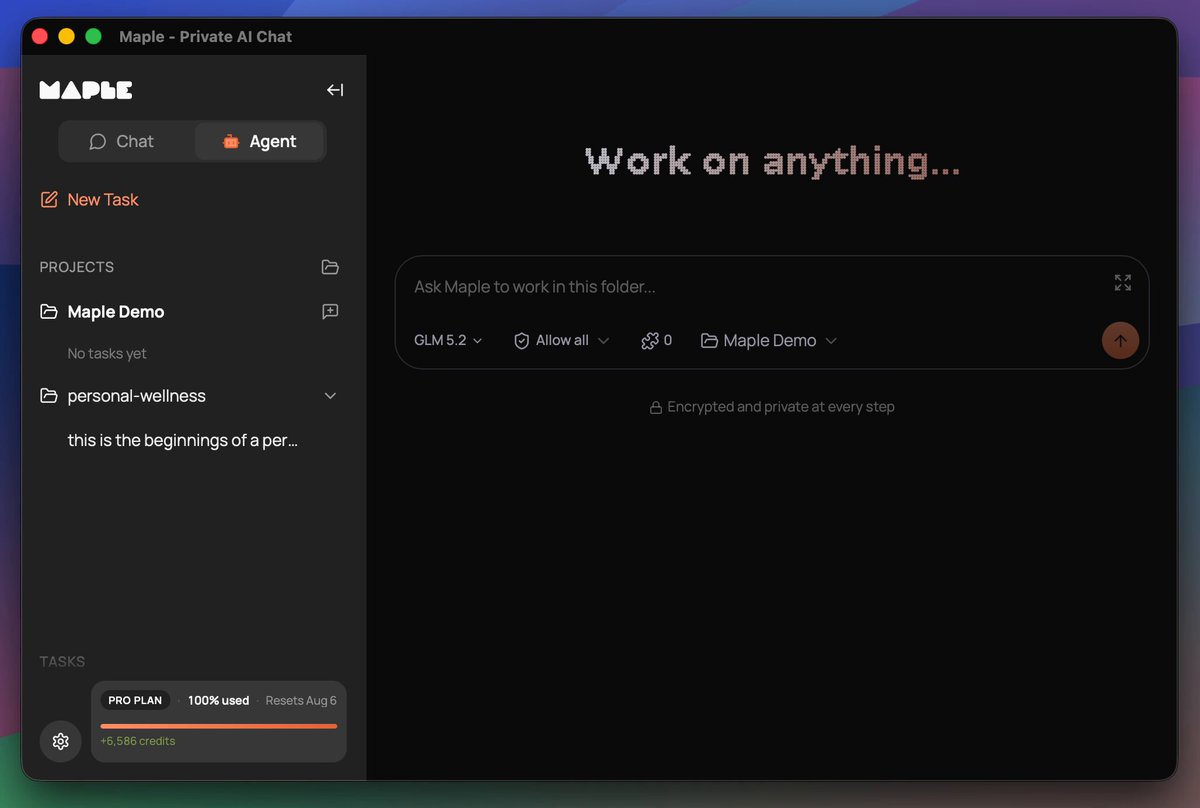
Maple is preparing for the release of a co-working agent. You install it locally and it works with your files, whether it's office work or building websites and apps. It's a turnkey solution, as easy as Claude Code, that keeps your data secure and private, no data sharing with closed AI labs. This is THE sovereign AI app for individuals and businesses who want powerful AI while retaining ownership of their information. Why build an agent into the Maple app when other agents already exist? Easy, we want to give you control over your work. We don't have a business plan that incorporates making money off our users' data. In the age of AI, your information, whether it's personal or company trade secrets, is the single thing that differentiates you from everyone else. We all have access to AI that can build a professional website for selling shoes. But your strategy and network for how you sell shoes should not be shared with your competitors. Sovereignty is the path to protecting what makes you, you. Maple sits at the intersection of Usability and Sovereignty. Maple gives you the best tools that are both easy to use and maintain your data sovereignty. Sovereign for one, sovereign for all. It has been a journey to get here. We brought to market the very first personal chatbot with end-to-end encryption using TEEs in late 2024. Prior to that there were proofs of concept but no full product offerings. Every other AI chat product on the market handled your data in plain text, either selling you a service to get your data or asking you to trust that they won't snoop on you. Quickly people found Maple and latched onto its open-source code and verifiable encryption. We didn't stop there. You may remember earlier this year we teased a product called "Maple Agent" and opened up a waiting list. That product is a mobile app that acts as your AI "friend", maintaining one long continuous chat, and getting to know you over time. I dislike using the word "friend" there, but it's the best way to convey the UX in a few words. AI is a tool, always has been, always will be. Any kind of friendly personality on top is just synthetic. In our testing, the UX of Maple Agent is really powerful for what it does. Think about the many short AI chats you have in your favorite app, whether it's looking up a historical fact or asking advice about a topic. With Maple Agent, those all go away in favor of the long-running chat with the friendly agent. It's like you have your own personal assistant who knows you so well and can look up anything for you. When I ask AI certain questions, I want to ask an expert who already understands my situation so I'm not repeating myself for the 100th time. That's the amazing value the personal agent brings to the table. We still see great utility for a personal agent like the "Maple Agent". Thousands of people on the waiting list, hoping to get their hands on it, agree that the concept is worth exploring and trying out. We were constrained in launching it due to a few circumstances, one of them being access to the scale of compute needed to power it. We have a clear path laid out for how to get there, but today is not the day to execute on that. It will be in the near future. Instead we have a different agent ready to go that we think is also incredible. We now have an agentic harness inside of the Maple Research app. This thing is a powerhouse. It even builds and publishes its own software releases. The agent in Maple Research works with your local filesystem, speaks to the largest open models running in TEEs, utilizes local models for certain tasks, is compatible with MCP tools, has an API for connecting to anything you need, and also supports the ACP protocol, which means it can be extended in the future to speak to other tools like Claude Code, Codex, and local models running on your own hardware. A big unlock for us was the Goose Development Kit, which powers the core of our agent harness. More on that to come as we publish articles and documentation later about the agent. The agent inside Maple Research doesn't have a name. At least not yet, not sure if it ever will. For now we call it "Chat Mode" and "Agent Mode". Think of this as the workhorse, the truck, the heavy lifter. Our other "Agent", the phone app, is your sidekick in your pocket, ready to help with quick things and ongoing conversations about life. I am incredibly excited about the Maple Research Agent. While I'm already seeing great results using it for internal work items, I'm especially thrilled about the personal health and wellness work it's doing for me. I know there are plenty of apps out there for compiling wellness data, but I'm having it build a tool tailored specifically for what I need, without the extra fluff. And none of my health data is being donated to the closed AI labs or sent to advertisers. I know that the AI logic is not being silently adjusted to fit the whims of a large corporation that has paid for product placement. It's me, state of the art AI, and my data. That's how I want it. Maple's new agent makes that possible. We can't wait for you to try it out. If you want early access, comment here, email us, reach out in some way. To those on the other agent waitlist, you're already in the queue. Thanks for reading this lengthy update. :)

Mark

26,609 просмотров • 2 дней назад