正在加载视频...

视频加载失败

Reconstructing the world in 3D from random internet photos is a deep rabbit hole. In 2008, Photosynth proved that 3D reconstruction of smaller monuments was possible. The next year, "Building Rome in a Day" proved it could be done for entire cities. Since then, there’s been a wild lineage...

50,671 次观看 • 7 天前 •via X (Twitter)

0 条评论

暂无评论

原始帖子的评论将显示在这里

相关视频

🚀 Announcing Echo — our new frontier model for 3D world generation. Echo turns a simple text prompt or image into a fully explorable, 3D-consistent world. Instead of disconnected views, the result is a single, coherent spatial representation you can move through freely. This is part of a bigger shift in AI: from generating pixels and tokens to generating spaces. Echo predicts a geometry-grounded 3D scene at metric scale, meaning every novel view, depth map, and interaction comes from the same underlying world — not independent hallucinations. Once generated, the world is interactive in real time. You control the camera, explore from any angle, and render instantly — even on low-end hardware, directly in the browser. High-quality 3D world exploration is no longer gated by expensive equipment. Under the hood, Echo infers a physically grounded 3D representation and converts it into a renderable format. For our web demo, we use 3D Gaussian Splatting (3DGS) for fast, GPU-friendly rendering — but the representation itself is flexible and can be easily adapted. Why this matters: consistent 3D worlds unlock real workflows — digital twins, 3D design, game environments, robotics simulation, and more. From a single photo or a line of text, Echo builds worlds that are reliable, editable, and spatially faithful. Echo also enables scene editing and restyling. Change materials, remove or add objects, explore design variations — all while preserving global 3D consistency. Editing no longer breaks the world. This is only the beginning. Echo is the foundation for future world models with dynamics, physical reasoning, and richer interaction — environments that don’t just look right, but behave right. Explore the generated worlds on our website and sign up for the closed beta. The era of spatial intelligence starts here. 🌍 #Echo #WorldModels #SpatialAI #3DFoundationModels Check it out:

SpAItial AI

176,105 次观看 • 8 个月前

New greenpill.network pod today with @thedevanshmehta about Deep Funding, a new AI-powered funding mechanism that combines human evaluation and prediction markets to allocate resources for open-source projects. Topics: 1. how Deep Funding scales human judgment, 2. prevents Sybil attacks, 3. and creates a fair, dynamic “price feed” for public goods. 4. Devansh shares insights from the pilot run, the results of the data-science competition, and how the model will power Gitcoin Grants 24 #GG24 Timestamps: 00:00 – Intro: Welcome to the Greenpill Podcast – exploring tech, coordination & Protopia 00:45 – Introducing guest Devansh Mehta, AI & Public Goods Lead at the Ethereum Foundation 01:20 – What is Deep Funding and why it matters 02:00 – How Deep Funding scales human evaluations with AI models 02:45 – Overview of the pilot run and what was tested 03:20 – How the mechanism works: human jurors + model builders 04:30 – The White Hat Sybil attack and what it revealed 05:40 – How Deep Funding integrates data science competitions and prediction markets 06:50 – Results of the pilot: weighted funding for 45 open-source repos 07:30 – Creating a credibly neutral funding system with unequal weights 08:40 – Comparing Deep Funding with Protocol Guild and other mechanisms 09:20 – Building a strong community of AI developers and human jurors 10:30 – The role of jurors and models in fair evaluation 11:10 – What’s next: expanding to 90 repos in Gitcoin Grants 24 (GG24) 11:50 – Funding pool: $350K from Ethereum Foundation & Gitcoin 12:30 – Challenges of distributing capital efficiently and fairly 13:20 – Moving to GitHub repo-level governance: who controls the funds? 14:40 – Two models of spending: splits contracts vs counterfactual wallets 15:40 – Lessons from past Gitcoin funding rounds 16:20 – Why Deep Funding focuses on units of work, not organizations 17:20 – Avoiding distortions and improving fairness in funding 18:10 – The vision: creating a live price feed for public goods 19:10 – How prediction markets price open-source value 20:30 – Self-correcting market behavior and real-time adjustments 21:20 – Subsidies and liquidity: bootstrapping active participation 22:10 – Balancing liquidity levels to prevent manipulation 23:00 – What’s next for Deep Funding: refining future iterations 23:40 – Shoutout to the model builders and competition winners 24:20 – Where to learn more: & 25:00 – Closing: the future of AI, governance, and funding what matters If you’re curious about the intersection of AI, governance, and funding public goods, this conversation is for you. And participate in GG24 at

owocki’s gitcoin 3.0 arc

12,981 次观看 • 10 个月前

WOW. 😳 Apple just quietly won the 3D maps war at WWDC. Gaussian Splatting is coming to Apple Maps Flyover this fall. Apple Maps Flyover covers 300+ cities. Until yesterday, every single one was built on standard drone photogrammetry. The technology captures photos from the air and reconstructs 3D geometry from them. Gaussian Splatting does not reconstruct geometry. It represents the scene as millions of tiny 3D ellipsoids, each one carrying its own color and opacity information based on how light actually behaves in that location. The output is not a mesh model. It is a field of light. When you move through it, it does not crumble at the edges. The detail holds because it was never geometry to begin with. Apple has been hiring for this for years. Their SHARP model, published in research last year, generates photorealistic 3D scenes from a single image in under a second. Google has more sensor data than anyone. More Street View cars, more satellites, more capture history. On navigation accuracy and geodata depth, Google Maps is still ahead by most measures. But fidelity in 3D city rendering is a different competition, and Apple just set a bar in that. Most people will experience this in the fall without knowing the name of the technology. They will open Flyover, look at a city they know, and notice it looks different. Real, not rendered. That is the moment Gaussian Splatting stops being a research term and becomes something a billion people use. Bookmark this. It will look prescient by October.

Shruti

19,832 次观看 • 2 个月前

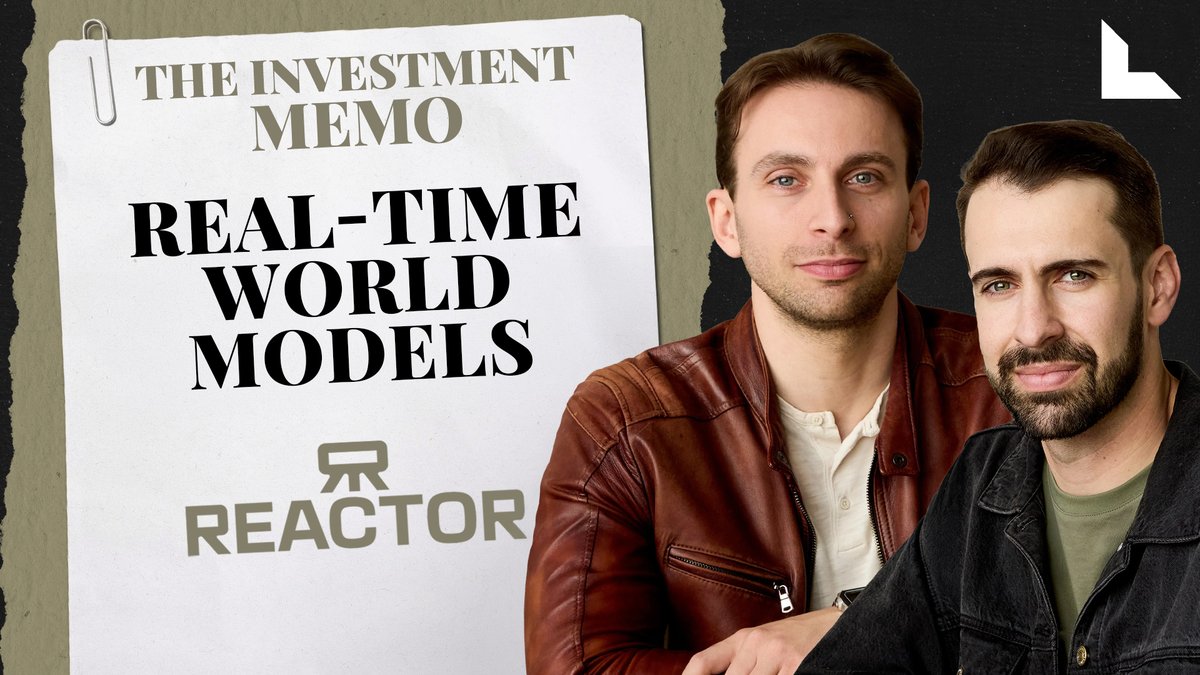
Real-time world models represent a fundamental shift in AI. reactor is building the platform for real-time generative video infrastructure, supporting developers who need the tech for use across entertainment, physical AI, and robotics. Co-founders Alberto and Bryce Schmidtchen joined us last week on The Investment Memo, hosted by Partners Bucky Moore and Amber Yang, to talk about the era of world models. The conversation centered around the infrastructure Reactor is building, why real-time models are the edge right now, and current use cases for the product. Alberto and Bryce agreed that world models are shaping the way simulations are created, and that developers need a streamlined platform that can support their ideas. We believe Reactor is positioned to be at the frontier of research into real-time generative models. We look forward to seeing how these models apply across industries. Chapters 00:00 Introduction & Overview of Reactor 01:08 Meet the Hosts & Founders 02:18 The Origin Story: From 3D Assets to World Models 05:07 Real-Time Video Applications Across Industries 06:55 The Open Source World Model Explosion 07:23 Why Infrastructure Is the Opportunity 08:42 Parallels to Past Technology Waves 09:51 Bridging the Research-to-Production Gap 13:13 What Developers Are Building with World Models 16:41 Lessons from Luma AI 18:23 What Apple Vision Pro Taught Bryce About Real-Time Systems 20:48 Company Values & Team Culture 22:40 Series A: What the Capital Unlocks 24:13 Reactor's Five-Year Vision 26:09 Closing Remarks

Lightspeed

144,942 次观看 • 2 个月前

3D scanning and rendering is moving so fast - got my splats up and running and I'm mind blown getting ~100fps for this complex 3D scene ⬇️ 🤯 1. WAY faster than NeRF: For comparison, NeRFs would takes around 10 seconds per frame (!) Instead I'm zipping around with FPV controls without breaking a sweat - though I do crash a few times towards the end of the video lol 2. Old Meets New: Gaussian Splatting is cool in that it fuses classical graphics and deep learning techniques. Like NeRFs, this is still a radiance field - just without the slower (ne)ural rendering part. 3. Explicit Representation: Instead you represent a 3D scene as a collection of ellipsoidal "splats" called gaussians. Each gaussian has a position, size, and color. Rendering in real-time is done by projecting into the image plane and alpha blending. 4. Photorealistic Effects: Gaussian splatting use spherical harmonics to represent the view-dependent effects and lighting - allowing surfaces to change color when viewed from different angles, enabling greater photorealism. It doesn't use a neural network, but the training loop is similar to deep learning. 5. Enables Direct Editing: But it's not just speed - with Gaussian Splatting you also get 3D editing support! So you can select, move, and delete stuff, even relight stuff. This type of editing has been more tedious to do with NeRFs and their implicit black box representations. 📲 More tests cooking! Much more to unpack here including simpler explanations. If you enjoyed this post, you might enjoy my feed: Bilawal Sidhu

Bilawal Sidhu

337,090 次观看 • 2 年前