Loading video...
Video Failed to Load
📢 Lyra: Generative 3D Scene Reconstruction via Video Diffusion Model Self-Distillation Got only one or a few images and wondering if recovering the 3D environment is a reconstruction or generation problem? Why not do it with a generative reconstruction model! We show that a camera-conditioned video diffusion model can... show more

66,918 views • 1 year ago •via X (Twitter)
38 Comments

Previous work (left) trains image-to-3D models using real-world datasets with limited diversity. In contrast, we propose a self-distillation framework (right) for generative 3D scene reconstruction. Specifically, a pre-trained camera-controlled video diffusion model (GEN3C) with its RGB decoder output (teacher) supervises the rendering of the 3DGS decoder (student). Using a video model pre-trained on large-scale real-world 2D video data allows us to provide diverse and potentially infinite multi-view supervision.
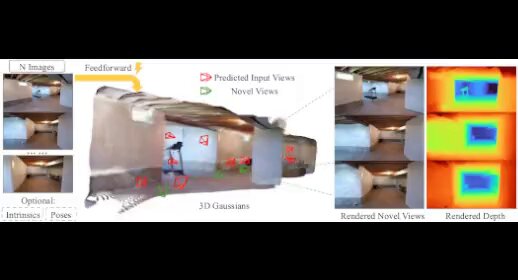
Our model generates 3DGS scenes from a single input image in a feed-forward manner generalizing across a wide range of scenarios., without the need for per-scene optimization.
Moreover, our framework easily extends to feed-forward 4D scene generation from a single input video.
Our approach seamlessly generalizes to full 3D scene generation from a single real image, without ever being trained on real-world data.
The generated 3D Gaussians can then be exported into into NVIDIA Isaac Sim based on 3DGUT to simulate humanoid robots in generated environments.
Joint work with @TianchangS @jiawei6_ren @huangjh_hjh Yifeng Jiang @Haithem_Turki @taiyasaki @davelindell @ZGojcic @FidlerSanja @HuanLing6 @JunGao33210520 @xuanchi13
@jiawei6_ren @huangjh_hjh @Haithem_Turki @taiyasaki @DaveLindell @ZGojcic @FidlerSanja @HuanLing6 @JunGao33210520 @xuanchi13 Check out this very related work Bolt3D ( at ICCV next month by @StanSzymanowicz @jasonyzhang2 @_pratul_ @RuiqiGao @ArthurBrussee @holynski_ @rmbrualla @jon_barron @philipphenzler
@jiawei6_ren @huangjh_hjh @Haithem_Turki @taiyasaki @DaveLindell @ZGojcic @FidlerSanja @HuanLing6 @JunGao33210520 @xuanchi13 @StanSzymanowicz @jasonyzhang2 @_pratul_ @RuiqiGao @holynski_ @rmbrualla @jon_barron @philipphenzler Special thanks to @robrombach @andi_blatt and the rest of the team at @bfl_ml for open-sourcing FLUX ( We use FLUX to generate high-quality input images and lift them into 3D.

Amazing work!
Thanks Matthias 🍻

Strong 👍👍🥳
Not as strong as you 😌

Uff 😮💨 sky is the limit! 🚀
Danke du Spruecheklopfer 🤪

Machine! Congrats 🚀
Danke Bro 😎

looks amazing!! 🎉
Thanks Lily 😊

🔥❤️👏🏼

Congrats, Sherwin!🎉🎉
Thanks Ziya 🫡

Amazing!!! Congrats Sherwin
Thanks big guy 🙏

Cool!That looks like a good time

This is insane.

that looks cool!

Amazing work! Congrats, Sherwin!
Thanks Yuyang 🤪

Very cool work! Congrats on the release
Thanks Hadi 😊

This is over 20 years ago:

The 4D 🐐 🤩
No, you are the 4D 🐐😮💨

Really cool work and amazing results Sherwin! :) Was wondering, how sensitive the 3DGS decoder is to the multivew inconsistencies?
Thanks! We learn to smoothen inconsistencies with LPIPS loss. Obviously, a more consistent diffusion model will make it easier to get consistent output. The current viewpoint change is mainly limited because the diffusion output gets more and more inconsistent far away from the input view. Hope to improve that!

Congrats! I really like the ideas here. 🙂
Thanks Ethan 😊

wow! this is cool