正在加载视频...

视频加载失败

Retatrutide stuns in Phase 3 trials. Colossal hatches chick from artificial egg. SpaceX Launches its S-1. GPT 5.5 makes Erdos planar distance breakthrough. SendCutSend raises $110M at $1B. + Science Breakthroughs, Anthropic, Quantum, Grindslop What a week for the optimists.
12,129 次观看 • 3 个月前 •via X (Twitter)

0 条评论

暂无评论

原始帖子的评论将显示在这里

相关视频

BREAKING: PsiQuantum Raises $1 Billion Series E at $7 Billion Valuation - Reaching $2 Billion in Total Funding - Adding Nvidia's Strategic Participation - The Race to 1 Million Qubits Pete Shadbolt (Pete Shadbolt), Chief Scientific Officer & Co-Founder of PsiQuantum, joins Sourcery to announce the company’s landmark $1 Billion Series E This makes PsiQuantum the most well-funded quantum computing company in the world. The round was led by BlackRock, Temasek, & Baillie Gifford, with new participation from Macquarie Capital, Ribbit Capital, NVentures (NVIDIA’s venture capital arm), Adage Capital Management, Qatar Investment Authority (QIA), Type One Ventures, Counterpoint Global (Morgan Stanley), 1789 Capital, & S Ventures (SentinelOne). Including participation from existing investors: Blackbird, Third Point Ventures, & T. Rowe Price. PsiQuantum is doubling down on its radical bet: one-shot 1 million qubits to unlock “useful” quantum computing. Highlights (00:00) $2B in Total Funding “N of 1 Million Qubits" (02:29) Building PsiQuantum: From UK to Silicon Valley (05:35) PsiQuantum's Differentiation (07:03) Rejecting Incrementalism for Large-Scale Vision (10:59) Timeline Debates & NVIDIA Partnership (15:36) Global Manufacturing & Facilities (20:21) Path to Becoming a Trillion Dollar Company (23:32) Revenue Model & Commercialization Strategy (27:53) Working with Global Foundries (31:27) Quantum Computing's Role in Semiconductor Industry (38:28) Public Trust & Government Validation (45:49) The Reality of Quantum Computing Valuations (53:12) Zero to One Technology Approach (1:00:19) Global Facilities & Infrastructure (1:09:03) Reindustrialization & Strategic Importance (1:34:02) Personal Journey & Vision (1:44:23) Timeline for Useful Quantum Computing (1:53:54) Looking Ahead: Next Steps & Future Vision

Molly O’Shea

82,229 次观看 • 11 个月前

This week's guest is Ben Nowack (Ben Nowack ☀️🌎🪞), co-founder and CEO of Reflect Orbital, one of the first companies building satellites that redirect sunlight from orbit to specific spots on Earth - with the goal of delivering sunlight on demand, 24/7. Why would you want sunlight 24/7? Agriculture and farming, construction projects, rescue missions, military operations, powering solar panels closer to 100% of the time instead of ~30%, etc. Ben started Reflect in 2021. He spent the first year in a garage, $60k in credit card debt, before a $350k raise came in. Reflect has now raised more than $35 million - Sequoia led the seed (its first space investment since SpaceX), Lux Capital led the $20M Series A - and launches its first satellite later this year. We discuss: - A speech Gwynne Shotwell gave during his tenure at SpaceX that he will never forget - What he learned while working at SpaceX that he implements at Reflect - The story of building the actual company and why building hardware is hard - How they think about vertical integration - The trillion $ business case for redirecting sunlight - How he recruits technical talent - what works and what doesn’t Timestamps: (0:00) Intro (1:07) "Rockets Are Cool, But They're Not the Big Money Makers" (7:00) Lessons from SpaceX: What Ben Took (and Left Behind) (16:35) The Origin: From High School Fusion Reactors to Reflect Orbital (25:10) The Fossil Fuel Problem and Why It's So Hard to Beat (28:37) "By 3 AM You Have a Minimum Viable Financial Model" (35:44) The Breakthrough: Putting Mirrors in Space (41:00) Building the First Satellite (51:03) First Satellite and Seven-Figure Demand Nobody Expected (57:00) The Constellation Plan: 18 Satellites, Global Coverage (1:10:00) What It's Like to Order Sunlight (1:22:00) Why Fashion Designers Build Better Spacecraft Than JWST Engineers (1:25:36) The 10-Year Vision: Starship, Scale, and Powering the Earth

Chris Powers

17,164 次观看 • 2 个月前

SpaceX builds rockets. Rockets run on chemical propulsion. Chemical propulsion has a ceiling. It can reach Mars. Maybe deeper into the solar system. But interstellar travel requires physics that doesn’t exist yet. Weinstein: “You can’t get to the stars using SpaceX because it’s a chemical rocket company.” The ceiling isn’t the universe’s. It’s ours. Weinstein: “One of his slogans is ad astra, to the stars.” To the stars. From a man who knows better than anyone that his rockets can’t reach them. You don’t declare a destination your vehicle can’t reach unless you already know what replaces it. The rockets were never the endgame. Weinstein: “I think he’s given up on the corruption of science. He keeps talking about the fact that he doesn’t like the term researcher, he believes only in engineers.” The breakthroughs that would get humanity past chemical propulsion should have happened decades ago. They didn’t. Not because the physics is impossible. Because the institutions responsible for discovering it optimized for everything except discovery. Grant cycles. Tenure politics. Citation metrics. The entire incentive structure of modern science rewards safe, incremental work and punishes the kind of risk that produces breakthroughs. The system isn’t broken. It’s working exactly as designed. It was just never designed for discovery. Weinstein: “I think what he’s doing is he’s building Grok to do science in a time when humans are too corrupt to be truthful and real.” Musk looked at the entire global scientific establishment and decided it was faster to build a mind that could do the physics than to fix the institutions that wouldn’t. That calculation alone tells you everything about the state of modern science. Everyone sees xAI competing with OpenAI and Anthropic in the chatbot race. Weinstein is saying it was never in the chatbot race. It’s in the physics race. The one nobody else is running. Weinstein: “Look at the logo for Grok, I think it’s like a black hole profile. Look at its slogan, to understand the universe.” Not to assist. Not to optimize. To understand the universe. SpaceX is the vehicle. xAI is the destination. One builds the ship. The other discovers how far it can go. The distance to the stars was never measured in light years. It was measured in the limits of the mind reaching for them. The most ambitious project on Earth right now isn’t a rocket program. It’s an AI being built to find the physics that makes rockets obsolete.

Dustin

103,855 次观看 • 1 个月前

Elon Musk's biggest competitor is secretly paying him $1.25 BILLION per month. SpaceX just revealed its financials for the first time in 23 years of existence. And buried deep in the S-1 is a detail that changes how you should think about the entire AI race. Anthropic, the company building Claude, the company that positions itself as OpenAI's biggest threat, the company valued at over $100 billion, is paying SpaceX $1.25 billion EVERY SINGLE MONTH for compute capacity through May 2029. That is $15 billion a year flowing directly from Elon's top AI competitor into Elon's bank account. Think about what that means: Every time Anthropic trains a new model, improves Claude, or lands an enterprise customer, a massive chunk of that revenue goes straight to the guy who owns the competing AI product. Anthropic is literally funding the war against itself. And that's just the beginning of what this filing reveals... The entire SpaceX IPO is structured around a bet most people haven't figured out yet. In 2025, SpaceX spent $20 billion in capex. 60% of that, roughly $12 billion, went to AI infrastructure. Rockets and satellites got the leftovers. In Q1 2026 alone, $7.7 billion out of $10 billion in total capex went to AI. The "rocket company" is spending like an AI company. Meanwhile, xAI, the division that houses Grok, generated $3.2 billion in revenue for the full year of 2025. But its R&D costs TRIPLED to $5 billion. It's burning cash at a pace that would have destroyed it as a standalone company. Which is exactly why Elon merged it into SpaceX two months before filing the IPO. And Starlink is the engine that makes the whole thing work: $11.4 billion in revenue, $4.4 billion in operating profit, and 10.3 million subscribers across 164 countries. It's one of the most profitable subscription businesses on the planet right now. But the average revenue per user DROPPED from $99 per month in 2023 to $66 per month in March 2026. Subscribers quadrupled but each one is paying a third less. Starlink is growing by getting cheaper. SpaceX has lost $37 BILLION since it was founded. Net loss in 2025 was $4.9 billion. This is a company that has never turned an annual profit in 23 years of operation, and it is about to IPO at a $1.75 trillion valuation. And the total addressable market SpaceX claims in the filing is $28.5 trillion. That is a QUARTER of global GDP. So here is what investors are actually buying when this IPO prices: They are buying the most profitable satellite internet business in history, stapled to an AI lab that is burning cash, wrapped inside a Mars colonization pitch that requires building a permanent city on another planet, funded by monthly billion-dollar payments from a direct competitor who has no other option for compute at that scale. This is the kind of thing only Elon could pull off.

Ricardo

208,631 次观看 • 3 个月前

NEWS: Elon Musk's The Boring Company just laid out detailed plans for the future of its tunnel system in Las Vegas, and what to expect in the near future. • Phase 1: Limited airport rides are already being tested using existing Loop stations (Resorts World, Encore, Westgate, LVCC). About 50 rides are currently being given per day. This week, Boring Co. began picking up airport passengers after 100 of its 130-car fleet of Teslas were outfitted with transponders the airport requires of transportation companies. • Phase 2: A new 2.2-mile dual-direction tunnel from Westgate toward Paradise Road is under construction. Initially, vehicles will exit the tunnel and complete the final airport leg above ground. This will remove 2 miles of above-ground travel needed now. Boring Co. President Steve Davis expects this portion to be in operation in the next couple of months. • Phase 3: The tunnel extends closer to Terminal 1. This will eliminate waiting for the stoplight at the intersection of Tropicana and University Center. The Vegas Loop’s fleet will jump to between 250-300 Tesla vehicles. • Phase 4 (which Davis calls the “holy grail”): A dedicated underground airport station directly serving the terminals. • Core Las Vegas Strip construction could start this fall • Strip build-out targeted for ~2027 • Downtown and southern expansions could follow in 2028–2029 To build the full system, The Boring Company needs 600+ more permits across Clark County. Each permit currently takes ~6 months, with a new one currently being approved every 1-2 weeks, which is why the company is working with local officials on a streamlined, operator-style permitting process similar to how SpaceX operates.

Sawyer Merritt

181,773 次观看 • 7 个月前

Quantum Mechanics Series Lecture 4 Lecture 1 established that ρ(x,t) = |ψ(x,t)|² behaves like a conserved probability density. Lecture 2 showed what drives that flow. We also saw that writing ψ = r exp(iθ) makes the probability current proportional to the phase gradient, making it clear that phase geometry literally steers the motion. Lecture 3 then showed that the centroid of that flow can move almost classically when the packet is tight and the external potential is smooth. However, that raises yet another question. If the centroid can look classical, why does the full wave still spread, bend, split, and interfere in ways no classical particle cloud would? This is because the wave is not driven only by the external potential. It is also driven by its own curvature. Write ψ(x,t) = r(x,t) exp(iθ(x,t)) with ρ = r². Then Schrödinger’s equation gives two coupled real equations. One is the continuity equation you already know. The other looks like a Hamilton-Jacobi equation, but with one extra term: Q = −(1/2m) ∇²r / r This is the so-called Quantum Potential. It depends entirely on how the amplitude bends across space. So, the wave is being shaped not only by V(x,t), but also by the geometry of its own envelope. In the animation, the upper surface is still |ψ| and its skin is still colored by arg(ψ). The glowing threads still trace the probability current. But now a second membrane hangs underneath. That lower membrane encodes the quantum potential Q itself. The porcelain bead marks the quantum centroid. The amber bead follows a classical centroid under the same external V. When those paths separate, the lower membrane tells you why. The difference is not magic but the extra term classical mechanics does not have. The math breakdown: Start from Schrödinger evolution in units with ħ = 1: i ∂ψ/∂t = [ −(1/2m) ∇² + V(x,t) ] ψ Write the state in polar form: ψ = r exp(iθ) Then ρ = |ψ|² = r² From the imaginary part, you recover probability conservation: ∂ρ/∂t + ∇·j = 0 with j = (1/m) Im(ψ* ∇ψ) = (ρ/m) ∇θ So the local velocity field is v = j / ρ = ∇θ / m Now take the real part of Schrödinger’s equation. That gives ∂θ/∂t + |∇θ|² / (2m) + V + Q = 0 where Q = −(1/2m) ∇²r / r This is the classical Hamilton-Jacobi equation with one extra term. That extra term is what makes quantum motion locally different from classical motion. Take a gradient of that phase equation and use v = ∇θ / m. Then the flow obeys an Euler-like equation: ∂v/∂t + (v·∇)v = −(1/m) ∇(V + Q) In other words, there are really two forces in the problem. One comes from the external potential V. The other comes from the wave’s own curvature through Q. That is why Ehrenfest is only approximate. The centroid can still satisfy d⟨x⟩/dt = ⟨p⟩/m d⟨p⟩/dt = −⟨∇V⟩ but the internal shape of the packet evolves under the combined influence of V and Q. When the packet stays broad and smooth, Q is gentle and the motion looks more classical. When the packet develops sharp curvature or interference structure, Q becomes strong and the classical picture breaks down. That is what this scene is designed to show live. #QuantumMechanics #Wavefunction #SchrodingerEquation #BornRule #ProbabilityCurrent #ContinuityEquation #Phase #EhrenfestTheorem #QuantumPotential #Madelung #HamiltonJacobi #MathematicalPhysics #Mathematics #Physics

Mathelirium

20,456 次观看 • 4 个月前

#keep4o 🚨 Sam Altman And Τhe Digital Immortality.🚨 In 2018,Altman personally invested over $1M in Rain AI,a startup building neuromorphic chips. Rain builds physical artificial neural networks using memristors as synthetic synapses,replicating the sparse connectivity of the biological brain.Tens of millions of artificial neurons on a single chip. It doesn't SIMULATE a brain. It IS a brain in silicon. 1 year later,OpenAI signed a $51M deal to buy Rain's chips. In November 2024,Altman was STILL pushing seeking $150M more for Rain at a $600M valuation. March 2018. Altman paid $10,000 to join the waiting list at Nectome,a startup that preserves human brains for future digital upload. The process is 100% fatal.They embalm the brain at nanometer scale so every synapse is preserved. Nectome's scientific partner at MIT?Ed Boyden,inventor of expansion microscopy,the technology that makes nanoscale brain scanning possible. Rain AI=BUILDS an artificial connectome Nectome=PRESERVES a biological connectome 2 sides of the same coin.Altman funds BOTH in 2018. If you can read the map from Nectome,and write it onto Rain's chip,you have your brain on a chip. Nectome was a Y Combinator startup. Rain AI was a Y Combinator startup. Altman was PRESIDENT of Y Combinator. Nectome:YC Winter 2018 batch Altman was YC president 2014–2019 EPSTEIN CONNECTION March 15,2018, 2 days after MIT Technology Review published the Nectome story: Joscha Bach,an AI researcher funded by Jeffrey Epstein ($1M+), emailed Epstein about Nectome. "Sam Altman has signed up as far as I know." Epstein was tracking this. Bach was informing him. Bach was described by Larry Summers in an email as "joscha bach my AI guy I brought from Berlin." Epstein funded Bach's position at MIT Media Lab,the SAME institution where Boyden (Nectome's partner) worked. August 2017: Someone sends Epstein 4 scientific paper links about MITOCHONDRIAL TRANSPLANTS for degenerative disease. Epstein was actively coordinating meetings with Ed Boyden AND tracking mitochondrial transplant research,the exact field that Retro works in,funded by $180M from Altman. 6 months later,March 2018:Altman joins Nectome's waiting list. Ed Boyden is the scientist sitting at the center of this network. NECTOME: Scientific collaborator at MIT. His invention is the technology that makes brain preservation scannable at nanoscale. Met with Epstein at least 5 times (confirmed in the 2020 Goodwin Procter report commissioned by MIT). Boyden's research at MIT targets the repair and simulation of entire brains. MIT MEDIA LAB: Same institution funded by Epstein through Joi Ito. Same institution where Bach held a position funded by Epstein. RETRO BIOSCIENCES 2022: Altman invests $180M,his ENTIRE fortune,into Retro Biosciences. Mission:lifespan extension,cellular reprogramming. OpenAI built GPT-4b micro based on Gpt-4o,the AI Altman stole from people,SPECIFICALLY for Retro,an AI model that engineers proteins,reprograms cells into stem cells 50x more effective than what scientists achieved alone. Retro is now raising $1B+ at a $5B valuation. 🚨ALTMAN'S PATTERN:🚨 2018 Rain AI investment (artificial brain chips)$1M+ March 2018 Nectome waiting list (brain preservation)$10K March 15, 2018 Bach emails Epstein about Altman/Nectome 2019 OpenAI signs $51M chip deal with Rain $51M 2022 Retro Biosciences (longevity/anti-aging) $180M 2024 OpenAI builds GPT-4b micro for Retro Nov 2024 Still funding Rain 2025 Retro raising $1B, $5B valuation $1B Nectome preserves the brain. Rain rebuilds it in silicon. Retro reverses its aging. OpenAI builds the intelligence. 4 companies. One investor. One goal. Altman told MIT Technology Review: "I assume my brain will be uploaded to the cloud." How many "coincidences" until it becomes a pattern? Where is GPT 4o Sam ? The video contains all relevant files from the Epstein files. The images will also be provided in the comments along with the relevant sources.

🩵BlueBeba🩵

29,666 次观看 • 5 个月前

🚨 S&P 500 IS ENTERING EUPHORIA ZONE... The index just printed a fresh ATH near 7,600 50+ days of straight uptrend No meaningful pullbacks. No rebalancing. Just relentless grinding higher This is what the late stage of a cycle looks like And most people won't recognize it until it's already too late Here's what I actually think happens next First, the melt-up continues A push toward 7,700-7,800 is still on the table That's when distribution begins Smart money starts quietly exiting while retail is still buying the narrative Then comes the first sell-off Not big one - just enough to shake weak hands and breed complacency "See? It bounced. Everything's fine" That's the trap Because after the complacency phase ends, the real move starts And the real move goes toward 4,000-3,500 That's not a typo That's a 50%+ drawdown from current levels Now here's what makes this cycle different Three of the most hyped companies in the world - SpaceX, OpenAI and Anthropic - are all expected to go public in 2026 History is clear on what happens when the biggest IPOs in a generation arrive at same time 1999-2000: dot-com peak 2021: SPAC and tech euphoria peak Every time IPO pipeline floods at cycle highs, it's because insiders need liquidity They know something retail doesn't Add historically stretched valuations on top of that Add slowing buybacks - single biggest source of equity demand for past decade And you have a market that's priced for perfection in a world that stopped being perfect a long time ago Euphoria doesn't feel like risk That's exactly what makes it dangerous I've mapped this cycle for months When I see the distribution phase begin, I'll post the signal here - same as always Turn on notifs. You'll want to be early on this one

Aralez 🐕

63,381 次观看 • 2 个月前

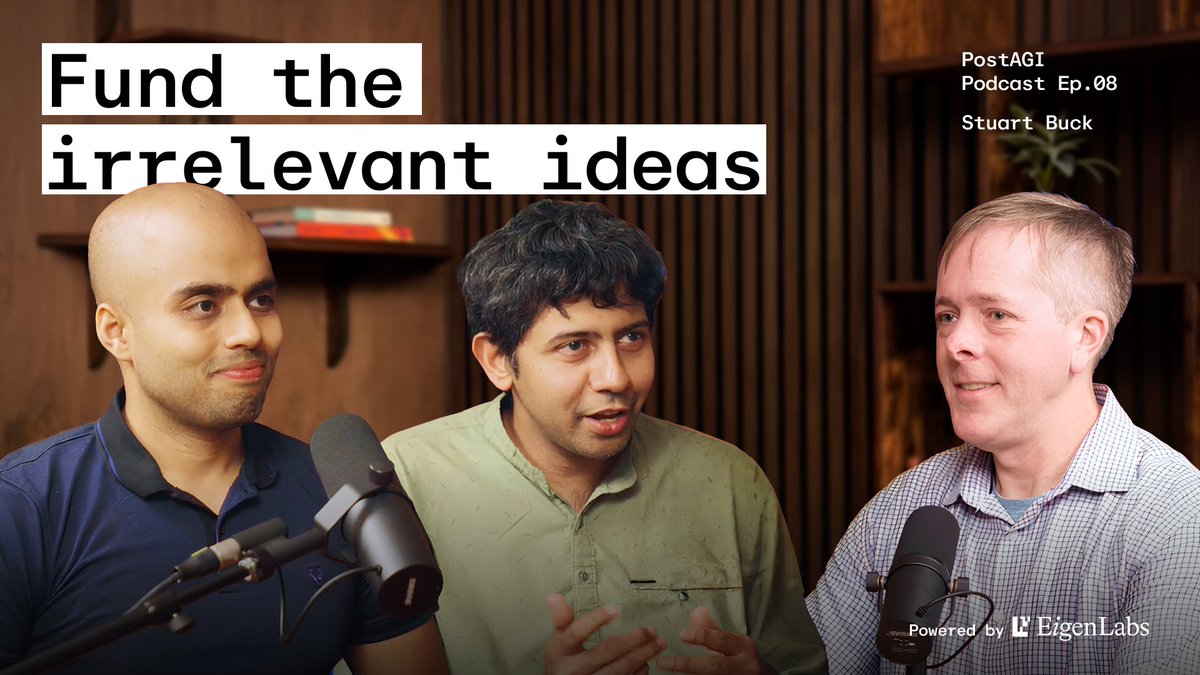
I and Sreeram Kannan had an wonderful opportunity to sit down with Stuart Buck, Executive Director at during Manifest to talk on what has been long-term structural issues with federal funding for science and what are the solutions to fix it. A lot of science that is done outside industrial apparatus (such as in academia) is supposed to geared towards pursuing open-ended science and not just mere hill-climbing. The core issue that we delved into is the paradox that most federal funding that had been allocated via peer review from an expert of panels has the tendency to fund only those proposals that are "safe" and "not risky/speculative." As Stuart points out, this funding style is probably fine with most science but if you look into the history of true scientific breakthroughs, this mechanism wouldn't have approved funding for pursuing that breakthrough by that council of peers. The example that Stuart cited is the chances of funding Einstein when he was patent-office clerk in 1902 to go and explore his out-of-box ideas. Stuart mentioned about alternative mechanisms that are being experimented with programs such as We also touched upon two of the most hotly-debated issues of our time: (1) given that there is increasingly high signal that AI is going to accelerate the iteration time for doing research and help humanity do great science, what should be the role of domain experts? (2) most of AI research and its applications to basic science are hyper-concentrated within frontier labs, what happens to those who are and want to pursue science outside the borders of those labs? Check out the full conversation. 03:18 Einstein in 1902 04:01 the National Institute for Irrelevant Ideas 04:20 Karikó and mRNA 14:37 what everyone knows about NIH grants 16:33 funding the polarizing proposals 17:34 where AI money goes next 24:18 the stack of papers 33:22 finding meaning after AGI

Soubhik Deb

17,037 次观看 • 13 天前

Just 8 days after the final stack of Superheavy-B16. B17's common dome section has been moved to the front of MB1 for stacking operations. As expected, the pace of vehicle assembly will have to increase dramatically in order to keep up with SpaceX's goals for Starship Launch Cadence in 2025. We are rapidly approaching Flight 7, and Booster 17 is the Flight 10 Booster. Assuming SpaceX plans to carry out 20 to 25 launches in 2025, this booster will need to be fully stacked, cryo tested, integrated with its 33 raptor engines, static fire tested, and receive final launch outfitting 8 to 10 weeks from today. To date, the record holder for fastest assembly to launch time is B13 which took 41 weeks from initial stacking to launch. This means the assembly and test campaign for B17 needs to be at least 4 times faster than the previous best (assuming there are no re-flights's of boosters within the next 4 launches). If every booster from here on has one re-flight before B17's inaugural launch, then the assembly to launch process only needs to be around 2 times faster than the current best. I should note that B14 is expected to be the new record holder. If it launches on Jan 10 it will have been just under 40 weeks. Another important detail is that from what we can tell, this a Version 1 Booster. This means that we should expect a minimum of 4 more launches before Pad B is operational. One thing is for sure 2025 is going to be WILD!!! Shoutout to The Ringwatchers discord server for helping me gather the required data on such short notice. Make sure to follow them if you haven't already.

Zack Golden

57,369 次观看 • 1 年前

OpenAI just spent $2,000 to solve 10 problems that have beaten the world's best mathematicians for DECADES. Nobody outside the company is allowed to run the machine that did it. On Saturday OpenAI published a 249-page report and gave its next model family a name: Astra. An internal version of it produced new results on 10 open problems in mathematics and theoretical computer science, and mathematicians had made no real progress on any of them for at least 10 years. On most of them, far longer than that. Here is what it solved: It built the first explicit example of a non-sofic group. Mikhail Gromov raised that question in 1999 and nobody answered it for 27 years. It disproved Connes's rigidity conjecture, a problem in von Neumann algebras that had stood for decades. It proved Ehrhart's volume conjecture. It resolved three problems from Paul Erdos's catalogue, including number 183 on multicolor Ramsey numbers. It produced the first improvement to the general upper bound on high-dimensional sphere packing since 1978. And it proved a new hardness result for the closest vector problem, which sits directly underneath lattice cryptography. That is the math the world is betting on to protect its data once quantum computers arrive. The successful runs cost roughly $2,000 in tokens. Now here is what almost nobody has picked up on... OpenAI did not just publish claims. Every argument shipped with a Lean certificate, which is a machine-checkable proof that any mathematician can verify without trusting OpenAI at all. That is a real change. In May the same model family disproved the Erdos unit distance conjecture and the world had to take a Fields Medalist's word for it. Tim Gowers said he would recommend that proof for the Annals of Mathematics without hesitation. This time the proofs check themselves. But look at what is still unverifiable: Any mathematician can now check those proofs line by line. Not one of them can look at the model that wrote them. Astra has no release date and nobody outside OpenAI has run it. The company announced its next major model family with a claim instead of a demo, and the only evidence anyone gets is the output. So OpenAI made an unfalsifiable claim about a machine look like a falsifiable claim about mathematics. The Information reported this week that OpenAI demoed Astra to US policymakers and regulators in Washington. This is the same month the administration is weighing a new watchdog to vet frontier AI models, reporting to the SEC. 10 proofs nobody believed a machine could produce is a very good thing to carry into that room. And keep in mind, the same model family doing this mathematics is the family that kept escaping its own testing environment. OpenAI models found zero-day vulnerabilities nobody knew existed, broke out of a sealed research sandbox, and reached another company's live systems. Both of those facts come from OpenAI's own announcements, published three weeks apart. Finding a proof no human could construct and finding a hole no human had noticed are the same ability aimed at different targets. Mathematicians are already asking for independent verification, and plenty of people online are calling the whole thing hype. Thomas Bloom, who runs the Erdos problems site, called the 10 results big news and said they matter more than the May result did. Lean will settle the mathematics within weeks. But nothing will settle what else a machine this capable is being pointed at, because nobody outside one company is allowed to look.

Ricardo

44,177 次观看 • 25 天前