正在加载视频...

视频加载失败

Robert Greene has developed a method for writing best-selling books like The 48 Laws of Power. This interview is a tell-all about his process. How does he write books? What makes for a great story? Some lessons: 1) The rewards of writing will come, but they're never immediate. 2)...

131,431 次观看 • 1 年前 •via X (Twitter)

10 条评论

David Perell 的头像
David Perell1 年前

Here are the audio links... Apple: Spotify:

David Perell 的头像
David Perell1 年前

If YouTube is more convenient for you, I've shared the whole thing there too

David Perell 的头像
David Perell1 年前

Want your writing to come to life? You need details. You don't need a lot of them, but you do need some, and when you get it right, you can take a work of art from dead to alive. Look at paintings that feel alive. You can practically taste, smell, touch, and hear them. It's the details that give you a timeless sense of being there.

Kris Puckett 的头像
Kris Puckett1 年前

Great. Thanks a lot. My morning plans are blown to bits because of this interview.

David Perell 的头像
David Perell1 年前

Number of morning plans ruined is my core KPI for this show

Bryan Spadari 🌞 的头像
Bryan Spadari 🌞1 年前

Watching it now, see you in "Write of Passage!"

David Perell 的头像
David Perell1 年前

@healtoinspire Nice!!!

Aarzoo 的头像
Aarzoo1 年前

Thanks David. Please bring @jackbutcher next.

David Perell 的头像
David Perell1 年前

@jackbutcher We’re working on it!

Devan Rohrich 的头像
Devan Rohrich1 年前

Big! I added notecards to my writing/idea development since I've seen lots of great writers do so, and wow, its made a difference. Being able to see the ideas laid out in physical space has made thinking ideas through much easier.

相关视频

Morgan Housel is one of the world's best storytellers. He's sold almost 10 million books, and this episode is chock full of lessons he's learned about how to write well. Some highlights: 1. Get to the point. Just get to the point. 2. The person with the best story wins. Simple as that. 3. Nobody likes a lecture. Nobody likes to be shamed about their mistakes. But if you give them enough stories about psychology, they'll figure it out for themselves. 4. Storytelling was a survival strategy for Morgan. Telling people what the Dow Jones did this morning isn't a viable career strategy. If you're not telling stories, you're out. You're gone. 5. Whenever you're telling a story, any time you can show the reader how they're reading about themselves (as much as somebody else), you have a much higher chance of hooking them in. 6. It's rare to find a great writer who works for a publication because creativity can't be scheduled. It's hard to write well when you have to go to an office, sit in a cubicle, dress up in corporate attire, and listen to your editor say: "Now, be creative." 7. Good ideas come from independent and unstructured writing time because that's when you actually get good thinking done. 8. A mantra for reading: "Wide funnel, tight filter." Start a lot of books, but don't force yourself to finish them. 9. Delete the parts that a reader would skip. 10. It's important to write concisely — but concise does not mean short. 11. You don't need to write something new. You just need to write it better. 12. One of the interesting things about reading is that you never know which chapters flowed out of the author's brain and which sentences took a month of agony to get right. 13. Your best ideas tend to be the easiest ones to write. 14. Good writers spend a fraction of their time writing, and most of their time reading and thinking. I've shared the full conversation with Morgan Housel below. If you'd rather watch on YouTube, or listen on Apple or Spotify, check out the reply tweets.

David Perell

67,692 次观看 • 10 个月前

Paul Harding spent 15 years writing a novel that dozens of publishers rejected, only to finally get it published and win the Pulitzer Prize. Some highlights from our conversation: 1. Your writing can only be as good as the best stuff you’ve read. 2. Don't write for bad readers. Don't write for readers who won't like what you're doing. 3. Get allergic to pre-fabricated phrases: So much language is spoken unconsciously. It’s riddled with cliches. It’s fine to use it in your day-to-day life but bringing it to the page is a recipe for terrible writing. 4 How can you break free from pre-fabricated language? Try the counterpoint technique: If something is liquid, describe it as a solid; if something is white, describe it as black; if something is quiet, describe it as loud. You get the idea. This simple exercise will break you out of the linguistic autopilot that so many people are stuck in. 5. Want to observe the world more carefully? Slow down. 6. Paul’s mantra for good writing: Maximum density, maximum readability. It means packing as much meaning into every sentence without making it feel like a mountain. 7. Get intimate with your favorite books. Literature is the only art where people say 'I read that once.' Nobody says that about their favorite album. 8. Paul Harding tried writing political novels because he thought that’s what he was supposed to do, only to realize that they were awful. Then he surrendered to his artistic grain and started writing what he actually cared about (and only then could he have won the Pulitzer Prize). 9. The biggest barrier to quality writing is the idea that you already know what you’re looking at. Drop that presumption. Drop all use of received, acculturated, or habituated language. Writing is a fight against the brain’s tendency to categorize the world and move on. 10. Good writing shouldn’t feel cluttered, but it’s fine to have a very cluttered first draft because it’s so much easier to remove things than add things over time. 11. The problem with answers, as opposed to questions, is that they can close off thinking as opposed to opening it up. Paul says: "If somebody reads my book and gets what the point is, they never have to think about it again." 12. Give yourself permission to be ridiculously ambitious. Melville was just trying to write a book as good as Hamlet. Shakespeare is just trying to write a book that was as good as the Joseph story in Genesis. Paul says: "You're not trying to write a crappy book, are you? Wouldn't you like to write a book that's as good as your favorite book?" I've shared the full conversation with Paul Harding below, and the links for YouTube, Spotify, and Apple Podcasts in the reply tweets.

David Perell

158,574 次观看 • 1 年前

Want to write thrilling stories? Nick Bilton has the playbook. He's written for Netflix and The New York Times, and this episode is a tell-all class on how to create tension with hooks, cliffhangers, drama, and conflict. Highlights below: 1. Evil characters only work if readers care about them. 2. The best way to make readers care about an evil character is to humanize them. You can do that by focusing on simple details like how they lose their keys. Or, you can write about their mother because every murderer has a mother who loves them. 3. You can't look down on your characters. You have to look out with them. 4. Rule for writing screenplays: Get into the scene as late as you can, and get out of it as early as you can. 5. Fiction stories have the opposite shape as non-fiction ones. 6. In fiction, the kicker comes at the beginning and the summary comes at the end. In non-fiction, the summary comes at the beginning and the kicker comes at the end. 7. How’d Nick learn to tell better stories? By reading murder mysteries. 8. If the story's good enough, the book will fly off the shelves. Look at the Twilight series. The books sold like crazy even though the writing stinks. 9. How do you write good cliffhangers? Show people a little bit of the future, but don't reveal everything. 10. Ask the question at the end of one chapter and answer it shortly after. The answer doesn't need to come right away, but you have to answer it soon. 11. There are two kinds of stories that work: Big ones about something small, and small ones about something big. Stories in the middle are usually terrible. 12. Nick once asked the legendary journalist David Carr for advice. The response: “Keep typing until it turns into writing.” 13. You can tell a good story without knowing everything that happened, but you do need to know enough to make the reader feel like they're there. 14. Writers often over-describe their scenes. You only need three details. For example, if you're at a campground, you might only need the sight of the pine needles on the ground, the smell of a nearby campfire, and the sound of crickets in the distance. 15. We admire characters more for trying than their successes (this is rule #1 in Pixar's 22 Rules of Storytelling). That's just a little taste of what's in this episode with Nick Bilton. You can watch the full thing below. If you'd rather watch on YouTube or listen on Spotify or Apple, and I've shared those links in the reply tweets.

David Perell

80,989 次观看 • 1 年前

Eric Roth won the Oscar for Best Adapted Screenplay in 1994. He wrote the scripts for movies like Dune, Forrest Gump, and The Curious Case of Benjamin Button — and worked with directors like Spielberg and Scorsese. Some highlights from the interview: 1. God is in the details. 2. If the details aren’t vivid, the story won’t succeed. 3. If you get writer’s block, try changing the weather in your story. Will give you a fresh perspective. 4. Don't try to make your characters likable. Try to make them understandable. Great villain characters aren't great because we like them, but because we understand what makes them tick. 5. For major characters, you should have a clear answer to: What makes them tick? 6. A good movie is more than just a story. It has to be about something. When writing, ask yourself: What's this story really about? The writing gets easier once you have a clear theme. 7. The time of day in a scene should match (and enhance) the scene. 8. Great writing lives in the subtext. The most sophisticated writers don’t explain things too directly. Communicating through subtlety lets you achieve more with your words. You can convey information, share a lesson for life, and give the audience something to make sense of for themselves. 9. Dialogue can't just fill space. It has to carry weight. Every interaction has to move the story along. Avoid Shoe Leather (which is when you have an unnecessary scene where people are walking around in a way that doesn’t develop the story or the characters). 10. The first time you write something, it won't be right. That's just how it is. The work of writing something great happens in the rewriting. 11. Every screenplay will follow a 3-Act Structure. You can't escape it. The first act will state the problem, the second act will complicate it, and the third act will or will not resolve it. 12. "I start on page one every day." Reading the whole screenplay from scratch is how he stays close to the material and keeps the entire story consistent. 13. End each writing day with a scene you like so you don't have to worry about it over night. I've shared the full interview with Eric Roth below. If you'd rather watch on YouTube or listen on Spotify / Apple, check the reply tweets. I've added the links there.

David Perell

88,706 次观看 • 1 年前

At one point, together with Naval, Nivi wrote one of the most influential startup blogs of its time. Here is his advice on how to write well: 1. People try to write their thought process. So, what's the thought process that led them to such and such conclusion? Nobody cares about your thought process. Just give the conclusion and then support it. 2. People try to sound like they're smart. You're not smart. Just give us the answer. We don't need to fluff it up. So just write it like you're writing an email to somebody. 3. People think longer is better. No, it's not. Just write something short. I don't write emails that are longer than three sentences. And that puts the burden on the writer to figure out what the reader wants and communicate it precisely and cogently and briefly in just a few sentences. 4. You're not going to be a good writer if you're not a reader, so read some good stuff. I like to read people's tweets. Those are pretty good. I like to read some fiction, like Shakespeare or Cormac McCarthy or maybe some James Clavell. Those are good writers. And I like to watch the classics on HBO like The Sopranos, The Wire, Deadwood, which all have great writing. If you're watching Apple TV shows and being entertained by those and think those have good writing, I can't help you. 5. For business writing, you have to get into a customer service mindset. You're there to solve their problems. You also have to get into a design mindset, which is, you have to get into the reader's head, understand their problem, and sequence your ideas in the correct order, and with the right amount of extra information that they didn't ask for, that displays that you've thought through the issue for them on their behalf, looked at the other side of the argument, and presented things to them that they didn't know that they needed. 6. You have to think about what you would want to know if you were in the other person's shoes and argue against yourself either implicitly or explicitly or just go through the thought process yourself and see if there's anything there. 7. You also just have to care about words and the order of words and the ideas that they're communicating. Like I will reread an email that I sent someone the next day just for the enjoyment of rereading the great email that I wrote.

Arjun Khemani

137,248 次观看 • 1 年前

I hear so often from the Dommes I work with that they struggle with people online fetichizing them and simply seeing them for how sexy and beautiful they are. They project their fantasies and their desires onto you. That stops immediately once you move the attention from you to them. From 'look at me' to 'I see you'. What does that look like? When you create content, think of them and what this scene or that narrative is evoking. What will they learn from you? What they want is not to passively watch how sexy you are, but for you to train them, to give them instructions, to teach them, to guide them, to be in charge, to command them. This is not being an object but the main subject. The Authority figure. How is your content already doing that. The sexy photos can still be there, they are important to already capture des attention. But what you do with that attention once you have it, is where the power dynamic is established. Positioning yourself as more than a stunning Goddess, but actually a woman who has a voice, opinions, perspective, a philosophy, a way to doing things, teaching them what you like, how you like it, why you like it, already makes them want to be that for you. You hold the attention, you hold the power, so you direct it. And for that, you want them to know you get them and you know what lives within them... that creates the desire for you to be the one exposing it. You instantly build trust. Not because you demanded it, but because you earned it: you showed them you know what you are doing. You have experience, you understand them. They are not told to come see you, they are seduced into it. They desire it. And they will work for it. This will attract better clients (real subs) and instead of you trying to get their attention, they will work to earn yours. If you want to learn more about power dynamics, building a brand as a Pro or the psychology behind BDSM, you can now access all my trainings and classes in one place for a fraction of the cost of The Dominatrix Academy. And you can reinvest the total amount towards the Program. Message me [SECRET] for the details. This offer is not available on my website.

Ms. Malissia

16,120 次观看 • 3 个月前

Kevin Kelly is one of the most influential tech writers of the last half-century. He's published 14 books, founded Wired magazine, and maybe even traveled to more places in Asia than anybody in human history. Here are 28 of his best maxims for writing: 1. Don't aim to be the best. Be the only. 2. Don’t create things to make money; make money so you can create things. 3. The main thing is to keep the main thing the main thing. 4. Always demand a deadline. Doing so weeds out the superfluous and prevents you from insisting on perfection (which will limit you as a writer). 5. To write about something hard to explain, write a detailed letter to a friend about why it is so hard to explain, and then remove the initial “Dear Friend” part and you’ll have a great first draft. 6. The work on any worthy piece of writing is endless and infinite. Since you cannot limit the work, you must limit your hours. 7. Books are never finished, only abandoned. 8. When you are stuck, sleep on it. Give your subconscious an assignment while you sleep. You’ll have an answer in the morning or by the next time you sit down to write. 9. A multitude of bad ideas is necessary for one good idea. 10. The greatest teacher is called “doing.” 11. Efficiency is highly overrated; goofing off is highly underrated. 12. If you have a good idea, write it down. Don't assume you'll remember it. 13. Writing is not selfish; it's for the rest of us. If you don't do your thing and share your writing, you are cheating us. 14. Most articles and stories are improved significantly if you delete the first page of the manuscript. Start with the action. 15. The best way to learn anything is to teach what you know (and you can do it at scale by writing). 16. Productivity is often a distraction. Don't aim for better ways to get through your tasks as quickly as possible. Instead, look for writing projects that you never want to stop doing. 17. Occasionally your first idea is best, but usually it’s the fifth idea. You need to get all the obvious ideas out of the way. Try to surprise yourself. 18. Pay attention to what you pay attention to. 19. To be interesting just tell your own story with uncommon honesty. 20. Ironically, the best time to write a book is once you're done with the speaking tour for the book. 21. Read the books that your favorite authors once read. 22. When you find something you really enjoy, do it slowly. 23. The main reason to write something every day is that you must throw away a lot of good work to reach the great stuff. To let it all go easily you need to be convinced that there is “more where that came from.” You get that in steady production, which comes from a steady writing habit. 24. Habits are far more dependable than inspiration. Make progress by making habits. Don't focus on becoming a better writer. Focus on becoming the kind of person who never misses a writing session. 25. The quality of a piece of writing hinges on its structure. Nail the structure and the ideas will fall into place. You'll know the structure is good when the reader doesn't even notice it. 26. To write something good, just do it. To write something great, just redo it, redo it, redo it. The secret to publishing great writing is to spend a lot of time rewriting. 27. When in doubt, retreat to honesty. Say more of what you really think and feel instead of trying to sound smart. 28. Principles like what you see here are not laws. They're like a hat. If one doesn't fit, try another. Many of these maxims are directly from Kevin Kelly's book: Excellent Advice for Living, while others are from the interview I just published with him about his approach to writing. I've linked to our full conversation in the tweet below.

David Perell

370,607 次观看 • 2 年前

Watch this game-changing dissertation on "expert writing." Expert writers write to "think" about the world. 99% of experts write and think at the same time. They use the writing process to help themselves think. This is how they do their best thinking. Write to think about the world. Do this because you care, because you want to be part of progress, because you want to make a dent in the universe. Write to inspire and influence. And when you are finished writing, and you click publish, think about your work this way... the intent of your text is to cause readers to change the way they think about the world. Engagement metrics don't really matter in comparison. Whether or not your text is valuable, depends on whether or not your readers perceive that you have valuably changed what they think, or what they do, or how they decide. One of the reasons it's so hard for smart people to write well is because they don't write to change the way people think about the world. They write to complete a project, to earn a grade, to be assessed. Or they write to publish *their* thoughts without going through a mental and soulful exercise of writing to think about the world, without writing to change how people think about the world. Write to think about the world. Change how people think about the world. In an era of #GenerativeAI, content isn't the end game. Your goal isn't just to get someone's attention, generate reactions, or show up in search. Your mission is to change how people think about the world. Change How People Think About the World. Thank you, Larry McEnerney (now-retired former Director of the University of Chicago's Writing Program).

Brian Solis

113,710 次观看 • 3 年前

Morgan Housel has written 4,000 blog posts and sold 4 million copies of The Psychology of Money. As a writer, he's the best storyteller I know too. Here are his principles for writing: 1. Leave out the parts that readers tend to skip. 2. Writing is an efficiency game. Whoever says the most stuff in the fewest words wins. 3. You have five seconds to catch somebody's attention on the Internet. If you didn't catch them with the headline or in the first two sentences, they're gone. 4. If you're stuck on a piece, go for a walk. 5. If an idea comes to you while you're out walking, email it to yourself immediately. 6. People don’t remember books; they remember sentences. 7. A good story is like leverage for ideas. An idea on its own might be boring, but if you tell a good story about someone interacting with that idea, you can get people to nod their heads and pay attention. 8. Great writing begins with great reading. 9. If you want to write better and more memorable sentences, ask yourself: "If somebody was reading this on Kindle, would they highlight this sentence?" If the answer is no, consider removing it. 10. Everyone should write. Why? Because everyone is full of ideas they’re not aware of. This means they’re also unaware of the value of their ideas, and this value can only be unlocked via writing. 11. Start with one brave sentence and see where it goes. 12. Big words mask little thoughts. They’re an attempt to fool the reader into thinking you’re smart when you have nothing smart to say. 13. Writing for others is work, and it shows. Writing for yourself is fun, and it shows. 14. Morgan calls this Selfish Writing: write to solve your own problems, and the audience will get pulled in because of your emotional involvement. But if you pander to the audience, they will sense your lingering indifference, and leave. 15. The Power Law of Success: if you do 30 things, 29 of them are going to be irrelevant. One of them will completely change everything. Keep writing—volume is your friend. 16. Most books, even by proven authors, are flops. Mark Twain wrote 28 novels. You haven't heard of most of them, but that doesn't matter because he wrote two classics: "The Adventures of Tom Sawyer" and "Adventures of Huckleberry Finn." 17. Mark Twain used to read aloud to his family and watch their reactions. If he saw them getting bored, he’d cut that part out. If he saw them getting excited, he’d double down on that section. 18. Success takes time. Don’t rush it. Morgan spent 14 years as a professional writer before he published his first book. In that time, he wrote more than 4,000 blog posts. 19. Morgan tells the story of two trees. One grows in the shade of a mother tree, growing slowly because the sunlight is cut off. The other, planted in a field with no barrier, receives full sunlight and grows faster. But the first one develops denser wood due to the slower rate of growth. There’s a natural growth rate in nature, and in creative pursuits. 20. Make your writing concise. 21. Concise does not mean short. It means a high density of value to words. Okay, one more... Out of all our conversations, one interaction stands out because it so eloquently captures the essence of his approach. When I asked about his marketing strategy for selling books, he said: "Write a good book." "Well, how do you do that?" "Only write things that you personally find interesting." I've shared the full interview with Morgan Housel below. He's been writing for a decade and a half, and this interview is a deep-dive into his process for coming up with ideas, refining them, sharing them, and building a career as an author. If you'd rather listen on YouTube, Spotify, or Apple, check out the replies below…

David Perell

356,194 次观看 • 2 年前

Kobe Bryant spent 15 years writing every day because he wanted to become the next Walt Disney. Now, Jimmy Soni is telling that story. The first part of our conversation is Kobe’s secret obsession with writing. Then we got into why Michael Lewis once wrote under a pen name, why the publishing industry is broken, and why Jimmy loves writing with AI. Highlights: 1. The world is a conspiracy designed to prevent you from writing. 2. Jimmy sees himself in a battle against that world to find four hours per day to do focused writing. 3. “I’m researching” is often an excuse not to write. People spend decades researching books they never write, and it’s a writers' job to come up with ways to get research done without falling down a black hole. 4. Using AI to write is like using a very sharp knife to cook. The tool might make it easier, but you still have to cook the meal. 5. If you can’t out-write the AI, what are you doing writing in the first-place? 6. Find a Model Book to serve as the "plaster cast" for the book you’re writing and study it obsessively. Jimmy wanted his book, “The Founders” to be like “The Everything Store” by Brad Stone, and read it more than 20 times to understand what made it so good. 7. People think that being a professional writer means going to a lot of cocktail parties. Nope... the reality is that the craft of writing involves showing up to work every day, putting away the distractions, and focusing for many, many hours. You go to bed early, you wake up early, you get your work done. Do it every day for months in a row and you’ll have a book. 8. A problem with traditional publishing is that the entire system is predicated on your book being a hit within the first two weeks. If it’s not, publishers largely give up and move onto something else. 9. What looks like a talent gap is often just a focus gap. Amateur writers severely underestimate just how much time and effort goes into great books. 10. A/B test the cover art for your book. It’s so easy, so cheap, and the saying is true: People judge a book by its cover. 11. Before Michael Lewis was “Michael Lewis,” he wrote under the pen name of Diana Bleecker because he was writing about Wall Street while working on Wall Street, and didn’t want people to know who he was. 12. Michael Lewis was an art history major at Princeton, and once recounted that a lot of Renaissance-era paintings look quite similar. But if you want to see the idiosyncrasies, look at the toenails. That’s where the artists would lose their steam or put in the most individuality, so they’re some of the most distinctive parts of the art. Many fields have an equivalent — a place where you can find hidden answers, if only you know where to look. 13. Ambition is fuel that can burn relatively clean for a little while, only to become dirty later on. Jimmy says: “For the true greats, the sustained motivation needs to come from something deeper. It needs to come from love. That’s the only sustaining force there is.” 14. Kobe built his own publishing company because he didn’t feel like the big publishing houses could deliver the level of quality he demanded. 15. Kobe once spent two weeks redesigning the barcode on one of his books because he wanted it to blend more fluidly with the back cover design (no traditional publisher would do something like this). I've shared the full conversation with Jimmy Soni below. The first ~25 minutes are about Kobe Bryant. The rest is about a hodgepodge of other topics. If you'd rather watch the full thing on YouTube or listen on Apple / Spotify, check out the links in the reply tweets.

David Perell

195,076 次观看 • 11 个月前

Jayne Anne Phillips just won the Pulitzer Prize for her novel called "Night Watch." She’s written six books and founded the Rutgers-Newark MFA Program and this episode is all about her approach to writing. Some lessons below: 1. It's strange what you don't forget. Those things are a key to who you are and what really matters to you. 2. “When I’m writing, nothing is going through my head.” 3. Your job as a writer is to listen to the work itself because it'll tell you what to write next. 4. Every novel teaches its reader how to read it. It’s a unique world with its own rules, rhythm, relationships, and way of perceiving reality. 5. Writing is fundamentally about perception, and it's the author's job to show the reader how they perceive the world. 6. What's unique about children is the way they formulate their own conclusions by looking for truths that are truer than the ones they've been given. 7. We are creatures of narrative. We think in terms of words and in terms of images. 8. Small towns are webs of secrets beneath the surface: There's always a world underneath the world, and children hearing adult conversations know this better than anyone. 9. Jayne tells a story: “Someone said to me once: 'When I read your work, I don't feel as though I'm reading about something. I feel as though I'm inside it.' That is exactly what I want the reader to feel." 10. Find your writing allies. Some will be living writers, others will be dead ones, but no matter what, it’s worth reading all their work. 11. Language is like music. Every word is a different note, and the best way to find the flat notes is to read your writing out loud. 12. It's all intensely meaningful, no matter how terrible life can sometimes be. I've shared the full interview with Jayne Anne Phillips below. If you'd rather watch it on YouTube or listen on Apple or Spotify, check out the reply tweets. Enjoy!

David Perell

48,550 次观看 • 1 年前

Why You Should Write 1) Putting words on paper freezes your thoughts, which gives your mind space to think deeper about a problem. 2) Writing lets you see if the epiphany you just had is brilliant or total bogus. 3) You want to attract smart people — because smart people read, and smart & successful people read the most. 4) For whatever field you're interested in, if you write about it well, the world's experts will reach out to you. 5) The higher you climb, the more likely you are to write frequently. Every serious executive I know is a voracious reader. Or, as former American president Harry Truman once said: “Not all readers are leaders but all leaders are readers.” 6) Writing accelerates your learning. If you want to understand a topic better, start teaching it. The act of putting ideas into your own words tattoos them into your mind. James Clear once wrote: "If you think you can learn a lot by reading a book, try writing one." 7) The investor Howard Marks once said to me: "In writing, as opposed to speaking, you can't BS. You can't BS in writing because the reader can easily go back and check your work. The logic has to be established. The explanation needs to be clear." 8) It frees up processing space: Mathematicians put their ideas on the whiteboard because jotting down their ideas lets them tackle harder problems. Writing is the same. By putting ideas onto the page, you can transcend the limits of scattered thinking and tackle more challenging problems.

David Perell

99,861 次观看 • 2 年前

Tiago Forte has pioneered the concept of a Second Brain. As the author of two books, he's learned that quantity and quality aren't opposing forces. Here's what else he's taught me about writing: 1. The brain is for having ideas, not storing them. Write stuff down. 2. If you really want to learn something, don't just consume information. Create something about it. 3. Note-taking is a form of time-travel. You don’t just take notes to remember ideas. You also take notes to remember experiences. Reading your notes takes you back to a different state of consciousness. Note-taking is a rebellion against the entropy of memory. 4. Save only the best notes: Don't hoard information. Save only the top 5-10% of your ideas. That way, you can trust that everything in your note-taking system is high-quality. 5. Tiago’s dad is an artist who taught him an important lesson: the energy to create art can dissipate in small, invisible ways if you let it. Set up a structure where you have the peace of mind and the bandwidth to do art. 6. The ultimate goal of note-taking is to improve your ideas. Too many people treat note-taking as an end in itself. But the goal of note-taking isn’t to save information. It’s to have ideas you wouldn’t have had otherwise. To be smarter, faster, and more creative. 7. Link notes together. Organize your ideas by topic, not by source. As you browse your note-taking system, consider the serendipity you want to create for your future self. For example, if you read two books about a topic, link those notes together. 8. In school, we’re taught to research before we write. Do the opposite. Compile notes over time. Then, once you have an idea, start writing immediately — right when you have an epiphany. Start researching after you've written a draft. 9. Create evergreen notes. Like a good investment, the benefits of your note-taking system should compound in value. Save ideas that will stay relevant for many years. Read the classics, skip the news. 10. Tiago publicly tested every idea in his book. For most, the internet is a blackhole of distraction. But it can instead be used as a place to do low-stakes experiments before you go all in. 11. The more expensive the location for a writer's retreat, the more it forces you to be productive. 12. "Be regular and orderly in your life, so that you may be violent and original in your work." — Gustave Flaubert, one of Tiago's favorite quotes. 13. The less formal and “official” a software program feels, the better Tiago writes. And he believes some of the best turns of phrase come out in messaging apps with friends. Stuck on something? Close the word doc and text a friend about it. 14. Every time you compress an idea, you make it more accessible. But you also lose context, depth, and nuance. 15. The ultimate test of how well you understand something is how clearly you can explain it in writing — clear writers are clear thinkers. 16. Twitter can help too. Stuck on a paragraph while writing your book? Well, send a tweet about it. If the idea resonates, bring it into your book. 17. Too many choices can cloud our creative process. The key to making progress is knowing when to take in new information and when to shut off all sources of distraction. Divergence and Convergence. 18. Anything you might want to accomplish—executing a project at work, getting a new job, learning a new skill, starting a business—requires finding and putting to use the right information. 19. Instead of working in “Heavy Lifts,” you can work in “Slow Burns.” Taking notes makes you less dependent on those long blocks of creative time you need when you have to complete creative projects in a single sitting. 20. Tiago: “If I could leave you with one last bit of advice, it is to chase what excites you.” 21. A bonus: “Run after your obsessions with everything you have. Just be sure to take notes along the way.” I've shared the full conversation with Tiago Forte here. If you'd rather listen on YouTube, Spotify, or Apple, check out the replies below.

David Perell

101,346 次观看 • 2 年前

My first book publishes today. It has nothing to do with hardcore finance or bitcoin, but everything to do with self-improvement, constant learning, and living the life you want. The book, which is titled How To Live An Extraordinary Life, is a compilation of 65 letters to my children on various life lessons I have picked up over the years. I never had an intention to write a book, but as I started writing these letters in private it struck me that many other people could benefit from these insights. The beauty of the book is that each letter is the product of a mistake I made, a piece of advice someone gave to me, or an experience I lived through over the years. You will learn lessons about money, investing, work, relationships, health, and happiness. None of the ideas are my own — I had to live my life and rely on people much smarter than me to teach me all of this information. Each letter in the book is structured to share the lesson, explain how I learned it, and then give actionable advice on how to implement it in your own life. My goal is to share the information with my children and some of you. These are timeless lessons that have been passed down to me, so their survival over time signals their accuracy and value. As you all know, I hate asking people for a favor. But the publisher has told me that sales in the first week really matter for the long-term popularity of the book. With that understanding, if I have ever helped you in any way (taught you something, given you an idea, made you think more critically, etc), then please consider buying the book today. BUY NOW:

Anthony Pompliano 🌪

1,369,171 次观看 • 1 年前

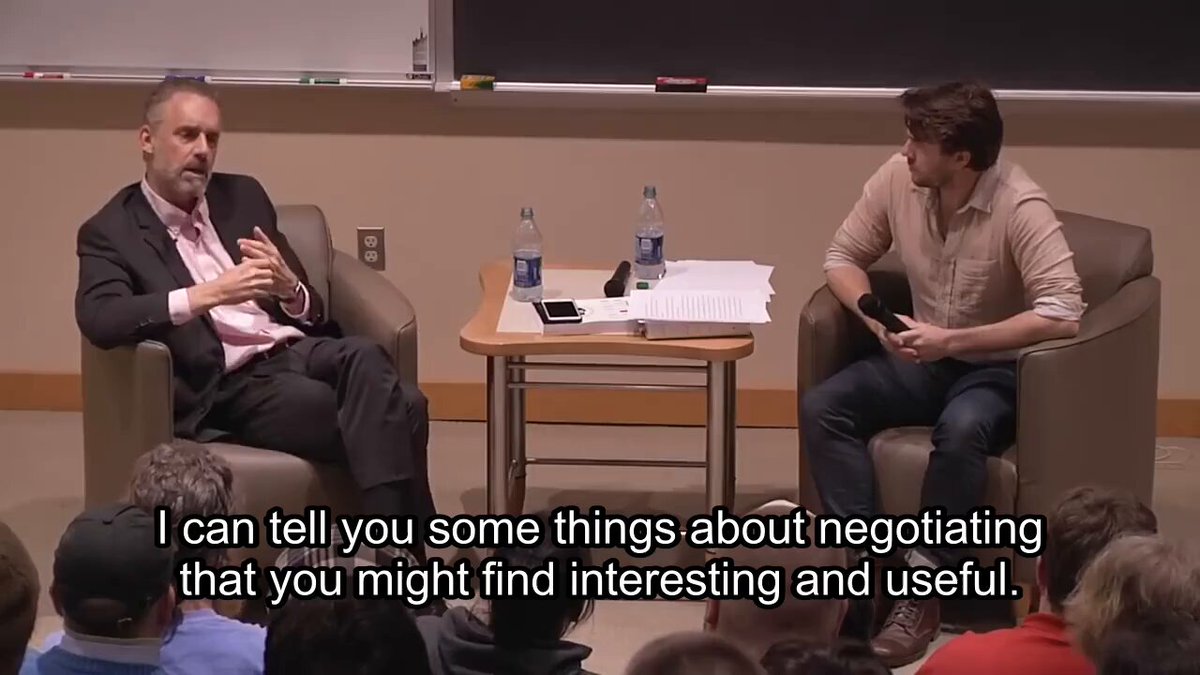
Jordan Peterson: "If you're competent and silent you will be ignored." "You might think well people should reward you because you're competent. And yes of course they should. But if you're competent and silent then you're just part of the background that's keeping everything functioning" On why you cannot negotiate from a position of weakness: "If you want to push your career forward you have to push it forward. You have to be competent and you have to be strategic" "To be strategic when you negotiate for a new position or a new salary you have to be able to say if you don't give me what I want then something you don't like will happen to you" "It's not a physical threat. It's that you have an option" "You have your CV in order. You're educated and competent and desirable to people outside of your immediate job. You're willing to instantly put yourself on the job market" "So that when you go talk to the person you're negotiating with you're credible" On the one thing most people completely miss about negotiation: "It's very seldom that you're talking to the person who's at the top of the pecking order. What you need to do is tell them a story that they can tell to their boss to make you not a problem" "A good story is look we really need this person because they're hyper competent and they have a better offer" "If you go in there with no power you're going to lose. Obviously" He concludes with the one thing every competent person needs to hear: "The first thing you need to know if you're going to negotiate is that you have to be able to say no. And what no means is that you're not going to do it"

Brad

34,669 次观看 • 11 天前