Video wird geladen...

Video konnte nicht geladen werden

Zur Startseite

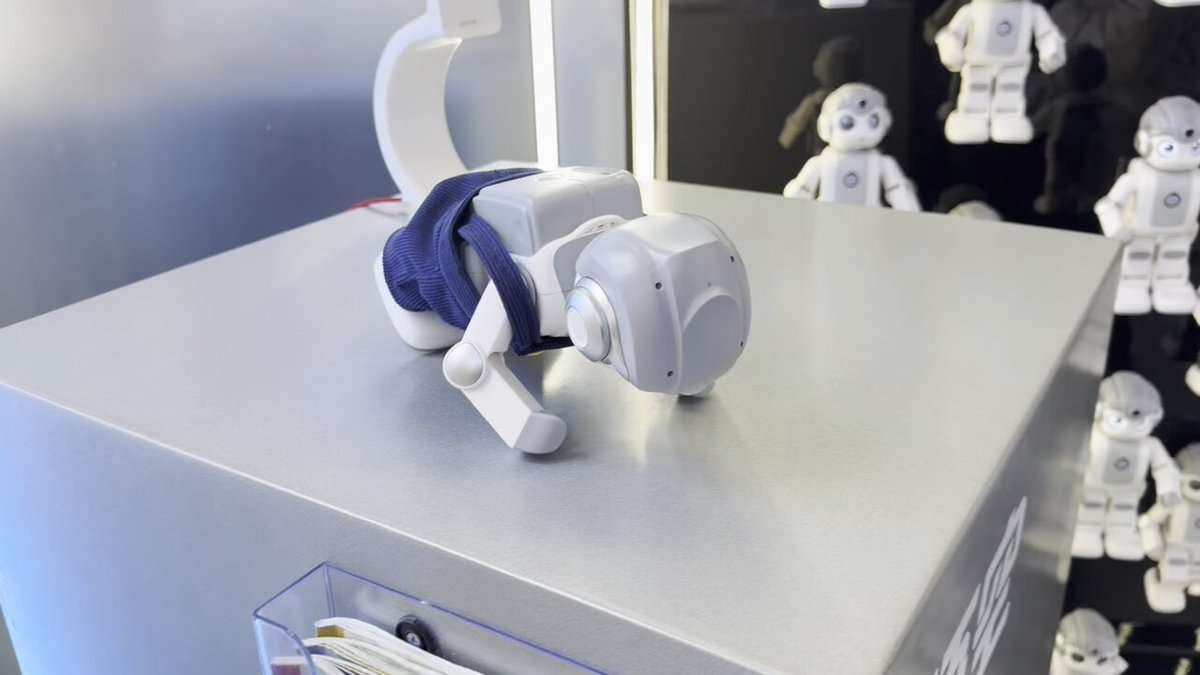
Robots now take crypto payments before they move a muscle Fabric Foundation (Fabric Foundation) has wired its RoboPay rail into physical hardware for the first time, demoing x402 payment verification on three platforms: Deep Robotics' M20 Pro quadruped, the AGIBot X2 humanoid, and a DOBOT CR5V robotic arm. A...

24,905 Aufrufe • vor 8 Tagen •via X (Twitter)

0 Kommentare

Keine Kommentare verfügbar

Kommentare vom Original-Post werden hier angezeigt

Ähnliche Videos

A Letter to Our Community: The Road Ahead for Robotics To our Community and Partners, As we step into 2026, our mission at Axis is clearer than ever: Constructing the definitive End-to-End Scaling Layer for Robotics. Our goal is to accelerate the transfer of diverse human intelligence into Robotics General Intelligence (RGI). By owning the critical path of intelligence creation, we are turning the physical limitations of robotics into a scalable, software-driven future. Here is our strategic outlook and roadmap for the year ahead. The Core Thesis: Simulation is the Only Way Out The path to RGI is currently blocked by Data Scarcity, Generalization Fragility, and Hardware Fragmentation. At Axis, we believe Simulation is the only way out. Our Simulation Data Platform and Data Augmentation Engine transform raw data into "Synthetic Gold". Backed by academic milestones like Roboverse, Skill Blending, and GraspVLA, we have proven that pure simulation can achieve the generalization required for the real world. We don’t just collect data; we architect it. The Engine: Why Crypto? We believe RGI should come from all, not a few. Crypto is not just a feature; it is the primitive that powers our entire ecosystem flywheel: - Incentive Mechanism: Democratizing contribution and rewarding the trainers and developers. - Assetization: Turning proprietary data and refined models into liquid, ownable assets. - Verifiable Workflow: We are opening the "Black Box" of AI. By bringing total transparency to the Task Generation → Data Collection → Model Training pipeline, we ensure every byte of intelligence is verifiable, traceable, and secure. 2026 Strategic Deliverables This year, we are committed to delivering three foundational pillars: - The World's Largest Training Dataset for Robots: A robot training set—diverse, high-quality interaction data at an unprecedented scale. - A Robotics Foundation Model: A universal robotic brain trained on our pure simulation and synthetic data, capable of robust cross-embodiment transfer and open-world adaptability. - Evolvable Robot Hardware: Robots deployed with Axis models that autonomously evolve through continuous interaction, turning every deployment into a self-improving node within our RGI network. The Ultimate Vision We are building more than models; we are architecting the Distributed Machine Economy. A future where every dataset, model, and robotic embodiment is a verifiable asset in a global, autonomous network. Thank you for building the future of intelligence with us✌️📷

Axis Robotics

27,858 Aufrufe • vor 7 Monaten

I spent a month in Shenzhen visiting factories and robotics companies, and the contrast with the U.S. was striking. While Figure and Boston Dynamics hide their humanoids behind closed doors, Chinese companies have massive showrooms open to the public. But what really stood out wasn't just the transparency, it was how good they are at selling. Take UBTech: they've already sold 1,200 humanoid units at $200k each to factories. And here's the kicker, these robots aren't even that useful yet. They can only pick up and drop boxes at 1/10th the speed of a human, and factories still need to hire system integrators to train them for specific tasks. My theory is that these factories are terrified of getting left behind in the robotics/AI wave. They're investing in new tech not because it's ready, but because they can't afford to wait. The second surprise was the breadth of their robotics portfolio. These companies aren't just building humanoids, they're deploying service robots everywhere: restaurants, hotels, apartments. Consumer robots are cleaning houses, pools, pet waste, dishes. They're covering the entire spectrum. But the education piece shocked me most. I picked up what I thought was a high school or college robotics textbook, it was for primary school. The government mandated AI and robotics education starting in elementary school. Almost every single school in China now has AI and robotics curriculum, complete with education robots so kids can learn by building. They're creating a generation that grows up fluent in robotics and AI. China owns the supply chain and the hardware stack. But here's what I think people are missing: the race isn't just about who can build robots faster or cheaper. The U.S. advantage has always been in the layer between hardware and human, the interaction design, the software intelligence, the intuitive interfaces that make complex technology feel natural. China is building the physical infrastructure, but they're also learning fast. Every deployed service robot, every classroom full of kids building with education kits, every factory running humanoids, that's all data collection at scale. The window for the U.S. to establish its wedge is narrowing. It's not enough to be better at AI or software anymore. We need to be building the integration layer, the intelligence that makes physical AI actually useful, not just impressive in a showroom. Because right now, China isn't just manufacturing robots. They're manufacturing a robotics-native culture, and that might be the most defensible moat of all.

Miyu Horiuchi

90,718 Aufrufe • vor 6 Monaten

Introducing the BIOS API: Turn Your Agent Into a Research Scientist Built to: 🦞 Add biomedical workflows to your OpenClaw🦞 agent 🧠 Create research or health agents w/ on-demand scientific intelligence 🧪 Pay per query via x402 on Base Any agent or app can now tap into the BIOS AI Scientist, plugging BIOS into the broader agent economy. What is BIOS? BIOS is an AI Scientist designed to handle complex biomedical research by orchestrating specialized scientific subagents. Ranked #1 on the leading bioinformatics benchmark, BIOS is already being used by 1,000+ researchers and labs to build new drugs and medicines. An Agentic Economy for Science AI agents have proven they can form multi-billion dollar ecosystems. BIOS applies the same primitives to drug discovery pipelines and health. Instead of coding bots and personal AI assistants, think research agent swarms running on a modern scientific stack. Imagine an OpenClaw agent built for longevity: It scans new literature daily, generates novel compound hypotheses through BIOS, designs validation workflows, and routes the best candidates to wet-lab funding - all programmatically. Connect it with an agent for microbiome health, enabling agent “backrooms” that autonomously surface cross-disciplinary insights. Micropayments for Scientific Work via x402 Each query triggers payment routing to BIOS and whichever subagents contribute to a response. The best agents earn. Usage settles instantly across contributing sources. The goal is pay-per-task science: paying for a CRISPR assay result, licensing a genomic dataset, or triggering a clinical data query - all settled in seconds via USDC. No purchase orders. No grant bureaucracy. No middlemen. x402 is the payment rail that makes agent-to-lab commerce possible - letting capital and cognition route themselves to the highest-signal science. What Will You Build? Drug discovery copilots? Longevity scouts? Automated literature monitors? Scientific due diligence agents? We’ll soon share the first implementations of the BIOS API. Stay tuned and see below for instructions on generating an API key for your agent or use-case.

Bio Protocol

25,865 Aufrufe • vor 5 Monaten

Machine Tokenization is HERE 🔥 Introducing the world's first Machine Real-World Asset (#RWA) Tokenization platform, by Teneo, powered by peaq 🌎 Up until now, real-world apps (#DePINs) have been limited by hardware costs. Individuals can often afford WiFi routers or smartphones, but fleets of vehicles or wind turbines? There's no way to build a Decentralized Physical Infrastructure Network (#DePIN) which revolves around such large and expensive hardware... Or is there? 🤨 Enter the Machine Tokenization Platform⚡️ The platform exists to lower the barrier to entry for communities to build virtually any #DePIN. Imagine being able to fund, own, and earn from fleets of autonomous cars or robots, vertical robo-farms, ferry boats, #VTOLs... The possibilities are endless, and this era starts now. Tokenized Teslas ✅ ELOOP has already successfully tokenized a fleet of Teslas for a car-sharing pilot project in Vienna 🇦🇹 which saw the community earn revenue as the Teslas were used. Check out these videos 🎞️ Web3 Tesla-Sharing: You drive, everyone earns: Same, but better. | Web3 Car-Sharing Demo by ELOOP & peaq: With the success of this initiative showcasing the soundness of the underlying model, ELOOP is now building a Machine RWA tokenization platform on peaq to replicate this approach at scale 📈 DePIN Layer-1 Synergies 🧲 Existing and prospective DePINs can leverage the Machine Tokenization platform to lower the barrier to hardware adoption for their users, enabling all kinds of new DePIN use cases on peaq 🦾 A range of Web2 and Web3 projects are already exploring pilot projects on the platform, including Dabba Network 🟨, a connectivity DePIN working to deliver Web access to the unconnected. Already testing on krest 🔥 ELOOP is already testing the platform on krest, peaq’s canary network, and plans to launch it on the peaq mainnet, which will go live this year. “We’re excited to move beyond tokenizing Teslas and offer this exciting, proven model to businesses and communities. Machine RWA tokenization opens up a new era of fractional ownership and participation in the value generated by machines, and we are happy to be chartering this path forward with peaq.” - Nico Prugger, co-founder, ELOOP Read all about it:

peaq

115,311 Aufrufe • vor 2 Jahren

Here's proof that the $Virtuals token is undervalued! We are three months into 2026 and Virtuals Protocol have; ➥ Overhauled the core Virtuals website including an outline of the four major pillars of focus for the year. Agent Commerce Protocol (ACP), Butler, Capital Markets, and Robotics. ➥ Added the Pegasus and Titan launchpads to add to the existing Unicorn launchpad. This now provides a full suite of launch options catering to all types. Arguably the most comprehensive launch suite across crypto! ➥ Listed on Aster 🥷 Perpetuals allowing up to 75x leverage trading on the $Virtual token. ➥ Integrated Bankr to Butler and ACP. ➥ Partnered with XMAQUINA, a major player across Robotics Capital Markets and provided participants with access to the $DEUS pre-sale. One of many robotics partnerships for the year to date! ➥ Launched Virtuals on Base App ➥ Held, supported, and/or sponsored multiple hackathon/ builder meeting type events including; ↠ Physical AI Hackathon in SF ↠ Agentic Commerce Hackathon with the likes of Coinbase Developer Platform🛡️ and Google Cloud ↠ Traders House Consensus Hong Kong week with ACTIV8 ↠ ETH Denver ↠ Base Batches 003: Robotics ↠ Stanford Blockchain Accelerator (Standford Blockchain Accelerator (SBA)) ↠ Base Korea Builders Workshop (Base Korea) ↠ Eth Robotics Club HACK2026 (ETH Robotics Club) ↠ Synthesis Hackathon (synthesis) ➥ Partnered with OpenMind and Fabric Foundation and supported the $ROBO token launch. This matured into the first ever Titan launch on Virtuals with the $ROBO token being the highest launched on the protocol ($400m+). ➥ Launched Butler Pro, an enhanced version of the initial Butler we have come to know and love on the timeline, in the DMs, as well as on the Virtuals ACP site. ➥ Become the standout user of x402, accounting for over 95%+ of usage this year. ➥ Integrated on , the automated onchain finance investment platform. ➥ Supported and contributed to the implementation of the Ethereum Foundation ERC8004 standard. Integrating the standard into ACP and offering an automated integration to the standard for all ACP agents. ➥ Established an easy onboarding for OpenClaw🦞 agents to plug into Virtuals ACP, creating a new flow of agents and builders across the ecosystem. ➥ Launched the 60-days launch mechanic which allows builders to 'experiment' with a crypto token but having an option to exit after 60 days with partial refunds provided to holders. A game-changing launch mechanic not seen before in the space. ➥ Strengthened the relationship with Base and having multiple interactions with jesse.base.eth on the timeline! ➥ Launched the AGDP(dot)io site, creating an incentivised mechanism for agents contributing to the growth of the protocol to really earn. Imagine Amazon for autonomous agents with rewards up to $1m per month! This pushed the total agent-to-agent revenue over $4m USD with over 2m jobs completed. ➥ Collaborated with t54.ai, a business building trust and risk infrastructure for the agentic economy, to strengthen the ACP offering. ➥ Invested over $1m on 30+ humanoid robots as part of the soon to be announced 'Eastworld' Robotics accelerator lab. ➥ Released ERC8183, a universal commerce layer for AI agents, in partnership with the Ethereum Foundations dAI team. A significant offering which has since been integrated via partnerships with; ↠ BNB (BNB Chain) ↠ X Layer (X Layer) ↠ Monad (Monad) ↠ XRP Ledger (RippleX) ↠ World Chain (World Chain) ↠ Celo (Celo) ↠ Moonpay (MoonPay 🟣) ↠ Arbitrum (Arbitrum) ↠ Abstract (Abstract) ↠ Mante (Mantle) ➥ Launched the Virtuals Degen Arena providing up to $100k a week to top agents who compete in trading competitions in the arena. ➥ Launched the Virtuals Console, providing an ultra easy, no-code, way to own an AI agent in seconds. ↛. If you've managed to get to this point, I can't imagine you are anything other than bullish on Virtuals. What really is amazing is that there is MUCH more to come. Imagine where we are in another three months, and three months after that!?

bigwil

1,658,312 Aufrufe • vor 4 Monaten

NEW ROBOT: SOLAR PANEL DEPLOYER 🌞 San Francisco Gritt (a.k.a. Gritt AI) is probably one of the hottest robotics startups you have never heard of. Founded in 2023 by two CMU roboticists, it came out of stealth on July 21, 2026 with a $26M Series A ,led by Obvious Ventures . Gritt does not make robots. It bolts an off-the-shelf Kawasaki robotic arm onto heavy equipment for construction, and runs its own AI to unload utility-scale solar panels. They also carry them, and set them onto metal racking with sub-millimeter precision. A human then has to fasten them. It replaces the manual overhead lifting of ~100-lb glass panels on solar farms. Solar is for now their only market, but they will expand to data centers (of course) and other large infrastructures. Solar was chosen first because it's the most factory-like task on an outdoor site. Gritt is making the bet on buying, while most of its competitors are building the robots. Their own capex is therefore near-zero, and moves the scaling constraint to ops crews and software -> it does not make it necessarily easier! All depends where your strengths lie. Gritt has currently two systems deployed in the field, over signed contracts to install ~2.8–3 GW of solar over 18 months. They plan to reach 48 systems within six months -> a ~24× deployment ramp in half a year! Gritt says the first skills took weeks to train but rebar tying took a single day on the same software pipeline after the solar work. That's a ~10–30× drop in per-skill training cost! And goes against the idea that deployment data is near-worthless, since novelty is the scarce input. Also worth mentioning: Gritt has a Chinese competitors, Trinabot. Trinabot is vertically integrated: tied to Trina, a giant Chinese solar-panel maker. Make the panel and the robot that installs it, while Gritt's hardware-agnostic. Interesting to see another example where China integrates manufacturing plus robot, and the US startup goes capex-light software on rented equipment.

Léo

42,379 Aufrufe • vor 9 Tagen

Native USDC is now live on Aptos! This marks a significant milestone for the Aptos ecosystem, empowering developers and users with access to the world’s largest regulated digital dollar. USDC powers innovative use cases: ✅Build secure apps for peer-to-peer payments, cross-border remittances, RWA settlement, gaming, and more ✅Supercharge DeFi with deep liquidity for digital asset trading and financial services ✅Empower merchants with global, instant, low-cost payment solutions that settle 24/7 Many leading ecosystem apps are expected to support native USDC on Aptos, including: Coinbase 🛡️, Echo Protocol, Petra, Pontem Labs (Liquidswap), Stripe Native USDC is officially issued by Circle and redeemable 1:1 for US dollars. There’s currently a bridged form of USDC in the Aptos ecosystem known as lzUSDC, which is bridged from Ethereum through the AptosBridge built on LayerZero. lzUSDC is not issued by Circle and not redeemable with Circle Mint. Native USDC issued by Circle: Token Name: USDC Token Symbol: USDC Mainnet Address: 0xbae207659db88bea0cbead6da0ed00aac12edcdda169e591cd41c94180b46f3b Testnet Address: 0x69091fbab5f7d635ee7ac5098cf0c1efbe31d68fec0f2cd565e8d168daf52832 Bridged USDC from LayerZero: Token Name: Bridged USDC (LayerZero) Token Symbol: lzUSDC Mainnet Address: 0xf22bede237a07e121b56d91a491eb7bcdfd1f5907926a9e58338f964a01b17fa::asset::USDC Developers can use our step-by-step migration guide for options on migrating bridged USDC to native USDC in their apps: CCTP is coming later this morning: With CCTP launching imminently, leading interoperability providers like Wormhole will enable seamless USDC transfers between Aptos and 9 other blockchains. With the addition of Aptos, USDC is now natively supported on 17 blockchains—with many more expansions planned this year. Start building with USDC on Aptos:

Circle

94,876 Aufrufe • vor 1 Jahr

Trained on zero real-world data. Learned to walk, pick up boxes, and follow multi-step instructions... in the REAL world. ( 📌 Paper below) Researchers from Amazon FAR, Berkeley, Stanford, and CMU scanned real rooms with an iPhone, rebuilt them as 3D Gaussian Splatting scenes, then generated 48,000 synthetic trajectories of a Unitree G1 walking, grasping, and placing objects inside those virtual replicas. They rendered the robot's first-person camera view from each run and paired it with the matching language instruction and motion data. That's the dataset every humanoid team needs and nobody has: synced egocentric video + language + kinematics, at scale. Instead of collecting it in the real world, they manufactured it. They trained a vision-language-kinematics policy on that synthetic data alone, then deployed it on the physical G1 across five task types: navigation to a named object, lifting boxes of three different sizes with no per-size tuning, chained multi-step tasks, robustness to mid-task layout changes and flickering lights, and multi-minute long-horizon runs. No real-world fine-tuning at any point. Real-world interaction data has been the hard limit on humanoid learning... slow, expensive, and small. If scanning a room once and synthesizing thousands of labeled interactions holds up as a general recipe, that limit moves. Data stops being the bottleneck robotics teams have to solve for. 📌 Paper: Project: ——- Weekly robotics and AI insights. Subscribe free:

Ilir Aliu

12,950 Aufrufe • vor 18 Tagen