Video wird geladen...

Video konnte nicht geladen werden

Zur Startseite

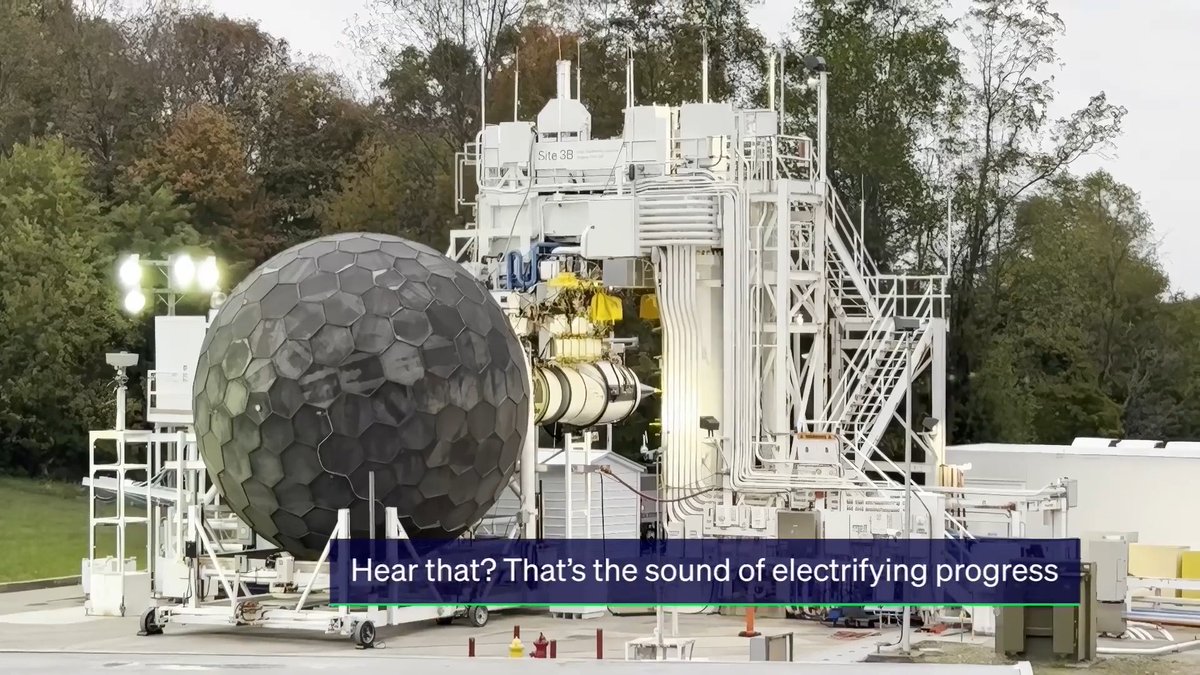
🚨 ROLLS-ROYCE JUST RAN A JET ENGINE ON 100% HYDROGEN AND IT REACHED FULL TAKE-OFF POWER. In a landmark test, a Rolls-Royce jet engine successfully operated at full thrust using only hydrogen fuel for the first time in history. The engine was tested across a complete simulated flight cycle,...

243,303 Aufrufe • vor 2 Monaten •via X (Twitter)

0 Kommentare

Keine Kommentare verfügbar

Kommentare vom Original-Post werden hier angezeigt

Ähnliche Videos
Is Using a Nebulizer with Food Grade Hydrogen Peroxide preventive and healing for upper respiratory symptoms? The earlier you get this in the better, so if you start feeling run down or stuffy take action sooner. ***THIS IS NOT MEDICAL ADVICE. Not only can nebulizing save you money, but also time from healing and potentially from the damage/side effects that antibiotics can have. I used a nasal mist sprayer with a 50/50 mix of 3% HP to distilled water and ate raw chopped garlic too when I had pneumonia and I relieved congestion, coughing or anything chest related. Just aches and pains. I’m all about prevention and using natural medicines first! “The inhalation of HP by nebulization has been shown to be extremely effective for the rapid elimination of any pathogen presence in the sinuses, nose, throat, and deep into the lungs.” -Dr. Levy HOW TO PREPARE HYDROGEN PEROXIDE FOR NEBULIZING 1. Add 2 tsp of 3% food grade hydrogen peroxide to 8 oz of saline water (this makes.1% dilution), if you are starting with 12% hydrogen peroxide, add 1/2 tsp to 8 oz of saline water. 2. Transfer this mix to a glass dropper bottle. 3. Use about 2-3 mL or (1/2 tsp) of this mix for each nebulizing session. 4. You can keep this solution refrigerated for a long time and continue to reuse it. Praying for your health and abundance of goodness 🙌🏼
0:12

Sensitive content

Is Using a Nebulizer with Food Grade Hydrogen Peroxide preventive and healing for upper respiratory symptoms? The earlier you get this in the better, so if you start feeling run down or stuffy take action sooner. ***THIS IS NOT MEDICAL ADVICE. Not only can nebulizing save you money, but also time from healing and potentially from the damage/side effects that antibiotics can have. I used a nasal mist sprayer with a 50/50 mix of 3% HP to distilled water and ate raw chopped garlic too when I had pneumonia and I relieved congestion, coughing or anything chest related. Just aches and pains. I’m all about prevention and using natural medicines first! “The inhalation of HP by nebulization has been shown to be extremely effective for the rapid elimination of any pathogen presence in the sinuses, nose, throat, and deep into the lungs.” -Dr. Levy HOW TO PREPARE HYDROGEN PEROXIDE FOR NEBULIZING 1. Add 2 tsp of 3% food grade hydrogen peroxide to 8 oz of saline water (this makes.1% dilution), if you are starting with 12% hydrogen peroxide, add 1/2 tsp to 8 oz of saline water. 2. Transfer this mix to a glass dropper bottle. 3. Use about 2-3 mL or (1/2 tsp) of this mix for each nebulizing session. 4. You can keep this solution refrigerated for a long time and continue to reuse it. Praying for your health and abundance of goodness 🙌🏼

Cleanse Parasites .com 🧹🪱 Herbal Cleanse Co.

46,711 Aufrufe • vor 4 Monaten

:Scientists Capture the Birth of Water, Atom by AtomFor the first time ever, researchers have directly observed hydrogen and oxygen atoms combining in real time to form tiny nanoscale bubbles of water—essentially witnessing one of chemistry’s most fundamental reactions at the molecular early 2024, a team from Northwestern University unveiled a groundbreaking imaging technique that traps gas molecules inside tiny, honeycomb-shaped nanoreactors sealed by ultra-thin glassy membranes. This innovation allows scientists to observe chemical processes in real time using high-vacuum transmission electron microscopes, something previously impossible for gaseous reactions.The team, led by Professor Vinayak Dravid and including first author Yukun Liu, turned their attention to a century-old puzzle: how palladium—a rare metallic element—acts as a powerful catalyst to rapidly combine hydrogen and oxygen into water As Yukun Liu explained: “It’s a known phenomenon, but it was never fully understood. You really need both direct visualization of the reaction and atomic-level structural analysis to figure out exactly what’s happening.”What they saw was astonishing.Using their nanoreactor platform, the researchers watched hydrogen atoms diffuse into a palladium nanocube, causing its crystal lattice to expand slightly. Then, when oxygen was introduced, the gases reacted at the surface. Suddenly, tiny water bubbles began to nucleate and grow right before their eyes on the palladium surface.“We think it might be the smallest bubble ever formed that has been directly viewed,” said Liu. “It’s not what we were expecting. Luckily, we were recording it—so we could prove to others that we weren’t crazy.” The bubbles were confirmed to be water using electron energy-loss spectroscopy and heating experiments. Remarkably, the reaction occurs efficiently at room temperature, and palladium itself is recyclable—it doesn’t get consumed in the process. The order in which the gases are introduced also plays a key role in the speed of water formation.This direct, atomic-scale observation not only solves a long-standing mystery in catalysis but could also inspire new technologies: from more efficient ways to generate clean water in remote or arid environments to improved hydrogen fuel cells and even systems for producing water in space.What once seemed like “water from thin air” is now literally visible—captured in stunning detail at the nanoscale. This breakthrough highlights how advanced imaging tools are unlocking secrets of matter that have remained hidden for generations.The study was published in the Proceedings of the National Academy of Sciences (PNAS) in 2024.

Black Hole

31,895 Aufrufe • vor 4 Monaten

Jet Fuel is a fascinating story. We don’t measure it in litres, we measure it in weight, because fuel expands/contracts with temperature while weight stays constant. Jet fuel’s specific gravity is ~0.8, so 1 litre ≈ 0.8 kg (lighter than water). It’s also worth noting that jet fuel is essentially a highly refined kerosene, far less volatile than gasoline, which makes it safer to handle in large quantities. On a long-haul, fuel can be close to half the aircraft’s total weight at departure. On the A350-1000, that can be ~129 tonnes. At most major international airports, this much fuel doesn’t turn up in a tanker. It’s stored in a depot and delivered through a network of underground hydrant pipes to each stand. The “tanker” you see is really a pump truck connecting the hydrant to the aircraft and metering the exact uplift. When I moved from the A340-600 to the A350-1000, one of the things that struck me most was just how much simpler and smarter the fuel system became and how much less fuel we required for the same journeys. On the A340-600, we needed a rear trim tank in the tail to keep the aircraft in balance during cruise. It worked beautifully, but it added complexity. The A350 doesn’t need that, instead, it uses tiny fractions of flap in cruise, together with the latest wing aerodynamics, to keep perfectly in trim. London → New York comparison (typical figures): - A340-600: ~80–90 tonnes of trip fuel - A350-1000: ~50–60 tonnes of trip fuel That’s roughly 30–40% less fuel, saving ~25–30 tonnes on a single flight, which also means about 80–95 tonnes less CO₂ (rule of thumb: 1 tonne of jet fuel ≈ 3.16 tonnes CO₂) 📸 by ig/captainchris

aircraftmaintenancengineer

509,361 Aufrufe • vor 1 Jahr

NEWS: SpaceX has released a statement after today's successful 11th Starship test flight. "Every major objective of the flight test was achieved, providing valuable data as we prepare the next generation of Starship and Super Heavy. The flight test began with Super Heavy igniting all 33 Raptor engines and ascending over the Gulf. The successful first-stage ascent was followed by a hot-staging maneuver, with Starship’s upper stage igniting its six Raptor engines to continue its flight to space. Following stage separation, the Super Heavy booster completed its boostback burn to put it on a course to a pre-planned splashdown zone off the coast of Texas using 12 of the 13 planned engines. Under the same angle of attack tested on the previous flight, the booster descended until successfully igniting all 13 planned engines (including one that did not relight during the boostback burn) for the high-thrust portion of the landing burn. The booster successfully executed a unique landing burn planned for use on the next generation booster. Super Heavy hovered above the water before shutting down its engines and splashing down. After completing a full-duration ascent burn, Starship achieved its planned velocity and trajectory. During flight, Starship successfully deployed eight Starlink simulators and executed the third in-space relight of a Raptor engine, demonstrating a critical capability for future deorbit burns. Starship re-entered the Earth’s atmosphere and was able to gather extensive data on the performance of its heatshield as it was intentionally stressed to test the limits of the vehicle’s capabilities. In the final minutes of flight, Starship performed a dynamic banking maneuver to mimic the trajectory that future missions returning to Starbase will fly. Starship then guided itself using its four flaps to the pre-planned splashdown zone in the Indian Ocean, successfully executing a landing flip, landing burn, and soft splashdown. Focus now turns to the next generation of Starship and Super Heavy, with multiple vehicles currently in active build and preparing for tests. This next iteration will be used for the first Starship orbital flights, operational payload missions, propellant transfer, and more as we iterate to a fully and rapidly reusable vehicle with service to Earth orbit, the Moon, Mars, and beyond."

Sawyer Merritt

273,302 Aufrufe • vor 10 Monaten

A Change of Plan…🌍 A little insight into the realities of airline flying: sometimes the route you see on your flight tracker isn’t the one we originally planned. That’s because flight planning is a mix of science, safety, and flexibility. 🌐 One reason for changes is ATC flow management. Think of it like traffic lights in the sky, with thousands of aircraft moving through shared corridors, air traffic control sometimes adjusts our routes to keep the system flowing smoothly and safely. But today’s change wasn’t about traffic. It was about performance planning. Departing Delhi, our A350 was heavy with fuel and passengers, and the original routing led straight into an area of very high terrain. With a twin-engine aircraft, we always consider the “what if”: if one engine were to fail, how would the aircraft perform? Safety means ensuring we can still fly clear of terrain even under those conditions. That’s where ETOPS (Extended-range Twin-engine Operations) and drift down procedures come in. ETOPS rules let two-engine aircraft fly long oceanic and remote routes, but only with strict planning to guarantee diversion options. Drift down is the scenario where, after losing one engine, we calculate how the aircraft can descend to a level where it can safely continue flight and clear terrain. These are baked into every flight plan, and sometimes, the numbers don’t add up and they mean taking the longer way around. So today, instead of climbing northwest out of India, we turned south. The routing took us over Oman and the UAE, up the length of the Gulf, across Iraq, and back into our original track over western Turkey. That’s also where we passed one of my favourite places: the airfield named Batman 🦇. 👨‍✈️ It’s a great reminder that flying isn’t just point-to-point. Every route is carefully designed with safety, performance, and the flow of global air traffic in mind. It also means that we had a great opportunity to get some air-to-air pics of other aircraft. Will share these during the week 🙌🏻 #AvGeek #PilotLife #AirbusA350 #FlightDeckLife #ETOPS #FlightOps #AirlinePilot #AviationSafety #ProfessionalPilot #FromTheFlightDeck #FlyingTheWorld #SingleEngineDriftDown #AviationDaily #AvgeekCommunity #SkyHighViews

Scott Bateman MBE

33,219 Aufrufe • vor 11 Monaten

More Batteries vs. Submarines Now that the German TKMS and the French Naval Group have massively adopted lithium-ion batteries, following the Japanese lead, this is consolidating as a major trend, just as I had predicted. The next stage will be solid-state batteries, and at that point, we'll essentially be discussing only speed and submerged endurance in comparison to nuclear submarines. Since solid-state batteries are lighter, they will allow for a greater number to be installed, freeing up space for more powerful propulsion systems. Naval Group has already sold a version of the Scorpène to Indonesia capable of remaining submerged for up to 80 days. That's with lithium-ion batteries. Imagine what this could exceed, more than double, with solid-state batteries. In practical terms, a more powerful engine combined with solid-state batteries in the proportions that Naval Group is now using in the Scorpène would provide three times the speed, meaning something like 10–15 knots at constant speed while maintaining around 50 days submerged. This would give a range of 40,000–50,000 km, requiring less than one hour on the surface for a fast recharge. For speeds above 25 knots, simply adding more batteries and a better engine would suffice, as the solid-state system has high power output. All this at 15–20% of the cost of a nuclear submarine. And if the choice is to power the batteries with a micro-reactor, it would cost 25–35% of a conventional nuclear one. Then someone will say: “But a nuclear sub can stay submerged for years.” That makes no difference at all, since even with around 60 days of endurance, the crew still needs to surface to resupply provisions. The big advantages remain: battery-powered subs are superior in silence, and speed can be addressed with larger battery packs.

Patricia Marins

103,224 Aufrufe • vor 8 Monaten

Breaking: Hubble Telescope Opens a "Window" into the Dark Universe — First-Ever Detection of a Starless Dark Matter Cloud! In a groundbreaking discovery announced by NASA, the Hubble Space Telescope has revealed an entirely new class of cosmic object: a vast, starless cloud dominated by dark matter, rich in gas but completely devoid of stars. Nicknamed Cloud-9, this enigmatic structure lies about 14 million light-years away, on the outskirts of the spiral galaxy Messier 94 (M94).This is the first confirmed observation of such a "failed galaxy" or relic from the early universe — a massive dark matter halo that gathered hydrogen gas but never triggered star formation. Hubble's deep imaging ruled out any hidden faint stars, confirming it's truly dark and star-free.Key highlights from the discovery:Massive dark matter core — estimated at around 5 billion solar masses, anchoring a compact reservoir of gas. A cosmic fossil — likely a survivor from the universe's infancy, halted during reionization (when the first stars and galaxies lit up and ionized surrounding gas). Implications — This "phantom" object provides direct evidence for the existence of low-mass dark matter halos that never evolved into full galaxies. It suggests the universe could be filled with similar invisible structures, offering a major boost to our understanding of dark matter and galaxy formation. For decades, theorists predicted these "dark galaxies" or RELHICs (Reionization-Limited Hydrogen Clouds), but Cloud-9 marks the first solid proof caught in the act.Scientists are buzzing — this rare "wow" moment could rewrite parts of cosmic history and hint at countless other hidden building blocks of the universe lurking in the shadows.(Source: NASA/ESA Hubble release, January

Black Hole

10,676 Aufrufe • vor 7 Monaten