Video wird geladen...

Video konnte nicht geladen werden

Zur Startseite

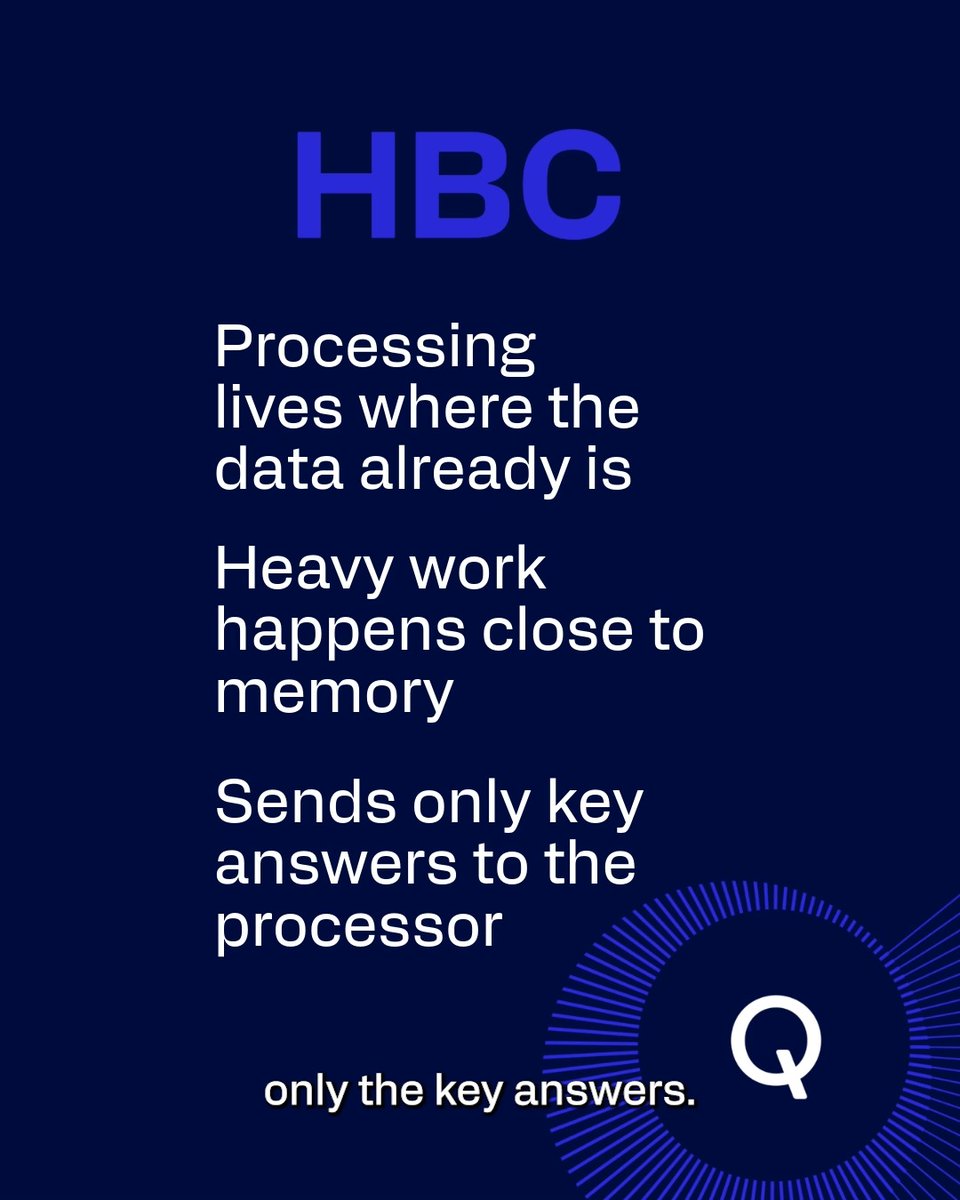
Running a single deep coding model at max context on Cerebras requires 24 systems ($24M Capex) just to support 256 concurrent users. At that scale, $100M gets you way more memory bandwidth in standard GB300 racks.

93,448 Aufrufe • vor 5 Monaten •via X (Twitter)

0 Kommentare

Keine Kommentare verfügbar

Kommentare vom Original-Post werden hier angezeigt

Ähnliche Videos

Etched is deploying two new technologies in chip design: low-voltage inference and cluster-scale memory. CEO Gavin Uberti says they'll make their chips much more power-efficient and way, way faster than today's leading GPUs. He breaks it down: "We looked at a lot of early research directions, and we realized the key things that models need are way more compute and way faster memory." "If you think about inference, there are two key parts: prefill and decode. For prefill, it's a compute-bound problem. You need to have more FLOPS, more operations per second on each of your chips." "On our GPU, the bottleneck's actually thermals. You can't really run a GPU at more than around 50% of what it could theoretically do, or it'll melt." "So we're using a new technology today called low-voltage inference to try to solve this problem. You bring the voltage of the chip down dramatically, which allows us to have way, way better efficiency in terms of how much power is drawn per unit of math, and thus fit way way more flops onto the chip..." "For decode, it's all about bandwidth. Not just bandwidth on a chip, but bandwidth across your cluster. That's why we have this technology we call cluster-scale memory. It reduces the amount of time it takes to communicate from one chip to another dramatically." "As a result we can go use all of our HBM, HBM bandwidth, SRAM, SRAM bandwidth, and our scale-up domain as a single coherent pool. And that means if you're a user, you can go get much faster tokens per second, while still keeping your costs low."

TBPN

20,404 Aufrufe • vor 4 Monaten

Cerebras just IPO’d and the stock already ran up over 100% (Save this). For the entire 70 year history of the semiconductor industry, every company on earth has followed the same process. You take a dinner plate sized silicon wafer, put hundreds of tiny chips onto it, and dice it up like a pizza. Nvidia does it this way, AMD does it this way, Intel has done it this way for six decades and everyone who tried to break that convention failed. Until Cerebras asked the most annoyingly obvious question in the industry’s history, what if you just didn’t cut it? The result is the Wafer Scale Engine, a single chip 56 times larger than Nvidia’s H100 and it fundamentally changes the physics of how AI inference works. The reason this matters is not the size, it’s the bandwidth. Every time an AI model generates a single word, it has to reach into memory, pull weights, multiply them together, and produce a prediction and when you’re running millions of concurrent sessions at once, the bottleneck is not raw processing power but how fast data moves between memory and compute. Nvidia’s H100 moves data at roughly 3 terabytes per second, while Cerebras’ WSE-3 moves data at 21 petabytes per second, roughly 7,000 times faster because memory and compute live on the same enormous piece of silicon and data barely has to travel at all. That gap is exactly why OpenAI went from 150 tokens per second on traditional GPUs to 2,000 tokens per second on Cerebras hardware, and why AWS integrated Cerebras into Bedrock to deliver roughly 5x more inference capacity in the same physical footprint. The macro setup is making the trade even more urgent. South Korea DRAM export prices recently jumped 35%, flash memory surged 47%, and SSD pricing spiked nearly 140% and every single one of those increases hits Nvidia-based infrastructure directly, because the H100 requires 80GB of the most expensive, most contested memory in the AI supply chain. Cerebras’ WSE-3 uses zero external HBM memory, baking 44GB of SRAM directly into the wafer itself which means as memory pricing goes parabolic, every CFO evaluating AI infrastructure is suddenly looking much more seriously at the architecture that sidesteps that cost entirely. The demand is already showing up in the backlog. Cerebras ended 2025 with $24.6 billion in remaining performance obligations for a company doing just over $500 million in annual revenue, that is a number that implies years of contracted growth already sitting on the books. The IPO was 20x oversubscribed, the price range was raised twice before listing, and shares opened 89% above their listing price on a $5.55 billion raise that made it the largest semiconductor IPO in history. The risks are real and worth naming. 86% of 2025 revenue came from two entities with UAE ties, U.S. revenue actually fell 34% to $187 million, and the $20 billion OpenAI contract is conditional, if Cerebras misses delivery milestones, OpenAI can terminate and trigger repayment demands on a $1 billion loan facility. And yet the market is valuing Cerebras at roughly 91x trailing revenue, richer than Nvidia, AMD, and Arm combined. What investors are betting on is not that Cerebras beats Nvidia, it is that the inference supercycle is large enough to support an entirely different architecture optimized for a different workload, and that $24.6 billion in contracted backlog converts to diversified revenue before the market starts asking harder questions. CEO Andrew Feldman said this took a decade of late nights to get right, everyone who tried to copy it failed and given that the entire inference economy is now running through exactly the bottleneck Cerebras was built to eliminate, the market is starting to believe him.

Milk Road AI

30,441 Aufrufe • vor 5 Monaten

Qwen3.8-27B running at full BF16 on a free Kaggle TPU is kind of ridiculous. No quantization. No tiny context window. No expensive GPU instance. Just Qwen3.8-27B running on a Kaggle TPU v5e-8. The reported numbers: ~130 tok/s decode ~10,000 tok/s prefill 262K context That prefill number is especially wild. You can throw a huge amount of code or context at the model and ingest it extremely quickly, while still getting around 130 tokens per second during generation. And because it’s running in full BF16, you’re not relying on an aggressive quant just to make the model fit. But the really interesting part isn’t even the raw throughput. You can expose it as an OpenAI-compatible endpoint. That means you can plug the model into tools that already understand OpenAI-style APIs. Claude Code. Codex. OpenCode. And other compatible clients. So the workflow becomes pretty simple: Spin up the Qwen3.8-27B endpoint on Kaggle. Point your coding tool at the API. And suddenly you have a 27B coding model sitting behind the same interface you’d normally use for hosted models. The 262K context is also a huge deal for agentic coding. Large repositories can fit into a single context. Long conversations don’t need to be constantly trimmed. And tools can feed much more information back to the model without hitting a tiny context ceiling. The fact that this can be built around a free TPU environment is what makes this especially interesting. We’re getting to a point where experimenting with serious open models doesn’t always require owning a $2,000 GPU or paying for a large cloud instance. Free compute + open weights + an OpenAI-compatible API + existing coding agents. That’s a pretty powerful combination. Qwen3.8-27B is already an interesting model. Running the full BF16 version at ~130 tok/s with 262K context on free Kaggle TPU compute makes it a lot more interesting.

FHILY👑

36,136 Aufrufe • vor 1 Monat

Qwen3.8-Flash-Next is still going strong at 364.7K tokens of context on an M5 Max. And this isn’t just a static long-context test. The model was reasoning about how to speed up its own workflow while using tools, and the tool calls kept working without misses. Setup: • Qwen3.8-Flash-Next • M5 Max • 128GB unified memory • MLX-Serve PR #363 • OpenCode 2 • 364.7K context The interesting part isn’t simply getting hundreds of thousands of tokens into memory. It’s what happens once the context gets this large. Long-context inference usually comes with a painful tradeoff. As the KV cache grows, memory pressure increases and generation can slow down. But this setup is still pushing through 364K tokens while maintaining a usable agent workflow. The model can reason, call tools, inspect results, continue working, and keep the session moving. And the tool calls reportedly haven’t missed so far. That’s important for agentic coding. A huge context window is only useful if the model can actually operate reliably inside it. A 400K-token context that constantly breaks tool calls isn’t very useful. A 364K session that can keep reasoning and executing tools is a different story. And the test isn’t finished yet. The current run is approaching 400K tokens, with the expectation that it can keep going. This is also another interesting example of why Apple Silicon keeps showing up in local LLM experiments. The M5 Max’s unified memory gives a large model and its growing KV cache access to one shared memory pool. With MLX-Serve continuing to improve, these machines are becoming surprisingly capable long-context inference boxes. The bigger takeaway: Context length is becoming a workload, not just a model specification. Running a model at 256K is one thing. Keeping an agent alive at 300K+ while it reasons and uses tools is much more interesting. And Qwen3.8-Flash-Next is showing that this can be pushed surprisingly far on a single 128GB Mac. 364.7K and counting. Next stop: 400K.

FHILY👑

39,982 Aufrufe • vor 1 Monat