Video wird geladen...

Video konnte nicht geladen werden

Zur Startseite

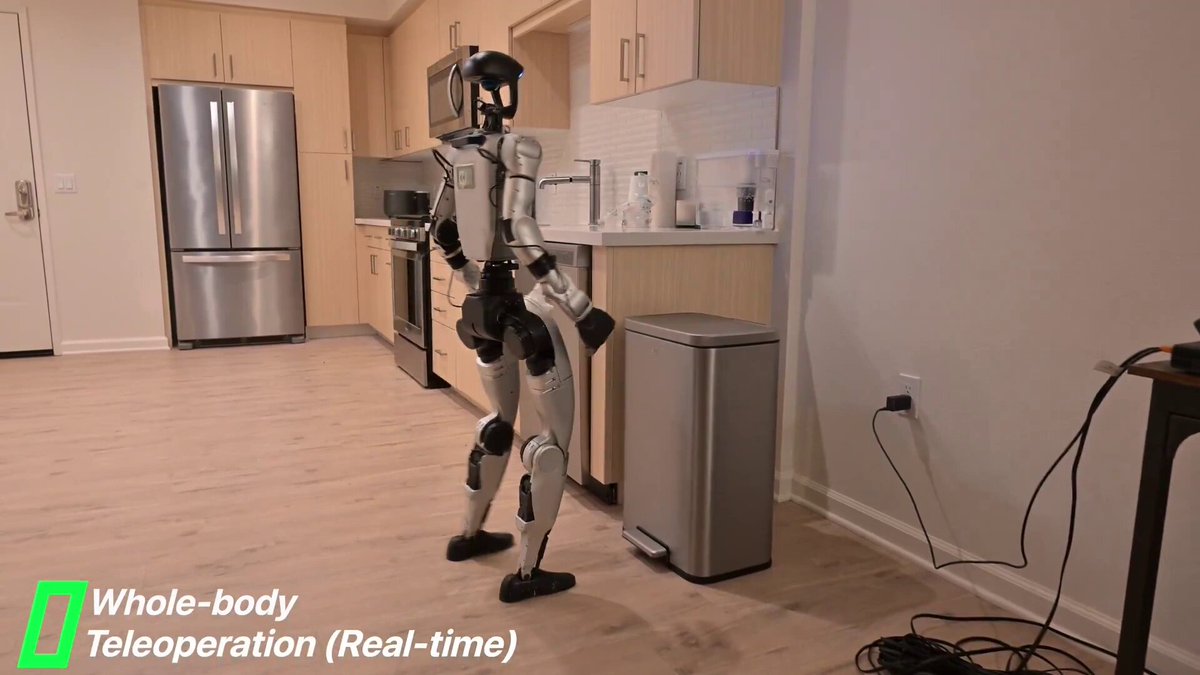
Scientists developed HumanX, a system that lets humanoid robots learn new skills by watching just one short human video. It learns directly from demonstrations instead of large datasets or complex training rewards. Using this, the Unitree G1 humanoid robot learned 10 different real-world skills without extra training.

27,686 Aufrufe • vor 3 Monaten •via X (Twitter)

0 Kommentare

Keine Kommentare verfügbar

Kommentare vom Original-Post werden hier angezeigt

Ähnliche Videos

We trained a humanoid with 22-DoF dexterous hands to assemble model cars, operate syringes, sort poker cards, fold/roll shirts, all learned primarily from 20,000+ hours of egocentric human video with no robot in the loop. Humans are the most scalable embodiment on the planet. We discovered a near-perfect log-linear scaling law (R² = 0.998) between human video volume and action prediction loss, and this loss directly predicts real-robot success rate. Humanoid robots will be the end game, because they are the practical form factor with minimal embodiment gap from humans. Call it the Bitter Lesson of robot hardware: the kinematic similarity lets us simply retarget human finger motion onto dexterous robot hand joints. No learned embeddings, no fancy transfer algorithms needed. Relative wrist motion + retargeted 22-DoF finger actions serve as a unified action space that carries through from pre-training to robot execution. Our recipe is called "EgoScale": - Pre-train GR00T N1.5 on 20K hours of human video, mid-train with only 4 hours (!) of robot play data with Sharpa hands. 54% gains over training from scratch across 5 highly dexterous tasks. - Most surprising result: a *single* teleop demo is sufficient to learn a never-before-seen task. Our recipe enables extreme data efficiency. - Although we pre-train in 22-DoF hand joint space, the policy transfers to a Unitree G1 with 7-DoF tri-finger hands. 30%+ gains over training on G1 data alone. The scalable path to robot dexterity was never more robots. It was always us. Deep dives in thread:

Jim Fan

293,585 Aufrufe • vor 5 Monaten

This work makes a humanoid robot do simple parkour moves by looking with a depth camera and choosing the right move on the fly. The big deal is that it turns lots of small human moves into long, real-time robot behavior, without hand-coding every transition or retraining for each new course. A humanoid robot is usually good at steady walking, but it often fails when it has to do fast moves like jumping up, vaulting, or rolling, and then keep going to the next obstacle. The hard part is that you cannot easily collect training data for every possible obstacle shape, distance, and mistake, so robots end up learning a few moves that only work in a narrow setup. This work starts from short clips of real human parkour moves, like stepping over, vaulting, climbing, and rolling. It uses motion matching, which is basically a smart “pick the next clip that fits best right now” search, to stitch those short clips into a long, smooth plan that looks like a human doing a whole course. Then it trains a controller with reinforcement learning (RL), which means the robot learns by trial and error to copy that plan while staying balanced and not falling. After training separate expert controllers for different moves, it compresses them into 1 controller that uses only onboard depth sensing and a simple “go this fast in this direction” command. In real tests on a Unitree G1 humanoid, it can clear multiple obstacles in a row, adapt when obstacles get moved, and climb a wall up to 1.25m.

Rohan Paul

37,121 Aufrufe • vor 5 Monaten