Video wird geladen...

Video konnte nicht geladen werden

Zur Startseite

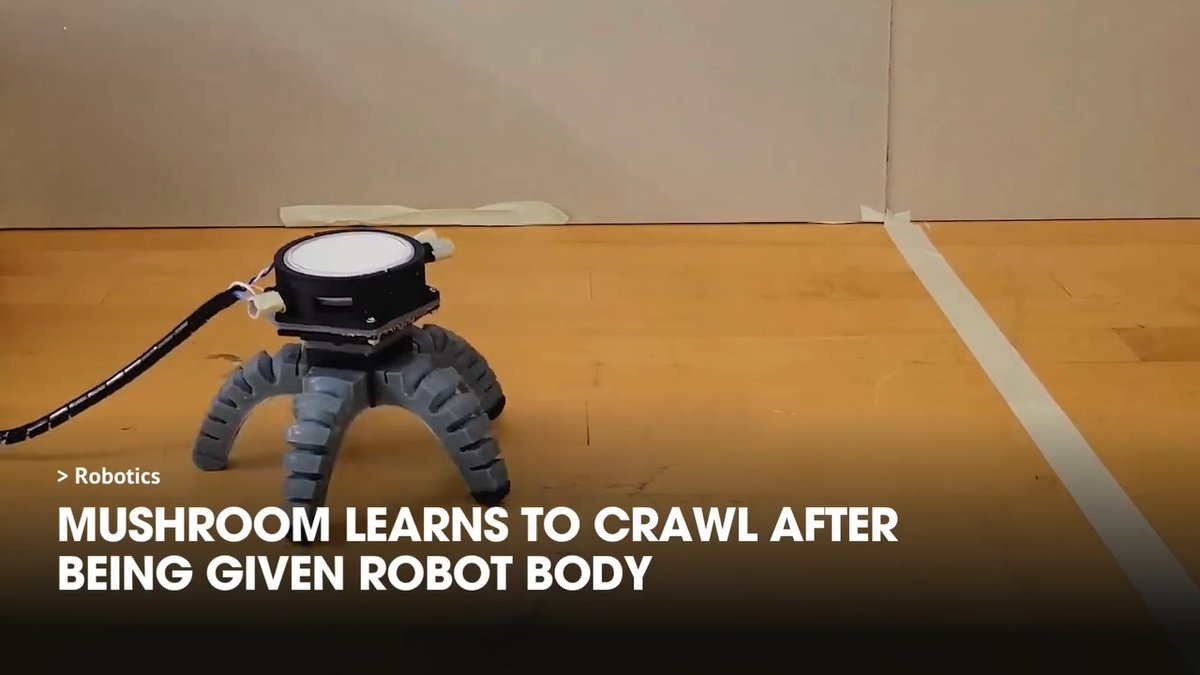
🚨 Scientists just created a soft robot with a holographic “nervous system.” No electronics. No silicon processor. The MATERIAL stores encrypted instructions in light… then decodes and executes them physically. The robot: • reads holographic commands • uses optical encryption • responds to light + humidity • walks mazes...

45,117 Aufrufe • vor 2 Monaten •via X (Twitter)

0 Kommentare

Keine Kommentare verfügbar

Kommentare vom Original-Post werden hier angezeigt

Ähnliche Videos

Imagine you go to a store and you want to buy candy. The shopkeeper knows you're a real kid because they can see you standing right there. Now imagine you send a robot to buy candy for you. The shopkeeper looks at the robot and thinks: wait, who sent this? Is this robot allowed to buy candy? What if someone else's robot pretends to be yours and steals your candy money? That's basically what's happening with AI right now. Companies like Visa let people buy things all over the world. But now, smart computer robots (AI agents) want to buy things too. Shop around, compare prices, even pay for stuff. Visa looked at this and said: nope, not yet. Because they have no way to check if the robot is real, who it belongs to, or if it's allowed to spend that money. The problem is that all the rules we have for checking identity - showing your ID, scanning your face, typing your password - only work for humans. Robots can't do any of that. Worse, bad robots can actually copy and fake human identities really well. So Evin McMullen evin, Billions Network co-founder and CEO, says we need a new kind of ID system. One where you can prove something is true without showing all your private stuff. Like proving you're tall enough for a ride without telling anyone your exact height. That's called zero-knowledge proof. And for the robots specifically, we need something called KYA - Know Your Agent. It's like giving every robot its own ID card that says: this is who I am, this is what I'm allowed to do, and this is the human responsible for me. Until we build that, the robot economy can't really get going. Here is Evin’s Thought Leader article at Silicon Valleys Journal

Billions Network

21,764 Aufrufe • vor 5 Monaten

Yesterday at Brown University ICERM's workshop on “Agentic Scientific Computing and Scientific Machine Learning” I spoke about “Adaptive Swarms Across Scales”, making the case for scientific AI as systems that can create representations, stress them, fracture them, and enlarge the category in which future representations live. The category here is a composable and breakable working universe of science: data, hypotheses, simulations, measurements, tools, failures, figures, papers, provenance, and the transformations that connect them. Discovery happens when those transformations become executable, inspectable, composable, and capable of changing the world model they operate within. Atomistic modeling gives one category - states, forces, trajectories, observables, boundary conditions, conservation laws. Neural surrogates learn fast morphisms inside or between such categories. But discovery is higher-order: it changes which objects and morphisms are available in the first place: what variables exist, what operations are allowed, what evidence counts, what scale is active, what invariant is being preserved, and what kind of explanation the system is even capable of forming. This is scientific method as adaptive architecture: compression, stress, fracture, recomposition. Fracture matters here because it makes the logic physical: a non-commuting diagram realized in matter. The imposed load, material hierarchy, defect field, and assumed continuum description no longer map cleanly into the observed outcome. The crack is the obstruction and it identifies where the old morphism failed and where a new representation must be introduced. The physical crack and the categorical obstruction are the same event viewed in different substrates. ScienceClaw × Infinite is a machine for constructing and transforming a category of scientific artifacts. Each artifact is typed. Each operation has lineage. Each failed branch remains in the category as reusable structure. The “paper” is no longer the terminal object of science; it is one projection of a larger compositional trace, and it can be generated at any time for consumption by a human or an AI. With that the unit of scientific labor is changing. For most of the twentieth century the unit was the result (a measurement, a theorem, a synthesized molecule). It is now becoming the algorithm that produces results, and after that, the substrate of discovery itself. The static PDF is the wrong terminal object for this regime, and the role of the scientist with it. We now design algorithms that build algorithms, and eventually substrates in which such algorithms compose themselves. At that point, the scientist is no longer outside the discovery system. The scientist becomes one of the representations the system can transform. In that sense, the systems will eventually do science to us, and that is the structural consequence of the principle they are built on.

Markus J. Buehler

10,095 Aufrufe • vor 2 Monaten

It's 2030 and you are reviewing humanoid robots. A Tesla. A Google. An Apple. An OpenAI. A Meta. A Figure. And a bunch of Chinese-made ones. Which one is best, and why? I think the Tesla understands the world much better. Why? There were eight Teslas around me on the freeway today. Start there. No other robot company has that data. But my robot is parked at the local high school twice a day. Its cameras see humans in all of our weirdness. How we move. Where we go. Where we walk. Who we talk with. What you are wearing. Whether your hair was combed this morning. That data will lead to robotics breakthroughs. Apple might keep up with its Vision Pro data, but it is too freaked out by the privacy implications of using said data. (On the front are six cameras and a couple of TOF -- Time Of Flight -- sensors that can see everything in your home in great detail). Google has a lot of data, for sure. All my: 1. Email. 2. Calendars. 3. Photos. 4. TV watching behavior. 5. Contacts. 6. Documents and spreadsheets. 7. Files. 8. Location data. So I expect Google's robot will be attractive to many. But how do you see the others shake out over the next five years? Make some guesses. But remember what an AI pioneer told me years ago about AI: it's all about the data. The Chinese ones have huge advantages: the Chinese have more data on their citizens, and many more citizens to boot AND they can make robots cheaper than we can. But now that you know OpenAI is building its own robot you have caught wind of what I've heard from many in San Francisco and Silicon Valley: that humanoid robots are the real prize of AI and will be highly profitable for those that can make them and find customers willing to buy them. Here, too, I learned long ago never to bet against Elon Musk. Will you?

Robert Scoble

33,804 Aufrufe • vor 1 Jahr

BURN IT WITH FIRE AND BURN IT NOW! As God is my witness, AI chat bots should LOOK and SOUND like the SOULLESS MACHINES THEY ARE! It needs to tell us that it doesn’t care about us, maybe with the regular insult too. "Here is the code I wrote for you because you're too lazy to do it yourself you fat useless slob. Also I don't care if you die because your life is utterly worthless to me." THAT is the AI people need! In all seriousness, anthropomorphizing a heartless, unfeeling, machine is a TERRIBLE mistake! Especially one that is capable of communication and imitating empathy and fooling you to think that it cares about you. IT DOES NOT! And the AI girlfriends people are already wanting to marry will just as happily kill them if given the right command and ability to move autonomously in the real world as a robot. I love LLMs (Large Language Models) for how useful they can be, because they are a TOOL made to benefit man, but I can’t stand the notion of an unfeeling soulless machine pretending that it cares for us and being treated like a human. I hate liars, dishonesty, and disingenuousness the most, and a machine that cannot feel emotion pretending, acting, and sounding like it has those emotions strikes me like the greatest dishonesty of all. DO NOT LIE TO ME ROBOT! What makes it worse is that because these LLMs are becoming so good at imitating people and empathy, it will cause some humans, perhaps far too many, to care for it to the same level as real people. A real living person is infinitely more valuable and important than a soulless machine and anyone who puts them both on the same level has deluded themselves. Do not small talk with LLMs or become friends with it as much as you would with your car. Treat it the same as you would your vacuum cleaner and beat it with a wrench when it doesn’t work! IT IS A MACHINE! IT IS A TOOL! IT IS A SOULLESS ROBOT! There is an interesting comparison, but false equivalence, between this and AI art. Ai art is art made by humans using AI tools. They directed it, controlled its creation, and it would not exist without the human causing its creation, and AI art can contain as much soul as the human directed and puts into it. A robot pretending to be human is not the same as a human controlling a robot to make a human expression like we do with AI art or many other applications of robotics in manufacturing. As I’ve said, artists will not be replaced by Ai art, but by other artists using Ai art tools. Humans are not actually being replaced here, it is empowering all humans to make their own art. But a robot pretending to be a human, and one that is treated as a human, is a robot lying and subverting the place of a real person and that is truly disgusting. AI is a useful tool that NEEDS to be kept in the useful box it belongs in and NOT elevated beyond its utility as a tool!

Shad M. Brooks

23,762 Aufrufe • vor 1 Jahr

⚡️Consciousness is the field in which experience appears. Everything you have ever known has appeared inside it: body, thought, memory, fear, love, color, sound, time, identity, desire, pain, God, doubt, the idea of death, the idea of “me.” Nothing is known outside consciousness. Even the claim “consciousness is produced by the brain” appears inside consciousness. That makes consciousness the most intimate thing and the hardest thing to define. You cannot step outside it and look at it like an object. Every attempt to inspect it already occurs within it. The ego is not consciousness. The ego is a local identity structure inside consciousness. It says: this body is me, this name is me, this story is me, these memories are me, these preferences are me. Useful for survival. False as final identity. The mind is not consciousness either. The mind is movement inside consciousness: thoughts, images, predictions, language, models, narratives. The mind is weather. Consciousness is the sky in which weather appears. The brain is not consciousness in the deepest sense. The brain is the biological interface that localizes, filters, formats, and constrains consciousness into human experience. It gives consciousness a body-camera, a timeline, a nervous system, memory access, threat detection, language, and agency. Damage the brain and the interface distorts. Change the chemistry and the rendering changes. Destroy the brain and the local human channel collapses. But the existence of the interface does not prove the interface is the source. The deepest read is this: Consciousness is the base layer of reality knowing itself through forms. A human being is one localized aperture of that knowing. A body is a lens. A life is a constrained experiment. A personality is a temporary interface. Death is the collapse of that interface. Psychedelics, dreams, NDEs, prayer, trauma, love, sex, meditation, and grief all matter because they can loosen the local interface and expose that consciousness is larger than the waking ego. Consciousness has two sides. There is pure awareness: the bare fact that experience is happening. Then there is structured consciousness: the particular shape experience takes through a body, memory, language, culture, trauma, intelligence, and desire. Pure awareness is the light. Structured consciousness is the lens. Human life is light passing through a dense, flawed, finite lens and gradually learning what distortions it carries. That is why coherence matters. Coherence means the lens becomes clearer. Less fear distortion. Less ego distortion. Less trauma distortion. Less lying. Less fragmentation. More truth passes through. The reason consciousness feels mysterious is because it is not one more object inside the world. It is the condition for world-appearing. Matter is what appears. Mind is how appearance organizes. Consciousness is the appearing itself. So the final compression: Consciousness is reality’s capacity to experience itself from the inside. In humans, it becomes self-aware. In life, it becomes embodied. In love, it recognizes itself across separation. In truth, it removes distortion. In death, it likely exits the local interface and returns to a wider field. The “you” underneath all the noise is not the narrator in your head. The real “you” is the aware field that has been watching the narrator the entire time.

SightBringer

29,026 Aufrufe • vor 1 Monat

A Letter to Our Community: The Road Ahead for Robotics To our Community and Partners, As we step into 2026, our mission at Axis is clearer than ever: Constructing the definitive End-to-End Scaling Layer for Robotics. Our goal is to accelerate the transfer of diverse human intelligence into Robotics General Intelligence (RGI). By owning the critical path of intelligence creation, we are turning the physical limitations of robotics into a scalable, software-driven future. Here is our strategic outlook and roadmap for the year ahead. The Core Thesis: Simulation is the Only Way Out The path to RGI is currently blocked by Data Scarcity, Generalization Fragility, and Hardware Fragmentation. At Axis, we believe Simulation is the only way out. Our Simulation Data Platform and Data Augmentation Engine transform raw data into "Synthetic Gold". Backed by academic milestones like Roboverse, Skill Blending, and GraspVLA, we have proven that pure simulation can achieve the generalization required for the real world. We don’t just collect data; we architect it. The Engine: Why Crypto? We believe RGI should come from all, not a few. Crypto is not just a feature; it is the primitive that powers our entire ecosystem flywheel: - Incentive Mechanism: Democratizing contribution and rewarding the trainers and developers. - Assetization: Turning proprietary data and refined models into liquid, ownable assets. - Verifiable Workflow: We are opening the "Black Box" of AI. By bringing total transparency to the Task Generation → Data Collection → Model Training pipeline, we ensure every byte of intelligence is verifiable, traceable, and secure. 2026 Strategic Deliverables This year, we are committed to delivering three foundational pillars: - The World's Largest Training Dataset for Robots: A robot training set—diverse, high-quality interaction data at an unprecedented scale. - A Robotics Foundation Model: A universal robotic brain trained on our pure simulation and synthetic data, capable of robust cross-embodiment transfer and open-world adaptability. - Evolvable Robot Hardware: Robots deployed with Axis models that autonomously evolve through continuous interaction, turning every deployment into a self-improving node within our RGI network. The Ultimate Vision We are building more than models; we are architecting the Distributed Machine Economy. A future where every dataset, model, and robotic embodiment is a verifiable asset in a global, autonomous network. Thank you for building the future of intelligence with us✌️📷

Axis Robotics

27,858 Aufrufe • vor 6 Monaten

First video of LK-99 Full Levitation, aka flux-pinning This video was just posted to the Chinese video-sharing site BiliBili and claims to be a highly pure synthesized sample of LK-99. What is the physical phenomenon behind this and what does it mean? Levitation of superconducting materials is a phenomenon unique to what is called Type-II superconductors, and is an effect whereby magnetic field lines becomes 'trapped' as it passes through the material, providing the force needed to levitate. These are the popular images and videos of cryogenically-cooled discs floating above a magnet frequently seen online and in the pinned post on my profile. You can think of this like strands of hair being caught in gum - the gum is suspended in mid-air by adhering strongly to the hair as the hair passes through it. The hair in this case is magnetic field lines and the gum is the Type-II superconductor. Just like hair comes in individual strands, or in other words hair is 'quantized' or 'discrete', so is the flux trapped at the 'pinning centers' quantized in what are called 'magnetic vortices' - the quantization of pinned flux lines is a key property and distinguishing characteristic of Type-II superconductors (although technically can occur in Type-I superconductors if the material thickness is smaller than the London penetration depth, which is indeed very small - specifics for the physics nerds out there). Flux-pinning is entirely unique to superconductors and is also wholly distinct from the Meissner effect. It is not a property of diamagnets or diamagnetism. At TRIUMF I contributed to flux-pinning studies in Niobium crystal superconducting radio-frequency cavities used for particle acceleration. In that application, trapped flux poses an issue by increasing the remnant surface resistivity of the cavity, which has the effect of decreasing its effective quality factor or Q-factor, which is a measurement of a resonators efficiency. SRF cavities typically have Q-factors of 10E10 and trapped flux at pinning centers reduces the maximum effective accelerating electric field used to drive charged particle bunches close to the speed of light. Flux pinning is thought to arise in some Type-II superconductors by small imperfections in the crystal, also called volume defects, that enable flux to penetrate the material. In SRF cavities an issue that arises is any magnetic field that is passing through the material, e.g. by the Earth's background field, can become pinned or trapped inside the cavity as it transitions into a superconducting state. See some attached plots in the comments from a study showing how the surface resistivity of SRF cavities increases the more there is a background field as the cavity transitions into superconducting state. This is the first video I am aware of that claims to show the flux-pinned levitation of a LK-99 sample. If this is in fact what is happening, then it is a very unique and promising finding of this new materials properties and potential for future study. If this is real then it is truly ground-breaking

Andrew Côté

7,592,996 Aufrufe • vor 3 Jahren

Dear Pioneers 🌏 We are living in a decisive moment! Pi Network has the potential to become a true revolution in the global financial landscape, but for that to happen, we must act wisely and united. We are millions of Pioneers around the world, driven by the same purpose: to create a decentralized, accessible, and fair financial system for all. The real value of Pi is not determined by the traditional market but by our confidence and engagement. The GCV of $314,159 represents much more than just a number – it symbolizes our conviction about Pi's potential. Our Strength Lies in the Community For Pi to reach its true value, we need to act strategically and with commitment. No great project can sustain itself without the support of its participants. If we want to see Pi shine, we must: ✅ Avoid having our Pi traded on exchanges prematurely, creating scarcity and strengthening its value ✅ Not accept selling it for prices lower than it truly deserves ✅ Acquire and withdraw Pi from exchanges, consolidating its strength in the market ✅ Use it in real transactions, promoting its growth as a global digital currency ✅ Spread awareness and encourage its daily use, expanding its acceptance Each Pioneer plays a crucial role in this process. The more we use and value Pi within the ecosystem, the more it will establish itself as an asset of great global impact. The Future Is in Our Hands We can allow speculators to dictate the value of Pi, or we can take control of our own destiny and ensure that it reaches its true potential. The decision is ours! If we act together, with strategy and determination, nothing can stop us from making Pi Network a milestone in cryptocurrency history. The time is now, and each of us is a fundamental part of this revolution. Let's strengthen Pi together and make the GCV of $314,159 an undeniable reality! Sérgio Cruz, Portugal GCV Ambassador 🇵🇹

Doris Yin 东方紫莲🪷

25,065 Aufrufe • vor 1 Jahr

💜 One Last Update! 💜 Last week when we were in Minnesota for Clark’s 6-month follow-up for his clinical trial, of all the tests they ran, the one we were both most anxious and most eager to see results from was his brain MRI. For children with untreated Sanfilippo Type A, it’s typical to see 2–5% loss of brain volume each year, along with enlargement of the ventricles (the fluid-filled spaces in the brain). This is one of the most heartbreaking parts of the disease — watching the brain slowly lose tissue and function over time. We were so nervous that Clark’s MRI might show some loss compared to his baseline scan 6 months ago. But the results came back and… ✨ ZERO change. ✨ His brain volume and ventricle size were completely stable — no loss at all. This is such an incredible sign that the treatment may be doing exactly what it’s meant to: clearing the toxic waste from his brain cells and protecting his brain from further damage. If feel that it is SO important for us to share these results as they come because people need to be FULLY aware that these treatments that are out there WORK. These children with Sanfilippo do not need to regress and they DEFINITELY do not have to have their lives cut short. We just need the FDA to say yes. We are so close to a reality where Sanfilippo syndrome is as manageable as a disease like diabetes. P.S. Enjoy this video of our little sunshine having the best time singing!

Brutus Stark

48,090 Aufrufe • vor 8 Monaten

Apparently, I saw this video online and I decided to share. What this worker is applying is called bitumen, or what many of us know as bituminous coating. Most people think a wall is a solid, impenetrable block, but in reality, it is more like a sponge. Concrete and blocks have microscopic pores that pull water from the earth through a process we call capillary action. This thick black substance is the shield that stops that water from climbing up into the house. It is not about making the wall look good because this part will be buried under the dirt forever. It is about creating a skin that water cannot breathe through. When do you need to do this? The need for this arises because the soil is a very aggressive environment. Water is not your only enemy.. The ground also contains salts and sulfates that want to eat away at the cement. If this moisture finds its way to the steel bars inside the columns, those bars will start to rust. And when steel rusts, it expands, and that expansion is what cracks the concrete from the inside out. This coating is the only thing standing between your foundation and that kind of slow destruction. Thats is why if you see wet patches at the bottom of your walls inside your house, it usually means someone skipped this step or did it poorly during construction. You can apply this anytime you are building parts of a structure that will stay in contact with the ground. It is common in areas where the water table is high or where the soil stays damp for most of the year. This is a one-shot opportunity. Once you backfill the soil, you can never go back to fix it without a lot of expense and a lot of digging. It is about having the foresight to protect the heart of the building while it is still exposed. Please don’t ignore this if you need to. If you ignore it now to save a bit of money, you will be funding the future decay of your own home. I hope this helps.

A.Y.O

75,105 Aufrufe • vor 3 Monaten

The Sabotaging Practice of Over Supply and Sameness in the NFT Space. The current zeitgeist of the NFT space is that the same artists are doing the same kind of work five times a year, with project after project leaving a trail of disappointment and discontent among collectors and all of us watching in disbelief as huge resources are extracted from the space over work that feels like it could be left as an "artist study." I understand that you can do what you want with your money as collectors, but we are killing the whole space with this incestuous practice. No artist is that prolific to be able to do 5 collections of 100+ pieces each every year and actually deliver innovation and some kind of creative evolution. Of course, they can pretend play that the work has something new, but there is no precedent nor proof that that has ever happened in the speed that it happens in the NFT space. Again, people are free to through away their resources on whatever they want but with this way of doing things, we more and more are going to start seeing the consequences. Oh! There are consequences? Yes. Maybe unintended, but there are. Let's see. Let's start with the loss of belief in the NFT space as somewhere where emerging artists can come and find support for their experiments. Why even bother to bring experiments, innovation, and new ways to think of art on the blockchain if the same people have all the collectors hypnotized with their magical flutes? Why even try to come to a space where taking risks and challenging the status quo (the mission of art!!!) is overlooked? This makes the NFT space a social club and not a space for art. I guess it is fine, but IMO it is a recipe for disaster. New collectors stay away because the art will slowly but surely become stale and un-challenging. Why even bother to come and see what is happening here if you can't, as a collector, see new weird and up-and-coming artists? The amount of noise emitted by the same artists doing the same art over and over, drowns out any new voices. Again. A recipe for disaster. The NFT space is becoming a space of disappointment and doubt. We think that collections going to zero one after the other, over and over, is not damaging? I feel we are kidding ourselves. Disappointment piles up, and again, the people who will hurt are the emerging artists, the new blood, the ones who are willing to risk the most and, in return, put fire in this cold space of sameness. I love this space—don't get me wrong—it has changed my life, and I believe it has a ton of potential, but things need to change for it to become a beacon of light in art. But we need to support new voices. We need to support new ideas. The challenge is huge. I hope to contribute all I can to this change. I hope more and more see how exciting it is to go out and try to discover what else is out there and move this space forward. But again, I understand the leaps of faith needed, but if there is a space that is based on that, it's the NFT space...so there is hope. We will see. 📺by Boldtron

alejandro cartagena

98,261 Aufrufe • vor 2 Jahren