正在加载视频...

视频加载失败

Seedance 2.5’s most underrated industry upgrade is its 3D white model input rendering — worth a close look for anyone in sci-fi film & VFX. It fixes real pre-production pain points, with clear efficiency wins: - Faster previs iteration: Get atmospheric previews straight from locked layout, no waiting on...

17,638 次观看 • 1 个月前 •via X (Twitter)

0 条评论

暂无评论

原始帖子的评论将显示在这里

相关视频

Netflix aquired Ben Affleck’s AI film startup InterPositive for up to $600 million (based on certain milestones). Affleck’s AI tool augments existing filmmaking workflows: ▫️directors can train a small model from their own dailies ▫️improves the post-production editorial process ▫️more quickly mix, color and finish films (use their trained model to change shots, add props, enhance backgrounds or remove visuals while keeping consistency) Seems similar to work James Cameron is doing with AI and VFX. Cameron says his interest in GenAI is to reduce post-production costs by making the “cadence faster, so your throughput cycle is faster and artists get to move on and do other cool things.” If AI can reduce VFX costs by 1/2, Cameron thinks that means more blockbusters (including original IP or up-and-coming directors that wouldn’t otherwise get greenlit). Affleck mentions “getting more episodes” of your favourite TV shows with his tech. If Affleck hits the full $600 million cash deal, this looks to be Netflix’s largest tech acquisition ever. Whether or not the tech is worth that much, Netflix is getting the Affleck halo of a well-known (but still skeptical) AI practitioner. He has been Hollywood’s go-to takesman (eg. Rogan) on how AI can or can not change Hollywood (he doesn’t think it has creative chops for scriptwriting and thinks unions will protect a lot of acting/writing jobs for foreseeable future). If Netflix wants to ramp its use of AI, Affleck’s narrow view of the technology’s use makes it less threatening and helps with creative talent (David Fincher already using it for Brad Pitt film, probably the Once Upon A Time In Hollywood sequel). “It’s not about text prompting or building something from nothing,” Affleck says. “You’re building a model from your own material.” *** Lucas Shaw at Bloomberg on deal structure: Netflix CCO and CTO full interview Affleck:

Trung Phan

485,852 次观看 • 5 个月前

save this post to get the most out of unlimited Seedance 2.5 for up to 33 days on Higgsfield i'm going to show you how to use loops to produce ANY video format: ads, cinema, vlogs, UGC, music videos... with one system idea > vault > agent > references > images > script > video > montage > upscaling Seedance 2.5 one-shots a full 30 second video, audio generated in the same pass, carrying up to 30 image, 10 video and 10 audio references into a single generation here's a full breakdown of the setup: > idea: steal taste from work that already worked: - frameset․app and shotdeck․com for film stills - savee․com and cosmos․so for boards - eyecannndy․com for transitions then have a vision model name the lens, light, palette and grain of your picks in one locked paragraph you paste into every prompt > vault: an obsidian folder as your reference bible, one page per asset (idea, locked style, character sheets, reference images, the exact prompts that worked) plus one index page, reviewed after every session so it never rots into dead files > agent: three commands make every model callable from Claude Code: - npm install -g @ higgsfield/cli - higgsfield auth login - npx skills add higgsfield-ai/skills and your agent now submits, polls, retries and logs every job > references: build reference images by hand first, midjourney for cinema and stylized shots, nanobanana pro or gpt images 2 for realism use one locked style across the whole project, recurring characters turned into full sheets (front, side, back, blank background), and once locked you never regenerate them, you fix the motion prompt instead > images: frames before motion, always, a frame costs seconds and a clip costs minutes, so exploration happens at the cheap layer and only winners get animated > script: every shot gets the same six details, subject, action, place, camera, style, rules, and the 30 seconds splits into four timed beats inside one prompt, 0-6 set the scene, 6-14 build it out, 14-24 the turn, 24-30 the end > video: every reference gets a job and a boundary, "Video 1 defines motion and pacing" is half the instruction, "do not use the person's identity, clothing or scene" is the half that stops one reference leaking into shots it was never meant to touch > montage: the cut is a text file, one line per clip with its duration and an audio flag, ffmpeg renders the film from it, so the whole edit reruns in seconds > upscaling: once, at the end, on the finished cut, 720p while exploring, 1080p for keepers, 4K only for the master (use Topaz) for UGC ads, the same loop with two changes render the hook clip alone first, approve the face and the voice before anything else inherits them, then anchor every later clip with the approved hook's audio so one voice carries the whole ad and the script math is fixed, about 3.5 words per second, a 30 second ad is roughly 105 words, counted before anything renders unlimited means every loop above costs nothing to run... start one tonight

Machina

36,495 次观看 • 9 天前

chatgpt images 2.0 has been live for 24h so let's dig in how to use ChatGPT Images 2.0 to create product photos, brand books, UI mockups, and ad creative that actually looks real: 1. GPT Images 2.0 now does 2K resolution, 3:1 aspect ratios, and spits out 8 images per prompt. text rendering is way better across multiple languages. it also has thinking mode where it searches the web before generating. 2. the biggest lesson with images 2.0: you have to be extremely specific. if you give it a lazy prompt you get stock photos. give it camera type, lighting conditions, color palette, and subject details and it cooks. 3. product photography is where it shines. I created a full brand shoot for a skincare line. golden hour lighting, Mediterranean aesthetic, slight imperfections in the subjects. every image looked like a real photo shoot. 4. use it to create visual directions before you make video ads. I prompted 8 directions for the same Shopify ad story. Wes Anderson, Nike, cinematic, Apple shot on iPhone. the cinematic and Nike styles were the strongest. 5. UI mockups work now. give it your app, a feature description, the resolution, and say you want realistic data in every cell. it gave me four clean variations of a leaderboard screen. 6. apparel and merch: generate photorealistic product shots before you print anything. test if people would buy it before you spend money on production. 7. illustrations got a massive upgrade. editorial style, flat vector, limited color palettes. use these to make proposals, one-pagers, and decks look professional. 8. every business has four creative bottlenecks: marketing content, internal docs and decks, explaining things visually, and testing before building. Images 2.0 helps with all four. 9. five things you need in every prompt: context (what is this for), style references (name specific brands or aesthetics), palette (use hex codes), real copy (no lorem ipsum), and aspect ratios so it drops into production without rework. 10. use ChatGPT itself to help you write better prompts. you might not know camera types or lighting terms. ask it to help you build the prompt before you generate. also in this episode: I share a startup idea someone should steal: a learn to draw app with AI feedback on every sketch. $5/month. I put it into Claude Design and got three incredible wireframe directions. I share a framework for finding vertical AI agent businesses. find a boring pain point, map the workflow, do the job as a service first, document edge cases, then add agents to replace the steps. and I share an AI tool called No Scroll that blew me away in 5 minutes. it monitors the internet for you and texts you only what matters. the onboarding felt like talking to a real person. episode is live on The Startup Ideas Podcast (SIP) 🧃 (walkthrough, tips, prompts) im rooting for you, so share this with your friends and enjoy watch

GREG ISENBERG

70,968 次观看 • 3 个月前

[New Xbox Controller Review] #ad Special thanks to Qrdgame_offcial for supplying me with a review unit of their Ferrox M5 Xbox & PC Controller QRD Ferrox M5 The QRD Ferrox M5 is a Wireless Xbox One–style gamepad with a transparent design. Since it targets Xbox One natively, it works automatically on PC and Xbox Series S/X. The included 2.4Ghz USB Dongle also supports Switch and Android with the right adapter (USB C), but I was not able to test those in time for this review. A Wireless Xbox Controller The QRD FERROX M5 comes in a familiar Xbox layout with Hall Effect joysticks, RGB rings around the sticks, and a magnetic & detachable clear shell that shows the internals. The controller feels very similar to a standard Xbox pad in terms of shape and size, but it’s slightly lighter at compared to the usual Xbox controller weight. The lighter weight makes it easier to hold for longer sessions without hand fatigue. The D-Pad is surprisingly good at dialing special moves feels as solid and responsive as the official Xbox controller, and that’s impressive at a lower price point. I spent a few days trying out the Mortal Kombat Legacy Kollection exclusively using this controller and I did not notice any difference at all. Capabilities From what I’ve tested, the controller performs extremely well for action games, fighting games, and shooters. The Hall Effect joysticks offer smooth movement and precise control with no drift issues. The D-Pad uses micro switches, so every input is tactile and accurate. The back triggers support an adaptive “trigger stop” mode, which shortens the travel distance for faster reaction time in FPS games or quicker blocks in Fighting Games. You also get 4 back macro buttons, turbo mode, and adjustable joystick sensitivity with deadzone options. Vibration strength and RGB lighting modes are also customizable. What can it do The FERROX M5 includes an 800mAh battery that lasts around 8 hours of gameplay. It only uses the 2.4Ghz wireless connection, not Bluetooth, so it always requires the included USB Dongle. The good thing is once you sync it with your Xbox or PC, you don’t need to sync it again—it carries over between both devices automatically. The 2.4G connection is stable and low latency, and the controller has a 3.5mm headphone jack for audio and mic support. It also features a quick calibration system to keep sticks and triggers accurate over time. The overall grip and shape feel close to the official Xbox controller, comfortable for long gaming sessions, and the transparent shell gives it a distinct look. Areas of improvement I initially had trouble charging the controller while playing because connecting it to the Xbox via USB would disable all inputs, making it unusable in wired mode. But luckily QRD Support helped and provided me with an updat - I had to connect it to a PC, download the firmware tool from QRD’s website, and update the controller manually. After installing the new firmware, the controller can now charge while being used normally on Xbox, so the issue is fully resolved. The Xbox button also behaves differently on Xbox, where the single press acts like hold and the hold acts like single press; this issue doesn’t appear on PC. Syncing with the dongle took a few attempts on both Xbox and PC, but once paired, it never needed syncing again. The wireless mode is strictly 2.4G with no Bluetooth support, so it cannot connect without the dongle, though the benefit is that one pairing works across both Xbox and PC. Final Summary ✅ Hall Effect Joystick ✅ Lights in the dark ✅ Good D-Pad for input dialing ✅ Light Controller ❌ First sync can be annoying on PC ❌ No bluetooth for phone usage - Dongle is necessary ❌ Needs an update for the Xbox Wired issues which require a PC The Controller is available on Amazon for $59.99, and will be part of the Black Friday Deals on their official website for even more discount! Amazon Link Website Link

thethiny 🐰🍉

16,864 次观看 • 9 个月前

🚨PERPLEXITY JUST LAUNCHED SOMETHING THAT MAKES EVERY OTHER AI PRODUCT LOOK LIKE A TOY.. AND NOBODY IS TALKING ABOUT IT.. They built a Personal Computer.. Not an app.. Not a chatbot.. A full digital worker that runs 24/7 on a Mac mini even while you sleep.. You press both command keys.. And it wakes up.. Ready to work.. But here's where it gets insane.. This thing doesn't run on one AI model.. It runs on 19 of them.. At the same time.. It uses Claude Opus for complex reasoning.. Gemini 3.1 Pro for deep research with a 2 million token context window.. Nano Banana Pro for 4K images.. Grok for fast tasks.. It doesn't just pick one model and hope for the best.. It reads your task.. Breaks it into subtasks.. And routes each one to whichever model is best at that specific thing.. All running in parallel.. While ChatGPT is still thinking about your first question.. Perplexity has already split your project into 6 pieces and assigned each one to a different AI.. And here's the part that should worry OpenAI.. Perplexity hallucinates at 3.3%.. ChatGPT hallucinates at 12%.. Claude at 15%.. It's not even close.. Because Perplexity is built differently.. Every other AI tries to remember facts.. Perplexity searches for them first.. It's structurally forced to cite live sources before it's even allowed to generate a response.. OpenAI Operator launched with a 32.6% success rate on computer-use tasks.. People called it "the world's most anxious intern" because it pauses every 5 seconds to ask if it's doing the right thing.. Perplexity runs multi-hour and multi-day workflows independently.. Only interrupts you when it hits a decision that actually matters.. You can start a task from your iPhone on the train.. And it executes on your Mac mini at home.. The economics are wild too.. Internal studies show it saved teams an average of $1.6 million in labor costs.. Performing 3.25 years of work in four weeks.. And unlike every other AI company.. Perplexity dropped ads entirely.. They charge $200 a month because they said they're in the "accuracy business".. Not the advertising business.. They even launched a $42.5 million publisher program to pay media partners when their content gets cited.. While OpenAI is getting sued by every newspaper on earth.. Google and OpenAI want you locked into their ecosystem.. If a better model comes out tomorrow you're stuck.. Perplexity just updates its routing matrix.. You get the best model on earth automatically.. No switching.. No migrations.. No friction.. This isn't an AI assistant anymore.. This is the first real AI employee.. And it costs $200 a month.

Evan Luthra

1,097,438 次观看 • 4 个月前

I’ve been using GPT-5.6 Sol internally for the past two months, I've spent probably 25+ billion tokens. Here’s my review and comparison to Fable 5: > Let's start with the analogy because everyone seems to be giving theirs - GPT-5.6 is likely the last version of the GPT-5 training run series. It's kind of like an athlete at their peak. Through years of experience in the game, they've become the most reliable player and has the highest game IQ. But, there's no more room to grow. Fable on the other hand, being essentially the first version of a new training run, is the first round draft pick rookie. Raw talent mixed with the energy only a young person would have results in some incredible plays we didn't think possible, but also mistakes due to lack of experience. But that rookie will only improve and likely will be better than the veteran ever was because it's a new game and a new era. > GPT-5.6 is genuinely better at long, sustained work. With /goal, I've had it running complex projects for days with almost no intervention. It built a Minecraft-style game, kept adding features and mobs after the core game worked, and only stopped because I stopped the run. I never felt as though I had to jump in and guide it back to the right path. > It keeps finding useful work when you give it a concrete finish line. I had it recreate Excel with a loop. It inspected the real desktop excel app with Computer Use, comparing that against its own build, and closing the gaps. I stopped it after six days after it had built an incredible amount of functionality. > It's faster than other models in two different ways. The raw generation speed is higher, something OpenAI has been putting effort into. But it also takes a shorter path to solutions. It wanders less, changes less code, and generally knows how to get things done directly. In daily use, it feels about 2-3x times faster than Fable. That's my impression, not a controlled benchmark. The difference is large enough that I notice it constantly. > It works well across a wide range of tasks. I use it for one-line edits, quick questions, browser chores, and multi-day builds without changing my prompting style. Speaking of browser control, its the best ever I've used. To the point where I actually use it often. If a task lives on a website, GPT-5.6 usually opens the browser and does it there instead of asking for an API key or forcing everything through the terminal. When I switched back to GPT-5.5, it went straight to the command line even when the browser was clearly the better tool. > And it can handle real browser work, not just toy demos. During a data import, I had it monitor Supabase and resize instances as the load changed. It stayed on the dashboard, adjusted capacity, and checked the result without an API or a custom script. > I also gave it a full Google Workspace migration. It moved Forward Future from to preserved the old aliases, and configured MX, SPF, and DKIM. Before a consequential save, it stopped, explained exactly what would change, and waited for confirmation. > The reasoning setting matters a lot. Light is good for questions and small edits. High and Extra High are the sweet spots for serious work. Ultra usually takes longer than the extra thinking is worth and burns tokens. > I love that 5.6 is split into 3 sizes. Not only can you control speed and cost that way, but you still also have the thinking effort setting for each of them. Very precise controls. I just wish Codex automatically routed my prompts for me. > Its personality is blunt and a little bland. Claude feels warmer and more natural to talk to. GPT-5.6 is more clinical, but I like that for work. It gives me enough explanation and rarely pads the answer. I usually have to ask Fable to explain things more simply and/or more concise. > Its front-end taste has improved, but the default is predictable. Left alone, it turns websites into PowerPoint decks with huge statements and hard section breaks. The good news is that it takes design direction well and can revise without destroying the parts that already work. > It still makes confident mistakes. I asked it to rebuild parts of a system, and it told me the job was finished. Later, I found out it wasn't. Bits of its internal process also leak into the answer occasionally. > Claude Fable is more naturally autonomous on large, open-ended projects. GPT-5.6 is easier to reach for. I don't need to invent a huge project to justify using it. It works just as well for a small edit or browser chore. > GPT-5.6 is also cheaper. Sol costs $5 per million input tokens and $30 per million output tokens. Fable costs $10 and $50. Cached input is cheaper too. Still, cost per finished task matters more than cost per token. > GPT-5.6 isn't the best at everything, and it still needs supervision. But it generates faster, wanders less, works at almost any scale, and wastes less of my time. It's the model I have the most confidence in to get the job done right the first time. I put together a full breakdown with all the tests, prompts, and examples on a site. You can read it here:

Matthew Berman

187,321 次观看 • 1 个月前

Real estate has a simple problem that people don’t always say out loud: it’s not designed for partial participation. You either have enough money to buy in properly, or you don’t. There’s usually no “in-between.” And once you do invest, your money is tied up for a long time. Selling isn’t instant and flexibility is limited. So even though real estate is seen as a solid way to build wealth, a lot of people are effectively locked out... not by lack of interest but by how the system is structured. That’s the gap APARTCHAIN is focused on. APARTCHAIN is a platform that turns real estate into something you can invest in fractionally. Instead of buying an entire property, the ownership is divided into digital shares (tokens), and investors can buy a portion that fits their budget. So rather than needing large capital, you’re able to take smaller positions in actual properties. Here’s how it works in practice: • APARTCHAIN acquires real estate • The property is split into multiple ownership shares • Investors buy those shares on-chain • Rental income from the property is distributed to shareholders • When the property is eventually sold, any profit is also shared So your return comes from two places: ongoing rental income and potential appreciation when the property is sold. Now, fractional real estate isn’t a brand-new idea. What makes APARTCHAIN different is how it’s positioned. It operates within Kazakhstan’s regulatory framework, with oversight connected to the country’s national financial authority. That’s a key detail because a lot of tokenization platforms operate without clear local regulation. Here, the structure is built to align with an existing legal system, not bypass it. On the technical side, it runs on a blockchain network designed for low fees and fast transactions. That means buying, holding or transferring your share doesn’t come with the heavy costs or delays typically associated with traditional property processes. There’s also no strict lock-in at the protocol level... you’re not forced to hold your position for a fixed period. But in reality, your ability to exit depends on the secondary market, which is still developing. So liquidity exists, but it’s not fully mature yet. It’s also worth being clear about the risks. Property values can go up or down. Rental income isn’t guaranteed and because this system relies on smart contracts, there’s a technical layer that traditional real estate doesn’t have. On top of that, the platform itself is still growing. Property inventory is limited for now and the resale market for shares is still building. That said, it’s not just an idea on paper... APARTCHAIN has already completed at least one full investment cycle... acquiring a property, generating returns, and exiting. That matters because it shows the model can actually function beyond theory. So at the core, this isn’t really about “changing real estate” in some dramatic way. It’s about removing the all-or-nothing barrier that’s always surrounded it. And that leaves a simple question: if you could start building exposure to real estate without needing to go all in from day one, would more people actually step in earlier or would they still wait until it feels “big enough” to matter? Superteam Kazakhstan || APARTCHAIN

Jessica♡🛡

105,405 次观看 • 3 个月前

Calmness, Trust, and Community: A Message to Our Pioneers Dear Pioneers, I want to take a moment to speak honestly and calmly with all of you. First, let me be clear: GCV has already been successful. Even though some pioneers may still doubt it or argue against it, this does not change reality. When we want to truly understand something, humility is essential. Calm your heart, study carefully, and allow yourself to improve. Some pioneers resist GCV because they have a wrong concept. They do not yet see their mistake. In many cases, they have not read the articles thoroughly or have misunderstood the information. At this point, it does not matter whether someone agrees or disagrees. What matters is that it has already been written into the system — fixed at both the institutional and retail level at GCV. There is no other option for Pi Network to realize its vision. Many pioneers ask: > “Why is it not activated yet?” “Why is it not officially showing that GCV has been accepted?” The answer is timing. When the timing is not correct, it is simply not yet the time to announce it. But this does not mean it did not happen. It has happened — it is just not visible to everypioneer yet.. Why? Perhaps someone are smart, have knowledge and have access to information but most pioneers don’t have this knowledge or skills — just like in the stock market. Here, the principle is the same. From our side, we can already see confirmation: From the economic side, GCV is confirmed. From the technical side, it is confirmed. But that does not mean everything is fully ready. There may still be regulations, compliance procedures, or coordination across more than 100 countries and multiple fiat currencies. It is complicated, and the team must handle it carefully. So, we should trust the PCT and give them the time. Meanwhile, live happily during this time, because we are almost at success. I want to remind you: Enjoy your life and be happy. If you don’t have a job, look for one. Sleep well. Exercise and make yourself physically and mentally strong. Maintain a positive energy in our community. The community is very important — not only before the full activation, but also after. We have a lot of information, belongings, and opportunities within the community. By contributing, reposting accurate information, or simply participating, you improve yourself and help build a stronger community. Even small contributions matter. Not everyone can participate fully, and that is okay. What matters is having the knowledge, confidence, and willingness to support the community. This work benefits both yourself and the pioneers around you. Calmness, patience, humility, trust, and positive energy — these are the keys to navigating this stage. Focus your energy on learning, improving, and contributing. Worry is unnecessary. Confidence, understanding, and steady action will guide us to success. Thank you for your trust, your patience, and your dedication. Doris Yin 🪷 🪷🪷

Doris Yin 东方紫莲🪷

13,136 次观看 • 8 个月前

It's finally time for the massive update I know EVERYONE has been eagerly waiting for... Presenting to you over 6 straight minutes of spliced footage directly captured from my actual physical Sega Dreamcast... RUNNING THE LATEST BUILD OF OUR SONIC MANIA PORT!!! I can't even begin to describe to you how polished and fantastic it's starting to feel... as though it belonged on the Dreamcast all-along... Thanks to the hard work of jnmartin, sonicfreak94, and a few others, not only is the Dreamcast port nearing completion, but... wait for it... THE 3D STAGES THAT STRUGGLED ON EVERY UNOFFICIAL PORT ARE NOW ALL RUNNING FULLSPEED!!!! Trust me when I say that this took an absolutely ENORMOUS amount of effort from jnmartin and the crew to pull off, considering the low-end for this game was the original Nintendo Switch, and ports running on consoles with twice our processing power struggled to run these levels fullspeed. The first and most obvious thing is that the 3D software renderer was ditched and all rendering was done natively with our PowerVR GPU... which actually wasn't as simple as it sounds. The tilemaps for these levels have had to be tessellated into a bajillion PVR quads and transformed and rendered as individual polygons to look correct and run faster than a slideshow. Mr anonymous Ocarina of Time chad developer came up with a pretty slick LoD scheme for drawing tiles closest to the player at 1x1 pixel sizes with sizes increasing with distance up to 2x2 and 4x4 pixels, allowing them to reduce the overall number of tile vertices that have to be transformed by the SH4 CPU and submitted to the PVR GPU, by strategically keeping the majority of the polygon detail closest to the camera, with detail decreasing as the tiles get further away. Next, the 3D geometry was preprocessed and converted from being triangle-based to being triangle-strip based, drastically reducing the number of vertices per model that our 200Mhz SH4 CPU had to transform (with plain integer arithmetic and no FPU vectorization, since this is all slow-ass fixed-point integer math)! Finally, it was discovered that the lighting was a disproportionately significant contributor to the TnL load on the SH4 for processing vertices. Jnmartin came to the realization that 99% of the time only the Y axis direction is considered for lighting equation intensity with just a white color. So this simplified lighting model got baked into the renderer, which gave another round of gainz. So in the end, after all of this work came together, a draw distance of 75% the distance of the retail Sonic Mania versions was achieved for the decorations, plus the character models have their full geometry count and have not been simplified on a freaking Sega Dreamcast with a 200Mhz SH4 CPU and only 16MB of RAM! 🔥

Falco Girgis

88,417 次观看 • 5 个月前

VEO 2 by Google DeepMind : MY CHEAT SHEET Alright, so after 500h-ish spent on VEO and giving birth to both "Kitsune" and "Banished", tons of people asked for a making-of. Instead, I decided to give you what I actually know of VEO 2 to this day. Please share! it's made to be spread around! 1/ If you're not using a LLM (Gemini, ChatGPT, whatever), you're doing it wrong. VEO 2 currently has a sweet spot when it comes to prompt length: too short is poor, too long drops information, action, description etc. I did a lot of back and forth to find my sweet spot, but once I got in a place I thought felt right, I used a LLM to help me keep my structure, length, and help me draft actions. I would then spent an extensive amount of time tweaking, iterating, removing words, changing order, adding others, but the draft would come from a LLM and a conversation I built and trained to understand what my structure looked like, what was a success, or a failure. I would also share the prompts working well for further reference, and sharing the failures also for further reference. This would ensure my LLM conversation became a true companion. 2/ Structure, structure, structure Structure is important. Each recipe is different but same as any GenAI text-to something, it looks like the "higher on the prompt has more weight" rule applies. So, in my case I would start by describing the aesthetics I am looking for, time of day, colors, mood, then move to camera, subject, action, and all the rest. Once again, you might have a different experience but what is important is to stick to whatever structure you have as you move forward. Keeping it organized also makes it easier to edit later. 3/ Only describe what you see in the frame If you have a character you want to keep consistent, but you want a close-up on the face for example, your reflex will be to describe the character from head to toe and then mention you want a close-up...It's not that simple. If I tell VEO I want a face close-up but then proceed to describe the character's feet, the close-up mention will be dropped by VEO... Once again, the LLM can help you in this by giving it the instruction to only describe what is in the frame. 4/ Patience Well, it can get costly to be patient, but even if you repeat the same structure, sometimes changing one word can still throw the entire thing out and totally change the aesthetics of your scene. It is by nature extremely consistent if you conserve most words, but sometimes it happens. In those situations, trace your steps back and try to figure out which words are triggering a larger change. 5/ Documenting When I started "Kitsune" (and did the same for all others), the first thing I did was start a Figjam file so I could save the successful prompts and come back to them for future reference. Why Figjam? So I could also upload 1 to 4 generations from this prompt, and browse through them in the future. 6/ VEO is the Midjourney of video Currently, no text-to-video tool (Minimax being the closest behind) gave me a feeling I could provide strong art directions and actually get them. I have been a designer for nearly 20 years, and art direction to me has been one of the strongest foundations of most of my work. Dark, light, happy, sad, colorful or not, it doesn't matter as long as you have a point of view and please...have a point of view. Recently watched a great video about the slow death of art direction in film (link in comments) and oh boy, did VEO 2 deliver on giving me the feeling I was listened. Try starting your prompts with different kinds of medium (watercolor for example), the mood you are trying to achieve, the kind of lighting you want, the dust in the rays of light, etc... which gets me to the next one 7/ You can direct your colors in VEO It's as simple as mentioning the hues you want to have in the final result, in which quantity, and where. When I direct shots, I am constantly describing colors for two reasons: 1. Well, having a point of view and 2. reaching better consistency through text-to-video. If I have a strong and consistent mood but my character is slightly different because of text-to-video, the impact won't be dramatic because a strong art direction helps a lot with consistency. 8/ Describe your life away Some people asked me how I achieved a good consistency between shots knowing it's only text-to-video and the answer is simple: I describe my characters, their unique traits, their clothing, their haircut, etc..anything which could help someone visually impaired have a very precise mental representation of the subject. 9/ But don't describe too much either... It would be magical if you could stuff 3000 words in the window and have exactly what you asked for, right? Well, it turns out VEO is amazing with its prompt adherence, but there is always a moment where it starts dropping animations or visual elements when your prompt stretches for a tad too long. This actually happens way before the character limit allowed by VEO is reached, so don't overdo it, it's no use and will play against the results. For info, 200-250 words seems like a sweet spot! 10/ Natural movements but... VEO is great with natural movements and this is also one of the reasons why I used it so extensively: people walking don't walk in slow-motion. That being said, don't try to be too ambitious on some of the expected movements: multiple camera movements won't work, full 360 revolutions around a subject won't work, anime-style crazy camera movements won't work, etc... what it can do is already great, but there are still some limitations...

Henry Daubrez 🌸💀

31,141 次观看 • 1 年前

If you watch this ~50 minute screen recording closely (yeah, I know, it's long; there are also some times when my computer was very slow and laggy, just skip past that part. And at one point I had to run and get my 9-month-old a new bottle and left it on a boring screen, sorry!), I believe you can see real signs of the kind of runaway, recursive AI self-improvement that people have been warning of for a while (Mr. Kurzweil most notably and prophetically). Why do I say that? What's different now? Well, there's a reason my set of agent coding tooling is called the Flywheel. These tools all mutually self-reinforce each other. And they all flow directly into my ntm tool (short for "named_tmux_manager"), which acts as a sort of integration point and nerve center for the tools (this is becoming more true by the minute as I'm now seriously working on ntm). Now, ntm was something I started making to automate some aspects of my workflow, but it was the kind of thing where, until it was perfect, it sort of just slowed me down. So I didn't actually use it even though I kept working on it and trying to improve it, and suggested to users that they try it in my tutorials. Well anyway, I finally got around to "dogfooding" ntm last night, and now it's going to get very dramatically better at an alarming rate. Some of that is from applying my "idea wizard" prompt to generate more useful features and building that stuff out and addressing obvious pain points I encountered during my newfound usage of the tool. But a lot comes from my realization that, once again, ntm's true utility is not as a tool for ME, but for an agent. That is, ntm lets one instance of Claude Code or Codex act as, well, me, do the things that I had been doing manually. Do I wish I had started using ntm earlier? No, for two big reasons: 1) Doing it manually helped me build up my intuition massively, which directly led me down the path of creating useful prompt strategies and workflows; these often began as ad-hoc prompts that I realized could be generalized and made more versatile/universal. Lesson: don't prematurely automate until you have an intimate, intuitive feel for your "core value-add loop." Otherwise you'll have a fully automated system quickly that efficiently and automatically does a stupid or otherwise sub-optimal thing. 2) My eyes have been opened to the beauty and power of Skills. I'm not talking about your garden-variety skills that are just a simple markdown file. I'm talking about true tour-de-force directories of perfectly structured and organized files that are filled with good information, insights, workflows, etc., but presented in a way that is highly optimized for consumption by AI agents, with extreme attention paid to things like perfect progressive disclosure, token density, agent-ergonomics, agent-intuitiveness, etc. And also Skills that go way beyond markdown files, with full integration into Claude Code where it makes sense via hooks, sub-agents, and even Python scripts. These kinds of skills are a qualitative difference in expressive power and usefulness and a total game changer. They are also effectively composable, creating almost an algebra of skills that let you use them together in powerful ways. I'm working on a subscription service website and CLI tool now to share what I've learned here most effectively, stay tuned for that in the coming days. Anyway, I now know what to make and how to make it. So, getting back to that screen recording, what does it show that makes me claim recursive self-improvement is here? If you keep your eye on the upper left tmux pane, that's the "controller" agent. It is using ntm to control all the other panes which are also running Claude Code (but ntm fully supports other agent types like Codex and Gemini-CLI, and it's trivially easy to mix and match them if you wanted to have, say, 8 CCs and 6 Codexes for writing the code and 3 Gemini-CLIs for reviewing code.) Now, there's nothing that crazy about this much so far. But where it starts to get very cool is that as the session continues and we encounter real-world problems, things like my ridiculously overloaded computer that keeps hanging for long periods, Claude Code instances that crash and get into a frozen, unresponsive state, it can learn from that. And you can see it using my skill writing skill to refine its ntm vibe coding skill in real time. And then take that skill and refine it to be more intuitive for itself. Or use my cass tool skill to search all the session histories to look for problems that came up and strategize how to solve them. The most useful part was when, towards the end of the session, I told it to reflect on all the things we had done and problems we encountered. One way it can usefully leverage those reflections is by improving its ntm vibe coding skill to make it cover more edge cases and exigencies. But the other, more fundamental, way is for it to conceive of and design the optimal new features and functionality for ntm itself so that the tool embodies those lessons in a first-class way. This offloads cognition from its brain onto its tooling, just like how a person can lean on spellcheck or a calculator. It codifies correct, effective reasoning at the tool level, where it's more reliable and robust and repeatable. And btw, did you notice what code base it was working on the whole time? It was none other than ntm itself! So as it worked on its own tool, it had reflections and ideas about how to further improve the tool. Now, it could have just as easily gotten those insights and ideas while using ntm to work on a different project, but the fact that it was working on itself is almost gloriously meta and recursive. So by the end, after learning from tending to a big group of agent workers (btw, I have previously emphasized doing everything in a really distributed/decentralized way, where each fungible agent gets identical marching orders that tell it to use my bv tool to find the optimal bead to work on. This does work very well, but occasionally results in some contention and overlap from thundering herd, or at least wastes time/tokens/communication in avoiding that before the agents waste time duplicating work. But in this new ntm-oriented workflow, I was able to have the controller agent in the upper left use bv itself and then optimally parcel out the instructions to each agent so that we could know for sure that there's no overlap), I ended up with a ton of new beads for new features, which I had it optimize and polish a few times. Now I can swap to a new Claude Max account and have the swarm implement all those new features! It should only take a couple passes like the one shown in the screen recording to get everything implemented. Then we can rinse and repeat, having the agent read through the full session histories of each agent and its experience from its own session in sending ntm commands and seeing how they worked out in practice, to come up with the next batch of changes to both its ntm vibe coding skill AND to the ntm tool itself. Do you see how rapidly this turns into Skynet? My mistake earlier was in focusing on making myself a "faster horse" as Henry Ford used to joke about customers wanting before he showed them what they should really want (a Model T). That is, something that would make my experience nicer while doing this agent swarm based development workflow. But the obvious lesson is that you should make all your tooling agent-first because the agents are just better at this stuff. You can still watch, and of course I did add a ridiculous number of very nice human-centric features to ntm that you'll be seeing in the next day or two, but those are really kind of "for fun" to make us humans feel better about the process. All the real value-add is happening "by agents, for agents." PS: Towards the end, you can see me switch to my Mac and tell Claude to improve the skill that I made earlier today for taking the mkv screen recording files from OBS Studio and muxing them into MP4 files for sharing, while downloading songs from YouTube to serve as the background music. I made it so it can also grab the thumbnails and generate little song credit cards that show up in the lower right corner. This worked perfectly the first time! I'll include some screenshots in a response post showing how that worked, but it was awesome to witness. Skills are POWERFUL. I'll also post a link to this video on YouTube if you prefer to watch it there.

Jeffrey Emanuel

25,483 次观看 • 7 个月前

📖SEEDANCE 2.0 JUST MADE EVERY FILM SCHOOL IRRELEVANT FOR SOLO CREATORS Solo creators with the right workflow are closing clients that used to require a full production studio. Seedance 2.0 inside Dreamina holds character consistency across scenes in a way no other tool at this price point comes close to. Same face, same costume, same lighting logic — frame after frame after frame. That's the feature that turns a single prompt session into a short film. The lava demon materializing inside a gothic cathedral. The girl in black holding her ground while everything burns around her. Two characters with completely different visual languages sharing the same atmospheric world — and Seedance holds both of them consistent across every cut. That's not a generation. That's a production. Here's the 7-step workflow that produced this: • Step 1 — Define the character before you define the scene. Write a complete physical description — face structure, hair, clothing, skin, posture. This becomes the anchor every future generation references. • Step 2 — Build the world separately from the character. Gothic cathedral, candlelight, fog, cracked stone, scattered bodies. Define the atmosphere as its own entity before you place anyone inside it. • Step 3 — Generate the reference frame. One image that establishes the visual language, the color grade, the lighting temperature. Lock this as your style reference before generating any video. • Step 4 — Feed the reference into Seedance's image-to-video pipeline with a motion prompt. Camera behavior only — slow push, hold, circle. The image handles the subject. The prompt handles the direction. • Step 5 — Generate four variations per scene. Delete the two that look generated. Keep the one where the character's face holds and the atmosphere feels physical rather than rendered. • Step 6 — Edit in CapCut or Premiere Pro. Add music that matches the emotional temperature of the grade — the visual already tells you what the sound should feel like. Dark orchestral, slow tempo, single instrument carrying the melody. • Step 7 — Save the character description and reference frame as a template. The next episode starts from the same character in the same world. Series content becomes a system, not a restart. How a freelancer sells this: Dark fantasy content for game studios, music artists, and fantasy brands is a real market with real budgets. A musician dropping an album needs a visual world. A game studio needs promotional cinematics. A fantasy brand needs a story. Where to find clients: • Music artists on SoundCloud and Spotify releasing dark, gothic, or cinematic albums — search by genre, find artists with 1k–50k listeners who have no visual content. They have the audience and the need but no production budget for traditional video. • Indie game studios on Itch and Steam launching fantasy or horror titles — they need promotional cinematics and trailers but can't afford a production company. A single free scene built from their game's character art opens every conversation. • Dark fantasy and gothic brands on Instagram and TikTok with strong photo content but zero video presence — jewelry brands, clothing labels, occult lifestyle brands. They have the aesthetic already built. You just add motion to it. • Fantasy and horror fiction authors on Instagram and Substack launching new books — they need visual teasers, trailers, and world-building content to build pre-launch audiences. Most have no idea this kind of production is accessible at this price point. • Tabletop RPG creators and Dungeon Masters on Patreon and Kickstarter — they build entire fantasy universes and need cinematic content for campaigns, promotional videos, and subscriber rewards. The niche is underserved and the creators inside it spend consistently on content tools and services. 📥Tomorrow I'll show you what's sitting right next to this opportunity. 🔖Save this if you are looking for practical AI methods that actually pay.

Zentrix⌚️

50,098 次观看 • 1 个月前

Fast Company just published a great piece on World Labs , Fei-Fei Li , Marble, and the idea that spatial intelligence / world models may be one of the next big shifts in AI. I was happy to be quoted in the article, but I also wanted to share more context about my own experience with World Labs and Marble, and why this direction is especially interesting to me. My starting point: volumetric capture — For the past few years I’ve been exploring and using volumetric capture and reconstruction (photogrammetry, NeRFs, 3D Gaussian Splats) mostly capturing locations around Montreal. Alleys, museums, urban interiors. I love every step of it: the capture itself, the pipeline, and what can be done with the output. Turning real spaces into real-time explorable systems. I do this personally, sharing explorations here, and professionally as chief technologist, and co-founder of Dpt. Physical reality + generative manipulation — In my work I’m especially drawn to mixing physical reality with generative and digital manipulation: using physical interfaces (light, clay, ink, ... ) to drive generative AI pipelines, building mixed reality prototypes that reshape your surroundings, or starting from real captured spaces and transforming them using tools like Marble. Like many people, I saw the World Labs announcement on Twitter in September 2024, and Marble when it surfaced in early December. But by then, I already had a sense something was coming. The first conversation — As someone deep into volumetric capture and radiance fields, I obviously knew about Ben Mildenhall and his pioneering work on NeRF. To my surprise, Ben reached out to me in late June 2024. He’d been following some of my experiments and wanted to chat about my process and workflows and how I was using this “stuff” creatively. At that point he didn’t share what he was building, but we had a genuinely great conversation about radiance fields, AI, and my work. He was curious about the creative perspective, not just the technical one. When the World Labs announcement dropped a few months later, it all made sense. I understood what Ben had been working on, and why the creative angle mattered to them. Then in August 2025, he invited me to try the Marble beta, and I’ve been experimenting with it since. Experimenting with Marble — The first thing I used Marble for was materializing scene and world concepts during ideation at the studio, and seeing if and how it could fit into our production pipeline. In parallel, I dove into a series of experiments focused on world manipulation: starting from real captured spaces and transforming them using Marble. I’d already been exploring that idea using img2img diffusion with ControlNet on NeRF renders, real-time video streams, and even mixed reality using headset camera feeds. But Marble brings something different. It generates persistent, spatially cohesive 3D worlds that can be rendered in real time across a wide range of devices. That’s a real shift. Experiment 01: Parallel Realities — The first experiment, Parallel Realities, starts from a volumetric capture of a real location, reconstructed as 3D Gaussian Splats. Using Marble, I generate an alternate version of that same space, something informed by the original architecture: abandoned, nature-reclaimed, alternate era. Then, using Spark (World Labs’ 3D Gaussian Splatting renderer for THREE.js) I make both realities coexist in the same spatial coordinate system. From there, I use a portal UX mechanic to let the user step between the real reconstruction and the Marble-generated version. Experiment 02: Hidden Depth The second experiment, Hidden Depth, does not transform a space as much as expand it. A captured location has a visual boundary (a mural, a doorway, a dark corridor) and Marble generates what exists beyond it. For example: a Montreal alley has a painted mural; step through it and you’re inside a world informed by what is actually depicted there. World Labs showcased part of this work here: And in their Spark 2.0 post: The project page is here: Why this matters to me — Being able to start from a real 3D Gaussian Splat scene and manipulate it with Marble opens up a lot of ideas. The 3DGS pipeline is becoming an increasingly compelling foundation for exploration, experimentation, and storytelling. What matters most to me right now is more control. The more I can steer the generated scene or world, the more useful the tool becomes. I want more features like the already existing multiple input images and Chisel, the blockout-based approach. I would like better local control, the ability to expand a generated world more and more while preserving coherence, and the ability to directly import 3D Gaussian Splat scenes to be used as a starting point. I want more ways to shape the result, not just a “prompt and hope” approach. — It is exciting to see this field moving from research and demos toward actual creative workflows.

Hugues Bruyère

69,960 次观看 • 2 个月前

Scaling campaigns overseas sounds like a creative problem. Honestly, it’s not. The real bottleneck is localization. As a product lead, I’ve lost too many weeks waiting for native voice actors, rebuilding region-specific edits, and manually fixing lip-sync issues that still looked slightly off in the final export. The worst part is that every new market turns into another production branch to maintain. That simply does not scale. So over the last few weeks, I started testing a few different AI localization workflows with our own ecommerce video ads to see which ones could actually survive real production conditions. Wizstar_official ended up being the one we kept coming back to. Not because it generated the flashiest demo. Because it was the first one that consistently held together once we pushed it into actual multi-market production. The Video Translation workflow supports 12 major languages, which already covers most global consumer markets we care about. But what stood out during testing was how natural the localization sounded. Not “translated”. Actually localized. The tone, pacing, and delivery felt native enough that most people on our team genuinely stopped noticing it was AI-generated after a few runs. More importantly, the video itself stays intact. Audio and visual timing remain aligned after translation, lip-sync holds even during side angles and faster speech, and multi-character scenes stay surprisingly stable instead of collapsing into mismatched cuts. That matters a lot more in production than benchmark style demos. We also tested it against a few other tools internally, and Wizstar consistently handled complex scenes better, especially when multiple speakers, product close-ups, and fast pacing were involved. The output needed significantly less cleanup before going live. Video Reference was another reason we kept using it. Being able to reuse existing high-performing ecommerce structures instead of rebuilding creative logic market by market saves an unreasonable amount of time. Seedance 2.0 also supports face input and multi-model orchestration, which noticeably improves character consistency and scene stability across longer sequences. After a few projects, Wizstar quietly became part of our workflow. We can now produce localized ecommerce creatives in minutes instead of rebuilding entire pipelines around every market. If you want to test it yourself: New users get free credits on signup. First subscription is $19 and includes a complimentary 30-second Ecommerce Agent workflow to test features like Product to Video. Let the tools handle the production overhead. The side-by-side comparison below shows one of our English masters translated into Spanish while keeping almost the exact same pacing and vibe intact. #Wizstar #AIVideo #GrowthHacking

Leo Reed

121,791 次观看 • 3 个月前

This launch is one of the most exciting and important decisions we have ever made. In the traditional gaming industry, KingNet ( company , is well-known as the developer of the game 《The Legend of MIR 》, Over the past decade, KingNet has supported its operations through a three-pronged business model of research and development, publishing, and investment + IP, launching 100+ high-quality games to date. Web3's building has been ongoing for nearly two years. We have established a brand-new game studio SmileCobra Studio , and establish long-term cooperative relationships with some big guys like TON 💎 BNB Chain Solana Scroll Delphinus Lab ($ZKWASM) Cocos Studio and others. However, after speaking with many developers, we found that before a real user consumption scenario is formed, one of the main challenges many teams face is how to reduce game development costs. So it's best time to learn about Xingyi AI model : the first AI industrialization pipeline, making game production truly "automated". Check here: What problem we want to solve? 1. High Production Costs: Traditional animation design and refinement can cost anywhere from several thousand to tens of thousands of dollars, making it difficult for small startup teams to afford. 2. Long Development Cycles: The fluidity and consistency of animations have always been one of the most time-consuming aspects of development. Designers often spend weeks to achieve a satisfactory result. With Xingyi, it only takes a few steps and minutes to generate the desired animation. 3. Inefficient Collaboration: In the past, game development was usually divided into multiple stages, each managed by independent teams responsible for art, planning, programming, and other roles. The smooth transition between stages relied on high levels of team collaboration and communication. The Xingyi toolchain breaks the traditional division of labor, promoting automation and collaboration across various stages. 4. Automated but Not Passive: Outside of the automated processes, developers are the true creators of the game. Xingyi makes prototype validation and adjustments more scientific and efficient. We will gradually open source the underlying model of Xingyi and make it available to interested collaboration developers (DM is open). We have already made various agent material generation available, and you can try it now: Finally, we would like to discuss a point that many people are concerned about, why was there a launch at @pumpdotfun and it was abandoned? The most important reason is that we lacked experience in the first launch and were affected by snipers and the market. We conducted wallet statistics and found that, excluding bots, a total of 25 addresses suffered a loss of approximately 17 sol. We will use the trading fee of Launch Coin on Believe to airdrop these accounts and apologize again for our mistake. Also, thank you to Launch Coin on Believe for the smooth launch and long-term creative sharing with the builders, only $KNET CA is : CfVs3waH2Z9TM397qSkaipTDhA9wWgtt8UchZKfwkYiu $KNET not representing any equity interests of the parent company , $KNET is a meme, but at the same time, it’s not just a meme. $KNET will play a key role in the consumption scenarios of the KingnetAI ecosystem—imagine having to continuously spend $KNET each time you generate the game modules you want. Gamefi is died? NO, AI-Gaming just begain here .

Kingnet AI

187,843 次观看 • 1 年前

After regrouping with our investors and the team, I’ve made the difficult decision to wind down Hike completely. Our US business, launched just nine months ago, is off to a strong start. But scaling globally would require a full recap, a reset that is not the best use of capital or time. The Big Question → We could raise the capital, but the real question is: is it worth it? Is this a climb worth pivoting for? For the first time in 13 years, my answer is no. Not for me, not for my team, and not for our investors. Why? 1. RMG was never the destination. It was a way to test unit economics and traction in India while working toward a bigger vision. In hindsight, starting in India locked us into the model and regulatory headwinds, turning a temporary path into a more permanent one. 2. The Gaming Nation vision is real, but we may be too early. The world will eventually move toward a Nation-type model in gaming and Web3 - Company 2.0. But crypto regulation is still developing globally, and we don’t want to repeat India, where we hoped for clarity that never came. 3. And most importantly, if doing a full reset, is this where I’d put my own capital and energy today? For the first time, the answer is no. The world has changed in the last decade - and so have I. There are more important problems to solve and bigger opportunities to deploy brilliant talent and capital. Looking Back & Lessons The last 13 years have been immense. Hike Messenger reached 40M MAUs and became the 35th most loved consumer brand in India at its peak. With Rush, we built a brand new kind of Casual PvP gaming platform and scaled it to 10M users and $500M+ in gross revenue in just 4 years. Our execution was super, but we could never quite make it stick. There are clear lessons to carry forward, especially on market selection: 1. Be careful with winner-take-all markets. To win, you need to go global. 2. Don’t build for today’s tech constraints. Build on the spring/summer of new technologies. 3. Regulatory clarity matters. Risk is fine; uncertainty is not. More importantly momentum is everything. And build what your heart and mind are deeply excited about. It’s the conviction that carries you through. This is both a disappointment and a hard outcome. But I choose to look on the bright side: the learnings are invaluable, and my conviction for what’s next is even stronger. To everyone who has been part of this journey - our users, our team, our investors, and our community - thank you. As a CEO, you’re only as strong as your team, and I want to give a special shout-out to mine - an incredible group of people who gave this everything. Hike This chapter ends, but the climb continues. Looking Forward I’ve always thrived at building at the forefront of technology. Over the last decade, in the little time I had to explore outside of Hike, I kept returning to the same three frontiers. And now, they feel like the great canvases for decades to come → 1. AI → For the first time, technology has both intelligence and memory. Imagine products that don’t just serve us functionally but truly know us - systems that adapt, grow, and partner with us. As a UX-first builder, this is the most exciting time to be building software. 2. Breakthroughs in Energy → Human progress has always been bound by energy. The world’s demand for energy is rising faster than ever. Breakthrough approaches, especially in physics are needed to power the future. The last century gave us mastery of fine matters and electricity, the next will move deeper, at the intersection of science and spirituality - into what yogis call divine magnetism and physicists call the quantum world or electromagnetism. From there will come technologies that today feel impossible to imagine. 3. Mastery of the Self → As AI takes on more of our work, a deeper question will rise: what now defines us? When productivity is no longer the measure of worth, humanity will turn inward. Man’s evolution will move from the intellect to intuitive attunement - a deeper connection with ourselves and the divine (which we’ll realise are one and the same). The tools, spaces, and guides that help us explore this inner world will be as transformative as any innovation in the outer one - unlocking the next level of humanity’s potential. If you put these together, a picture emerges: → the cost of intelligence trending to zero → the cost of energy trending to zero → and the cost of willpower falling lower and lower. Just imagine a future where willpower is infinite, energy is abundant, and intelligence is at our fingertips. This is the future I will help build — and it’s where I’ll be contributing in the decades to come. This new chapter will look very different from the last one 🚀 Video for perspective. Full substack post link below.

Kavin

24,481 次观看 • 11 个月前

How I Build My Teams I always liked the idea of ‘possession football’: - Control the game. - A tool to develop players. - The opponent can’t score without the ball. But I built it the wrong way: “Keep the ball. Find a gap to attack.” This turned into “side-to-side” passing. It was boring and ineffective. \ The idea. So, I flipped the idea: Instead of controlling to attack, we attack to control. Play as vertical as possible (while maintaining control). If not possible, pass back. Avoid sideways passes. For better connections and counter-press, we use a vertical, narrow structure: These simple decisions lead to short, vertical, and diagonal passes. This is what I call 'vertical possession' football. \ Make it work. The idea is simple. The execution is not. Over the years, I’ve worked to close the gap between vision and reality. (watch example below) My goal is to get closer to my vision every day. But as Vince Lombardi said: “Perfection is unattainable, but if we chase perfection we can catch excellence.” Here’s my plan to 'catch excellence': 1. Build it my way. Ignore opinions. Opinions lead to conformity. We reduce our philosophy to its essence—and build from there. Everything else is a distraction. 2. Stick to it. We limit ourselves to core principles, and stick to them. When there’s a problem, we don’t change the idea—we improve its execution. 3. Eliminate waste. Building a style of play is like carving a statue. You start with a block of marble and chip away everything unnecessary. All that’s left is the sculpture. We do the same. We cut every unnecessary touch and step: - Fewer touches mean we need less time and space. We have more space to be creative. - The simpler it gets, the more recognizable the style. 4. Obsess over the players. We don’t adapt to opponents. We focus on our players. That's what matters in the long run. When our ideas work, we can compete against anyone. 5. Develop technical and creative players as a by-product. - Possession: Many touches to refine technique. - Vertical: No “easy” sideways passes. Learn to play in tight spaces. - Control: Avoid hectic football. Control the ball to make deliberate decisions. 6. One Training Structure. We compress our philosophy into one structure. Then, we repeat it every session. We make our style of play a habit. And we develop the tools to execute it. 7. Master a Few Exercises. We repeat a small set of core games over and over. We focus on improving execution, not on new drills. The better we execute, the faster we get to our vision. 8. Bottleneck Coaching. We can’t predict what happens, so we don’t over-plan. Instead, we prepare for what might happen. This liberates our coaching: Rather than sticking to pre-planned coaching points, we solve the most critical issue—the bottleneck. 9. Competition Drives Development. Games are the core of our training. Players compete to win. They force each other to get better and better, session after session. 10. Positive Team Culture. I used to react with anger when things didn’t go right. And yes, it can work in the short term. But to build something great, players must stay on the path for a long time. This is more likely when they enjoy the process. Positive reinforcement is harder to do, but more sustainable. \ What's next? That's the plan. Now, it’s all about execution. I'll keep you updated.

Bene Schneiderbauer

59,810 次观看 • 1 年前

The Cybercab is aiming to produce 2 million units per year. Let this sink in. Today, Tesla produces about ~1.7 million vehicles per year total, across its entire lineup. And now Tesla is preparing to outproduce that with one single vehicle, a fully autonomous one. This is Elon and Tesla going ALL-IN on autonomy. Production is scheduled to start April 2026 at Giga Texas, with volume ramping throughout the year. And as of early 2026, Cybercab prototypes are already being tested around the U.S. The Tesla Cybercab is built from the ground up for unsupervised autonomy. There is no steering wheel and no pedals, just cameras, AI, and Tesla’s custom inference computers. No lidar and radar like other companies, just pure vision and software. Elon put it best on the Q3 2024 earnings call: “It’s not just a revolutionary vehicle design, but a revolution in vehicle manufacturing that is also coming with the Cybercab.” That quote matters a lot bc that means the entire way a vehicle is manufactured is changing with the Cybercab. Tesla is designing what Elon calls “the machine that builds the machine.” The Cybercab uses Tesla’s unboxed manufacturing process, where major sections are built in parallel instead of one long assembly line. There are fewer parts, less steps & cost, and faster scale. That’s how you make 2 million Cybercabs per year possible. FYI, this is not going to be easy though. Elon has been brutally honest about production for many years: • “Prototypes are easy, production is hard.” • “The extreme difficulty of scaling production of new technology is poorly understood. It’s 1000% to 10,000% harder than making a few prototypes.” • “For cars, it’s maybe 100 times harder to design the manufacturing system than the car itself.” He reinforced this again in January 2026 when talking about Cybercab and Optimus on 𝕏: “Initial production is always very slow and follows an S-curve. The speed of the production ramp is inversely proportional to how many new parts and steps there are. For Cybercab and Optimus, almost everything is new, so the early production rate will be agonizingly slow - but eventually end up being insanely fast.” This is the key thing most people miss about Tesla manufacturing. Early output will be slow by design. Almost everything is new like the vehicle architecture, factory layout, AI hardware, and manufacturing flow. But once it works and clicks, it begins to scale hard. Tesla already proved they can do this. They survived Model 3 production hell. They turned Model Y into the BEST selling car in the world, of any kind. They ramped Cybertruck, which has over 30,000+ unique parts, to meaningful volume. Elon summed it up perfectly in 2024: “Compared to the insane pain of reaching high volume, positive margin production, prototypes are a piece of cake.” That’s why Tesla makes manufacturing look easy bc they already earned the scars from the last vehicle lineups. The Cybercab is aiming to be: 1/ Under $30,000 price 2/ ~$0.20 per mile operating cost 3/ 200+ mile range 4/ Up to 5x utilization vs personal cars 5/ Designed to run nearly nonstop 24/7 This is what you call manufacturing + AI + autonomy converging at scale. The competitors are still showing prototypes and demos, while Tesla is building new production lines, expanding factories, and actually building the product. I remember when Elon told me in the past that one of Tesla’s key advantage long term was going to be manufacturing technology. I get it now.

Teslaconomics

31,985 次观看 • 7 个月前

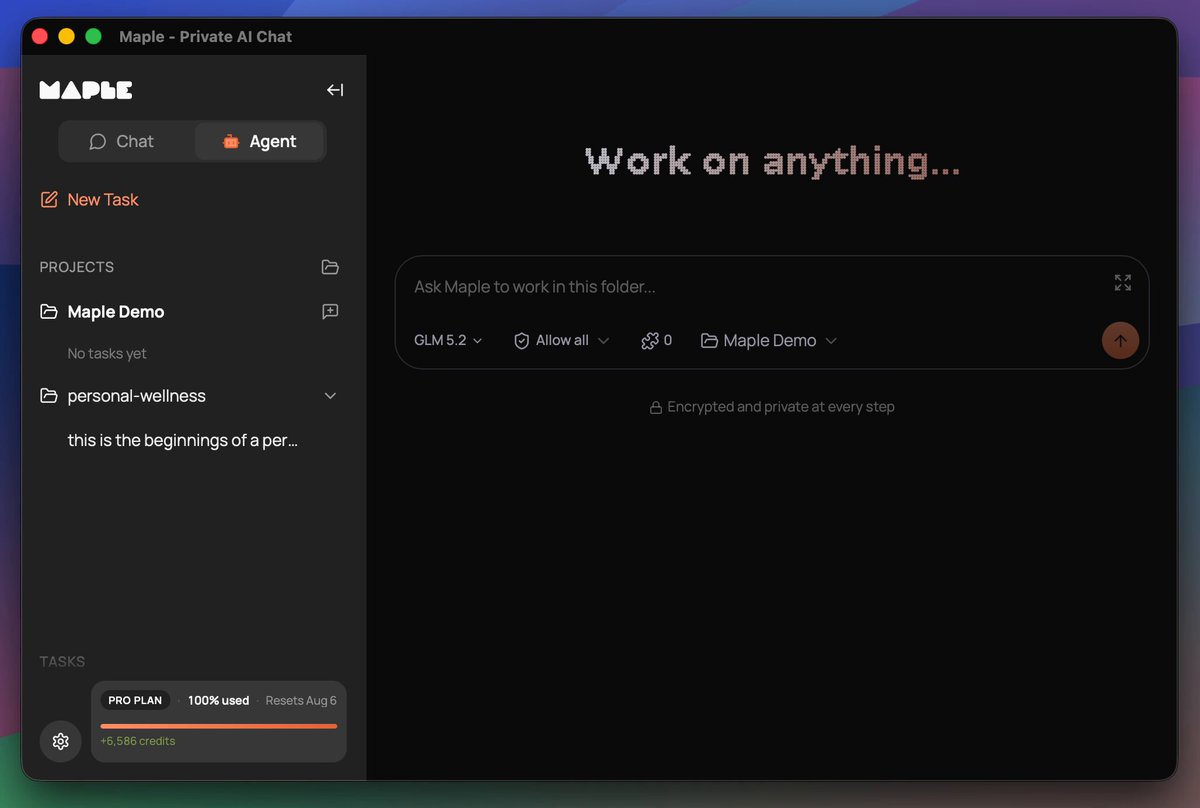
Maple is preparing for the release of a co-working agent. You install it locally and it works with your files, whether it's office work or building websites and apps. It's a turnkey solution, as easy as Claude Code, that keeps your data secure and private, no data sharing with closed AI labs. This is THE sovereign AI app for individuals and businesses who want powerful AI while retaining ownership of their information. Why build an agent into the Maple app when other agents already exist? Easy, we want to give you control over your work. We don't have a business plan that incorporates making money off our users' data. In the age of AI, your information, whether it's personal or company trade secrets, is the single thing that differentiates you from everyone else. We all have access to AI that can build a professional website for selling shoes. But your strategy and network for how you sell shoes should not be shared with your competitors. Sovereignty is the path to protecting what makes you, you. Maple sits at the intersection of Usability and Sovereignty. Maple gives you the best tools that are both easy to use and maintain your data sovereignty. Sovereign for one, sovereign for all. It has been a journey to get here. We brought to market the very first personal chatbot with end-to-end encryption using TEEs in late 2024. Prior to that there were proofs of concept but no full product offerings. Every other AI chat product on the market handled your data in plain text, either selling you a service to get your data or asking you to trust that they won't snoop on you. Quickly people found Maple and latched onto its open-source code and verifiable encryption. We didn't stop there. You may remember earlier this year we teased a product called "Maple Agent" and opened up a waiting list. That product is a mobile app that acts as your AI "friend", maintaining one long continuous chat, and getting to know you over time. I dislike using the word "friend" there, but it's the best way to convey the UX in a few words. AI is a tool, always has been, always will be. Any kind of friendly personality on top is just synthetic. In our testing, the UX of Maple Agent is really powerful for what it does. Think about the many short AI chats you have in your favorite app, whether it's looking up a historical fact or asking advice about a topic. With Maple Agent, those all go away in favor of the long-running chat with the friendly agent. It's like you have your own personal assistant who knows you so well and can look up anything for you. When I ask AI certain questions, I want to ask an expert who already understands my situation so I'm not repeating myself for the 100th time. That's the amazing value the personal agent brings to the table. We still see great utility for a personal agent like the "Maple Agent". Thousands of people on the waiting list, hoping to get their hands on it, agree that the concept is worth exploring and trying out. We were constrained in launching it due to a few circumstances, one of them being access to the scale of compute needed to power it. We have a clear path laid out for how to get there, but today is not the day to execute on that. It will be in the near future. Instead we have a different agent ready to go that we think is also incredible. We now have an agentic harness inside of the Maple Research app. This thing is a powerhouse. It even builds and publishes its own software releases. The agent in Maple Research works with your local filesystem, speaks to the largest open models running in TEEs, utilizes local models for certain tasks, is compatible with MCP tools, has an API for connecting to anything you need, and also supports the ACP protocol, which means it can be extended in the future to speak to other tools like Claude Code, Codex, and local models running on your own hardware. A big unlock for us was the Goose Development Kit, which powers the core of our agent harness. More on that to come as we publish articles and documentation later about the agent. The agent inside Maple Research doesn't have a name. At least not yet, not sure if it ever will. For now we call it "Chat Mode" and "Agent Mode". Think of this as the workhorse, the truck, the heavy lifter. Our other "Agent", the phone app, is your sidekick in your pocket, ready to help with quick things and ongoing conversations about life. I am incredibly excited about the Maple Research Agent. While I'm already seeing great results using it for internal work items, I'm especially thrilled about the personal health and wellness work it's doing for me. I know there are plenty of apps out there for compiling wellness data, but I'm having it build a tool tailored specifically for what I need, without the extra fluff. And none of my health data is being donated to the closed AI labs or sent to advertisers. I know that the AI logic is not being silently adjusted to fit the whims of a large corporation that has paid for product placement. It's me, state of the art AI, and my data. That's how I want it. Maple's new agent makes that possible. We can't wait for you to try it out. If you want early access, comment here, email us, reach out in some way. To those on the other agent waitlist, you're already in the queue. Thanks for reading this lengthy update. :)

Mark

44,707 次观看 • 27 天前

I've received a lot of DMs asking about beef pricing and I'm putting the explanation here so I can reference the post in future responses: Why rancher-finished beef costs $6 a pound hanging weight when you can buy cheaper elsewhere. (Hanging weight is 70-75% of take home weight, putting final cost between $10-$11 take home weight per lb.) It's a fair question especially from those who haven't been around cattle or ranching. The answer comes down to what "finished" means and how the animal got there. Finishing is the last stretch of a beef animal's life, the final four to six months, when it puts on the fat that gives beef its marbling, tenderness, and flavor. An unfinished animal is leaner, tougher, and blander. Some folks sell cattle that never went through a real finishing phase; less time and less feed, and you can taste it the first time you cook a steak. It takes like deer meat (to me anyway). Our cattle finish on open pasture with free-choice feed available whenever they want it. They graze grass, supplement themselves at the feeder, and take the time they need. They have fresh water, shade, room to roam, and frolic. No growth hormone implants and no confinement or restricted movement. Our finishing steers on a cool morning will run, buck, and play right up to harvest weight. An animal finished this way typically takes 24 to 30 months from birth to harvest, and it lives well the whole way. Grocery store beef comes out of feedlots where thousands of head stand in manure filled dirt pens, no grass, no shade, eating a formulated high-grain ration, with hormone implants boosting weight gain 10 to 20 percent. All is designed to get to slaughter weight faster and cheaper. A feedlot animal is often done at 14 to 18 months. They rarely move, and that's intentional. By the end, they can at most barely waddle from the feed bunk to the water tank. That kind of scale is exactly how the price gets driven down, and it comes at a cost the label doesn't show. Cheap beef requires crowding, confinement, and treating animals as production units, "Quality" is whatever survives the process. Then it all gets pooled. The beef in the grocery case is blended from countless animals, often including imported beef from overseas. Nobody can tell you what ranch it came from, because it is a mix of beef from across the globe. It's why one beef recall affects hundreds of thousands of people-- nobody knows what cow the diseased meat came from or what it was mixed with. The $6 a pound at our place goes to raising the animal, meaning two-plus years of grass, hay, and feed for one animal rather than 14 months of commodity ration split across ten thousand head. It covers land, water, and vet care, with no implants doing part of the work for free. Processing runs another $1.05 a pound hanging weight, paid to a small family run processor that cares and hangs and ages your beef for two to three weeks instead of rushing it from kill floor to cryovac. Nobody's getting rich at $6: we turn a modest profit only because we own the land. A rancher paying to lease or buy ground doesn't break even at $6 a pound hanging. That's the real cost of raising beef right at small scale, and it's why the price can't go lower without changing how the animal is raised. When you buy from a ranch, you're paying what the beef actually costs to produce, not what an industrial system can squeeze it down to. Cheaper beef is cheaper because somebody cut corners. Around here, nobody does. All life costs life and to believe otherwise disrespects that which sustains us. Our philosophy is to respect every animal that sustains us and our customers, giving each the best life possible. That is the real cost of doing business this way, and it's worth it.

Okie_Rancher

99,800 次观看 • 4 天前