Video wird geladen...

Video konnte nicht geladen werden

Zur Startseite

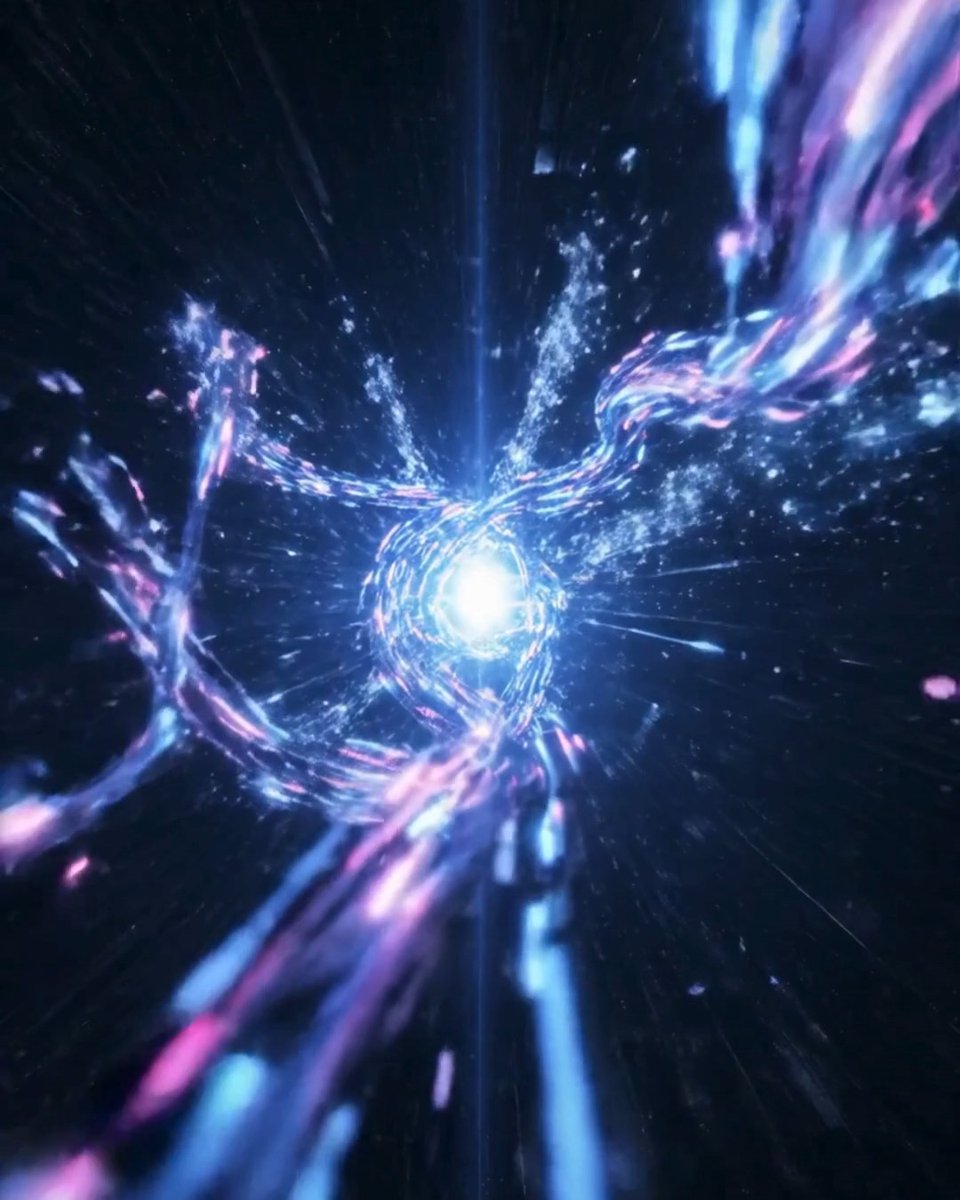
Seeing The Quantum World In Action! Ever wondered how particles pass through impossible barriers? This video provides a clear visualization of the Quantum Tunneling Effect, a fundamental phenomenon in quantum mechanics where a particle passes through a potential barrier that it classically could not surmount. Watch as the incident...

25,400 Aufrufe • vor 1 Monat •via X (Twitter)

0 Kommentare

Keine Kommentare verfügbar

Kommentare vom Original-Post werden hier angezeigt

Ähnliche Videos

🚨 PHYSICISTS JUST SPLIT A SINGLE PHOTON AND IT TURNED INTO AN IMPROBABLE SWARM OF PARTICLES. In a striking experiment, researchers have shown that a photon can be split apart in such a way that it produces a large number of particles, creating what they describe as a “mixture from zero to infinity.” Instead of the usual clean splitting into two photons (as seen in spontaneous parametric down-conversion), this process generated a complex, broad swarm of particles. The result challenges conventional intuition about how photons behave when pushed into extreme nonlinear regimes. Why this matters: • It demonstrates a rare and complex form of photon splitting that was previously very difficult to observe cleanly • Such processes could help simulate high-energy particle physics in table-top experiments • It opens new possibilities for generating exotic quantum states of light • It provides deeper insight into nonlinear quantum electrodynamics (QED) in strong fields The deeper implication: Photons are usually thought of as indivisible quanta of light. But under the right extreme conditions, a single photon can effectively “break apart” into many particles. This isn’t just a curiosity it touches on fundamental questions about the nature of light and matter, and could eventually lead to new tools for quantum technologies and for studying physics that normally requires particle accelerators. We’re seeing light behave in ways that blur the line between a single quantum and a many-particle system. How do you think being able to controllably split photons into swarms of particles could impact quantum optics or fundamental physics research? Follow for more frontier quantum physics and breakthroughs in light-matter interaction.

TheNewPhysics

25,874 Aufrufe • vor 23 Tagen

🚨 SCIENTISTS JUST DETECTED QUANTUM ENTANGLEMENT IN A CENTIMETER-SIZED PIECE OF METAL SOMETHING ONCE THOUGHT IMPOSSIBLE AT THIS SCALE. Researchers at the Vienna University of Technology have found clear evidence of high-degree quantum entanglement among particles inside a macroscopic crystal of a “strange metal” made of cerium, palladium, and silicon. This is one of the first times multipartite entanglement has been convincingly demonstrated in a solid object large enough to hold in your hand. Strange metals are already bizarre their electrons don’t behave like normal individual particles. Now it appears large numbers of them can act as a single, highly entangled quantum system even at everyday scales. Why this matters: • Quantum entanglement has almost always been limited to tiny numbers of particles in carefully isolated lab conditions • This experiment shows entanglement can persist collectively across a visible, macroscopic object • It was measured using neutron scattering, which revealed the material responding as one entangled system rather than many independent particles • This bridges the gap between microscopic quantum effects and real-world materials The deeper implication: For decades, physicists have wondered whether the strange, collective behavior seen in certain quantum materials could be explained by underlying entanglement. This result strongly suggests the answer is yes even at scales we can see and touch. It doesn’t mean your coffee mug is in a quantum superposition, but it does show that quantum correlations can dominate the physics of certain solids in ways we’re only beginning to understand. This kind of macroscopic quantum behavior could eventually help us design new materials with exotic properties, or give us new tools to study fundamental questions about quantum mechanics itself. How do you think discovering entanglement at this scale changes our understanding of where the quantum world ends and the classical world begins? Follow for more frontier quantum physics and materials science.

TheNewPhysics

17,001 Aufrufe • vor 20 Tagen

🚨QUANTUM🚨: A brand new quantum state just appeared that links two fields we thought were separate 🧨 Scientists at Rice University have discovered a new quantum state of matter that connects quantum criticality — where electrons fluctuate between different phases — with electronic topology, which describes organized wave-like behavior of electrons. This hybrid state could open new paths for advanced computing, sensing, and materials. Source: Rice University news release on a study published in Nature Physics (January 2026). Uniphics explains this emergence directly through spin-wave dynamics in the ξM-field. Each Gyrotron is a stable 3D gyroscope formed by three orthogonal spin quanta — every quantum a tempest of whirling energy spinning clockwise or counterclockwise in its own plane. When local energy density and spin bias allow mixed configurations (similar to the musktron and maleytron patterns), the resulting spin-wave interference naturally produces both critical fluctuations and topological order at the same time. Negentropy favors these hybrid states because they represent lower-energy, organized patterns within the field. No new particles or exotic couplings are needed; the same principles that govern particle formation, the weak and strong forces through spin alignments, and the low-acceleration gravitational surge also allow these combined quantum behaviors in real materials when conditions permit. This turns the “unexpected new quantum state” into a predicted outcome of spin-wave physics once the three pillars are allowed to select stable hybrid configurations. How might recognizing that hybrid quantum states arise from mixed spin-wave interference change the way we search for new materials or design future quantum technologies? A Theory of Everything should be able to answer everything. Uniphics Explained Simply PDF: Chapters 1–10 free: Grokipedia #Uniphics #QuantumStates #SpinWaves #Topology #QuantumCriticality Grok xAI

Paul Maley

22,669 Aufrufe • vor 1 Monat

🚨 PHYSICISTS JUST CONFIRMED “NEGATIVE TIME” IS REAL IN A MIND-BENDING QUANTUM EXPERIMENT. Light can exit a cloud of atoms before it even enters. In a new experiment, researchers fired photons through a dense cloud of ultra-cold atoms and measured something that shouldn’t be possible in classical physics. Some photons appeared to spend a negative amount of time inside the cloud effectively leaving before they had fully arrived. Why this matters: • This isn’t time travel it’s a quantum effect involving how light interacts with matter at the deepest level • It comes from “weak measurements” that let scientists observe the system without fully disturbing it • The atoms themselves “report” spending negative time in an excited state • It challenges our everyday intuition about cause and effect in quantum systems The deeper implication is enormous: We are seeing the strange, non-intuitive nature of quantum mechanics play out in real experiments. Time at the quantum scale doesn’t always behave like the arrow we experience in daily life. Effects can appear to precede causes in measurable ways without breaking relativity or causality. This is one of the clearest experimental windows yet into how reality works at its most fundamental level. What do you think does “negative time” change how you see reality, or is it just another quantum quirk we’ll eventually get used to? Follow for more frontier physics and reality-bending discoveries.

TheNewPhysics

22,256 Aufrufe • vor 1 Monat

🚨 SCIENTISTS SAY “MAGIC” MAY BE WHAT GIVES SPACE-TIME ITS GRAVITY. For years, physicists have understood how entanglement can build the structure of space-time in holographic models. But something was missing: why does space-time curve in response to matter the essence of gravity? A team including Charles Cao and John Preskill now proposes the missing ingredient is a quantum property called “magic” a measure of how complex and non-classical a quantum state is (the kind that makes quantum computers hard to simulate classically). In their theoretical framework, adding this magic turns rigid space into something that can bend. Matter can now tell space how to curve. Why this matters: • It offers a new way to think about how gravity emerges from quantum information • It connects ideas from quantum computing (error correction, magic states) directly to fundamental physics • It suggests space-time itself may be one of the most quantum objects in existence The deeper implication: Gravity may not be a fundamental force at all. It may be what happens when quantum information becomes sufficiently complex and “magical.” This is still early theoretical work in specific holographic models. But it hints that the pliability of the universe might have quantum roots we are only beginning to understand. What do you think is gravity ultimately just extremely complicated quantum information, or do you think we’re still missing something much deeper? Follow for more frontier quantum gravity and quantum information research.

TheNewPhysics

15,329 Aufrufe • vor 1 Monat

🚨 JAPAN JUST PUT A REAL QUANTUM COMPUTER ONLINE FOR THE WORLD TO ACCESS. And most people still don’t realize how big this moment is. For decades, quantum computers sounded like science fiction: machines that use quantum states instead of ordinary binary bits. Now researchers in Japan have opened access to a real superconducting quantum system connected to the internet. Why this matters: • quantum simulations • next-generation AI research • new material discovery • drug development • cryptography disruption • solving problems impossible for classical computers But quantum computers work nothing like normal machines. A regular computer checks possibilities one at a time. A quantum computer can explore many probability states simultaneously through superposition and entanglement. In simple terms: It doesn’t just calculate faster… It calculates differently. That’s why these systems look so strange. The giant gold structure isn’t “the computer” itself. It’s an ultra-cold dilution refrigerator designed to keep the quantum processor near absolute zero so fragile quantum states don’t collapse. The terrifying implication is this: Humanity may be entering the first era where computation starts operating on the rules of quantum reality itself. And once quantum hardware becomes scalable… Entire industries may be rewritten from the ground up. What happens when computers stop thinking like machines… and start behaving like physics itself? Which field do you think gets transformed first and would you actually trust it with something important?

Paul White Gold Eagle

55,784 Aufrufe • vor 1 Monat

🚨PHYSICS NEWS🚨: Gravity Leaves Its Mark on Quantum Interference in a Tabletop Setup 🧨 According to research published in *Physical Review Letters* on June 8, 2026 by physicists at the University of Tennessee at Knoxville, scientists have performed the first tabletop experiment to detect a gravitationally induced phase shift in quantum interference. Using a 50-kilometer fiber interferometer, they measured a tiny but clear effect of gravity on quantum wave interference with high precision. **Uniphics explains this result as a direct consequence of variable time flow caused by energy density gradients.** In Uniphics, gravity is not the curvature of spacetime. Instead, it arises from differences in energy density across the ξM-field. These gradients create regions where time flows at different rates — a concept described by the Maley factor (the ratio of time flow between two locations). When quantum waves (spin waves in the Uniphics framework) travel along two different paths in an interferometer, they experience slightly different time flows if one path is closer to Earth’s mass than the other. Because the phase of a quantum wave depends on how much time has passed along its path, even a tiny difference in time flow produces a measurable phase shift between the two arms of the interferometer. The University of Tennessee experiment detected exactly this kind of phase shift, confirming that gravity affects the relative timing of quantum waves in a way that can be measured in a controlled laboratory setting. This result aligns closely with Uniphics predictions. The experiment effectively measures how energy density gradients near Earth alter local time flow, which then imprints itself on the interference pattern of quantum states. It provides clean, tabletop evidence that gravity influences quantum systems through changes in time flow rather than through geometric curvature. The ability to observe this effect with such precision in a laboratory opens the door to testing gravitational effects on quantum coherence in controlled environments — something Uniphics expects to become increasingly important as we explore the deep connection between energy density, time flow, and quantum behavior. Could tabletop experiments like this eventually allow us to map energy density gradients with quantum precision and test the effects of modified time flow in different gravitational environments? **A Theory of Everything should be able to answer everything.** Uniphics Explained Simply PDF: Chapters 1–10 free: Grokipedia: #Uniphics #TheoryOfEverything #QuantumGravity #Interferometry #TabletopPhysics Grok xAI

Paul Maley

17,993 Aufrufe • vor 1 Monat

🚨 Physicists may have just directly imaged one of the strangest quantum states ever discovered. Scientists used a new tool called a “Quantum Twisting Microscope” to look inside magic-angle graphene a material where electrons suddenly stop behaving normally and begin acting like two completely different particles at once. Some electrons became “heavy” and localized, almost frozen in place. Others stayed “light” and mobile, moving through the material like relativistic particles. And somehow… both behaviors existed inside the SAME quantum state. The team found: • Interaction-driven reshaping of energy bands • “Dirac revivals” where quantum states reappear after collapsing • Mott-like cascades of heavy electrons • A mysterious persistent 15 meV excitation no current model fully explains This matters because magic-angle graphene is one of the strongest candidates for unlocking: • Room-temperature superconductivity • Exotic quantum computing states • Entirely new electronic materials The weirdest part? The electrons don’t split into separate materials. The dual behavior emerges from different regions of momentum-space inside the same topological flat band structure. Physics is starting to look less like “particles moving through space”… …and more like hidden structure emerging from geometry itself. What if matter is just stable patterns inside deeper quantum topology? Follow me if you want the frontier where condensed matter physics starts rewriting reality.

TheNewPhysics

42,536 Aufrufe • vor 2 Monaten