Video wird geladen...

Video konnte nicht geladen werden

Zur Startseite

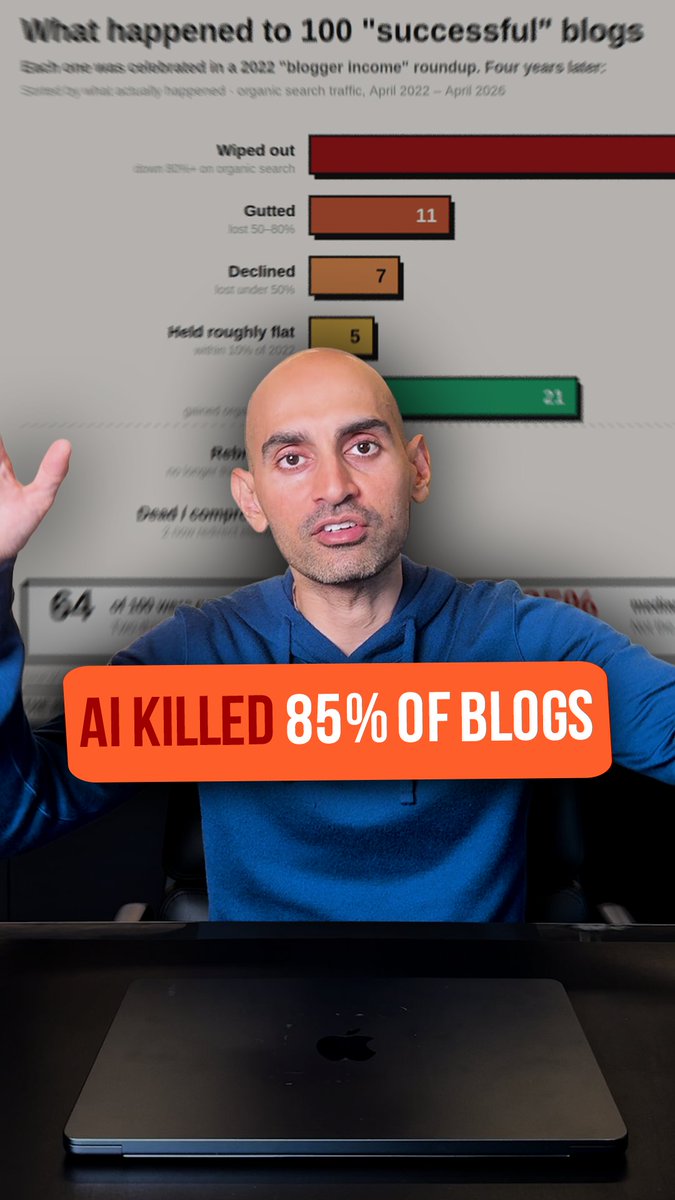
SEO spent 20 years training its own replacement. Marketers did exactly what Google asked, answer the question better than anyone, and got so good at it that Google no longer needs to send you the visitor. It just reads your work out loud. This video breaks down why the...

15,347 Aufrufe • vor 2 Monaten •via X (Twitter)

0 Kommentare

Keine Kommentare verfügbar

Kommentare vom Original-Post werden hier angezeigt

Ähnliche Videos

Google is making $62 billion a quarter destroying the websites it NEEDS to survive. This is literally a death spiral that ends with Google killing itself. Let me explain what's going on... Google added AI summaries to the top of every search result in 2024. When you Google something now, the answer sits right there on Google's page. You never have to click anywhere. Google took the information from someone else's website, summarized it, and kept you inside Google's ecosystem. The result: 60% of all Google searches now end without a single click to any website. Small publishers lost 60% of their traffic in one year. Medium publishers lost 47%. Even the biggest names in media, the New York Times, the Washington Post, Business Insider, all saw traffic fall between 22% and 55%. The Axios CEO called it "a referral extinction event for the ad-supported web." Google's response to all of this was to tell publishers they can "opt out" of having their content summarized. But opting out also REMOVES your description from normal search results. So the choice Google gives you is let us steal your content for free, or become invisible on the internet. That's extortion. The Washington Post laid off another round of journalists this year because of it. Stereogum, one of the most respected music publications on the internet, had to BEG readers for donations. Business Insider cut 21% of its staff. Dozens of smaller publishers have shut down entirely. The people who actually CREATE the information Google summarizes are going bankrupt while Google posts record revenue. But here's where this gets interesting and where everyone stops thinking: Google's AI summaries are only as good as the content they summarize. If the publishers who write the original articles, run the original investigations, and create the original data go out of business, there is nothing left for Google to summarize. The AI starts recycling old information, the answers get stale, the quality drops, and users start noticing that Google's summaries are increasingly wrong, outdated, or useless. Google is essentially strip-mining the internet for short-term revenue. They are extracting all the value from content creators without paying for it, driving those creators out of business, and then wondering why the quality of their own product is declining. This is exactly what Napster did to the music industry in the early 2000s: Made content free, creators went broke, and quality collapsed. It took a decade to rebuild. Google is doing the same thing to the entire internet at 100x the scale. Rolling Stone, Variety, Deadline, The Hollywood Reporter, and Billboard are now suing Google for antitrust violations. Chegg, the education platform, lost 49% of its traffic and is suing too. The UK's competition authority just ordered Google to let publishers opt out without being punished. The DOJ already ruled Google is an illegal monopoly. And Google's defense in court is genuinely unbelievable. They argue that publishers CHOOSE to let Google index their content and can leave anytime they want. That's like saying you choose to pay protection money to the mob because technically you could close your business and move to another city. Google controls 90% of search. Leaving Google means leaving the internet. Meanwhile Google is investing billions in custom AI chips to make these summaries cheaper at scale. Every quarter the problem gets worse. The internet as we've known it for 25 years ran on a simple deal: Publishers make content. Google sends traffic. Advertisers pay for the traffic. Everyone wins. But Google just BROKE that deal and kept all the money.

Ricardo

251,186 Aufrufe • vor 4 Monaten

Coinbase CEO Explains “Reverse Prompting” and the Rise of the AI CEO Brian Armstrong: “One of the big pushes we made in the last year was we got our own internal hosted AI model that was connected to all of our data sources, right?” “So it's like every Slack message, every Google doc, Salesforce data, Confluence, you know.” “So now the data is all aggregated and I've started to ask it really… it's not just like prompting it, ‘Hey, can you write this kind of memo for me,’ or something.” “I'm asking these AI agents now, ‘As CEO, what should I be aware of in the company that I might not be aware of?’ And it'll tell me, ‘Did you know that there's actually disagreement on this team about the strategy?’ And I was like, actually, I didn't know that.” “This is like reverse prompting. So instead of telling the AI agent what you want it to do, you ask it what you should be thinking more about.” @jason: “It's a mentor. It's a coach.” Brian: “Yeah. Like, what could make me a better CEO? And it's like, ‘Well, I looked at how you spent your time in the last quarter and here's how you said that you wanted to spend it, but you actually spent 32% of your time on this instead of 20%.’” “I've asked it other questions like, ‘What's the thing that I changed my mind on the most over the last year?’ Things like that.” “It'll prompt you with information you should be thinking about instead of the other way around.” Thanks to our partner for making this happen!: Our episode is sponsored by the New York Stock Exchange - a modern marketplace and exchange for building the future. It all happens at the NYSE 🏛.

The All-In Podcast

80,524 Aufrufe • vor 8 Monaten

Former Meta Chief AI Scientist Yann LeCun on the three paradigms of machine learning — and why the third is what made ChatGPT possible: Here's each one, and where it breaks. First, supervised learning. You tell the machine the answer. "You show it a picture, let's say of a table, and you tell it this is a table. So it's supervised because you tell it what the correct answer is." Get it wrong, and the machine rewrites itself: "The system computes its output, and if it says something else than table, then it's going to adjust its parameters, its internal structure, so that the output it produces gets closer to the output you want." Repeat at scale and something more than memorisation appears: "Eventually the system will find a way to recognize every image you trained it on, but also images it's never seen that are similar to the one you train it on. This is called a generalization ability." The limit: a human has to supply every single answer. That doesn't scale to the size of the internet. Second, reinforcement learning. You don't give the answer, only a verdict. "You don't tell the system what the correct answer is. You only tell it whether the answer it produced was good or bad." Learning to ride a bike, essentially: "You try to ride a bike and you don't know how to ride the bike and after a while you fall. So you know you did something bad and so you change your strategy a little bit. And eventually you learn how to ride a bike." For years the field assumed this was the closest thing to how animals actually learn. Yann LeCun's verdict: "Now it turns out reinforcement learning is extremely inefficient." It dominates wherever failure is free: "It works really well if you want to train a system to play chess or play go or poker, because you can have the system play millions and millions of games against itself and basically fine-tune itself. But it doesn't really work in the real world." The limit, in one image: "If you want to train a car to drive itself, you're not going to do it with reinforcement learning. It's going to crash thousands of times." On robotics he's careful rather than dismissive: "Reinforcement learning can be part of the solution, but it's not the complete answer. It's not sufficient." Third, self-supervised learning. You tell the machine nothing at all. "And this is what has enabled the recent progress in natural language understanding and chatbots." The strange part is that you stop asking for a task: "You don't train the system to accomplish any particular task. You just train it to basically capture the structure..." The method is deliberate sabotage: "You take a piece of text, you corrupt it in some way, by for example removing some words, and then you train a big neural net to predict the words that are missing." And one narrow version of that trick runs every chatbot on Earth: "A special case of this is that you take a piece of text and the last word in that text is not visible, and so you train the system to predict the last word in that text — and this is the way large language models are trained on." So why did the third one win? Supervised learning needs a human. Reinforcement learning needs a crash. Self-supervised learning needs neither — because the missing word and the correct answer are the same thing. The data grades itself.

Big Brain AI

49,293 Aufrufe • vor 1 Monat