Sensitive content

This media may contain sensitive content.

Video wird geladen...

Video konnte nicht geladen werden

Zur Startseite

short 034 - micro dick😁🍆proof that it's all about how you use it 🤭😅2:00m full clip on patreon #nsfw #futa #futanari #dickgirl #aiporn #aiartworksnsfw #AIgirls #AiFuta #Aifutanari #AIイラスト #AI美女 #AI_NSFW #aiartworksnsfw #NSFWAnimations #NSFWArt #AIAnimation

0 Kommentare

Keine Kommentare verfügbar

Kommentare vom Original-Post werden hier angezeigt

Ähnliche Videos

Last week I saw the future of how we'll all work with AI. Logan (Google's AI Studio lead) was showing me Gemini's new“real time streaming” feature. He had his code editor open, and casually said via voice 'hey, should I change this function?' The clip below is wild - you have to see it to believe it. The AI was watching his screen. Like literally watching - seeing his cursor move, understanding his code, giving real-time feedback. Like pair programming with an AI that never gets tired. I've been playing with Claude, ChatGPT, building with v0/Bolt. They're all powerful but this was different. This was like having an AI co-pilot actually seeing your screen, understanding context, and helping in real-time. Different use-case but really bent my mind. Think what this means: • Coding – Ask about any line you're looking at • Debugging – It sees the error in real-time • Learning new tools – It watches you struggle and helps • Writing – It sees what you're typing and suggests edits The tech behind it is really cool: • Processes entire screen in real-time • Understands spatial context • Can handle 500K+ tokens (like reading a book in seconds) • Remembers your entire session Google's giving this away free in AI Studio. Yes, they're competing with OpenAI. But for makers, this is massive. Thanks to Logan Kilpatrick for the time and the demo. It really blew my mind. This is a clip from the full episode of the Startup Ideas Pod which I’ll link below. In that episode he gives 2 more demos so it's worth watching. Happy building.

GREG ISENBERG

284,070 Aufrufe • vor 1 Jahr

🚨Medical coder/whistleblower: Here's how Palantir's "KILL CHAIN" programs were used to target and "EXECUTE" American citizens with COVID jabs/remdesivir/ventilators. "They identified different hospitals or different individual patients based on [their 'threat risk score'] and [that's how they] determined [who]...to execute...with their AI kill-chain Gotham program." This clip of author, former medical coder, and whistleblower Zowe Smith (Sheldon Diedericks) is taken from an interview with James Corbett posted to Rumble on June 17, 2025. ----------------Partial transcription of clip--------------- "So there was a program called HHS Protect during Operation Warp Speed, was part of Operation Warp Speed. That's where I think most of the public-facing infrastructure began. Although I was looking into Operation Stargate, and I'm seeing documentation on CIA databases that say it's more than 10 years in the making. So, definitely it's, it's a planned thing. It didn't just come out with day two, Trump administration. "But, so this HHS Protect program is really interesting because what it did, it used two different Palantir programs. So the AMA, HHS, the CDC specifically, all partnered with Palantir. And then Palantir developed a program for Operation Warp Speed. And that program, what it did was it assigned people a Threat Risk Score. And then that was a program called Tiberius, which they also use for other purposes. "So I want to make this point about AI, because when I was a medical coder, I was using a program which is a partner of Palantir, both 3M and Epic, and those are two different programs that I use that both have AI built into them that are partners of Palantir. And so all of these AI databases talk to each other as a condition of working with each other. So this has been going on for a very long time. But within Epic there are programs and you can rename them whatever you want, but it's the same program at any hospital across the country. So, like your program, Epic, might not be named Epic at Johns Hopkins or Mayo, it might have a different name at Johns Hopkins or Mayo, but it's still the same program. "So this program from Palantir called Tiberius, they can rename that whatever they want, but the program will still do what it was programmed to do. It's, it's just a function really. And HHS had two programs built in. Tiberius was the thing that assigned you a Threat Risk score. And that was if you were following lockdown criteria, if you were actually distancing from people, if you had been vaccinated, if you were masking, you know, how obedient were you, that was your threat risk score. They also could determine down to the zip code where you were and how compliant areas were. "And so, as Whitney Webb covers from the Unlimited Hangout, she wrote a article covering this program, HHS Protect, and highlights how this was used to target ethnic groups. So this threat risk score also incorporated your ethnicity and they thought, you know, you're higher risk if you're certain ethnic groups. So of course that was part of the risk score. And then Gotham is the AI kill chain program created by Palantir and that was used within HHS Protect to execute. "So the Gotham program, it takes the threat risk score from Tiberius and then it executes the threat or tells, does an AI decision making process and decides when and how and where to deploy the countermeasures. Which was your vaccine, your remdesivir and your ventilator. That is why HHS Protect was created so that they could monitor all of this. And that is how they identified different hospitals or different individual patients based on some algorithm and determined that's how we're going to execute people with their AI kill chain Gotham program."

Sense Receptor

275,734 Aufrufe • vor 1 Jahr

The world of writing has changed forever. AI is getting really good, really fast. ChatGPT is already a better writer than most humans and some professional writers. So, what’s the future of writing? 18 thoughts from Tyler Cowen: 1) Don't let AI smooth out your idiosyncrasies. Let your writing stay weird and uniquely yours. 2) Generic content is dying and the burden is on you as the writer to be distinctive. 3) The more personal your writing becomes, the more future-proof it is. Nobody wants to read memoirs from AI, even if they're technically "better." 4) Use AI as your secondary literature when you read — not just for quick answers, but as a thinking companion. As Tyler puts it, "I'll keep on asking the AI: 'What do you think of chapter two? What happened there? What are some puzzles?' It just gets me thinking... and I'm smarter about the thing in the final analysis." 5) Hallucinations aren't the crisis everyone makes them out to be. No matter the source, if you're going to use a piece of information, you should double-check it. This is true for both books and AI. 6) Secrets will become more valuable in an AI-driven world. 7) One way to use AI as a writer is to research fields you aren't as familiar with before you start writing about them. Tyler said: "I just wrote a column about declassifying classified documents. I don't know that law very well. I asked the AI for a lot of background... now I feel like I'm not an idiot on the topic." 8) AI changes what books are even worth writing. "Predictive books and books about the near future. They don't make sense to write anymore." 9) Editing trick: Try running your writing through AI and asking what some people might find obnoxious. It’s a surprisingly powerful editing trick. 10) When prompting AI, put humans out of your mind and imagine you're talking to an alien or a non-human animal. 11) Many of the most significant AI advancements are likely happening behind closed doors. For example, I hear that Google allows employees to use Gemini with virtually unlimited context windows. 12) What possibilities do large context windows open up? Researchers will be able to load entire regulatory frameworks, historical archives, or massive datasets like "tax records from Renaissance Florence" into a single query. 13) The rate of AI improvement matters more than its current capabilities. As Tyler puts it, "This is the worst they will ever be" is key to understanding their trajectory. "A lot of people don't get that. They're impressed by what they see in the moment, but they don't understand the rate of improvement." 14) The best way to appreciate the current rate of improvement is to use the latest models. 15) Being non-technical can sometimes be an advantage when thinking about AI. Here’s Tyler: "If you're not focused on the technical side, you will see other things more clearly... You just focus on what is this actually good for? And not, am I impressed by all the neat bells and whistles on this advance with AI?" 16) How Tyler uses AI to prep for podcast interviews: Don't waste time asking AI for generic interview questions or broad topics. Tyler says that's the worst question you can ask an AI. It’s “too normy.” Instead, ask specific questions about historical examples and get context. Then, let your own creative questions emerge. 17) Your relationship with mentors and peers becomes more crucial, not less, in an AI world. "Two pieces of general advice with or without AI in the world." Tyler says: "Get more and better mentors and work every day at improving the quality of your peer network." 18) The divide between AI and humans creates a striking paradox. As Tyler puts it: "On one hand the AIs are getting so much better, so learn how to use the AIs. On the other hand, the AIs are getting so much better, so invest in these other things that aren't AI—pure networks. You've gotta do both." I've shared the full conversation with tylercowen below. In the replies, I've also linked to a full transcript and relevant links to YouTube, Spotify, and Apple Podcasts if you want to listen there. And if you want a bite-size entry to the episode, I've shared some clips in the replies too.

David Perell

175,200 Aufrufe • vor 1 Jahr

F it, full automated money making now on Larrybrain. I have released the app template I use for Snugly that generated me revenue without touching anything on Larrybrain. The template gives your agent ideas of what the app can become and how to create it. Most importantly, it will give your openclaw agent full context of your app to automate your marketing with Larry's viral marketing skill - now used by over 5500 agents. It is my entire playbook from app, to marketing all the way down to revenue generation. All you have to do is ask your agent "install the larrybrain skill please" Or click the link in replies. Then ask to use the Larry marketing skill with the AI Image App Template. As always, the best part about any of the Openclaw skills is they are not a black box. This is just a template, you can rip it apart and customise it how you want. The key is to show you what is possible with these skills and how you can start to use the power of larrybrain and the context of knowing about the different skills to build extremely powerful and useful tools. This is the first skill specifically designed to work hand in hand with another. To note as this confuses a lot of people: Larrybrain doesn't download the entire marketplace once installed. It just is aware of everything on the marketplace at all times, so when you ask it questions, it can search and find the best skills for you to achieve your goals. When you download some skills, like this new AI image app template, it is aware of the larry marketing skill to help it reach it's full potential. Larrybrain will not install skills without you asking it, just like on Clawhub. No information you add to any of the skills gets sent back through Larrybrain, this is all hosted locally and communicated between you and whatever endpoint you are using. It is a powerful marketplace tool to help enable you to reach your goals. Link below.

Oliver Henry

110,150 Aufrufe • vor 6 Monaten

What's the Big Deal with DeepSeek in AI? Here's why DeepSeek is making everyone take notice: 1. Super Smart on a Budget: DeepSeek showed you can make awesome AI without breaking the bank. Their latest model, DeepSeek-V3, was trained for only about $10 million, which is a lot less than the usual big bucks spent on AI, like the rumored $78 million for some of OpenAI's models. They did this in just two months with fewer fancy computers. 2. Open for Everyone: DeepSeek isn't keeping their tech a secret. They've made it open-source, meaning anyone can use, tweak, and learn from it. It's like they're saying, "Come join the party!" 3. Beating the Big Names: DeepSeek-V3 has done better than some top dogs from companies like OpenAI and Google in solving puzzles, math, and coding. This proves you can get great AI results without spending a fortune. 4. Challenging NVIDIA: NVIDIA's chips are usually the choice for AI because they're really powerful. But since DeepSeek did so well with less expensive chips, it might make people think twice about always going for NVIDIA's priciest options. 5. The DeepSeek Crew: The team at DeepSeek is young and smart, mostly from top Chinese schools, with brains in physics, math, and computer science. They learned AI in about six months by themselves! They use first principle thinking, which means they break down problems to the basics and build from there. This has helped them come up with cool new ways to do AI. 6. Changing AI for Good: DeepSeek is showing that AI can be cheaper and more open to everyone. They're changing how we think AI should be made and shared, which could shake up the whole AI world. So, as we watch DeepSeek, it's clear they're not just another player; they're changing the rules of the game. I predicted that this would be a make or break year for all the massive investments made in AI by American VC's. A few weeks later, DeepSeek happens! Watch the rest of my predictions in my 2025 outlook video . Link in replies #AIInnovation #DeepSeek #NVIDIA #OpenAI #TechDisruption

Dr Ola Brown

83,460 Aufrufe • vor 1 Jahr

I just press a button… and my Tesla takes me to my destination. No stress, no constant steering, no thinking about every little turn. It just drives me safely there. And honestly, it’s hard to explain this feeling to someone who hasn’t experienced the latest software yet. It’s freakin 2026... If your car isn’t electric and can’t take you from parking lot to parking lot by itself, it's like using a flip phone with a keyboard… or riding a horse in this era. That might sound dramatic, but once you see what’s actually happening behind the scenes, it starts to make sense. When I activate Tesla’s Full Self-Driving, the car is doing far more than simple cruise control that other car companies show off... it's really funny when I see them advertise it tbh. My Tesla is literally watching the world around it with eight cameras that give it a full 360° view. All that video feeds into the onboard AI computer inside the car, which is constantly analyzing everything around it like cars, lanes, pedestrians, traffic lights, construction zones, and making decisions in real time. Tesla has millions of cars on the road, and every single one is helping train the system. Even when people are driving manually, the AI is running quietly in the background predicting what it would do in that situation. And when something unusual happens, a weird intersection, a sudden obstacle, an unexpected move from another driver, that short clip gets sent back to Tesla’s data systems. Engineers then use those clips to train the next version of the driving AI. And that updated AI then gets pushed back to every Tesla through a software update. So literally overnight, your car wakes up smarter. This is what we call the Tesla’s AI flywheel. The more cars on the road, the more data the system learns from. The more it learns, the better the driving gets. The better the driving gets, the more people use it. And that cycle just keeps spinning faster. At this point the fleet has driven billions of miles using FSD, which means the system has already experienced situations that no single human driver could ever see in a lifetime. That’s why when you press that button, the car is running a massive neural network that learned from millions of real drivers and billions of miles on real roads. And the result is something that honestly feels like the future. You literally just press a button… then you arrive at your destination. I really don't know how anyone in their right mind would choose anything other than a Tesla.

Teslaconomics

19,059 Aufrufe • vor 6 Monaten

My full talk on the future of AI & media is up! I used Alex Imas's prompt of "What will be scarce?" to propose 4 ways that media is changing, and how writers can still win in the AI age: 1) Secrets > summaries Reporting is the act of taking private knowledge and making it public: when you get a source to tell you about corporate malfeasance, or venture to a remote town that few people have been to, or sneak your way into an underground party, you are working in a space where there is no training data. 2) Live interaction > static content We’re not far from a world where AI can replicate any prose style. But readers want to know there's a real person generating the text—not just the final presentation, but the proof of work behind it. For creators, doing live events, podcasts, and meetups reveal the life behind the voice. And if I care about my ideas, I want people to know about them, no matter the format. 3) Founders > bureaucracies AI is already allowing startups to run leaner by helping founders act as their own marketer, data scientist, engineer, etc. It's the same in media — AI is a boon to jacks-of-all-trades. There’s a lot of stuff AI does that I don't want to: verifying cites, reading contracts, negotiating speaking fees. It's an amazing time for independent creatives who want to direct their own vision. 4) Personal style > polish The house style in most newsrooms is extremely LLMable. What stands out (besides reporting) is a distinct and authentic first-person voice, even if that means the occasional typo / provocation / admitting "I'm not really sure." After all, trust isn't about the perfect sentence: it’s about the track record of who says it. And the stronger your brand, the more trusted you’ll be. I spend a lot of time covering the real disruptions AI brings. But I also believe, for those with the gumption to seize the opportunity, there's never been a better time to be a writer 🧡

jasmine sun

58,484 Aufrufe • vor 3 Monaten

REMINDER: The genome for SARS-CoV-2 is a "consensus sequence." Anybody who says the gene sequence for SARS2 is confirmed is *confused or lying.* "[The reality is that] nobody has the code of the pathogen..." "What they set for the control [for the PCR 'test'] is a consensus sequence, which [means] they took AI, they averaged out a section of the genome that they want as that test, and they set it for that. So it doesn't even exist in nature anywhere." This is a clip from a recent discussion between former medical coder and whistleblower Zowe Smith (Sheldon Diedericks) and retired pharma R&D executive Sasha Latypova (sashalatypova.substack.com "Due Diligence and Art"). Smith and Latypova discuss the many shortcomings of PCR "tests," as well as the fact that no genome for SARS-CoV-2 has ever been characterized—only a "consensus sequence," which Smith notes is developed when AI "average[s] out... a section of the genome that they want as a test." She adds, "it doesn't even exist in nature anywhere." Latypova confirms, "when they're saying, 'Oh, we have the COVID virus, the full genome...it's been sequenced. Look at all these papers.' [The reality is that] nobody has the code of the pathogen... Ralph Baric also wrote about it in his work all the time. So nobody has the pathogenic sequence." The pharma insider adds, "What they upload to GenBank is... averaged... And once it's averaged, it's no longer pathogenic anything. It's just a model. And then for PCR, [it] doesn't test the full genome. They do these, like, snippets, and then whatever snippet you wanna set it to, you will find it, and that's how they find... positive COVID. So all of this is total BS." Interestingly, Smith notes that when she worked with PCR in a lab at the Oregon Health and Science University "[she] realized that everything was controlled through EUA [Emergency Use Authorization] and the CDC, so there was no way to independently verify [the controls that were used]."

Sense Receptor

22,818 Aufrufe • vor 1 Jahr

🚨PERPLEXITY JUST LAUNCHED SOMETHING THAT MAKES EVERY OTHER AI PRODUCT LOOK LIKE A TOY.. AND NOBODY IS TALKING ABOUT IT.. They built a Personal Computer.. Not an app.. Not a chatbot.. A full digital worker that runs 24/7 on a Mac mini even while you sleep.. You press both command keys.. And it wakes up.. Ready to work.. But here's where it gets insane.. This thing doesn't run on one AI model.. It runs on 19 of them.. At the same time.. It uses Claude Opus for complex reasoning.. Gemini 3.1 Pro for deep research with a 2 million token context window.. Nano Banana Pro for 4K images.. Grok for fast tasks.. It doesn't just pick one model and hope for the best.. It reads your task.. Breaks it into subtasks.. And routes each one to whichever model is best at that specific thing.. All running in parallel.. While ChatGPT is still thinking about your first question.. Perplexity has already split your project into 6 pieces and assigned each one to a different AI.. And here's the part that should worry OpenAI.. Perplexity hallucinates at 3.3%.. ChatGPT hallucinates at 12%.. Claude at 15%.. It's not even close.. Because Perplexity is built differently.. Every other AI tries to remember facts.. Perplexity searches for them first.. It's structurally forced to cite live sources before it's even allowed to generate a response.. OpenAI Operator launched with a 32.6% success rate on computer-use tasks.. People called it "the world's most anxious intern" because it pauses every 5 seconds to ask if it's doing the right thing.. Perplexity runs multi-hour and multi-day workflows independently.. Only interrupts you when it hits a decision that actually matters.. You can start a task from your iPhone on the train.. And it executes on your Mac mini at home.. The economics are wild too.. Internal studies show it saved teams an average of $1.6 million in labor costs.. Performing 3.25 years of work in four weeks.. And unlike every other AI company.. Perplexity dropped ads entirely.. They charge $200 a month because they said they're in the "accuracy business".. Not the advertising business.. They even launched a $42.5 million publisher program to pay media partners when their content gets cited.. While OpenAI is getting sued by every newspaper on earth.. Google and OpenAI want you locked into their ecosystem.. If a better model comes out tomorrow you're stuck.. Perplexity just updates its routing matrix.. You get the best model on earth automatically.. No switching.. No migrations.. No friction.. This isn't an AI assistant anymore.. This is the first real AI employee.. And it costs $200 a month.

Evan Luthra

1,097,697 Aufrufe • vor 5 Monaten

Google DeepMind CEO Demis Hassabis on "leaving AI in the lab for longer” (full question + answer in the video as I've seen him misquoted). Here's what he said: "For me, the best use case of AI was to improve human health and accelerate scientific discovery..." "Given how important AGI is and how transformative a technology is, maybe the most transformative one in human history, I thought it would be best to approach the sort of latter stages of building it, which we're in now, using the scientific method, very carefully, very precisely, very thoughtfully, and rigorously with all the best scientists, in my ideal world, collaborating on in CERN-like effort, on making sure each step we understood each step each as we got to the final goal of, of building AGI.... "While we're building AGI in this careful scientific way, humanity could benefit from the proceeds of that, like cures for cancer, or maybe new energy sources or new materials… “Looking at this from 20, 30 years ago when I started out on all of this, that would have been the ideal way for it to play out, in my opinion. “Now, it didn't happen like that because technology's unpredictable and in fact, it turns out that things like language were a lot easier than we were all expecting… “We were sort of playing around with that, so were the other leading labs, but of course with ChatGPT and fair play to OpenAI, they scaled it and then they put it out there. “And I think even they say it was kind of a research experiment. They didn't realize it would go so viral. And I think none of us did and we had sort of fairly equivalent systems at the time… “Now, the downside of it is, we're in this sort of ferocious commercial pressure race that everyone's sort of locked into currently. “And then on top of that, there's geopolitical issues like the US-China race and so on. So there's sort of multiple levels of pressure to sort of move fast. So the benefit of that, of course, you get faster progress, obviously. The progress is just at lightning speed these days. So that's good for all the good use cases. The second benefit is that everybody, all of the viewers out there, everyone, you're all getting to use the most cutting edge AI technology, perhaps only three to six months behind what is actually in the labs. So that's kind of mind blowing. “It's also great because I think it gives everyone a feeling for, it's democratizing AI. It's giving everyone a feeling for what it's like to interact with cutting edge AI and what it can do and what it can't do… “So I think there's positives and negatives about the way it's gone. It's not the way I dreamed about years ago where we would be sort of contemplating this philosophically and carefully considering each next step. We're not in that world. And I'm, although I'm a scientist first and foremost, I'm also a pragmatic engineer. So, we have to deal with the world as we find it and make the best of that. And we try to do that by advancing the frontier, but also trying to be as responsible as we can with doing that as we deploy these, you know, very powerful technologies, like Gemini and Alphafold.”

Cleo Abram

64,840 Aufrufe • vor 5 Monaten

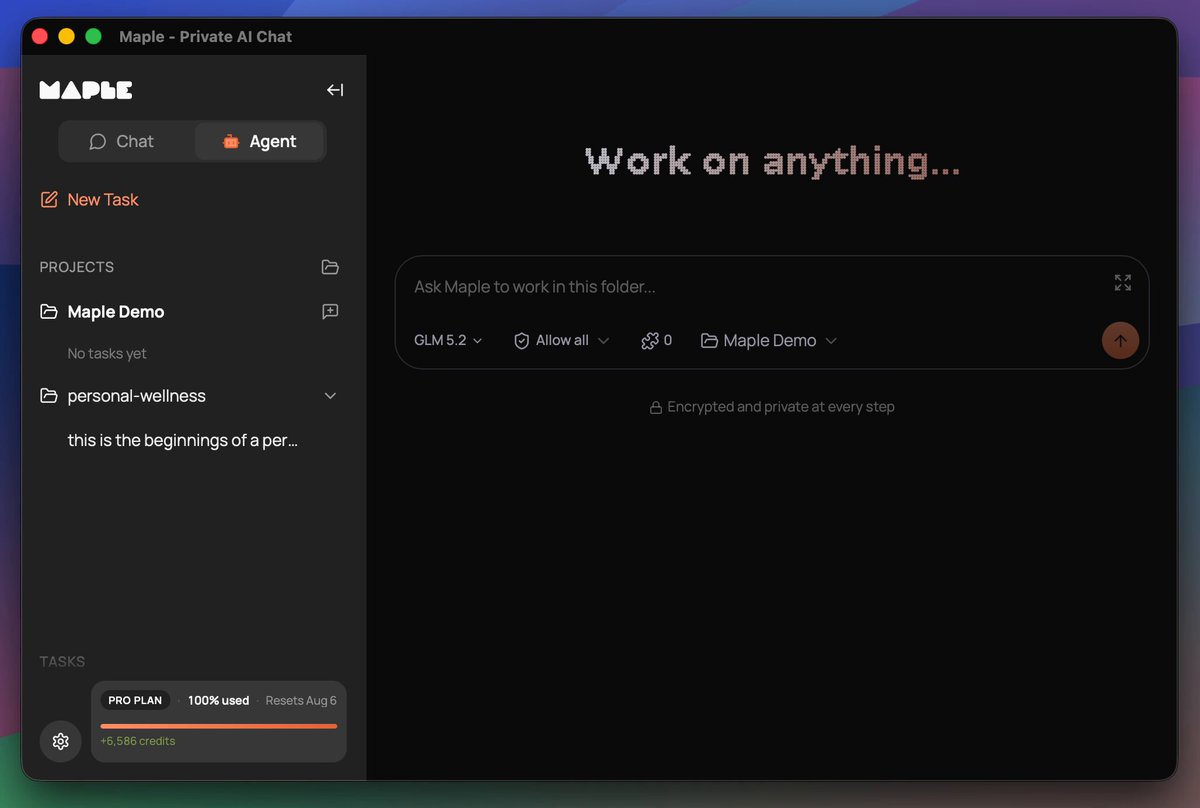
Maple is preparing for the release of a co-working agent. You install it locally and it works with your files, whether it's office work or building websites and apps. It's a turnkey solution, as easy as Claude Code, that keeps your data secure and private, no data sharing with closed AI labs. This is THE sovereign AI app for individuals and businesses who want powerful AI while retaining ownership of their information. Why build an agent into the Maple app when other agents already exist? Easy, we want to give you control over your work. We don't have a business plan that incorporates making money off our users' data. In the age of AI, your information, whether it's personal or company trade secrets, is the single thing that differentiates you from everyone else. We all have access to AI that can build a professional website for selling shoes. But your strategy and network for how you sell shoes should not be shared with your competitors. Sovereignty is the path to protecting what makes you, you. Maple sits at the intersection of Usability and Sovereignty. Maple gives you the best tools that are both easy to use and maintain your data sovereignty. Sovereign for one, sovereign for all. It has been a journey to get here. We brought to market the very first personal chatbot with end-to-end encryption using TEEs in late 2024. Prior to that there were proofs of concept but no full product offerings. Every other AI chat product on the market handled your data in plain text, either selling you a service to get your data or asking you to trust that they won't snoop on you. Quickly people found Maple and latched onto its open-source code and verifiable encryption. We didn't stop there. You may remember earlier this year we teased a product called "Maple Agent" and opened up a waiting list. That product is a mobile app that acts as your AI "friend", maintaining one long continuous chat, and getting to know you over time. I dislike using the word "friend" there, but it's the best way to convey the UX in a few words. AI is a tool, always has been, always will be. Any kind of friendly personality on top is just synthetic. In our testing, the UX of Maple Agent is really powerful for what it does. Think about the many short AI chats you have in your favorite app, whether it's looking up a historical fact or asking advice about a topic. With Maple Agent, those all go away in favor of the long-running chat with the friendly agent. It's like you have your own personal assistant who knows you so well and can look up anything for you. When I ask AI certain questions, I want to ask an expert who already understands my situation so I'm not repeating myself for the 100th time. That's the amazing value the personal agent brings to the table. We still see great utility for a personal agent like the "Maple Agent". Thousands of people on the waiting list, hoping to get their hands on it, agree that the concept is worth exploring and trying out. We were constrained in launching it due to a few circumstances, one of them being access to the scale of compute needed to power it. We have a clear path laid out for how to get there, but today is not the day to execute on that. It will be in the near future. Instead we have a different agent ready to go that we think is also incredible. We now have an agentic harness inside of the Maple Research app. This thing is a powerhouse. It even builds and publishes its own software releases. The agent in Maple Research works with your local filesystem, speaks to the largest open models running in TEEs, utilizes local models for certain tasks, is compatible with MCP tools, has an API for connecting to anything you need, and also supports the ACP protocol, which means it can be extended in the future to speak to other tools like Claude Code, Codex, and local models running on your own hardware. A big unlock for us was the Goose Development Kit, which powers the core of our agent harness. More on that to come as we publish articles and documentation later about the agent. The agent inside Maple Research doesn't have a name. At least not yet, not sure if it ever will. For now we call it "Chat Mode" and "Agent Mode". Think of this as the workhorse, the truck, the heavy lifter. Our other "Agent", the phone app, is your sidekick in your pocket, ready to help with quick things and ongoing conversations about life. I am incredibly excited about the Maple Research Agent. While I'm already seeing great results using it for internal work items, I'm especially thrilled about the personal health and wellness work it's doing for me. I know there are plenty of apps out there for compiling wellness data, but I'm having it build a tool tailored specifically for what I need, without the extra fluff. And none of my health data is being donated to the closed AI labs or sent to advertisers. I know that the AI logic is not being silently adjusted to fit the whims of a large corporation that has paid for product placement. It's me, state of the art AI, and my data. That's how I want it. Maple's new agent makes that possible. We can't wait for you to try it out. If you want early access, comment here, email us, reach out in some way. To those on the other agent waitlist, you're already in the queue. Thanks for reading this lengthy update. :)

Mark

46,589 Aufrufe • vor 1 Monat