Video wird geladen...

Video konnte nicht geladen werden

Zur Startseite

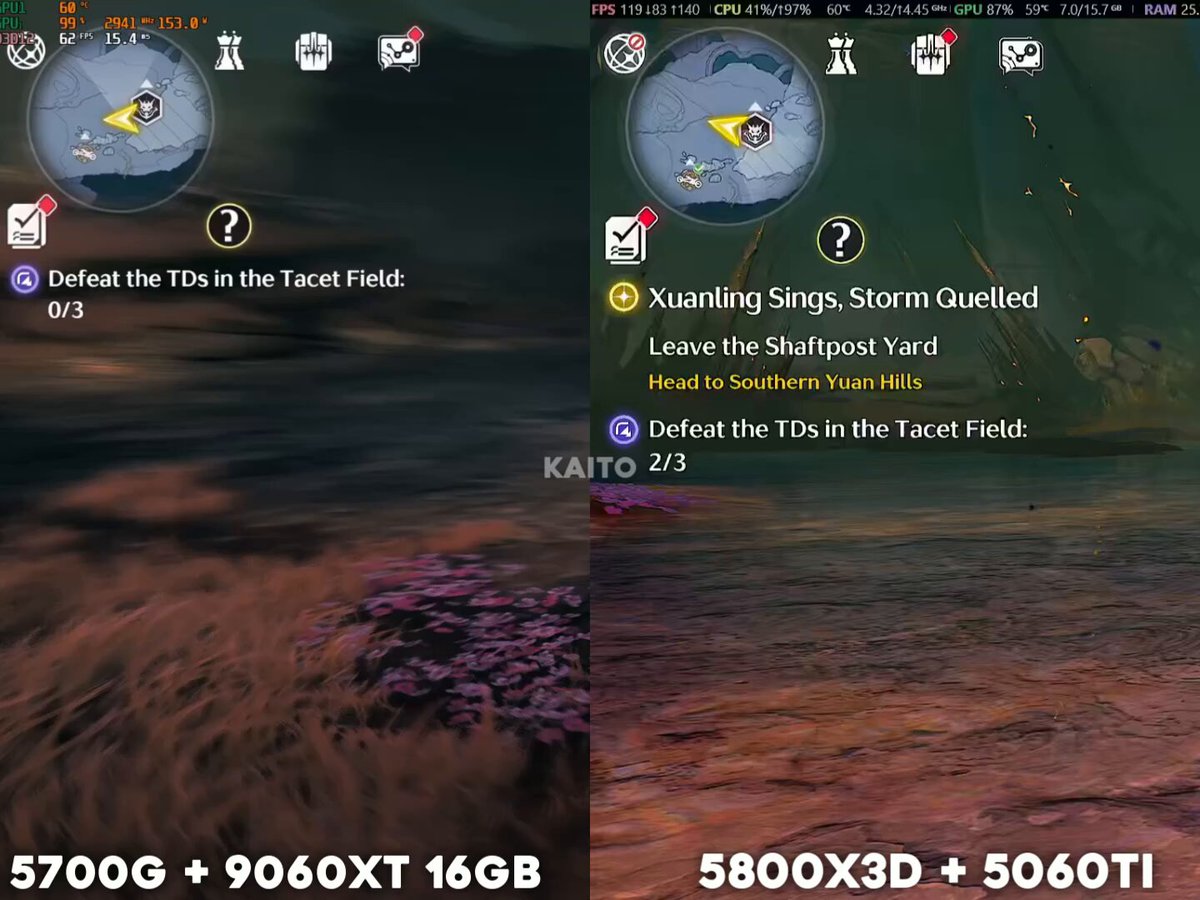
Silver Palace is struggling to maintain smooth performance on RTX 4060 at max settings in 1440p. It definitely needs more optimization before launch. Hopefully the devs improve performance by release. 🤞 #SilverPalace #同一律テスト #白銀の城 #Gacha

10,629 Aufrufe • vor 2 Monaten •via X (Twitter)

0 Kommentare

Keine Kommentare verfügbar

Kommentare vom Original-Post werden hier angezeigt

Ähnliche Videos

Wuthering Waves PS5 Performance Test • Test Setup PS5 Slim (brand new, clean, no dust) Room temperature: 22°C with AC • Map Issue Yes, it's real. The new map is locked to around 2 FPS when opened from the menu, making it extremely laggy. • Stuttering Problems The game has severe stuttering. In some areas, it even freezes for 4–5 seconds, making the experience frustrating. • My Observation From my testing, the game appears to be running at a very high internal resolution on PS5 instead of relying on aggressive upscaling. For example, DLSS Quality at 1440p renders the game internally at approximately 1707×960 before upscaling it to 2560×1440. On PS5, however, it looks like the game is rendering at or near 2560×1440 internally and then upscaling to 4K. If that's true, it's an extremely demanding target for a base PS5. • Is This Fixable? Yes. If the game is indeed using such a high internal resolution, lowering it and using better reconstruction or dynamic resolution scaling could significantly improve performance. Running at such a high internal resolution on a base PS5 doesn't make much sense, and the game has suffered from performance issues for nearly 12 months. • Final Thoughts Kuro Games needs to address this. At this point, we can't keep blaming players, their hardware, or the engine. If the high internal resolution is the cause, it should be adjusted. If it isn't, then something else in the game's optimization is seriously wrong. #WutheringWaves #Gacha

Kaito

50,372 Aufrufe • vor 2 Monaten

Few people care more about software performance than Casey Muratori. Give him a few minutes of your attention with this episode, and he'll convince you to learn to read Assembly (no, really, I finally started to read it, it's really not that scary, esp with an AI that can help explain the sequences). Timestamps: 00:00 Intro 05:17 Games at Microsoft 12:52 Building games 16:00 Why performance matters 27:12 Why you should learn to read assembly 30:36 Designing for optimization 42:51 How to get better at writing performant software 49:04 Understanding how the CPU works 55:53 Building games then and now 1:05:56 How game engines changed building games 1:10:48 Why new games compete with old games 1:13:25 GTA 6: why is it taking so long? 1:16:59 Casey's critique of clean code 1:21:48 Casey's take on TDD 1:24:30 What is good code? 1:27:32 What makes a good software engineer? 1:33:56 Why Casey doesn't code with AI 1:39:01 AI's impact on the game industry 1:44:43 AI and burnout 1:50:21 Why you should read papers Brought to you by: • Antithesis – verify your system’s correctness without human review or traditional integration tests – and avoid bugs or outages • Sentry – application monitoring software considered “not bad” by millions of developers • turbopuffer – a vector and full-text search engine built on object storage. It’s fast, cheap, and extremely scalable Three interesting things we talked about: 1. Is performance starting to matter to businesses? Enterprise software buyers care mainly about cost, compliance, and capabilities – but not performance. Even so, there are some products gaining major popularity and market share due to their performance, such as File Pilot (next-gen file explorer) and the Blick video editor. Is the tide turning? 2. Profiler-driven performance optimization is the wrong way to optimize The standard way of optimizing is to profile the application, tweak hotspots, then check if the stats have improved. But this only finds a local minimum; Casey says every engineer he’s worked with who was a great “optimizer” began by establishing what the hardware could theoretically do, and then did not stop until they’d closed the gap to that performance level. 3. Take a grain of salt with conventional wisdom that premature optimization is the “root of all evil” Many devs use it as an excuse to delay performance optimization, but Casey says that not optimizing in time could mean that only performance hotspots can be fixed later, and not the architectural issues that create poor performance. Architect your system to be performant, or you’ll have trouble solving problems without a rewrite!

Gergely Orosz

97,977 Aufrufe • vor 26 Tagen

Here’s my written & video review of the new 2026 Tesla Model Y Performance after driving it for a week. This is the best-value new Tesla you can buy. Crazy performance, no real drawbacks, and all for just $57,490. Let’s dive in. Price: I haven’t seen many others mention this: every option on the Model Y Performance is included at no extra cost in the US (except FSD). So if you spec a Model Y Premium AWD with an upgraded paint color, tow package, white interior, and upgraded 20" wheels, a fully loaded Model Y Premium AWD ends up only about $2,500 less expensive than a fully loaded Model Y Performance. Ride Quality: I thought I might feel worse ride quality vs my Premium AWD Model Y with 20" wheels, but I struggled to find any real difference, despite the larger 21" wheels, firmer suspension setting, and 0.6" lower ride height on the Performance trim. A true testament to Tesla's engineering magic on this thing. Exterior Design: Unlike the previous Model Y Performance, Tesla made some exterior design tweaks with a new front and rear fascia to spice things up a bit. The result, in my opinion, is the best-looking Model Y trim you can buy. It definitely has a more aggressive presence in person, even if it's subtle. The carbon-fiber spoiler boosts high-speed stability and cuts aerodynamic drag by 10%. The new 21’’ Arachnid 2.0 wheels look fantastic in person, one of my favorite designs ever from Tesla. Staggered wheel and tire fitment provides better grip and steering. The beefier 275mm rear tires (255mm in the front) give the vehicle a better stance from behind. Vehicle-to-Load (V2L): For the first time on a Model Y in North America, you can now plug in anything you want to the exterior charge port with an adapter, even a campsite! It provides up to 2.4 kW of power (120V at 20A) from two household outlets. It's a great feature. Interior: It’s what you know and love, but with a few changes that elevate the ownership experience. New with the Performance is a larger 16" center screen (vs. 15.4" on non-Performance models), with thinner bezels and higher resolution. It’s not a huge difference on paper, but you definitely notice it in daily use. The carbon-fiber décor on the door cards and dash is a nice touch, though I would like to see it extended to the center console. The new performance seats are the best seats of any Tesla I've ever experienced. While they retain aggressive bolstering in the torso area, the bottom seat cushion has less aggressive bolstering than on the Model 3 Performance seats, making it easier to get in and out. It also doesn’t squeeze your thighs too tightly. The powered thigh extenders add comfort on longer drives, especially for taller people who want extra support. And of course, they’re heated and ventilated. The headrests also feel more comfortable than the ones in my Model Y. I want these seats. Unlike the old Model Y Performance, the new one has no Track Mode. Why? Because nobody used it lol. No point in putting engineering resources into something people won’t use. The refreshed Model 3 Performance still has it, though. Cabin Quietness: Despite the thinner-profile tires, there is no noticeable difference vs my Premium Model Y. Decibel reading results at highway speeds were visually the same compared to my 2026 Model Y Premium (65-66). Driving Impressions: It’s amazing. Sharp, precise, and agile. The vehicle feels stable at all times. Acceleration is blistering (3.3s 0–60 mph), with plenty of punch even at higher speeds. The tires offer good grip, and cornering is fantastic for an SUV. The suspension setup is great. More steering wheel feedback would be nice, though. Cruising around traffic is a joy. The brakes are much improved over the previous Model Y Performance and are far better suited for spirited driving. There are three acceleration modes: Chill, Standard, and Insane. Just stay in Insane. You’d be insane not to lol. The car also lets you switch between two ride and handling modes: Standard and Sport. The difference isn’t huge, but Standard is better if you’ve got passengers. FSD: I unfortunately wasn’t able to get FSD V14 on this car. It had V13.2.9, so I didn’t use it much. But in the little time I did, it was smooth and comfortable. It didn’t bother me because V14 will perform just as well here as it does on my 2026 Model Y Premium AWD. Conclusion: You won’t find another new SUV today that offers this level of performance for the price. Back in 2022, when Tesla couldn’t build Model Ys fast enough, a fully loaded Model Y Performance cost over $90,440. Today, the refreshed and far more capable 2026 Model Y Performance is just $57,490 fully loaded, and you can simply subscribe to FSD for $99/month. The 2026 Model Y Performance delivers utility, great performance, comfort, tech, self-driving and everything else people love about the Model Y. It’s a no-brainer purchase. I want one badly, but I'll need to show restraint, as I’m saving up for a house lol.

Sawyer Merritt

225,461 Aufrufe • vor 9 Monaten