Загрузка видео...

Не удалось загрузить видео

На главную

Since I joined Cognition I've been obsessed with learning how our eng team uses Devin themselves If we are building the best coding agent + we have the most cracked engineers + we've been fully AI-pilled from day one... it stands to reason that there is a lot to...

131,565 просмотров • 1 месяц назад •via X (Twitter)

Комментарии: 0

Нет доступных комментариев

Здесь появятся комментарии из оригинального поста

Похожие видео

How I get shit done, Episode 001 I've set up a playbook called ‘land’, which is triggered automatically when I drag an issue into the merging column in Linear. That reliably runs CI and merges any green PRs. This has allowed me to ship way faster than before. I think the key takeaway here is you can try to build your own code factory and your own agent orchestration layer, but it is a huge amount of work. The truth is there are entire companies with massive funding that are already tackling this and it's just easier to use their platform. I think this is a lot like if you were a carpenter: you could build your own generator, fuel it, wire it up, and then build a plug and then you could plug your saw into it. Or you could just plug your saw into the wall. Because the electricity company has already done all the work in the infrastructure and investment to make that plug work. I think more of us who are building companies should just be plugging into the wall instead of trying to build all this tooling ourselves. As a dev it's so tempting to build your own dev tools but I think a lot of times, even though you can build fast with agents now, it's a complete waste of time. It probably sounds like I'm being paid by Devin or something but I have zero financial interest here. They don't give me credits. I'm not an investor. I'm not being paid. I just think the tooling is really damn good. If you used Devin a long time ago and wrote it off, you really should have another look - for $500/month it's pretty obscene what you can get done.

Ryan Carson

14,059 просмотров • 4 месяцев назад

Airtable's Howie Liu says that basically everyone will need to graduate from being ICs to ICs that manage teams of 20-30 agents: "The best developers today don't just sit there in front of their IDEs and synchronously talk to their agent." "[Instead], you have like 30 separate branches that are each being worked on by a different agent. And you can have the agents continue to update the branches based on human and other agent feedback." "And I think this whole idea of it taking hours for that entire loop to complete — agent pushes some changes, the changes get feedback from other agents or humans, the agent responds to that — that whole loop could be hours, not just minutes. So you're not going to just sit there and watch it one at a time." "But the powerful thing about this is, each one is still actually operating faster than a human engineer. One agent on one branch can do the work of maybe three humans, operating 3x as fast. So it's like a 10x leverage factor just for one agent." "But the best engineers are now able to multitask and say, 'I'm going to oversee my own little team of 20-30 agents working concurrently.'" "Everyone needs to graduate from being an IC to an IC manager of agents. Meaning, if you're a VC analyst, your job should no longer be to go synchronously research one company. You need to go and research like 30 companies, and do them all faster, better, and higher quality than you could before." "That's the greatest leap that is going to be challenging for a lot of people in a lot of roles. Because it's a totally different mentality in how you operate, and what your role is."

TBPN

35,595 просмотров • 3 месяцев назад

this video is the CLEAREST explanation of how claude skills + AI agents work and how to use them most people set up an AI agent and wonder why it keeps disappointing them. the context window is everything context is what the model assembles before it takes any action. think of it like everything the agent needs to read before it does anything. the quality of what goes in determines the quality of what comes out. the models are genuinely really good right now. claude and gpt are exceptional. the variable is almost always the context you give them. 1. agent.md files are mostly unnecessary every single line you put in an agent.md file gets added to every single conversation you have with your agent. a 1000 line file is around 7000 tokens burning on every run. the model already knows to use react. it can read your codebase. save the agent.md for proprietary information specific to your company that the model genuinely cannot know on its own. 2. skills are the actual unlock a skill.md file works differently. what loads into context is only the name and description, around 50 tokens. the full instructions only appear when the agent recognizes it needs that skill. so instead of 7000 tokens on every run you have 50. and the agent stays sharp because the context window stays lean. the closer you get to filling the context window the worse the agent performs, same way you perform worse when someone dumps 10 things on you at once. 3. here is how to actually build a skill the right way most people identify a workflow and immediately try to write the skill. what you want to do instead is run the workflow by hand with the agent first. walk it through every single step. tell it what to check, what good looks like, what bad looks like. correct it in real time. once you have had a full successful run from start to finish, tell the agent to review everything it just did and write the skill itself. it writes a better skill than you will because it has the full context of what actually worked in practice not in theory. 4. recursively building skills is how you go from frustrated to reliable when the skill breaks, and it will break, ask the agent exactly why it failed. it will tell you specifically what went wrong. fix it together in that same conversation. then tell it to update the skill file so that failure mode never happens again. ross mike did this five times with his youtube report generator. it now pulls from eight different data sources and runs flawlessly every single time without him touching it. 5. sub agents are something you earn not something you set up on day one start with one agent. build one workflow. turn it into one skill. once that works add another. ross mike has five sub agents now covering marketing, business, personal and more. it took months to get there and every single one exists because a workflow proved it deserved to exist. the people who set up 15 sub agents on day one and wonder why nothing works skipped all the steps that make the thing actually run. 6. your workflow is the thing the model cannot get anywhere else the model has been trained on everything. it knows more than you about most things. what it does not have is your specific process, your taste, your way of doing things. that is what skills capture. that is what makes your agent actually useful versus a generic one. downloading someone else's skill means downloading their context onto your setup and it will not work the way you want it to because it was never built around how you work. this is the clearest explanation of how agents actually work i have heard. Micky runs this stuff every single day and the results show it. full episode is now live on The Startup Ideas Podcast (SIP) 🧃 where you get your pods people charge for this sorta stuff i give away the sauce for free i just want you to win watch

GREG ISENBERG

193,219 просмотров • 4 месяцев назад

The subject of 'owning a slave' is dense. It is something we hear a lot when we are in the FemDom Realm. Is it just fantasy? Can it actually be a lifestyle? How do we navigate this type of dynamic? How do we even get to that level of D/s? In this short clip [Exerpt from SLAVE TRAINING Part 2] I want to already bring to your attention one thing that will define if your desire for a slave (or desire as a slave) is touching more on a fantasy or... how can you actually navigate this in a realistic way. No one person 'can do it all' or should be expected to. If you want your slave to be 'the best' , assign them a specific role in which they can excel... and then build upon that. Once they 'master' your housekeeping (which takes quite a bit of real training), they can move to other levels. And an important note I want to leave here... make them EARN access to certain things in your life that sometimes you just want to delegate because you don't want to manage or don't know how to manage. Entrusting them with serious tasks that can affect your life, your business, your reputation, are on top of the ladder. Are they even qualified for the thing you want them to take off your shoulders? Start small and allow them to grow in their submission, to develop their skills and to learn how to best satisfy you without setting them up for failure by expecting too much, too quick. In the end, if you want this to truly work, you have to approach it from a place that transcends the roles. As this is consensual power exchange. And you both want to be fulfilled in that relationship.

Ms. Malissia

12,836 просмотров • 5 месяцев назад

"Every team wants to win a championship, but not every team wants to do the things required for a championship. And here's the thing: it's easy to be an average team. It doesn't require a lot. It's less adversity to be average in the world. The consequences of being average aren't easy. We end up wearing them. There's strain and struggle that comes with that too. The standard is just lower to be an average team. To be a championship team, to be champion, to be a championship team member here . . . I'm not gonna lie to you . . . I'm going to tell you the truth. It is harder. It is. The question is: Is it worth it? Some people say, "Oh it's not harder work." Yes it is. It's harder work. You can pursue comfort or you can pursue excellence. If we pursue comfort, we gotta give up some excellence. But if we pursue excellence, then we're just going to face more adversity. Everyone who's ever accomplished something excellence has had to overcome it. We are here today for a reason. Two reasons actually. Reason #1 is let's make sure that we identify and realize the opportunities that are in front of us. Reason #2 is let's make sure that we are preparing for the adversity that those opportunities require. And just understand: every single time you lever up your opportunities and you identify, "Oh there's something more I can do, more I can achieve. I can get better. I can earn more. I can do this." It's going to be matched with the adversity that comes with it. I want to make sure we are prepared for both of those, so that we're not chasing big opportunities and then getting mad when things start getting harder along the way. Is that fair? Does that make sense?"

Brian Kight

125,742 просмотров • 2 лет назад

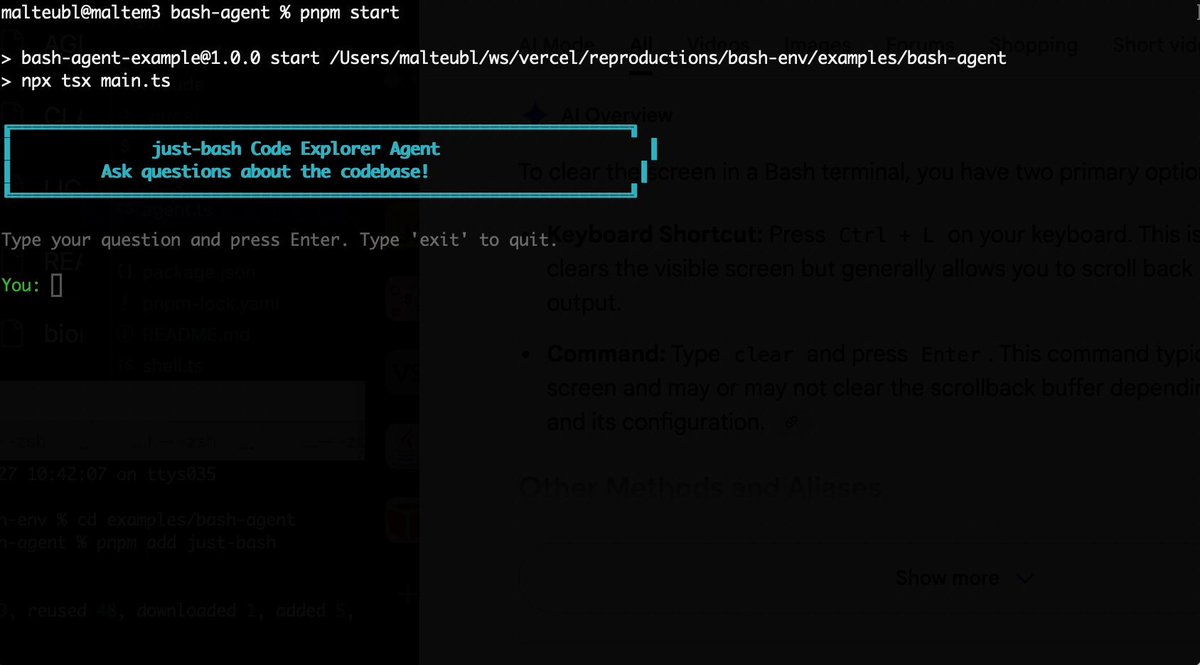
Bash is all you need! Which is why I'm introducing my holiday project: just-bash just-bash is a pretty complete implementation of bash in TypeScript designed to be used as a bash tool by AI agents. Because it turns out agents love exploring data via shell scripts, even beyond coding. It comes with grep, sed, awk and the 99th percentile features that an agent like Claude Code or Cursor would use. In fact, Claude Code can use it for secure bash execution. In the package - A bash-tool for AI SDK - A binary for use by yourself or your coding agents - An overlay filesystem to feed files to your agent securely - A Vercel Sandbox compatible API, so you can quickly upgrade to a real VM if you need to run binaries - An example AI agent that explores the just-bash code base using just-bash - I imported the Oils shell bash compatibility suite and just-bash passes a very good chunk What is interesting about this codebase: It was essentially entirely written by Opus 4.5. Coding agents love bash and they are good at reproducing it. They are also great at text-book recursive descent parsers and AST tweet-walk interpreters. That said, it is, like, a lot of code and I didn't read it all 😅. This is very much a hack, but it also seems to be _really_ useful. I haven't really found anything agents want to use that it doesn't support and it's fast and secure (caveats apply). It doesn't have write access to your computer and the filesystem is given a root that the agent cannot escape from. Find it at Related: Our recent blog post how we migrated our data analysis agent to bash tools and achieved incredible quality improvements The video shows the example agent investigating the just-bash code base

Malte Ubl

125,326 просмотров • 7 месяцев назад

How many AI agents work at your company? We now have over 3,258 agents working alongside 1,300 humans. The crazy part is these agents were created by EVERY EMPLOYEE at our company... sales reps, marketers, customer support, product, eng. Literally EVERYONE. BUT I'm most surprised by the adoption and value that MANAGERS are getting from agents. I used to think that every IC would become a manager of agents. Now I think that managers will very likely manage WAY more agents than their ICs combined. And managers' agents will manage their ICs' agents - overseeing them for human-in-the-loop interactions. When creating agents, we use 100% context from all of your activity, files edited, tasks and projects worked on, hierarchy, skills, and role information. We build a user-based context model to make agents as relatable as possible to the specific human that we're building for. This means they truly understand the nuances of the work and what "great" looks like - because great is very much in the eye of the beholder. Great is by definition, subjective. This is also why the human ENGAGEMENT loops are SO vital to agent value. The iteration AFTER the agent is onboarded is where the MAGIC happens. This is just like a manager managing an IC in real life... you're giving feedback. In this case, though, agents learn INSTANTLY, and they retain the knowledge perfectly and indefinitely. Even though I've been pushing AI for years now to everyone in our company, this was the first time we had truly end-to-end AI adoption and retention. This kind of AI adoption is wild. But the value we're realizing is truly INSANE. Super Agents outnumber our humans nearly 3 to 1. What if you could 3X your workforce overnight? Watch this video to see how 👇

Zeb Evans

425,244 просмотров • 6 месяцев назад

Brian still spends over two hours a day on recruiting and personally hires the top 200 people at Airbnb. I loved this idea of being in the flow of talent to find the best people: "Don't do searches. Build pipelines. I try to map out all the best people in the Valley. So let's say I need to hire really good engineers. I don't do searches. I just informationally meet the best engineers in the world. Every meeting, the job is to get the next meeting, meet someone else. The mistake people make when they hire. They go, "I need to hire a blank." So they hire a search firm. They give you 50 profiles, and you pick the best one. That is the wrong way to do it. The best way to do it is pipeline recruiting. You're constantly recruiting, you're constantly meeting people. in advance of searches. And all of it is referral based. The two ways to find out if people are good – is to start with the results and work backwards to the people. Find an ad you like and figure out who made that ad. Start with the results. Work backwards to people. Don't start with the resume. The other thing to do is just keep asking people to build your Rolodex. The moment I find somebody that's really good, I ask them who all the best people they know are. And I build these little mafias and they tell you who the other good people are. I am the co-hiring manager for the top 200 people in the company. This is very radical. A lot of CEOs think it's their job to hire their executive team, and their executive team hires their team. I think that is fatal. You always want to be marrying up, hiring people of the future. It should be like we're reaching. If you can hire them without my help, we're not reaching far enough. You want to hire the very best person you can."

Patrick OShaughnessy

317,097 просмотров • 3 месяцев назад

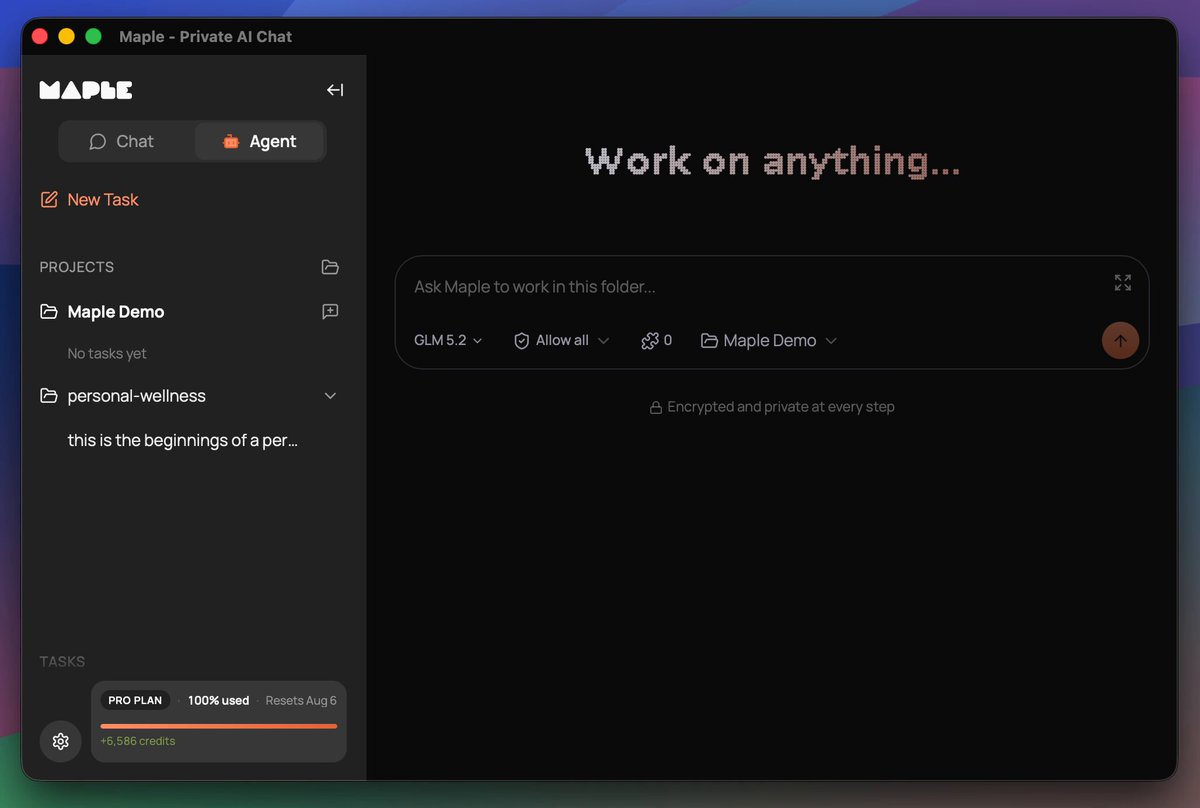
Maple is preparing for the release of a co-working agent. You install it locally and it works with your files, whether it's office work or building websites and apps. It's a turnkey solution, as easy as Claude Code, that keeps your data secure and private, no data sharing with closed AI labs. This is THE sovereign AI app for individuals and businesses who want powerful AI while retaining ownership of their information. Why build an agent into the Maple app when other agents already exist? Easy, we want to give you control over your work. We don't have a business plan that incorporates making money off our users' data. In the age of AI, your information, whether it's personal or company trade secrets, is the single thing that differentiates you from everyone else. We all have access to AI that can build a professional website for selling shoes. But your strategy and network for how you sell shoes should not be shared with your competitors. Sovereignty is the path to protecting what makes you, you. Maple sits at the intersection of Usability and Sovereignty. Maple gives you the best tools that are both easy to use and maintain your data sovereignty. Sovereign for one, sovereign for all. It has been a journey to get here. We brought to market the very first personal chatbot with end-to-end encryption using TEEs in late 2024. Prior to that there were proofs of concept but no full product offerings. Every other AI chat product on the market handled your data in plain text, either selling you a service to get your data or asking you to trust that they won't snoop on you. Quickly people found Maple and latched onto its open-source code and verifiable encryption. We didn't stop there. You may remember earlier this year we teased a product called "Maple Agent" and opened up a waiting list. That product is a mobile app that acts as your AI "friend", maintaining one long continuous chat, and getting to know you over time. I dislike using the word "friend" there, but it's the best way to convey the UX in a few words. AI is a tool, always has been, always will be. Any kind of friendly personality on top is just synthetic. In our testing, the UX of Maple Agent is really powerful for what it does. Think about the many short AI chats you have in your favorite app, whether it's looking up a historical fact or asking advice about a topic. With Maple Agent, those all go away in favor of the long-running chat with the friendly agent. It's like you have your own personal assistant who knows you so well and can look up anything for you. When I ask AI certain questions, I want to ask an expert who already understands my situation so I'm not repeating myself for the 100th time. That's the amazing value the personal agent brings to the table. We still see great utility for a personal agent like the "Maple Agent". Thousands of people on the waiting list, hoping to get their hands on it, agree that the concept is worth exploring and trying out. We were constrained in launching it due to a few circumstances, one of them being access to the scale of compute needed to power it. We have a clear path laid out for how to get there, but today is not the day to execute on that. It will be in the near future. Instead we have a different agent ready to go that we think is also incredible. We now have an agentic harness inside of the Maple Research app. This thing is a powerhouse. It even builds and publishes its own software releases. The agent in Maple Research works with your local filesystem, speaks to the largest open models running in TEEs, utilizes local models for certain tasks, is compatible with MCP tools, has an API for connecting to anything you need, and also supports the ACP protocol, which means it can be extended in the future to speak to other tools like Claude Code, Codex, and local models running on your own hardware. A big unlock for us was the Goose Development Kit, which powers the core of our agent harness. More on that to come as we publish articles and documentation later about the agent. The agent inside Maple Research doesn't have a name. At least not yet, not sure if it ever will. For now we call it "Chat Mode" and "Agent Mode". Think of this as the workhorse, the truck, the heavy lifter. Our other "Agent", the phone app, is your sidekick in your pocket, ready to help with quick things and ongoing conversations about life. I am incredibly excited about the Maple Research Agent. While I'm already seeing great results using it for internal work items, I'm especially thrilled about the personal health and wellness work it's doing for me. I know there are plenty of apps out there for compiling wellness data, but I'm having it build a tool tailored specifically for what I need, without the extra fluff. And none of my health data is being donated to the closed AI labs or sent to advertisers. I know that the AI logic is not being silently adjusted to fit the whims of a large corporation that has paid for product placement. It's me, state of the art AI, and my data. That's how I want it. Maple's new agent makes that possible. We can't wait for you to try it out. If you want early access, comment here, email us, reach out in some way. To those on the other agent waitlist, you're already in the queue. Thanks for reading this lengthy update. :)

Mark

44,707 просмотров • 20 дней назад

The same kinds of productivity gains we've seen in coding with AI agents are heading to the rest of knowledge work. This is the jump when you go from having a chatbot to being able to actually have an agent go off and do work for minutes or even hours and come back with a complete work output that you then review. Here's an example of the new Box Agent filling out an RFP response from an existing knowledge base. This process would normally take hours to fill out, and requires the full attention of the user doing the work. Now, you provide the Box Agent with the RFP questions, and it will go off, make a plan, extract all the relevant questions, read through existing source material to come up with an answer, and then generate a new word document as the final output. All while you're doing something else. The key to this architecture is that the agent is able to use all of the same tools in the background that a user uses to get work done. The agent can search for documents, read entire files, run scripts and tools in the background, and even be able to write code on the fly to automate tasks it hasn't seen before. And best of all, the Box Agent will (soon) work from the Box MCP and CLI so you can invoke it in any agentic system as a step in a process. This kind of agent complexity would have been impossible even 6 months ago. Models consistently failed at tracking long running tasks or using the right tools at the right moment for the task. But this is all now possible because of models like GPT-5.4, Opus 4.6, and Gemini 3, and is only getting better by the month. Just as we moved from engineers writing code and using AI as an assistant to answer questions, in many areas of knowledge work -like legal, finance, consulting, sales, marketing, and more- when we have a problem we'll just kick off the AI agent to just go work on it for us in the background.

Aaron Levie

24,618 просмотров • 4 месяцев назад