Loading video...

Video Failed to Load

Go Home

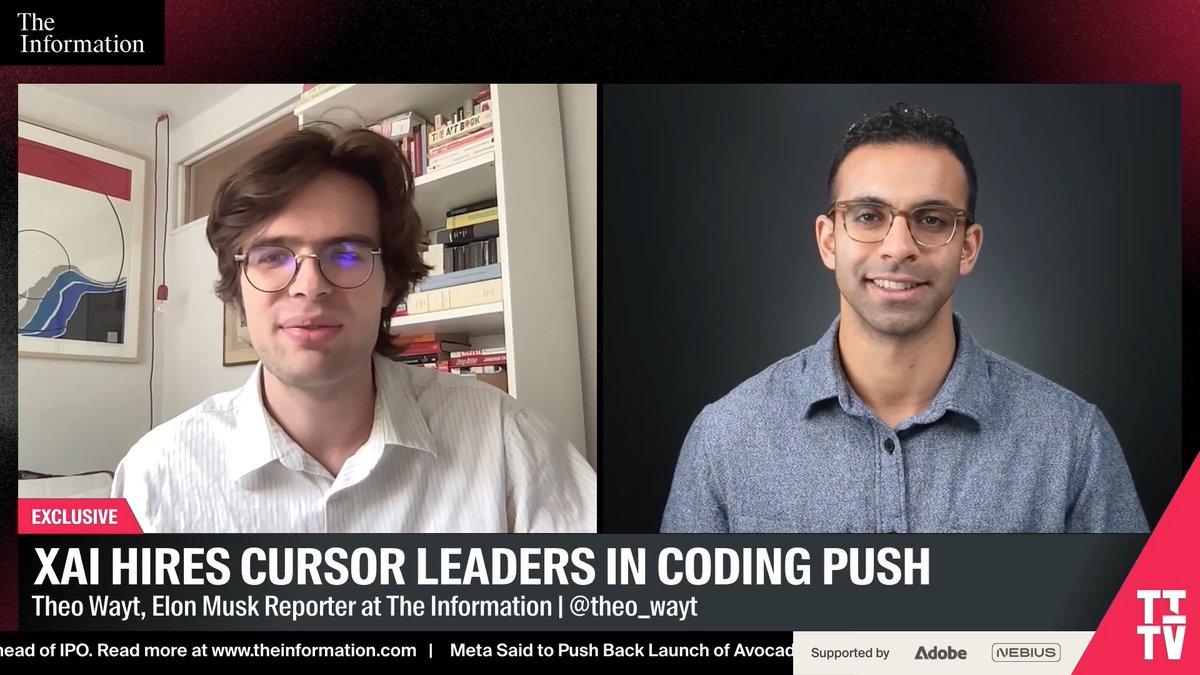
SITUATION EXPLAINED: Why are OpenAI and Anthropic suddenly buying tiny data centers? • OpenAI and Anthropic are both looking at deployments of 20 to 30 megawatts • Anthropic has sounded out agreements in that range across the UK and the Nordics. OpenAI has been exploring the Nordics too •...

22,882 views • 11 days ago •via X (Twitter)

3 Comments

Rune's profile picture
Rune11 days ago

👀

GGUFzy's profile picture
GGUFzy11 days ago

I still cannot tell when inference alone starts needing those tiny sites.

More Tulips's profile picture
More Tulips11 days ago

Yes it matters. Nordics high up north almost no cooling costs because of temperature.

Related Videos

THIS IS ABSOLUTELY RIDICULOUS. OpenAI and Anthropic are losing money on every dollar they make. OpenAI generated $20 billion in revenue in 2025 and is projected to lose $14 billion in the same year. Internal forecasts project cumulative losses hitting $44 billion by 2028. The company's own CFO warned executives in April 2026 that OpenAI might struggle to finance upcoming computing deals if revenue growth slows. Anthropic reached $4.3 billion in annualized revenue in April 2026 against $19 billion in total costs. It spends $3 to make $1, and is not expected to stop burning cash until 2027. Now look at what these two companies have committed to spend. OpenAI and Anthropic together have committed $1.05 trillion in cloud spending to Microsoft, Oracle, Google and Amazon, making up 43 to 54% of each provider's entire future revenue backlog. - Microsoft: $627B total backlog. OpenAI and Anthropic account for 49%. - Oracle: $553B total backlog. OpenAI alone accounts for 54%. - Google: $467.6B total backlog. Anthropic accounts for 43%. - Amazon: $464B total backlog. OpenAI and Anthropic account for 51%. The entire cloud industry's future revenue is a bet on two companies losing billions every quarter. Microsoft, Alphabet, Meta and Amazon are collectively expected to spend $725 billion in capex in 2026, almost entirely on AI infrastructure. Combined hyperscaler capex from 2025 to 2027 is projected at $1.15 trillion, more than double what was spent from 2022 to 2024. What is the return on all of this? McKinsey's 2025 State of AI survey found that only a minority of companies reported AI meaningfully increased revenue or reduced costs. Enterprise generative AI spending grew from $1.7 billion in 2023 to $37 billion in 2025 and most CIOs still describe their initiatives as pilots without clear ROI metrics. Microsoft's AI business is running at a $37 billion annual revenue run rate with 123% year over year growth. That sounds impressive until you realize most of the capex funding is justified by expected future AI revenue rather than current AI profit. The internet burned money for years before it became the most profitable industry in history. But right now $1 trillion in committed cloud spend, $725 billion in annual capex, two loss-making customers making up half of every major cloud provider's revenue backlog, and the enterprises writing the checks cannot tell you if any of it is working.

Crypto Rover

58,862 views • 4 months ago

Gabe on why he doesn't think Anthropic or OpenAI will own finance: "The reason people get confused when they look at app layer businesses like mine or Harvey or Legora or Sierra is because there's a spectrum of perpendicularity to what the labs are building. There's a whole bunch of stuff underneath the surface that the labs are never going to build, that we need to build for finance. All of finance is a collection of different niches with different data sets, different regulatory requirements. And we can get to $5 billion in revenue by going deep across those things and creating the systems of record that help manage them. That for Anthropic would be like stopping on the side of the road to pick up a penny, because they're on the pathway of trying to go from $100 billion in revenue to a trillion in revenue. Say you are a big public company buying another big public company and you need to send data back and forth. You actually need some sort of data room, something that is compliant, safe and secure. And I don't think OpenAI or Anthropic will ever want to build a data room business. If you actually want to be the exchange for all of high finance, you don't just need to own the intelligence, you need to own the transaction venue, the communication venue, the workflows, and all the data inputs that go into it. Think about the fundamental difference between Claude Code when it came out versus ChatGPT. The models were actually fairly similar, but the harness and the way that it was presented from Claude was far better. The way that you harness these models is so, so important."

Patrick OShaughnessy

85,168 views • 7 days ago

OpenAI just admitted Anthropic is KILLING their business. Their own applications chief told employees it was a "code red." Said Anthropic was a "wake-up call." Then admitted OpenAI had been "spreading efforts across too many apps" and it was "slowing them down." This is an internal confession. Here's why Anthropic is eating up OpenAI: 12 months ago, OpenAI owned 50% of all enterprise AI spending. Today it's just 27%. Anthropic went from nearly ZERO to winning 70% of every first-time enterprise AI deal. Seven out of ten companies buying AI tools for the first time are choosing Claude over ChatGPT. A year ago, one in 25 businesses on Ramp paid for Anthropic. Today it's one in four. OpenAI just had its biggest single-month adoption decline ever recorded. And Anthropic literally charges MORE than OpenAI for roughly the same performance. And businesses are STILL choosing them. In enterprise software, that never happens. The cheaper product usually wins. But Claude became something OpenAI never figured out how to be: Cool. Celebrities publicly switched to Claude. Senators are tweeting about using it. Engineers are shipping entire products with Claude Code in hours that used to take weeks. It started to became an identity signal. Like blue bubble vs green bubble in iMessage. Choosing Claude says something about you now. Meanwhile OpenAI went the opposite direction: They took the Pentagon contract that Anthropic refused. Greg Brockman donated $25 million to fund wars. ChatGPT uninstalls jumped 295% in a single day. Reddit posts saying "Cancel and Delete ChatGPT" got 30,000 upvotes. Anthropic said no to mass surveillance and autonomous weapons. Got blacklisted by the Pentagon. Trump called them a "Radical Left AI company." And their downloads went to #1 on the App Store the next day. Turns out refusing to build weapons is good marketing. But the real damage isn't consumer downloads. It's the MONEY. Claude Code hit $2.5 billion in annual revenue in six months. OpenAI's competing product Codex just barely crossed $1 billion. And Anthropic literally cannot meet demand. They're turning away paying customers because they don't have enough compute to serve them. A company REJECTING revenue because it's growing too fast. While OpenAI scrambles to consolidate. Last week OpenAI announced they're merging ChatGPT, Codex, and their browser into one "superapp." But what this really means: "We launched too many products, none of them worked well enough alone, so now we're cramming everything together and hoping it sticks." And remember their video tool Sora? Launched standalone. Hit #1 on the App Store. Usage flatlined within weeks. Now they're forced to shut it down. Their browser Atlas? Still hasn't launched publicly. Their IPO? Polymarket odds dropped from 55% to 35%. OpenAI has 900 million users. Anthropic has maybe 10 million daily actives. But here's the thing... OpenAI won the consumer war. ChatGPT is where your mom asks about recipes and your cousin makes memes. Anthropic won the war that actually MATTERS. The developers. The engineers. The enterprises writing 7 figure checks. OpenAI built the biggest chatbot on Earth. Anthropic built the tool that companies can't stop paying for. This is Yahoo vs Google all over again. Yahoo had the users. Google had the product. And we all know how that ended. OpenAI has 12 months to prove the superapp works, land the IPO, and stop the enterprise bleeding. If they can't, the most valuable startup in history becomes the most cautionary tale in tech. 900 million users don't mean anything if the people who actually pay are walking out the door. What do you think?

Ricardo

35,020 views • 6 months ago