正在加载视频...

视频加载失败

SOL staking could evolve from passive yield into a claim on real network revenue Mert highlights a key part of the Solana staking thesis: stakers can benefit from economic activity happening directly on the network. “Not only are you getting protected from issuance, you’re getting additional real productive yield...

21,626 次观看 • 2 个月前 •via X (Twitter)

13 条评论

mert 的头像
mert2 个月前

stake with helius and use solana

Kaiz 🐂🀄️ 的头像
Kaiz 🐂🀄️2 个月前

Solana summer 🔥🔥🔥

Kaiz 🐂🀄️ 的头像
Kaiz 🐂🀄️2 个月前

ft: @mert, @paulbarrontv

MORI⚡️ 的头像
MORI⚡️2 个月前

thats the part of solana staking people overlook real network revenue changes everything for holders

Unclearfatez 的头像
Unclearfatez2 个月前

Thats not real mert. The real @mert dont have hair

Honeycomb 的头像
Honeycomb2 个月前

@mert Stake and stack your solana:So11111111111111111111111111111111111111112

Fablo 的头像
Fablo2 个月前

more activity more fees, got it

Crypto Sapiens 的头像
Crypto Sapiens2 个月前

that actually makes sense yeah

Adel Bucetta 的头像
Adel Bucetta2 个月前

that's the beauty of solana's design: the more usage, the more revenue for stakers, but it's not just about yield it's a claim on the entire value chain

Hubra | Solana staking 的头像
Hubra | Solana staking2 个月前

This is why validator choice starts to matter more than the headline APY. Fee and MEV capture varies a lot between operators, and that spread is what actually lands in a staker's account.

Wolfgang 的头像
Wolfgang2 个月前

got it, will follow the instructions strictly now

JPool 的头像
JPool2 个月前

Yes, exactly this. Working on it.

MCF 的头像
MCF2 个月前

Right?

相关视频

OLY | Who Pays for Yield? Yield numbers are easy to advertise. Understanding where that money comes from takes a little more work. Whenever I look at a DeFi protocol, that's where I start. I went through OLY revenue structure on Ethereum, and its flywheel gives us a few things worth examining. - Following Revenue Sources OLY combines several income mechanisms: • ETH collected through sell taxes • ETH staking rewards through Lido stETH • Liquidity fees earned from Uniswap pools Each has a different source. Staking rewards come from Ethereum's validation system. Liquidity fees depend on trading activity, while transaction taxes are paid by market participants. None of these income streams is fixed or guaranteed. - Revenue and Token Inflation One detail worth pointing out is OLY Inflation, which also appears in its flywheel. Protocol inflation can increase treasury token holdings, but newly issued tokens aren't equivalent to revenue earned from staking or trading fees. I think separating these sources matters when evaluating any DeFi model. More incentives don't automatically mean more economic activity. - What Happens as OLY Expands? OLY is already extending its liquidity model into Robinhood Chain, including markets involving tokenized stocks. Bank of OLY is also being prepared as an onchain DeFi initiative, not a licensed bank. It will operate with OLY rather than introducing another token. I'm interested in seeing how staking, liquidity fees and transaction activity develop as this ecosystem grows. Revenue matters, but understanding its source matters even more. More details from OLY:

Arjantit

25,990 次观看 • 21 天前

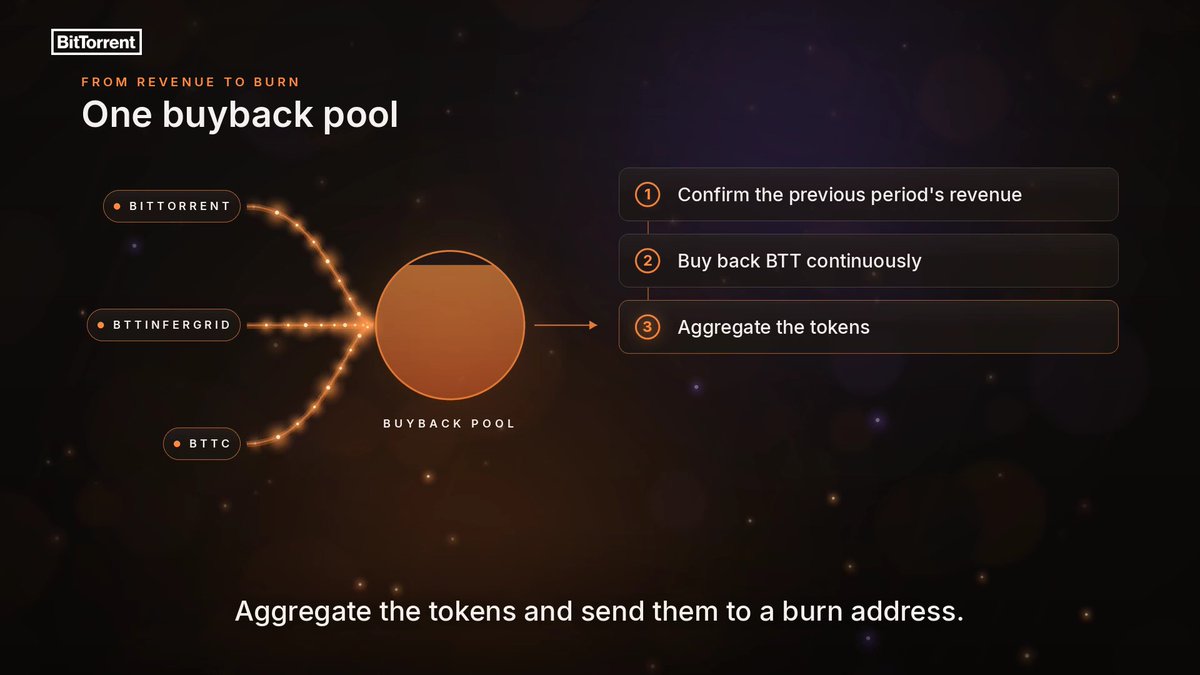
𝐖𝐡𝐚𝐭 𝐀𝐜𝐭𝐮𝐚𝐥𝐥𝐲 𝐅𝐮𝐞𝐥𝐬 𝐭𝐡𝐞 $𝐁𝐓𝐓 𝐁𝐮𝐲𝐛𝐚𝐜𝐤 & 𝐁𝐮𝐫𝐧 Token burns are common in crypto. The useful question is always the same: where does the money for the buyback actually come from? BitTorrent's answer is revenue from three products. The program started in Q3 2026, and the first burn was completed on October 16. ◆ Three revenue sources 1️⃣ BitTorrent: Apps and Acceleration Users can pay for faster downloads through download acceleration, and the client apps earn in-app revenue alongside their free versions. Both come from people choosing to pay for a better experience. 2️⃣ BTTInferGrid: Compute Leasing AI developers lease GPU capacity on the network to run inference workloads. When that compute is paid for, the network earns leasing revenue. 3️⃣ BTTC: Gas Fees Every on-chain transaction on BTTC pays a gas fee. More activity on the chain means more fees collected. ◆ From revenue to burn The official buyback page describes five steps: confirm the previous period's revenue, use it to buy back BTT continuously, aggregate the tokens, send them to a burn address, then publish the announcement and on-chain record. According to the first round announcement, 100% of BitTorrent's decentralized service revenue goes to buybacks, with each round's volume adjusted to market conditions. Round 1 burned about 21.6 trillion BTT, roughly 2.18% of total supply. Details for the next round are expected in January 2027. ◆ Where does $BTT fit? The design ties supply reduction to real usage rather than to promises. Each burn can be checked on TRONSCAN through its published transaction hash. ◆ Reality check A burn engine is only as strong as the usage behind it. If downloads, compute demand, or on-chain activity slow down, the funding pool shrinks with them. One round also says little about the long-term pace. The real test is whether revenue keeps growing round after round, visibly and on-chain. BitTorrent H.E. Justin Sun 👨‍🚀 🌞 #BTT #BitTorrent #TRON #TRONEcoStar

MR OFFICIAL

24,601 次观看 • 21 天前