Video yükleniyor...

Video Yüklenemedi

Ana Sayfaya Dön

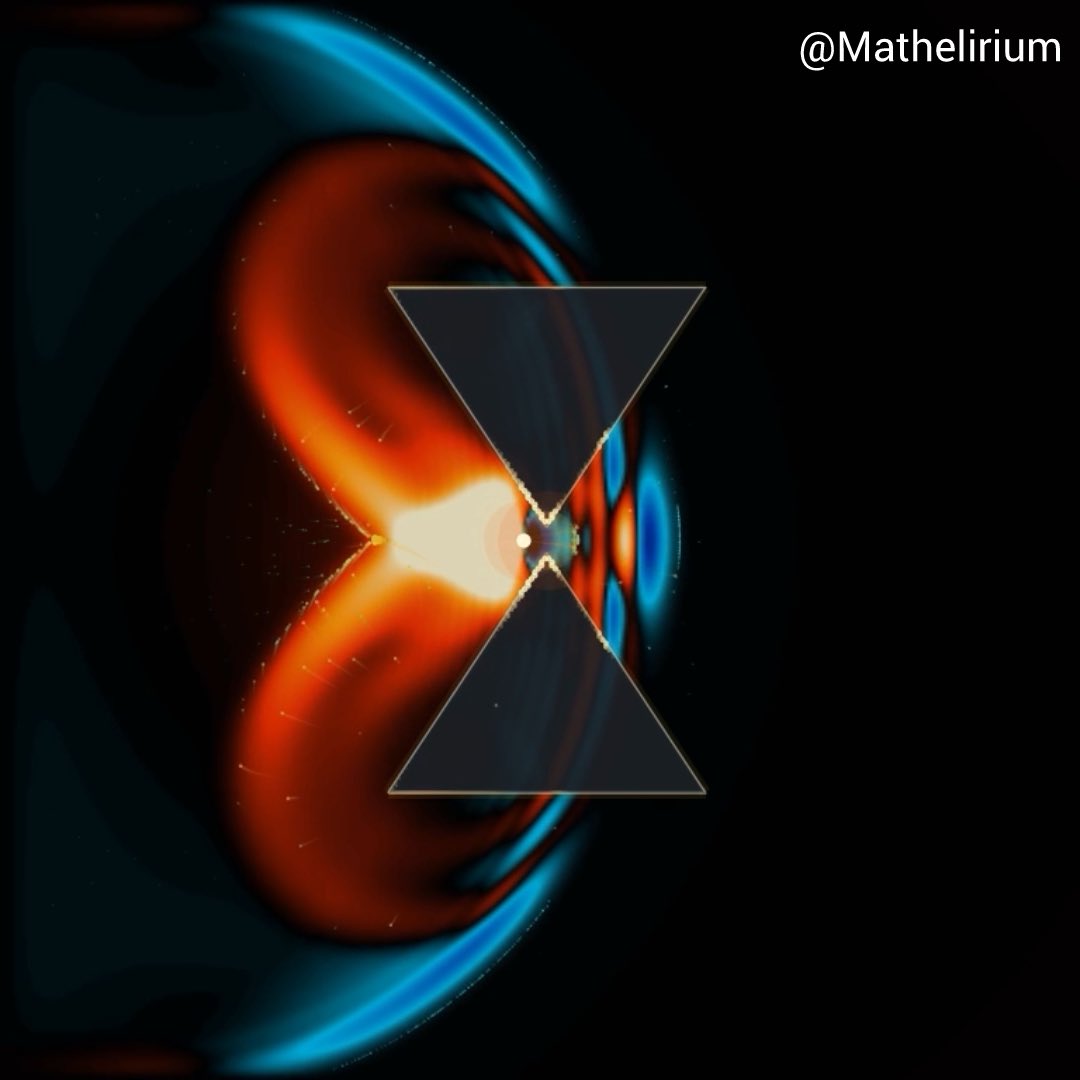
Spherical Harmonics 🤝 Fourier Transform I’m modeling the cell surface as a time-varying field u(θ,φ). Budding is energy shifting into higher angular frequencies. Decompose u into spherical harmonics (the Fourier basis on a sphere), evolve the coefficients aₗₘ(t) where growth/smoothing is clean, then inverse-transform back into a breathing, budding...

25,914 görüntüleme • 8 ay önce •via X (Twitter)

0 Yorum

Yorum bulunmuyor

Orijinal gönderinin yorumları burada görünecek

Benzer Videolar

The Trap in Every Mathematics Lecture If you’ve taken a lot of math courses, you start to recognize a pattern. There’s a moment where the lecturer is warming up with the obvious stuff...add matrices entrywise, scale by α, do the row-column product...and you’re thinking, alright… where is this going? Then you relax. You stop resisting. And right there, they slip in one line that changes how you see the whole subject. When Benedict Gross says "matrices represent linear operators,"he’s telling you to stop treating a matrix as a rectangle of numbers and start treating it as an action. A linear operator is a function T: Rⁿ → Rⁿ that respects two rules: T(u+v)=T(u)+T(v) and T(αu)=αT(u). Once you pick a basis, T is completely determined by where it sends the basis vectors e₁,…,eₙ. Put T(e₁),…,T(eₙ) into columns and you get a matrix A. That is what "A represents T" means...A is the coordinate portrait of the transformation. Now the punchline that makes matrix multiplication feel inevitable. If B represents S and A represents T, then doing S first and then T is the composition T∘S. In coordinates that becomes A(Bx)=(AB)x. So multiplying matrices is really composing transformations. That’s why multiplication is usually not commutative: T∘S is generally not the same transformation as S∘T, and the matrices inherit that noncommutativity. This explains half of Linear Algebra because it tells you what the course is really about...functions that move vectors around, not grids of numbers. A matrix is just the written form of that function once you choose coordinates. Then the rules stop feeling random Multiplying matrices means doing one move and then another, an inverse means you can undo the move, eigenvectors are directions that don’t get turned, and changing basis is just describing the same move in a different language. That one idea makes a lot of linear algebra click. #LinearAlgebra #Matrices #GroupTheory #GLn #MathLectures #Mathematics

Mathelirium

66,892 görüntüleme • 8 ay önce

The Fourier transform runs inside every MRI machine, every audio compressor, every signal processor on earth. JPMorgan pays $350K to engineers who can derive it from scratch. There is one professor alive who explains it the way nobody else can. His name is Gilbert Strang. MIT. The most brilliant mathematical mind of his generation. His textbook sits in over 10 million homes. No other person on earth holds this combination of depth and clarity in one head. He opens with one confession. The Fourier transform is unreasonably effective. It solves problems it was never designed for. The goal is not to compute it. The goal is to understand why it works at all. Then the core idea. A periodic signal breaks into pure sine waves. Each with a frequency, amplitude, and phase. The transform finds all three simultaneously. A complicated signal in time becomes a simple picture in frequency. Then 1807. Fourier invented the transform not for sound but for heat. How does warmth spread through a metal rod? In time the equation is a partial differential equation - hard. In frequency space it becomes ordinary - easy. Transform in, solve it, transform back. Then convolution. Convolution in time equals multiplication in frequency. Filtering a signal, removing noise, compressing audio - all multiplication in frequency space. Without the transform: thousands of computations. With it: a few multiplications. Then the delta function. Zero everywhere except one point where it is infinite. Integral equals one. Every mathematician in 1900 said it was not a function. Dirac used it anyway. It took 40 years to justify what engineers had been doing the whole time. Watch the moment Strang shows that the Fourier transform of a delta function is a constant - every frequency in equal measure. The more concentrated in time, the more spread in frequency. This is the uncertainty principle. Not quantum physics. A theorem about any signal at all. A signal processing engineer I know rewatched this before their first project at Apple. Said it was the first time the Fourier transform felt like a change of coordinates rather than a formula to memorize. Free on YouTube, MIT OpenCourseWare. bookmark this and watch later - after this lecture every sound, every image, and every signal will feel like a sum of sine waves waiting to be separated

Zyphor

122,696 görüntüleme • 21 gün önce

Quantum mechanics has a reputation for being mystical mainly because people skip the rules and jump to interpretations. In this lecture series, we’re doing the opposite. We start from the rules, follow the algebra, and let the picture be the calculation. Classical Probability Theory combines alternatives by adding their probabilities. Quantum Theory combines them one step earlier…add complex amplitudes first, then square at the end. That swap in order is everything. Expand |a₁ + a₂|² and you don’t just get |a₁|² + |a₂|²…you get a cross-term, 2 Re(a₁ a₂*). Its sign is set by phase, so the same two contributions can reinforce or cancel. Interference is just the algebra of squaring a sum. In the 3D render, the surface height is proportional to |a(x)| (so peaks become bright bands after squaring), while the surface skin is colored by the local phase arg(a(x)). As the phase knob φ(t) is swept on path 2, the cross-term oscillates, and you literally watch the interference ridges slide across the screen. We model a detector screen with coordinates x in R² (think x = (x,y)). A quantum state assigns a complex amplitude a(x). The rule for outcomes is p(x) = |a(x)|² Now the key situation: two coherent alternatives contribute to the same outcome x. Let their amplitudes be a₁(x) and a₂(x). Quantum says a(x) = a₁(x) + a₂(x) So the probability density becomes p(x) = |a₁(x) + a₂(x)|² Expand it (this is the whole episode): p(x) = (a₁ + a₂)(a₁* + a₂*) = |a₁|² + |a₂|² + a₁ a₂* + a₁* a₂ = |a₁|² + |a₂|² + 2 Re(a₁ a₂*) That last term is the interference term. It can be positive or negative. To see phase explicitly, write each contribution in polar form: a₁(x) = r₁(x) exp(i θ₁(x)) a₂(x) = r₂(x) exp(i θ₂(x)) Then a₁ a₂* = r₁ r₂ exp(i(θ₁ − θ₂)) So the cross-term is 2 Re(a₁ a₂*) = 2 r₁ r₂ cos(θ₁(x) − θ₂(x)) That’s the fringe engine: p(x) = r₁² + r₂² + 2 r₁ r₂ cos(Δθ(x)) Now the phase knob we animate: Add a controllable phase shift φ to path 2: a₂(x) → a₂(x) exp(i φ) Then Δθ(x) → Δθ(x) − φ, so p(x; φ) = r₁² + r₂² + 2 r₁ r₂ cos(Δθ(x) − φ) As φ changes smoothly, the bright/dark pattern slides continuously. Same setup, same geometry, same magnitudes r₁,r₂, only phase changed. #QuantumMechanics #WaveInterference #ComplexAmplitudes #DoubleSlit #Physics #Mathematics

Mathelirium

81,661 görüntüleme • 8 ay önce

The Trap in Every Mathematics Lecture If you’ve taken enough math courses, you start noticing the same little move. The lecturer warms up with the obvious stuff, add matrices entrywise, scale by α, do the row-column product, and you’re thinking alright, where is this going. Then you relax. You stop resisting. And right there, they drop one line that quietly rewires the whole subject. When Benedict Gross says matrices represent linear operators, he’s telling you to stop treating a matrix as a rectangle of numbers and start treating it as an action. A linear operator is a function T: ℝⁿ → ℝⁿ that respects two rules: T(u+v) = T(u) + T(v) T(αu) = αT(u) Once you pick a basis, T is completely determined by where it sends the basis vectors e₁,…,eₙ. Put T(e₁),…,T(eₙ) into columns and you get a matrix A. That is what A represents T means. A is the coordinate portrait of the transformation. Now the punchline that makes matrix multiplication feel inevitable. If B represents S and A represents T, then doing S first and then T is the composition T∘S. In coordinates that becomes A(Bx) = (AB)x. So multiplying matrices is really composing transformations. That’s why multiplication is usually not commutative. T∘S is generally not the same transformation as S∘T, and the matrices inherit that noncommutativity. This explains half of linear algebra because it tells you what the course is really about: functions that move vectors around, not grids of numbers. A matrix is just the written form of that function once you choose coordinates. After that, the rules stop feeling random. Multiplying matrices means doing one move and then another. An inverse means you can undo the move. Eigenvectors are directions that don’t get turned. Changing basis is just describing the same move in a different language. One idea, and a lot of linear algebra suddenly clicks. #LinearAlgebra #Matrices #LinearMaps #Eigenvectors #ChangeOfBasis #Mathematics

Mathelirium

133,454 görüntüleme • 7 ay önce