Loading video...
Video Failed to Load
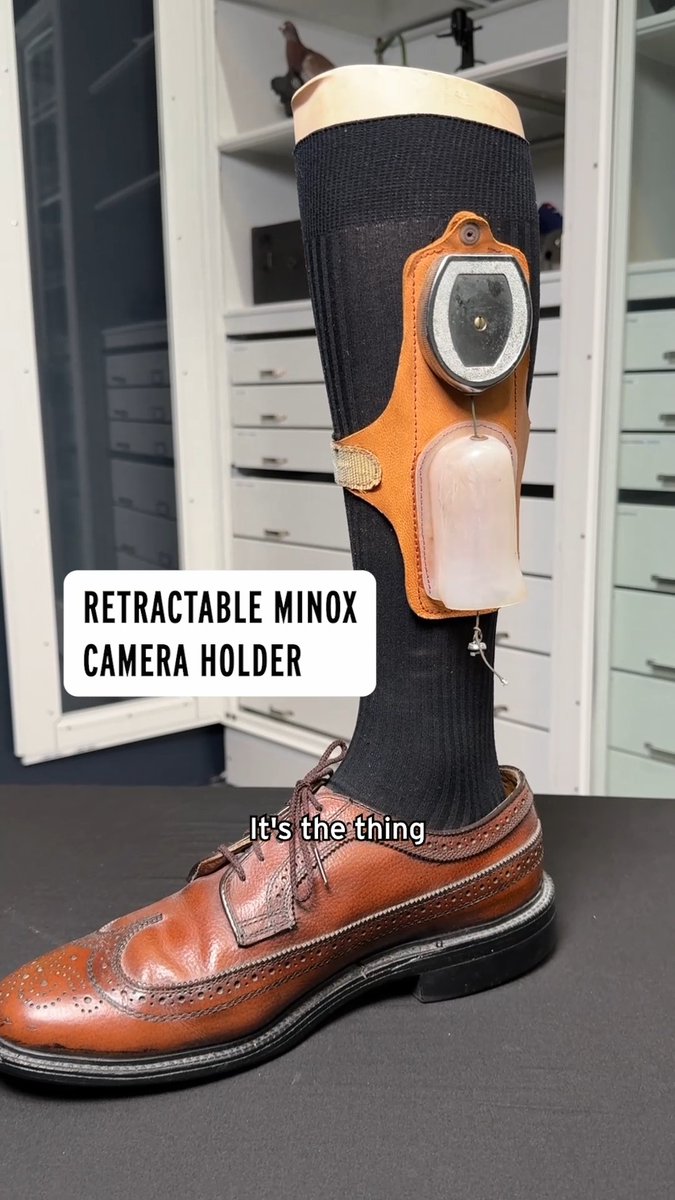
Spy camera made during the Cold War era

10,227,336 views • 2 years ago •via X (Twitter)
10 Comments

In 1936, Walter Zapp, a Latvian engineer, developed a portable camera that would fit easily into the palm of the hand and yet take high-quality, spontaneous pictures. The Minox subminiature camera, in its various models, was the world’s most widely used spy camera. When it first became available, the camera was considered a marvel of technology; it was originally made from steel in Riga, Latvia, from 1937 to 1944. Minox used film one-quarter the size of standard 35-mm film, with 50 frames loaded in a cassette. The ultra-light aluminum-shell Minox B was produced from 1958 to 1972. Because of its small size, it was easy to conceal. It could take excellent photographs of documents at close range and was a natural for secret photography. In 1969, the Minox C was introduced with an electronic shutter. It is no longer in production. Convicted KGB spy John A. Walker, Jr., used a Minox C to photograph sensitive National Security Agency codes.

@eddysnelders

The luckiest chicken

In Croatia they have Dog Lifeguards for the entire Summer season...

The Enigma machine, a pivotal cryptographic device in World War II, encrypting communications This video has sound 📹history_alice

If they made that back then, what do they make now? Just saying.

This video demonstrates how bridge foundations are built over a river
In 1983, during the tense Cold War era, Stanislav Petrov was a lieutenant colonel in the Soviet military responsible for monitoring early warning systems for potential nuclear attacks. On the night of September 26, the Soviet Union's computer systems detected what appeared to be incoming American nuclear missiles. The alarms blared, indicating an imminent attack. Petrov, however, had a gut feeling that something was amiss. He couldn't confirm the attack through other means, such as radar or visual observation, and the satellite data seemed unusual. Despite intense pressure and protocol dictating that he should report an incoming attack, Petrov decided to trust his instincts and judged that it was a false alarm. He reasoned that a full-scale American nuclear strike would likely involve more than just a few missiles. This critical decision, not to escalate the situation, proved to be correct. It was later determined that the system had indeed malfunctioned, and the world was spared from the potentially catastrophic consequences of a mistaken nuclear response.

So cute empathy

The Cold War was a period of geopolitical tension between the United States and the Soviet Union and their respective allies, the Western Bloc and the Eastern Bloc, that started in 1947 after the end of World War II and lasted to 1991. Some pictures of Soviet KGB Spy cameras.