Video yükleniyor...

Video Yüklenemedi

Ana Sayfaya Dön

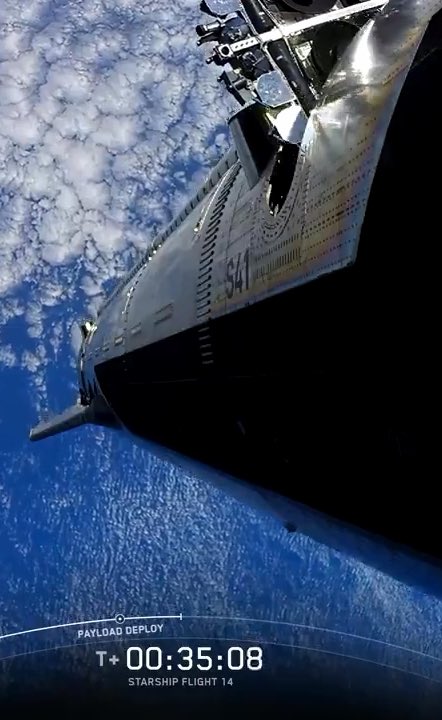
Starship’s PEZ dispenser, likely the largest and most space-efficient satellite deployment system ever flown. Each Starlink V3 is estimated to weigh around 2 tonnes. It deployed 26 in about 30 minutes, and future Starships could carry up to 60. If any company wants to build a constellation that can...

64,436 görüntüleme • 3 gün önce •via X (Twitter)

0 Yorum

Yorum bulunmuyor

Orijinal gönderinin yorumları burada görünecek

Benzer Videolar

🇷🇺 Russia’s Starlink killers showcase new era of electronic battlefield warfare Russia has ramped-up EW use to detect and jam Elon Musk’s Starlink terminals and satellites, Ukrainian media reports. 👉 Meet Russia’s key counter-Starlink systems: 🔸 Volna Kupol Garant Russia’s latest electronic warfare system reportedly uses a directed high-frequency radio beam to disrupt Starlink operations. Rather than damaging satellites orbiting roughly 500 kilometers above Earth, the system blinds them – cutting their ability to connect with ground terminals while they remain under attack. According to reports, Volna is a mobile system built around six trailers. Each carries a pair of steerable satellite dishes mounted on rotating platforms. A single battery is reportedly capable of denying Starlink coverage across an area of up to 20 sq km. Some analysts say the system was previously referenced under the designation Peresvet-M, although this has not been independently confirmed. Ukrainian sources claim Volna was first deployed during Russia's offensive in the Kharkov region in 2024. They also say its use has increased significantly in recent months. 🔸 Tobol The secretive Russian EW complex is reportedly used to disrupt signals from NATO-linked satellite networks, including GPS, Galileo, and Starlink. Reports claim that Tobol attacks satellite communications on both ends of the link – jamming downlinks from satellites to ground receivers and uplinks from Earth to orbit. Its power and range also allegedly allow it to create an electromagnetic "umbrella." 🔸 Kalinka The system is designed to hunt down satellite communications signals, including those transmitted by Starlink terminals at distances of up to 15 km. It can reportedly track and lock onto even Starshield – SpaceX’s hardened military variant of Starlink. Western media warns that while Tobol disrupts GPS signals on a broad scale, the Kalinka’s precision-targeting capabilities could pose a more direct threat to specific military operations. 🔸 Krasukha The Krasukha-S4 is designed to neutralize reconnaissance satellites, ground-based radar installations, and airborne surveillance systems. It does so by emitting powerful electronic jamming signals that disrupt key radar bands and other radio-frequency emissions. A standard Krasukha-S4 battery consists of two vehicles and has an operational range exceeding 300 kilometers. 🔸 Borshchevik The light mobile system is designed to detect and geolocate Starlink terminals within a 180-degree sector at ranges of up to 10 km, with a reported accuracy of five meters. Using direction-finding and biangulation algorithms, it can locate a target in less than three minutes at a single scanning position. The Borshchevik-2 airborne system hunts Starlink signals from the sky, with reported accuracy down to 0.4 m.

Sputnik

25,528 görüntüleme • 2 ay önce

SpaceX has introduced a new website for its next-generation Starlink V3 satellites, along with new information about the satellite. • 1 Tbps downlink capacity (~10× higher than Starlink V2). • 160 Gbps uplink capacity (~22× higher than Starlink V2). • 2,048 downlink beams + 2,048 uplink beams (vs. 192 downlink/144 uplink beams on V2). • Upgraded phased array antennas enable the increased user capacity and beam count. • New SpaceX-designed beamformer chips power the phased arrays. • Modem chips handle ~64× more throughput per chip, allowing more efficient simultaneous service and real-time beam allocation based on demand. • Each satellite includes 6 high-capacity 400 Gbps laser links, enabling a redundant petabit-scale laser mesh network for global routing. • Each satellite also has 4 quad-band RF backhaul antennas operating across Ka, E, V, and W bands. • RF backhaul capacity increases to 1.2 Tbps (>8× Starlink V2). • Backhaul uplink supports 60 GHz of spectrum across frequencies and polarizations (4.3× more than V2). • New solar arrays generate ~2× the power of the V2 satellite arrays. • Solar arrays are manufactured using a continuous roll of solar blanket, cut into 19-meter sections, with 4 sections stitched together per array. • Solar arrays are optimized to reduce atmospheric drag in low Earth orbit. • A Starship launch carrying V3 satellites will deploy ~20× more network capacity than a Falcon 9 launch carrying V2 satellites. • V3 technology will support future Starlink Mobile Gen 2 satellites, delivering terrestrial-like LTE speeds directly to unmodified smartphones. Website:

Sawyer Merritt

242,948 görüntüleme • 2 ay önce

NEWS: SpaceX says a new Starlink update means that the internet will keep working even if trees or other obstacles partially block your home’s view of the sky. "As a Starlink terminal communicates with satellites overhead, it continuously builds a real-time obstruction map, allowing Starlink to dynamically understand its environment. With this information, it can proactively select the best and most stable connection. For dynamic obstructions, such as are encountered by mobile terminals, the system reactively switches in less than 1/10th of a second, allowing a connection to remain stable. The dynamic nature of Starlink combined with the many paths for the system to route traffic provide a high degree of resiliency in obstructed and changing environments. Additionally, to help customers get the most out of their service, the Starlink app includes a built-in tool to preview the install location and guide customers to the best placement with the fewest obstructions. After setup, the Starlink app provides a live obstruction map that shows exactly where signal blockages are occurring and how they may affect your experience, so that users can make informed decisions about optimizing their installation. Starlink also measures uptime 10 times a second from every terminal, transparently reporting any outage that is longer than 1/10th of a second in the app. For well-installed, even partially obstructed terminals, this uptime is typically at the 99.9% level."

Sawyer Merritt

1,513,568 görüntüleme • 1 yıl önce

🇵🇰🚀 Pakistan Completes EO-3 Launch, Accelerating Its Satellite Constellation Drive Pakistan has successfully placed its PRSC EO-3 Earth Observation Satellite into orbit, marking a significant step in the country’s expanding space programme. The satellite, developed domestically by SUPARCO, was launched from China’s Taiyuan Satellite Launch Center, underscoring a model of local manufacturing supported by external launch capability. EO-3 completes a three satellite Earth Observation series: ◽EO-1 (2025) ◽EO-2 (February 2026) ◽EO-3 (latest launch) Together, they form the backbone of a planned integrated Earth Observation system aimed at improving data availability and coverage. Pakistan now operates 5+ Earth observation satellites, with most deployed in the last two years, highlighting a noticeable acceleration in activity. Officials describe the programme as part of a broader shift: 📡 From isolated missions → to a coordinated satellite network From external reliance → to increasing data independence 🚀 From slow launches → to a structured rollout strategy The EO-3 mission also reflects continued technical cooperation with China, particularly in launch services. With additional satellites expected in the coming years, Pakistan appears to be moving toward a multi satellite constellation designed for regular, wide area monitoring. The direction is clear: a steady build up rather than a one off achievement.

Defence Index

14,724 görüntüleme • 5 ay önce