Video yükleniyor...

Video Yüklenemedi

Ana Sayfaya Dön

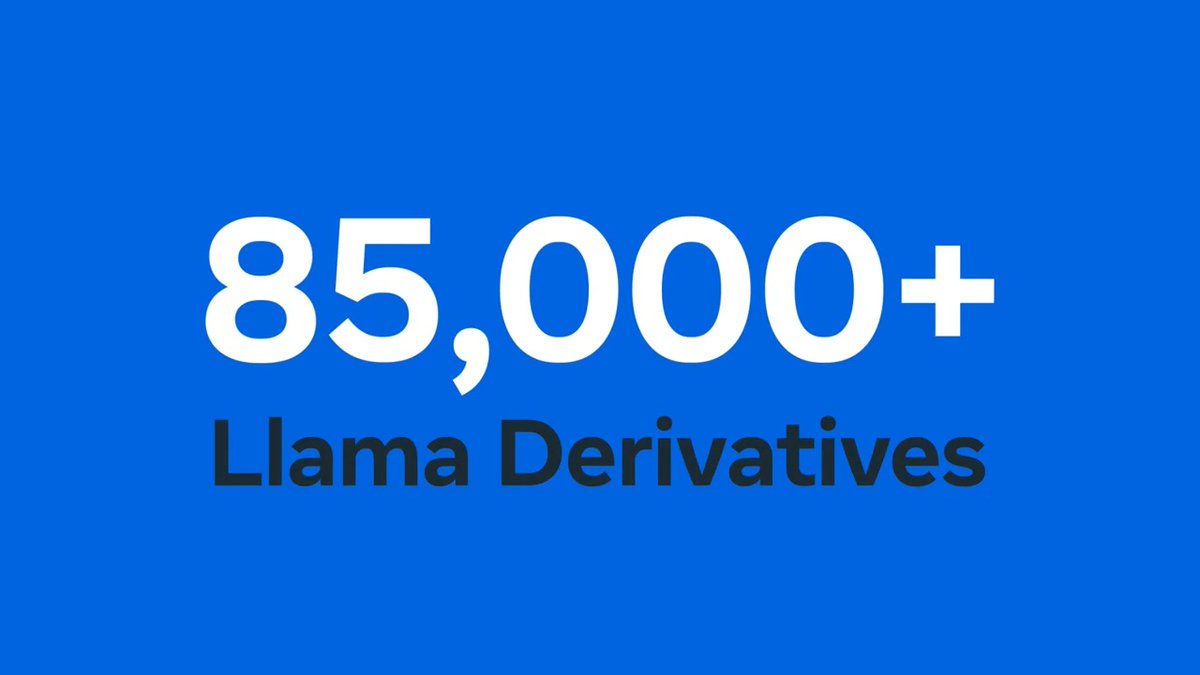
Starting today, open source is leading the way. Introducing Llama 3.1: Our most capable models yet. Today we’re releasing a collection of new Llama 3.1 models including our long awaited 405B. These models deliver improved reasoning capabilities, a larger 128K token context window and improved support for 8 languages...

1,269,392 görüntüleme • 2 yıl önce •via X (Twitter)

8 Yorum

AI at Meta profil fotoğrafı
AI at Meta2 yıl önce

Training a model as large and capable as Llama 3.1 405B was no simple task. The model was trained on over 15 trillion tokens over the course of several months requiring over 16K @NVIDIA H100 GPUs — making it the first Llama model ever trained at this scale. We also used the 405B parameter model to improve the post-training quality of our smaller models.

AI at Meta profil fotoğrafı
AI at Meta2 yıl önce

With Llama 3.1, we evaluated performance on >150 benchmark datasets spanning a wide range of languages — in addition to extensive human evaluations in real-world scenarios. These results show that the 405B competes with leading closed source models like GPT-4, Claude 2 and Gemini Ultra across a range of tasks. Our upgraded Llama 3.1 8B & 70B models are also best-in-class, outperforming other models at their size while also delivering a better balance of helpfulness and safety than their predecessors. These smaller models support the same improved 128K token context window, multilinguality, improved reasoning and state-of-the-art tool use to enable more advanced use cases.

AI at Meta profil fotoğrafı
AI at Meta2 yıl önce

We’ve also updated our license to allow developers to use the outputs from Llama models — including 405B — to improve other models for the first time. We’re excited about how this will enable new advancements in the field through synthetic data generation and model distillation workflows, capabilities that have never been achieved at this scale in open source.

AI at Meta profil fotoğrafı
AI at Meta2 yıl önce

As Mark Zuckerberg shared in an open letter this morning: we believe that open source will ensure that more people around the world have access to the benefits and opportunities of AI, that power isn't concentrated in the hands of a small few, and that the technology can be deployed more evenly and safely across society. That’s why we continue to take steps on the path for open source AI to become the industry standard. Read the letter ⬇️

Vaibhav (VB) Srivastav profil fotoğrafı
Vaibhav (VB) Srivastav2 yıl önce

Congratulations on the release @AIatMeta! Thanks for your unwavering support for Open Source 🤗 I put down some notes from the release below!

AI at Meta profil fotoğrafı
AI at Meta2 yıl önce

Open source AI is the path forward. ❤️

Luis Ceze profil fotoğrafı
Luis Ceze2 yıl önce

Fantastic to partner with Meta on this! Thank you Meta! And big thank you to the incredible team at OctoAI putting the models on the platform at launch! 🚀🙏🐙

Prime Intellect profil fotoğrafı
Prime Intellect2 yıl önce

Awesome research and progress towards open source AGI!!

Benzer Videolar

"Introducing Multimodal Llama 3.2": As promised two weeks ago, here's the short course on Meta's latest open model! This short course is created with Meta and taught by Amit Sangani, Director of AI Partner Engineering at Meta. Meta’s Llama family of models is leading the way in open models, allowing anyone to download, customize, fine-tune, or build new applications on top of them. Learn about the vision capabilities of the Llama 3.2, and use it for image classification, prompting, tokenization, tool-calling. You'll also learn about the open-source Llama stack, which gives building blocks for many different stages of the LLM application life cycle. In detail, you’ll: - Learn what are the features of Meta's four newest models, and when to use which Llama model. - Learn best practices for multimodal prompting, with applications to advanced image reasoning, illustrated by many examples: Understanding errors on a car dashboard, adding up the total of photographed restaurant receipts, grading written math homework. - Use different roles—system, user, assistant, ipython—in the Llama 3.1 and 3.2 models and the prompt format that identifies those roles. - Understand how Llama uses the tiktoken tokenizer, and how it has expanded to a 128k vocabulary size that improves encoding efficiency and multilingual support. - Learn how to prompt Llama to call built-in and custom tools (functions) with examples for web search and solving math equations. - Learn about Llama Stack, a standardized interface for common toolchain components like fine-tuning or synthetic data generation, useful for building agentic applications. By the end of this course, you’ll be equipped to build out new applications with the new Llama 3.2. Thank you to Ahmad Al-Dahle, Amit Sangani, and the whole AI at Meta team AI at Meta for all the hard work on Llama 3.2 — we’re excited to make these open models even more accessible to more developers with this new course! Please sign up here!

Andrew Ng

131,767 görüntüleme • 1 yıl önce

Today is a good day for open science. As part of our continued commitment to the growth and development of an open ecosystem, today at Meta FAIR we’re announcing four new publicly available AI models and additional research artifacts to inspire innovation in the community and help advance AI in a responsible way. More in the video from Joelle Pineau. What we’re releasing: 🦎 Meta Chameleon 7B & 34B language models that support mixed-modal input and text-only outputs. 🪙 Meta Multi-Token Prediction Pretrained Language Models for code completion using Multi-Token Prediction. 🎼 Meta JASCO Generative text-to-music models capable of accepting various conditioning inputs for greater controllability. Paper available today with a pretrained model coming soon. 🗣️ Meta AudioSeal An audio watermarking model that we believe is the first designed specifically for the localized detection of AI-generated speech, available under a commercial license. 📝 Additional RAI artifacts Including research, data and code to measure and improve the representation of geographical and cultural preferences and diversity in AI systems. We believe that access to state-of-the-art AI creates opportunities for everyone – not just a small handful of Big Tech companies. We’re excited to share this work and to see how the community learns, iterates and builds using this technology. Details and access to everything released by FAIR today ➡️

AI at Meta

380,962 görüntüleme • 2 yıl önce

Introducing "Building with Llama 4." This short course is created with Meta AI at Meta, and taught by Amit Sangani, Director of Partner Engineering for Meta’s AI team. Meta’s new Llama 4 has added three new models and introduced the Mixture-of-Experts (MoE) architecture to its family of open-weight models, making them more efficient to serve. In this course, you’ll work with two of the three new models introduced in Llama 4. First is Maverick, a 400B parameter model, with 128 experts and 17B active parameters. Second is Scout, a 109B parameter model with 16 experts and 17B active parameters. Maverick and Scout support long context windows of up to a million tokens and 10M tokens, respectively. The latter is enough to support directly inputting even fairly large GitHub repos for analysis! In hands-on lessons, you’ll build apps using Llama 4’s new multimodal capabilities including reasoning across multiple images and image grounding, in which you can identify elements in images. You’ll also use the official Llama API, work with Llama 4’s long-context abilities, and learn about Llama’s newest open-source tools: its prompt optimization tool that automatically improves system prompts and synthetic data kit that generates high-quality datasets for fine-tuning. If you need an open model, Llama is a great option, and the Llama 4 family is an important part of any GenAI developer's toolkit. Through this course, you’ll learn to call Llama 4 via API, use its optimization tools, and build features that span text, images, and large context. Please sign up here:

Andrew Ng

67,846 görüntüleme • 1 yıl önce

Open science is how we continue to push technology forward and today at Meta FAIR we’re sharing eight new AI research artifacts including new models, datasets and code to inspire innovation in the community. More in the video from Joelle Pineau. This work is another important step towards our goal of achieving Advanced Machine Intelligence (AMI). What we’re releasing: • Meta Spirit LM: An open source language model for seamless speech and text integration. • Meta Segment Anything Model 2.1: An updated checkpoint with improved results on visually similar objects, small objects and occlusion handling. Plus a new developer suite to make it easier for developers to build with SAM 2. • Layer Skip: Inference code and fine-tuned checkpoints demonstrating a new method for enhancing LLM performance. • SALSA: New code to enable researchers to benchmark AI-based attacks in support of validating security for post-quantum cryptography. • Meta Lingua: A lightweight and self-contained codebase designed to train language models at scale. • Meta Open Materials: New open source models and the largest dataset of its kind to accelerate AI-driven discovery of new inorganic materials. • MEXMA: A new research paper and code for our novel pre-trained cross-lingual sentence encoder with coverage across 80 languages. • Self-Taught Evaluator: a new method for generating synthetic preference data to train reward models without relying on human annotations. Access to state-of-the-art AI creates opportunities for everyone. We’re excited to share this work and look forward to seeing the community innovation that results from it. Details and access to everything released by FAIR today ➡️

AI at Meta

150,406 görüntüleme • 1 yıl önce