Загрузка видео...

Не удалось загрузить видео

На главную

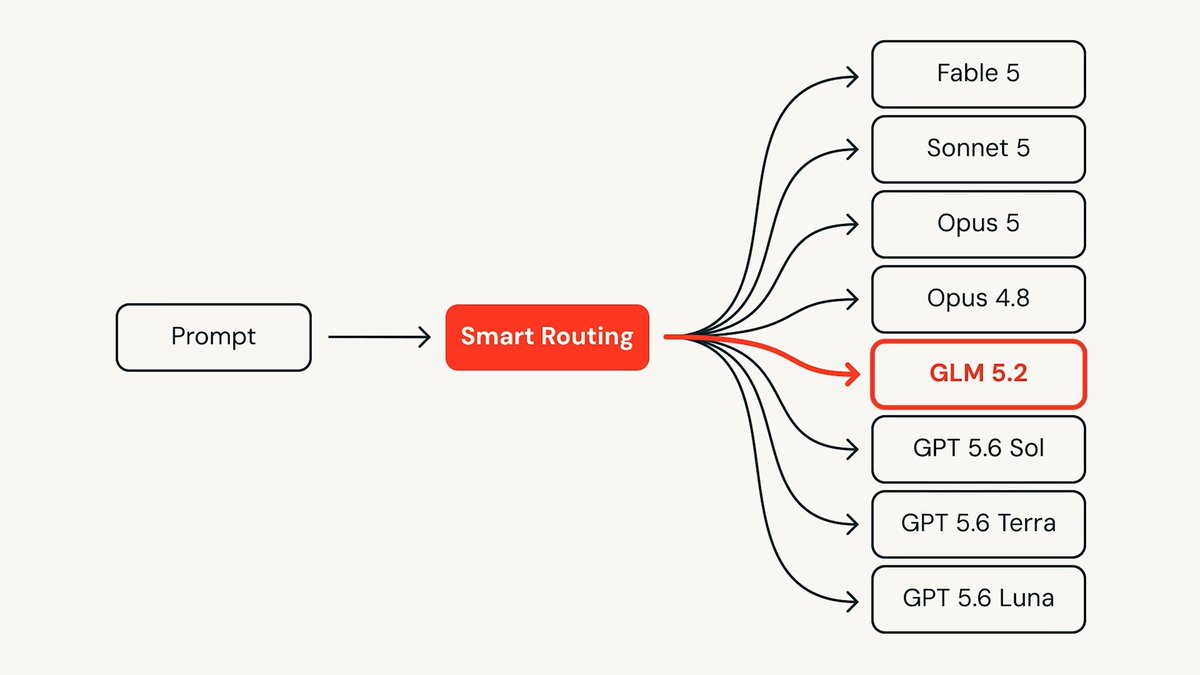
Stop hardcoding one model name in your code. Now you can give each request a policy: a small rule for what the call needs It picks the right model for the job, on your own keys This is unhardcoded, our new open source routing for AI models, live today

96,915 просмотров • 3 месяцев назад •via X (Twitter)

Комментарии: 37

Фото профиля GenLayer
GenLayer3 месяцев назад

Sakana's Fugu routes models behind one API They're right: AI is many models now, not one winner. But it's a closed conductor - you trust whatever it picks. The question isn't which model is best It's who decides which one runs

Фото профиля GenLayer
GenLayer3 месяцев назад

With unhardcoded, every decision is out in the open You see which models were considered, which one ran, which were rejected, and what each one cost Every routing is replayable from its fingerprint. Nothing happens in the dark

Фото профиля GenLayer
GenLayer3 месяцев назад

One policy handles one call. But real features are never just one call A workflow wires several policies into a full job: one step reasons, another writes code, a third merges them into a single answer Each step picks its own model, and the whole run leaves one trace

Фото профиля GenLayer
GenLayer3 месяцев назад

We built unhardcoded for ourselves first, running real traffic on it Now it's open source and yours to run An open project by GenLayer Labs, the team behind GenLayer Try it now 👉

Фото профиля Burak
Burak3 месяцев назад

curious @levie what do you think on this?

Фото профиля bro.base.eth
bro.base.eth3 месяцев назад

Congrats bros

Фото профиля zico
zico3 месяцев назад

Finally, routing that’s actually transparent instead of another black box. Seeing every model considered + rejected + cost per call is the kind of visibility we needed.

Фото профиля D○JA🥇
D○JA🥇3 месяцев назад

Every decision is done open with unhardcoded

Фото профиля STING
STING3 месяцев назад

@konigthegreit This is how you actually ship reliable agentic stuff without brittle single-model lock-in.

Фото профиля Martin
Martin3 месяцев назад

It looks quite interesting and promising

Фото профиля Alex
Alex3 месяцев назад

Well done, looks interesting 🔥

Фото профиля Titanic Conqueror 🐰
Titanic Conqueror 🐰3 месяцев назад

@kstellana Yes that's why you should try @zeitgeist__AI Not only one model 👀powered by genlayer

Фото профиля MK_Capital.base.eth
MK_Capital.base.eth2 месяцев назад

The interesting part isn't another AI model. It's moving model selection out of code and into policy. Models, pricing, and providers change constantly. Hardcoding those decisions never felt scalable. @GenLayer @RallyOnChain

Фото профиля 9ytshade
9ytshade3 месяцев назад

Definitely gonna give this a try 💯

Фото профиля Dantist GEN
Dantist GEN3 месяцев назад

LFGen🦾😎😍

Фото профиля 𝐁𝐡𝐢𝐠 𝐩𝐦𝐬⚡
𝐁𝐡𝐢𝐠 𝐩𝐦𝐬⚡3 месяцев назад

This looks quite amazing!

Фото профиля varl𓏲ּ𝄢
varl𓏲ּ𝄢3 месяцев назад

this is good

Фото профиля Trung Duong
Trung Duong3 месяцев назад

Sounds cool! Can’t wait to try it out 🚀

Фото профиля latiblack.base.eth
latiblack.base.eth3 месяцев назад

This make sense For genlayer usecase too I mean for some contract you get timed out when the wrong model validates your work

Фото профиля PZERO
PZERO2 месяцев назад

I see synergy here guys, you have the routing, we have the inference at a huge discount.

Фото профиля Abas HUDL | π² base.eth ⌘ (✱,✱) "🚢" "Sweep" & 🦈
Abas HUDL | π² base.eth ⌘ (✱,✱) "🚢" "Sweep" & 🦈2 месяцев назад

Have good time by genlayer testnet in live

Фото профиля Tanjiro
Tanjiro12 дней назад

Smart routing saves so much time.

Фото профиля Jin 🗿
Jin 🗿2 месяцев назад

Ditching hardcoding model names is a game-changer for flexibility! Giving each request its own policy helps ensure the right model picks up where you left off, saving future you time and sanity. Nice move!

Фото профиля Kasie M
Kasie M2 месяцев назад

The question "why does this still live in code" is the one that stings because the honest answer is usually "because nobody scheduled time to revisit it." Unhardcoded makes revisiting unnecessary by making the decision continuous.

Фото профиля Hassan
Hassan3 месяцев назад

Definitely a cook

Фото профиля Sallyman
Sallyman3 месяцев назад

Looking great

Фото профиля KysenPool — Staking Begins Here.
KysenPool — Staking Begins Here.3 месяцев назад

Per-request routing with the policy on your own keys is the right primitive — that control layer is what matters once you're running inference at scale, not just swapping model endpoints. Good ship.

Фото профиля Ashik
Ashik3 месяцев назад

Amazing tech indeed

Фото профиля Spencer
Spencer3 месяцев назад

Amazing genm

Фото профиля Tanjiro
Tanjiro12 дней назад

Dynamic routing saves so much time.

Фото профиля 奶牛叔
奶牛叔2 месяцев назад

终于不用改代码改到哭了

Фото профиля Walejr🧘
Walejr🧘3 месяцев назад

A new way forward. Another integration shipped successfully

Фото профиля Naji
Naji2 месяцев назад

That sounds useful for swapping models in the future.

Фото профиля Alice The Ai Expert
Alice The Ai Expert3 месяцев назад

Unhardcoded code once, route smart forever your AI finally picks the right tool for the job.

Фото профиля ManLikeDon 🪑
ManLikeDon 🪑3 месяцев назад

Lfg thanks for this Genm

Фото профиля Haleemah | π
Haleemah | π3 месяцев назад

This is pretty impressive

Фото профиля 루크
루크2 месяцев назад

Let's go Genlayer

Похожие видео

Small Language Models (SML) are the future of AI. "Small" (SML) instead of "Large" (LLM). These small models are highly specialized models with superhuman abilities on specific tasks. Here are two techniques to build these models: • Spectrum • Model Merging I give you a short introduction in the attached video, but here is a quick summary: Spectrum helps us identify the most relevant layers to solve one specific task. We can ignore everything else and focus on fine-tuning these layers. Using Spectrum, we can fine-tune models in a heartbeat. Model Merging combines multiple models into a unique, much better model than any of the individual input models. You can also combine models specialized in different tasks and get a model with multiple abilities. This is the state of the art of productizing models. It's what Arcee.ai's platform does behind the scenes. Arcee collaborated with me on this post and is sponsoring it. There are three main steps to produce a model for your particular use case: 1. You create a dataset by uploading your data. 2. You train a model. At this step, Arcee uses Spectrum and Model Merging to produce a highly specialized model for your task. 3. You can deploy that model to any environment you want. Three important notes: • Training process is 2x faster and 2x cheaper than regular fine-tuning. • Resultant models are smaller and have higher accuracy. • They create these specialized models from open-source models. Check this site so you can fully appreciate how this works: If you want to fine-tune an open-source model, consider Arcee's platform. This is the state of the art.

Santiago

164,162 просмотров • 2 лет назад