Video wird geladen...

Video konnte nicht geladen werden

Zur Startseite

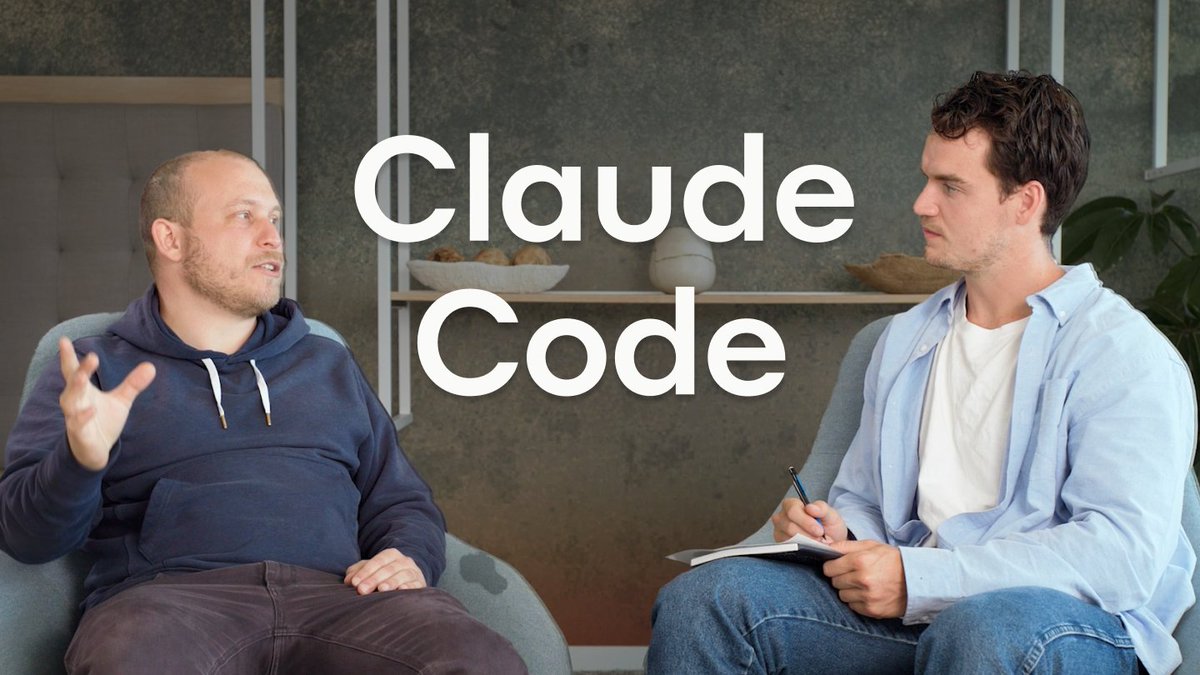
Struggling with Claude Code? Here's what Boris Cherny, the creator of Claude Code, recommends almost every time: 1) Use Opus 4.5 with thinking - It's smarter, uses fewer tokens, often ends up cheaper than smaller models. 2) Invest in your ClaudeMD - Just a text file. No special format....

159,534 Aufrufe • vor 5 Monaten •via X (Twitter)

0 Kommentare

Keine Kommentare verfügbar

Kommentare vom Original-Post werden hier angezeigt

Ähnliche Videos

THIS MIGHT BE THE #1 OPEN-SOURCE REPO FOR CLAUDE CODE RIGHT NOW. IT GIVES CLAUDE A MEMORY AND SLASHES YOUR TOKEN COST ON EVERY QUESTION The repo is safishamsi/graphify, a free open-source skill that turns any codebase into a knowledge graph Claude Code can read instantly. Instead of grepping through your files every session, Claude gets a map of how everything connects The problem it fixes: Every time you ask Claude Code about a big repo, it does the same thing, greps through dozens of files like a brute-force Ctrl+F, blows through your context window, and sometimes still misses the answer hiding in a file nobody searched. Claude Code has no memory of how your project is structured. Every session starts from zero What it does: It maps your entire codebase into a knowledge graph, capturing not just which files exist, but which functions depend on which, which modules are central, and which files cluster around the same concern. Claude queries the map instead of scanning files How it works, three passes: 1. Code structure, free and local. Tree-sitter parses your files and pulls out classes, functions, imports and call graphs. No LLM, no tokens, just your actual code mapped deterministically 2. Audio and video, if you have them. Transcribed locally and folded into the graph 3. Docs, papers, images. Here an LLM does semantic analysis, figuring out what each document means and where it fits. Only the meaning gets sent up, never your raw source It saves you money: Normally a question about a big repo makes Claude spawn explore agents that scan file after file, eating your context window and your token budget before you get an answer. With the graph already built, Claude queries the map instead of re-reading the codebase every time. Same answer, a fraction of the tokens. The graph only gets built once, then a hook rebuilds it after each commit for free, so you never pay that scanning cost again. The bigger the repo, the bigger the gap The best parts: it's a skill, so once installed Claude knows when to use it without you memorizing commands. It works on non-code folders too, point it at docs or notes and it can spin up an Obsidian vault How to add it to your Claude: 1. Install Claude Code if you haven't: npm install -g Paul Jankura-ai/claude-code 2. Add the skill: claude skill add safishamsi/graphify 3. Open your project folder and run /graphify . to build the graph 4. Optional, make it automatic: graphify hook install so the graph rebuilds after every commit That's it. Ask Claude about your repo and it reads the map instead of burning tokens on a file hunt Bookmark this

Yarchi

55,345 Aufrufe • vor 1 Monat

Here's what the Founder of Claude Code does before he starts ANY project: 1. Plans first, codes never, he goes back and forth with Claude on the plan until it's perfect. No code gets written yet 2. Creates a CLAUDE.md file (a simple doc that Claude reads every session so it knows your project, your rules, your style) 3. Gives Claude a way to verify its own work - For backend: write and run tests - For UI: take screenshots, check in browser Claude should never finish a task without proving it works 4. Sets up project-level permission rules in settings.json instead of skipping permissions entirely. Shared with the whole team 5. Five more preparation steps in VIDEO BELOW 6. Only then switches to auto-accept mode and lets Claude build The part most people miss: he doesn't treat Claude as a magic box that gets things right first try he treats it like a junior dev that needs clear instructions, feedback loops, and guardrails at scale he runs multiple sessions in parallel, uses Opus with thinking enabled because it makes fewer mistakes even though it's slower and relies on background agents that push code for later review his setup is surprisingly simple. no crazy custom tools. just slash commands, subagents, and a clean CLAUDE.md the difference isn't the tool. it's how you set it up before you start ❤️ P.S. for sure 99.5% of readers will scroll down this tweet, but I send it to 0.5% who loves to learn how to improve your workflow daily and control 99.5% in 2 years Hard skills literally mean nothing in our world The most important skills which you can have are: building architectures and orchestrations If you master it and use a creative approach, CONGRATS

Ronin

146,503 Aufrufe • vor 2 Monaten

I got curious how compaction works as a PM, so I did some brain surgery on Claude Code: (Anthropic's been doing really interesting work on context editing - they showed Claude Opus playing Settlers of Catan for 75+ minutes in a single thread by constantly editing the context instead of starting fresh. When I saw that Claude Code has a compaction command with optional custom instructions, I wanted to understand what's actually happening.) Abhishek Katiyar and Aman Khan gave me the key tip: Claude Code stores all your conversation history as text files on your computer. Open a new directory and give Claude Code a task. Here's how to watch compaction happening: 1. Go to your user's root directory 2. Press Command+Shift+Period (Mac) to show hidden folders 3. Navigate to ~/.claude/projects/ 4. Find your project folder and use Cursor/VSCode to open it (there's a reason) 5. Install the JSONL Gazelle plugin (open source, thank you Gabor Cselle!) 6. Open the most recent JSONL file - each row is a message in your conversation 7. Run the compact command in Claude Code with custom instructions 8. Watch what happens in the file What I learned: When you compact, Claude Code doesn't just summarize and delete everything. It creates a "compact boundary" in the conversation file, writes a summary of what happened before, but keeps the full original conversation (!!!!) The new thread can still retrieve any details from before compaction if needed. That is so damn cool. Why this matters: What you're getting in Claude Code is similar to what Anthropic ships in their developer SDK - so inspecting your daily tools is how you build real product intuition. The best way to understand AI systems is to open them up and look inside. Everything is text files.

Tal Raviv

57,910 Aufrufe • vor 6 Monaten

Anthropic just released a talk on building headless automation with Claude Code. Presented by Sid Bidasaria, Member of Technical Staff at Anthropic live at Code with Claude on May 22, 2025 in San Francisco. Here is what the talk covers. Headless mode lets you run Claude Code without a person actively typing prompts from inside an automated script. Instead of a live session, a script calls Claude with a pre-written instruction using the -p flag. This opens the door for Claude Code to become a piece of a much larger, automated process. In plain terms: Claude Code stops being a tool you use and starts being a service that runs on its own. What this unlocks: Scheduled tasks: Run Claude Code on a cron schedule without anyone at a keyboard. Fix linting errors across an entire codebase. Automatically. Overnight. CI/CD integration: Trigger Claude Code as a step in your build process. Open a PR. Claude reviews it, flags issues, and pushes fixes before a human ever looks at it. GitHub automation: A project manager comments "Claude fix this" on a GitHub issue. Claude reads the request, finds the code, writes the fix, and opens the PR. Multi-machine workflows: One orchestrator dispatches tasks to multiple Claude Code instances running in parallel across different repos simultaneously. When you combine headless mode, hooks, and GitHub Actions, development teams can automate tasks that usually eat up significant time freeing senior engineers to focus on architectural problems while Claude handles the repetitive ones. If you use Claude Code for anything beyond single sessions this talk is worth 20 minutes of your time.

Elias

14,028 Aufrufe • vor 1 Monat