Video wird geladen...

Video konnte nicht geladen werden

Zur Startseite

TeraWulf $WULF CFO Patrick Fleury states that either NVIDIA, Amazon, or Google will backstop Anthropic's lease payments to TeraWulf at their 401MW Kentucky data center, unless Anthropic itself goes public and establishes a "really strong" investment grade credit rating in the near-term. "In the press release, we said that...

15,665 Aufrufe • vor 1 Monat •via X (Twitter)

0 Kommentare

Keine Kommentare verfügbar

Kommentare vom Original-Post werden hier angezeigt
Ähnliche Videos

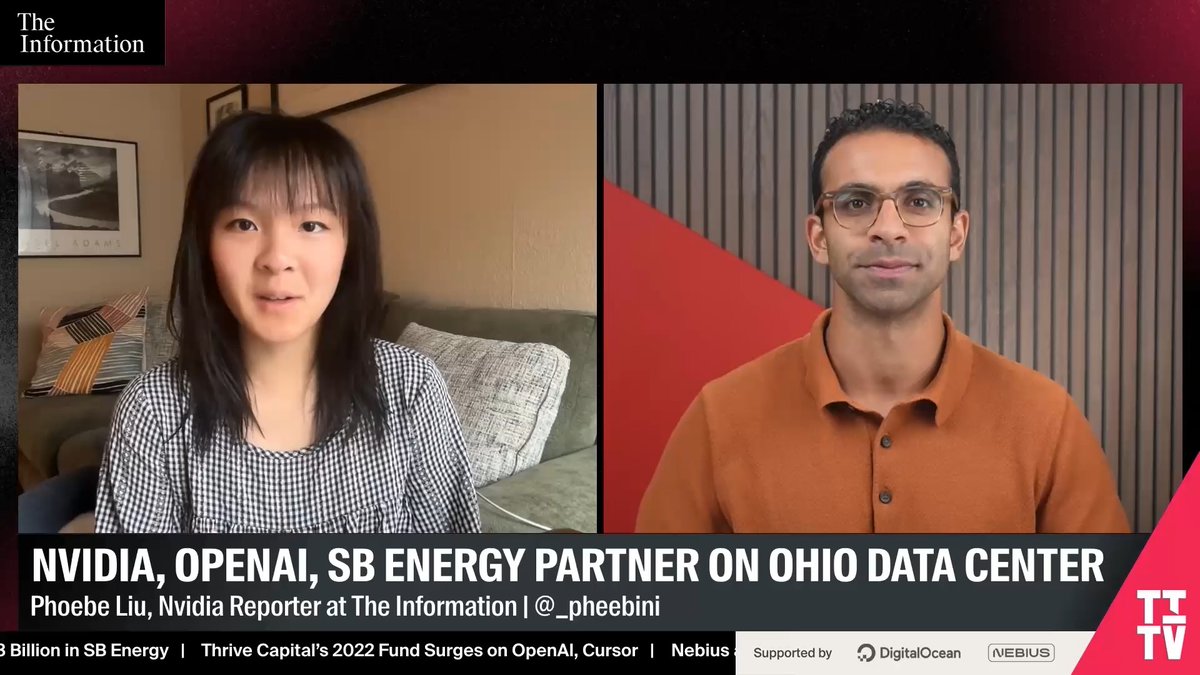
Jensen Huang just admitted the biggest AI labs can't borrow money like normal companies. So Nvidia signs for them, and they spend it on Nvidia chips. Nvidia reported Wednesday and the numbers are absurd: Revenue of $96.2 billion, up 106%, with net income of $59.7 billion, the most profitable quarter any public company has EVER posted. And Huang just told Fox Business that every chip Nvidia can make next year is already sold. Here's why this matters the most: Huang wrote this himself about his own customers: "Frontier AI labs have extraordinary demand for training and inference compute, but many are growing faster than their balance sheets and long-term credit profiles can support." Then: They "still lack the decades-long infrastructure contracts and investment-grade financing capacity needed to secure the AI factory infrastructure independently." Put simply: His customers can't get the loans. So Nvidia signs for them. There's a compute campus going up in Ohio with OpenAI as the tenant. Nvidia has tied roughly $105 billion in commitments to it. OpenAI's existing and planned commitments now come to about 12 gigawatts of Nvidia compute. CFO Colette Kress told analysts Nvidia will also provide selective credit enhancement for nearly 2 gigawatts of compute at a second frontier lab. She wouldn't say which one. Nvidia put up to $10 billion into Anthropic in November at a valuation near $350 billion, and Anthropic agreed to buy up to a gigawatt of Grace Blackwell and Vera Rubin systems in the same deal. And Nvidia isn't only guaranteeing these companies. It OWNS pieces of them. This week's filing shows $18 billion committed to equity investments for the rest of the fiscal year, and $47.9 billion already sitting in private companies as of late July. Now here's where it gets really insane: Last week, Huang sat on a CNBC set surrounded by six of Wall Street's biggest firms. Apollo, BlackRock, Blackstone, Brookfield, Goldman Sachs and KKR. They signed a memorandum to mobilise up to $500 billion in outside capital for AI data centres. Nvidia kept the option to backstop up to a quarter of those deals. And Huang used that stage to announce that Nvidia GPUs are now an asset class. Pension and credit funds can now lend against graphics cards the way they lend against office towers. Kress saw the accusation coming and got ahead of it on the earnings call: "We recognise the scale of this support, and we know some will call this circular financing. We see it differently." But look at the two things Huang says about the same companies. On the earnings call he said AI has hit its inflection point, that the tokens are productive and profitable, and that compute is now revenue. But he also said those same labs can't secure investment-grade financing on their own. A business that's inflecting into profit is exactly the business a bank lends to. Banks lend against cash flow every day. But Nvidia‘s guarantee exists because something in that first story isn't landing with the people whose job is pricing risk. Kress does have a real answer to this though. She said the second lab's credit support only complements capacity it already secured on its own, without Nvidia backing it. Vendor financing is also old and legal. Cisco did it and GE built a finance arm on it. Huang's case is that Nvidia understands these businesses better than any lender could, and he says the risk is low and his only regret is not investing more and sooner. He may be completely right. But one thing is certain: Nvidia guarantees the paper. The paper buys the chips. Nvidia books the sale. Then Nvidia tells you the order book is full for a year. That order book is the entire argument for a $5 trillion company. And Jensen Huang just explained, in his own words, that his customers couldn't have written those orders without him. Isn’t this suspicious?

Ricardo

61,238 Aufrufe • vor 3 Tagen

Wall Street just pulled off the exact move that turned 2008 from a housing problem into a global collapse. They turned Nvidia graphics cards into bonds, stamped them investment grade, and started selling them into the funds that hold retirement money. Here is what happened while everyone was busy arguing about whether AI stocks were overvalued: The company at the center is CoreWeave, which rents out Nvidia chips to AI companies. To buy those chips, it borrows enormous sums, and the collateral on the loans is the chips themselves. That alone is alarming because a graphics card LOSES most of its value within a few years as the next generation makes it obsolete. You are lending against an asset built to rot. In January, Nvidia invested $2 billion straight into CoreWeave, which then used borrowed money to buy more Nvidia chips. On March 31, CoreWeave closed an $8.5 billion loan backed by its chips, and for the first time the rating agencies stamped that chip-backed debt investment grade, with Moody's assigning it an A3. Debt secured by depreciating graphics cards was rated nearly as SAFE as a blue-chip corporate bond. Then on May 18, CoreWeave closed the first chip-backed facility designed to be publicly syndicated and traded on secondary markets. And that's the part that really matters because it means this debt can now be sliced up, passed around, and bought by anyone, including the bond funds and pension managers who are required to hold "safe" investment-grade paper. On June 11, it announced another $3.5 billion in bonds on top of all of it. Now compare this to what happened in the past: Subprime mortgages in 2007 were not dangerous because some people got loans they couldn't repay... They became a global bomb the moment that debt got rated AAA and sold into the wider financial system, because the rating is what let it bleed into money market funds, pensions, and bank balance sheets that were supposed to be boring and safe. The bad loans were the spark but the packaging and rating were the detonator. And that detonator just got built for AI. Debt backed by graphics cards is now rated investment grade and trades on secondary markets, which means the AI bubble is no longer trapped inside tech stocks you can choose not to own. It has been quietly converted into bonds and routed toward the retirement accounts of people who have never typed a single prompt in their lives. And the whole structure rests on a backlog of customer "commitments" that CoreWeave values at nearly $100 BILLION, backed by a $21 billion Meta deal and a $6 billion Jane Street deal. Those are promises to pay over many years, made by AI companies that are themselves mostly unprofitable and burning cash. If even a few of those customers slow down or walk away, the collateral sitting under all this rated debt is a warehouse of chips losing value by the month. The AI bubble used to be a stock-market story you could opt out of. But as of this spring, that isn't the case anymore. So here's the real question: When the people packaging this debt swear to you that it's safe, who do you think is standing on the other side of that trade?

Ricardo

212,052 Aufrufe • vor 2 Monaten

Gavin's takes on Microsoft, Google, Meta, & Amazon: Microsoft ($MSFT): "I like Satya, I admire him. He's an exceptional CEO, and I give him a lot of credit for the decisions he's made. But he did go from, "We're going to make Google dance," to being the product manager of Copilot in 3 years. The decision Satya is making now, which the market has punished him for, but I think is the right decision — who knows how fast Azure could be growing if they were willing to just sell GPUs to OpenAI. 'We're going to use our compute internally to make our own products better.' One reason Copilot was so bad, or has been so bad, is that there wasn't enough compute available. They're fixing that. He's making good decisions that are risky decisions, to position Microsoft for this world where frontier models are no longer API-accessible. It's a really courageous decision that I give him a lot of credit for. Microsoft probably would be an $800 stock today if they were using their GPUs to serve solely OpenAI and Anthropic's capacity instead of using them for their own products." Google ($GOOG): "Google was incredible last year because they had that TPU advantage, which is now gone. The reason I think they're still in a great position is they have the most compute of everyone. We talked about the value of installed bases being higher as a result of shortages — they have the biggest installed base of compute. Google I/O is this week. If they don't release something that even slightly leapfrogs OpenAI and/or Claude, that's interesting. It's not a disaster for Google, it's just interesting. Between the amount of data they have, the YouTube data, the amount of compute, the search business — Google's never not going to be in a good position. You see that with GCP going crazy." Meta ($META): "You've got to give Zuckerberg immense credit, for what he's done in terms of making Meta an AI-first company internally. He is the only one of those true internet giants to have done that. I give him a lot of credit for paying up when he did for contracts, that talent. And Muse was a really big upside surprise. It was the first model from MSL, and it's not on the Pareto frontier with xAI, Google's one entrant, OpenAI and Claude, but it's pretty close. That was very impressive to me. So Meta is in a better position — still not as strong of an absolute position as Google, but a better position." Amazon ($AMZN): "Amazon is in a really strong position because of Trainium. You're going to see real P&L efficiencies from robotics over the next 18 months in their retail business. I actually think Nova — their internal models are not where Muse is, but they're better than they get credit for. The two companies who are the most deeply engaged with startups are Amazon and Nvidia by a mile. It's going to end up being a pretty big advantage for Nvidia and Amazon — with Google right behind them — to have this engagement that you just don't see from these other hyperscalers."

Invest Like the Best

52,492 Aufrufe • vor 3 Monaten