Loading video...

Video Failed to Load

Go Home

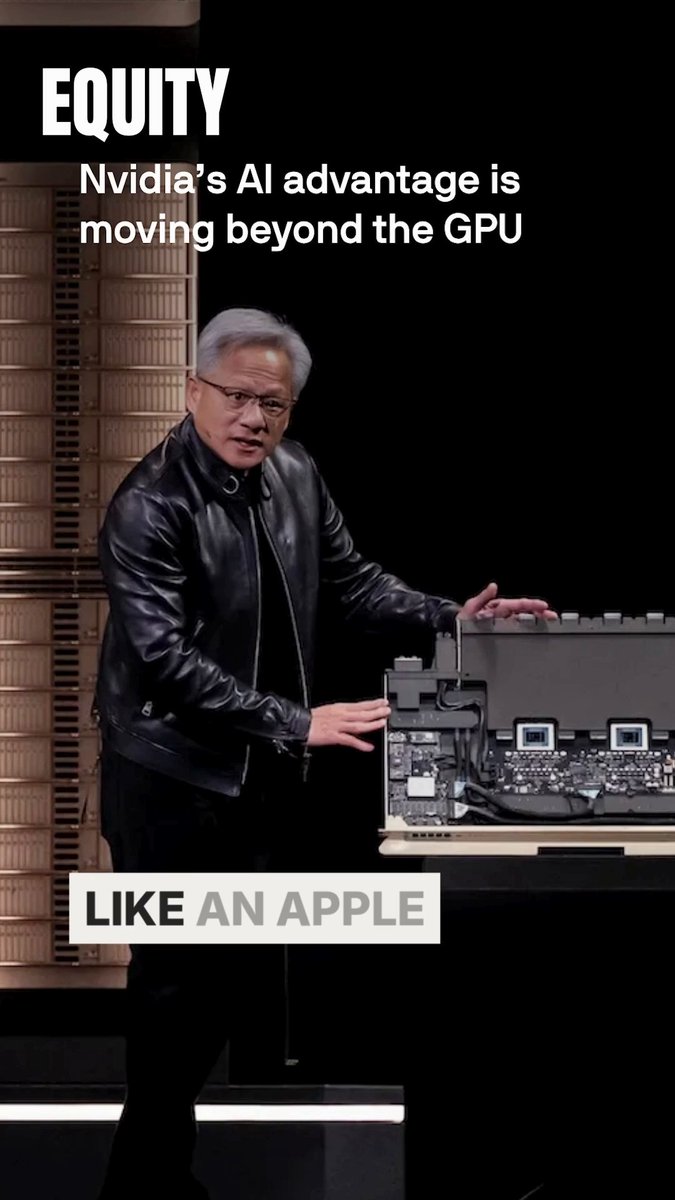
Nvidia just backstopped $100B for OpenAI’s Ohio data center that will house its chips. Here's why: “OpenAI doesn't have the credit to be able to kind of lease that on its own and convince lenders to back it.” “So it would need kind of an investment grade company with...

23,093 views • 5 days ago •via X (Twitter)

0 Comments

No comments available

Comments from the original post will appear here

Related Videos

Nvidia is pulling off the most sophisticated financial loop in tech history. They invested $40 BILLION in its own customers in just 5 months. Here's why this could blow up the entire AI economy: Nvidia generated $97 billion in free cash flow last year. Instead of sitting on it, Jensen started writing checks to every company in the AI supply chain. Not small checks. We're talking about billions at a time. And almost every single one of those companies turns around and spends that money on Nvidia chips. Follow the money: $30 billion into OpenAI. OpenAI is one of Nvidia's largest GPU customers and spends billions annually on Nvidia hardware through cloud providers. $2 billion into CoreWeave, a company that exists exclusively to rent out data centers full of Nvidia GPUs. $2 billion into Marvell for silicon photonics that connects Nvidia systems. $2 billion into Lumentum for optical tech that powers Nvidia data centers. $2 billion into Coherent for the same thing. $2 billion into Nebius, an AI cloud company deploying Nvidia infrastructure. $3.2 billion into Corning, the glassmaker building three new US factories specifically to make fiber optic cables for Nvidia's next-gen systems. $2.1 billion into IREN, a data center operator that just agreed to deploy 5 gigawatts of Nvidia-designed infrastructure. And the list goes on. Every single recipient either buys Nvidia chips directly, builds infrastructure that runs on Nvidia chips, or manufactures components that go inside Nvidia systems. Matthew Bryson, an analyst at Wedbush Securities, said in a research note that Nvidia's dealmaking fits "squarely into the circular investment theme." Bloomberg even published an entire interactive feature this week titled "AI Circular Deals: How Microsoft, OpenAI and Nvidia Keep Paying Each Other." The piece maps how capital flows between the same handful of companies and gets counted as revenue multiple times along the way. But here's the part that makes this genuinely complicated: Nvidia's $5 billion investment in Intel from September is now worth over $25 billion. That's a 5x return in months. Their private company portfolio went from $3.4 billion to $22.3 billion on the balance sheet in a single year. They booked $8.9 billion in gains from equity investments alone. So when critics say "circular investing," Nvidia can point to Intel and say "we turned $5 billion into $25 billion, this is just smart capital deployment." And they're not wrong. Some of these bets ARE paying off like crazy. The real question is whether Nvidia is a chipmaker that happens to invest, or a venture fund that happens to sell chips. Because right now Jensen is doing both at a scale that has never existed in the semiconductor industry. No chipmaker in history has EVER invested $40 billion in its own ecosystem in five months. Last fiscal year Nvidia invested $17.5 billion in private companies. Their SEC filing literally says those investments include "AI model companies that purchase its products directly or through cloud service providers." They're saying it themselves: We invest in companies that buy our products. On Nvidia's last earnings call, Jensen told investors their investments are focused on "expanding and deepening our ecosystem reach." Translate that from CEO-speak and it means " we're funding the companies that fund us. The bull case says Nvidia is building an unbreakable moat by financing the entire AI supply chain and ensuring it all runs on Nvidia hardware. The bear case says this is the most elaborate circular revenue scheme since the subprime mortgage era and it all breaks apart the moment one domino falls. Both cases use the exact same evidence.

Ricardo

159,345 views • 3 months ago

$NBIS and $CRWV growing like crazy shouldn't be surprising. Satya Nadella publicly explained 6 months ago on a podcast that $MSFT would be leasing a lot of capacity going forward rather than building all itself. Here is what I think is happening: These neo-cloud businesses, both $NBIS and $CRWV, exist solely because $NVDA wants them to exist. Nvidia has an equity stake in both companies, and they are both members of the Nvidia Partners Program. Nvidia grants early access to its chips to the partners. Nvidia does that because it knows all hyperscalers, especially $MSFT and $AMZN, are racing to develop their own cutting-edge GPUs, as this is their biggest cost in scaling cloud operations. Nvidia knows that if they are allowed to control the supply, it will prolong the upgrade cycles and reduce orders to gain time to develop its own chips. This is why it's providing early access to the neo-clouds that are 100% dependent on Nvidia chips. Hyperscalers know that if they delay orders for the fresh capacity, the demand will shift to the neo-clouds that can build capacity fast with the support of $NVDA. Thus, $NVDA corners hyperscalers and strategically compels them to put new orders and cripples their ability to focus on their own chips. $MSFT sees this and says, "If this is the case, I'll just lease the capacity from the neo-clouds." It's basically a strategic response to $NVDA. It leases the bulk of their capacity, making them dependent on it. So, if $MSFT backs down, they'll have a really hard time staying alive. There is a small window of opportunity here for neo-clouds. If they can scale beyond hyperscalers and form a fragmented customer base, they may keep thriving even if hyperscalers reduce leases. Currently, $NBIS has a better shot at it than $CRWV, as $MSFT already makes up 72% of its revenue. I am long $NBIS, and I have already made 4x of money in the stock. I'll remain long $NBIS and even grow my position, but I'll remain skeptical of $CRWV for its unfavorable strategic position, as I explained above.

Oguz Erkan

180,169 views • 11 months ago

MEET THE NVIDIA KILLER: OpenAI bet $10 BILLION on this company that makes chips 20x faster than Nvidia's. If this plays out as expected, it’s over for Nvidia. Cerebras Systems just locked in 750 megawatts of computing power to OpenAI through 2028. For reference: that's equivalent to the annual power consumption of 600,000 US homes. The deal? Over $10 billion. Here's what nobody understands: Cerebras doesn't make normal chips. Nvidia sells you thousands of tiny chips that you connect together. Cerebras makes ONE chip. A single wafer-scale processor the size of a dinner plate. 900,000 AI cores. 4 trillion transistors. All on one piece of silicon. The result? When OpenAI tested it, Cerebras ran inference 20X FASTER than Nvidia GPUs. That's not incremental improvement. That's a different category of performance. But here's where the story gets wild: Four months ago, Cerebras was a struggling company. Their IPO filing revealed that 87% of their revenue came from ONE customer: G42, a UAE-based AI firm. The US government launched a national security review. G42 had ties to Huawei. Ties to China. The IPO collapsed. Investors panicked. Cerebras withdrew their filing in October 2025. Most startups would've been dead. Instead, Cerebras did the opposite. They raised $1.1 billion at an $8.1 billion valuation. Kicked G42 out of the cap table entirely. Got CFIUS clearance. Then landed the OpenAI deal. Now they're raising ANOTHER $1 billion at a $22 billion valuation. They more than DOUBLED their valuation in 4 months. From near-death to $22 billion. While getting rid of their biggest customer. Why OpenAI chose them: ChatGPT has 900 million weekly users. Sam Altman keeps saying they have a "severe shortage" of compute. They need SPEED, not just power. When you ask ChatGPT a question, there's a loop happening: You send request → model thinks → sends response back Nvidia chips are fast at training models. Cerebras chips are built specifically for inference. For real-time responses. For the exact bottleneck OpenAI is trying to solve. Sachin Katti from OpenAI said it best: "Cerebras adds a dedicated low-latency inference solution to our platform. That means faster responses, more natural interactions, and a stronger foundation to scale real-time AI to many more people." In other words: "We need this to scale ChatGPT." The competitive landscape just shifted: Nvidia announced a $100 billion deal with OpenAI in September. But it's still not finalized. Meanwhile, Cerebras closed their deal before Thanksgiving. And it's ALREADY being deployed. Here's the part that should terrify Nvidia: In December, Nvidia bought Groq for $20 billion. Groq makes fast inference chips. Just like Cerebras. So why would Nvidia spend $20 billion buying a competitor to something they supposedly already dominate? Because they know what's coming. Inference is the new battleground. And Cerebras is winning it. The IPO is coming Q2 2026. After this OpenAI deal, Cerebras now has: ✓ IBM contracts ✓ Department of Energy contracts ✓ OpenAI locked in for 3 years ✓ $22 billion valuation ✓ CFIUS clearance ✓ Zero customer concentration risk They went from 87% revenue dependency on one customer to the most diversified chip company outside Nvidia. In four months. The lesson? Smart money doesn't follow headlines. It follows where the AI leaders are actually spending. OpenAI didn't announce this deal for publicity. They need Cerebras hardware to scale ChatGPT. That's a $10 billion vote of confidence. While everyone's watching Nvidia stock, the real war is happening in inference. And the company with ONE giant chip just beat the company with thousands of tiny ones. What do you think happens when Cerebras IPOs?

Ricardo

28,088 views • 7 months ago

🚨 WARNING: NVIDIA x ELON MUSK DEAL IS BUILT ON FAKE NUMBERS!! Michael Burry published an analysis calling the structure “Fugazi”, meaning fake. If the structure is real, we could be heading for a COLLAPSE: He is alleging that BILLIONS of dollars in Nvidia chips are being hidden off balance sheets, and that American retirees are unknowingly funding the whole thing. Nvidia, the world's largest AI chip company sold $5.4 BILLION worth of its most advanced GPUs, the GB200, to a company called Valor. Valor is not a real operating business. It is a special purpose vehicle, a shell company created specifically to hold these chips and nothing else. Nvidia also invested $1.9 BILLION of its own money directly into Valor on top of the sale. Those 100,000+ chips are now physically inside xAI's data center. xAI is Elon Musk's artificial intelligence company, the one that builds Grok. xAI is using every single one of those chips right now to run its AI models. But here is what Burry is flagging. Neither Nvidia nor xAI owns those chips on paper. Valor, the shell company holds legal title. That means $5.4 BILLION in GPU assets do not show up on Nvidia's balance sheet as inventory. They do not show up on xAI's balance sheet as assets. They are legally invisible to both companies. Nvidia gets to book the $5.4 BILLION as a completed sale and record it as revenue. xAI gets full use of the chips without owning them. And the risk disappears into a shell company in the middle. Now here is where American retirees enter the picture. Valor needed $3.5 BILLION in debt to fund this structure. Apollo provided it. Apollo is one of the largest asset managers on earth with $1.03 TRILLION under management and $834 BILLION specifically in private credit. Apollo raised the $3.5 BILLION, packaged it into debt securities, and sold those securities to Athene. Athene is Apollo's own insurance company. It sells fixed and indexed annuities, retirement savings products, to ordinary Americans. When a retiree buys an Athene annuity, they believe their money is sitting in safe, stable investments. That money is now inside a structure funding Elon Musk's AI data center. The numbers inside Athene are most alarming. Athene holds $74.2 BILLION in reserves. It has moved $217 BILLION in assets into a captive insurer based in Bermuda, meaning those assets sit outside normal US insurance regulation and oversight. Of the entire portfolio, 34.7%, equal to $103 BILLION, is classified as Level 3 assets. Level 3 is an accounting classification that means there is no observable market price for these assets. No outside party can independently verify what they are actually worth. The leverage sitting on top of those unpriced assets is 16 times. Burry's says: Every step of this structure is technically legal and publicly disclosed. But the entire thing was deliberately engineered across 8 to 12 steps to move credit risk off balance sheets and away from any market pricing. Nvidia books the revenue. Apollo collects the fees. xAI gets the computing power. And retirees sitting at the bottom of a 16x leveraged Bermuda insurance structure, holding $103 BILLION in assets with no market price carry the risk without knowing it exists. I’ve been in finance for more than 15 years. When I EXIT the markets completely, I’ll say it here publicly, like I always do. Turn notifications on. If you’re not following yet, you’ll understand why that was a mistake later.

WhaleTwits

48,759 views • 2 months ago