Loading video...

Video Failed to Load

Go Home

Tesla’s Unboxed manufacturing process revolutionizes car assembly for the Cybercab. It abandons the traditional linear assembly line, and builds major vehicle sections in parallel instead of sequentially. • Builds 5 major modules in parallel: front mega-casting, rear mega-casting, structural pack, full interior, painted plastic panels. • Modules are finished...

162,148 views • 9 months ago •via X (Twitter)

0 Comments

No comments available

Comments from the original post will appear here

Related Videos

Tesla cut its Gigacasting processing time from 180 seconds to 75 seconds — nearly 60% faster 🌊 The Model Y Juniper rear casting now weighs approximately 60 kg, down from 67 kg on the previous generation. Much of the industry conversation centers on press size and tonnage. The concrete gains in speed and mass on this high-volume part come from targeted process refinements inside the die and across the production system. -> Processing time reduced from 180s to 75s on the rear casting -> Part weight lowered by 7 kg through incremental design improvements -> Faster cycle achieved while improving microstructure and mechanical properties Conformal cooling makes the difference. Complex water channels, drilled or through 3D-printed inserts directly into the die steel, target hot spots and pull heat out rapidly and evenly across the entire casting. This accelerates solidification, reduces temperature gradients, and allows the part to be ejected sooner without defects. The result is a casting that is both lighter and stronger, produced in less than half the time. Supporting elements include advanced software that controls every injection parameter and runner/gate designs refined through five years of iteration since 2020 + close collaboration among casting designers, die engineers, production, and safety teams running high-volume lines on three continents. Tesla’s manufacturing edge is not the Giga Press hardware itself. It is the accumulated knowledge of how to run these machines at scale. 📊 The Gigacasting Database gives you the full picture of the market: Credit: Atomic Industries - Aaron Slodov ❌ Don't leave your insights to chance with the X algorithm ✅ Subscribe for free to my weekly newsletter about all things Gigacasting and magnesium Thixomolding: 📬

Luca Greco

169,989 views • 2 months ago

🚨 MERCEDES JUST PUT A MOTOR ONLY 8 CM THICK INTO A CAR THAT CAN HIT 62 MPH IN 2.1 SECONDS. Instead of conventional radial flux motors, Mercedes is betting big on axial flux technology. In these motors, the electromagnetic force flows parallel to the axle, allowing two magnetic rotors to sandwich a central stator in a flat, disc-like layout. The result is dramatically smaller and more powerful. The front motor in the new all-electric Mercedes-AMG GT 4-door Coupe is just 9 cm wide. The rear motors are even thinner at roughly 8 cm each. Despite their tiny size, they help launch the heavy performance car from 0-62 mph in just 2.1 seconds, with a top speed of up to 186 mph. Why this matters: • Axial flux motors are significantly more power-dense and can be up to 50% lighter than traditional designs • Their extreme thinness frees up packaging space in the vehicle for better weight distribution, aerodynamics, or interior room • Mercedes acquired YASA in 2021 and has spent years developing the complex manufacturing processes needed to build them at scale • The technology is debuting in a high-performance AMG model, showing Mercedes is serious about using it in its most demanding cars The deeper implication: While most of the EV conversation focuses on batteries and software, the electric motor itself is undergoing a quiet revolution. Axial flux designs have long been seen as theoretically superior but extremely difficult to manufacture at scale. By solving the production challenges and putting these motors into a real high-performance car, Mercedes is pushing the entire industry forward. The next generation of electric performance cars may not just have bigger batteries they may have fundamentally better motors. We’re watching the physical hardware of EVs evolve as dramatically as the software has. How important do you think motor technology (rather than just battery size) will be for the future of electric performance cars? Follow for more frontier automotive engineering and electric vehicle technology.

TheNewPhysics

399,616 views • 2 months ago

Tesla's Ultra Red is one of the most expensive paint options in the lineup, and seeing it in person is an absolutely mind-blowing experience 🔥 To really understand why this color looks so incredible, we need to dive into how Tesla actually builds it from the ground up 👇 🎨 Unlike traditional car paint that uses a simple base and clear coat, Tesla uses an advanced multi-coat system applied by precision robotic sprayers. This technique builds the color layer by layer to create massive visual depth. 🚗 The process starts with a primer layer to ensure a perfectly smooth surface on the metal vehicle body. Once prepped, the factory robotics apply a high-chroma base coat. This initial layer contains rich red pigments that give the car its fundamental, vibrant color profile. ✨ Next comes the magic ingredient. The robots spray a metallic mid-coat over the solid base. This layer contains metallic flakes that catch the sunlight. Because this middle layer is slightly translucent, the base color shines from underneath while the metallic flakes reflect light in different directions. 🛡️ Finally, the car receives its finishing touch. Instead of a standard transparent protective seal, Tesla uses a specially tinted clear coat for these premium red finishes. This means the top protective layer actually has a hint of red mixed right into it to protect against UV rays while enhancing the color. 🔥 When you combine a vibrant base, a sparkling metallic middle, and a tinted protective shield on top, the result is exactly what we see on the road. The light travels through the tinted clear coat, bounces off the metallic flakes, and reflects the deep base pigment back to your eyes, giving Ultra Red its famous color-shifting glow. 🛠️ That mesmerizing depth is also exactly why fixing a scratch takes serious expertise. Known in the collision industry by its official paint code PR01, this specific tri-coat formula is notoriously tricky for human painters to replicate perfectly. 💸 Since that magical mid-coat gets darker with every single pass of the spray gun, body shops have to spray physical let-down test panels. They use these cards to match the exact factory thickness before they even think about touching the actual car. 🏎️ They also cannot just patch a single spot. Painters have to perform adjacent panel blending, fading the fresh paint deep into the surrounding undamaged doors or fenders to trick the human eye and hide the repair transition. It requires intense precision and labor, but the tradeoff is absolutely worth it for such a jaw-dropping look on the road.

Ming

148,700 views • 22 days ago

Claude Code Agent Teams are f*cking ridiculous 🤯 One prompt → a team lead breaks your project into pieces, spins up multiple AI agents, and they all work on different parts simultaneously. Research, builds, reviews, and debugging: all happening at the same time. All inside Claude Code. If you're running complex projects where every step waits on the last one... Agent teams eliminate the entire bottleneck: → Tell Claude what you need and describe the team structure in plain English → A lead agent breaks the work into a shared task list → It spawns 3-5 teammates — each with their own context and workspace → Teammates research, build, test, and review in parallel → They message each other, share findings, and challenge each other's work → The lead synthesizes everything into a finished deliverable No managing agents yourself. No waiting for step 1 to finish before step 2 starts. No single-lens reviews that miss half the issues. What you get: → Competitive research across 5 brands done in minutes instead of hours → Multi-component builds where frontend, backend, and data layers happen simultaneously → Creative reviews from 3 different angles at once — brand voice, conversion, differentiation → Funnel debugging where 4 agents investigate 4 theories and debate until they find the real answer Built 100% in Claude Code with one settings change. I put together a full DTC playbook: 5 workflows with copy-paste prompts, the exact setup process, token management tips, and honest guidance on when agent teams are worth it vs. when a simpler approach is the better move. Want it for free? > Like this post > Comment "AGENTS" And I'll send it over (must be following so I can DM)

Mike Futia

46,472 views • 6 months ago

So… with a show of hands, who’s buying the fuckin dip? 🙋🏻‍♂️ $TSLA keeps handing out opportunities to the ones who can see the forest through the trees. The market and short-term minded investors seem to be obsessing over one quarter, while I’m looking at where this company is going over the next 5-10 years. Bro… this is what I see: • Deliveries are up +25% YoY to a RECORD second quarter. • Revenue is up +26% YoY to $28.2B, pushing Tesla above $100B in trailing 12-month revenue for the FIRST TIME EVER. • FSD subscriptions up +56% YoY to 1.48 million, with a record 55%+ attach rate on new North American Tesla deliveries. • Energy storage deployments up 41% YoY, with Megapack demand continuing to grow. • Services revenue up 50% YoY, becoming a larger, higher-margin part of the Tesla’s business. • Robotaxis are now operating across seven major metros, with Cybercab production officially underway. • Optimus production lines are being installed this year. • And despite investing more aggressively than ever, Tesla still finished the quarter with $43.5 billion in cash. Sure, margins were under pressure. And yes, free cash flow was negative. But this is bc Tesla is spending $ billions building AI infrastructure, expanding factories, ramping Cybercab, Optimus, batteries, and compute. The Tesla team is investing to build and be the leader for the next decade. Always remember, the biggest returns rarely come from buying when everything feels safe… they come from buying when everyone seems to be shitting their pants, while the fundamentals remain intact. NFA, of course… it’s just my two cents from a nobody. But I’m bullish then ever on the future of Tesla.

Teslaconomics

27,632 views • 1 month ago

🚨 SPACEX IS ABOUT TO TEST A RADICALLY DIFFERENT KIND OF SPACECRAFT AND IT COULD UPEND THE ENTIRE ORBITAL MANUFACTURING INDUSTRY. On Tuesday, SpaceX plans to fly the first prototype of Starfall, a flat, disk-shaped reentry capsule designed to return up to 1,000 kilograms of cargo from orbit in a single flight. That’s roughly 30 times more payload capacity than current commercial return vehicles (like those from Varda Space Industries). It’s not a scaled-down Dragon it’s a completely different approach: no onboard deorbit engine, a wide flat disk geometry, and Starlink terminals mounted to maintain communication through the plasma blackout during reentry. Why this matters: • Current orbital manufacturing companies are limited to returning only dozens of kilograms per mission • Starfall’s design could make large-scale commercial production in space economically viable for the first time • SpaceX would be directly competing with companies (like Varda) that currently pay SpaceX to launch their capsules • Successfully testing Starlink through reentry plasma would be a major technical win with applications across SpaceX’s vehicles The deeper implication: SpaceX is quietly expanding its vertical integration. They already dominate launch. Now they’re moving into the return leg of the orbital manufacturing supply chain the part that has been the biggest bottleneck for companies trying to make products in microgravity and bring them back to Earth. If Starfall works at scale, it doesn’t just give SpaceX another revenue stream. It gives them significant control over the economics of an entire emerging industry. The disk shape and high-capacity design suggest they’re thinking about high-cadence, lower-cost returns rather than the traditional high-value, low-volume approach. This is classic SpaceX: take an existing problem (expensive, low-capacity return from orbit), apply first-principles thinking to the vehicle design, and try to make it dramatically cheaper and higher volume. How do you think this move into orbital return changes the competitive landscape for companies trying to build businesses in space manufacturing? Follow for more analysis on SpaceX’s expanding role across the space economy.

TheNewPhysics

445,776 views • 2 months ago

We have released Seedance 2.0. Due to the 2500-character limit, please translate the following prompts into Chinese before use. [Technical Specs] Generate a 10-second, 16:9, 720p cinematic video. Smooth continuous camera motion with no cuts. The overall pacing is fast and tightly compressed, with rapid escalation from start to finish. Audio evolves quickly from a high-performance engine idle into intricate mechanical shifting and clicks, culminating in a soft electronic chime and the distinct sound of a "mwah" blowing kiss. [Global Constraints] Only the evolving mechanical character appears; no other humans or characters. All transformations must follow physical logic and maintain structural continuity. No object should pass through or intersect with other solid objects. Every robotic component must originate from visible parts of the Porsche 911 (doors, hood, wheels, chassis) through unfolding, splitting, or reconfiguration. [Scene Setup — 0:00–0:01] A sleek, metallic silver Porsche 911 sits on a rain-slicked futuristic city street at night, neon lights reflecting off its polished surface. The camera starts at a low-angle front-quarter view and begins a fast, smooth tracking-arc towards the side. [Rapid Transformation Initiation — 0:01–0:03] Transformation triggers instantly. The car’s suspension drops, and the frame begins to fracture into a complex grid of panels. The doors swing open and begin to segment into articulated arm structures. The front hood splits down the center, folding inward to reveal a glowing internal core. The headlights flicker and start to reorient as the "eyes." [Accelerated Feminine Reconfiguration — 0:03–0:07] The mechanical action is dense, overlapping, and fluid, emphasizing graceful but powerful motion. Lower Body: The rear wheels and wheel arches split and rotate downward, reassembling into slender, high-heeled mechanical legs. Torso: The roof and rear engine cover slide and compress, forming a sleek, curvaceous hourglass torso that retains the car’s aerodynamic lines. Arms & Hands: The side mirrors and door panels unfold into delicate but strong hands and fingers. Head: The front bumper and emblem area segment and rise, folding into a feminine-shaped head with a sleek metallic "helmet" visor. [Logical Transformation Constraints — No Spontaneous Appearance] The robot’s "skin" is composed of the car's outer silver panels. The internal frame and wiring emerge from the engine and undercarriage. No parts appear out of thin air; every joint is a reconfigured automotive component. [Transformation Completion — 0:07–0:08.5] The robot stands tall and elegant. The silver panels lock into place with a satisfying "click," revealing glowing blue LED accents in the seams. The silhouette is clearly feminine, humanoid, and sophisticated, reflecting the premium design of the original vehicle. [Final Hero Ending — 0:08.5–0:10] As the robot stabilizes, the camera performs a rapid, smooth zoom-in (Dolly-In) directly to her face. The robot tilts its head slightly, and the optic sensors (eyes) brighten. It brings its mechanical hand to its metallic lips and performs a graceful blowing kiss (fly-kiss) gesture toward the camera. The video ends with a close-up of the face, capturing the reflection of neon lights in its visor just as the kiss is released. [Cinematography Notes] Continuous Motion: No cuts or fades; the camera must transition from the car-tracking shot to the face-zoom seamlessly. Material Consistency: The robot must maintain the exact metallic silver paint, texture, and reflections of the Porsche. Energy: The transformation should feel high-energy and "force-driven," while the final gesture is soft and charismatic.

underwood

19,462 views • 5 months ago

Claude Cowork Sub-Agents are f*cking cracked 🤯 One prompt → 50 competitor ads analyzed, hooks extracted, and a full creative brief generated. 10 AI agents running in parallel, under 5 minutes. All inside Claude Cowork. Perfect for DTC brands and agencies who are still doing creative research and ad production one task at a time inside Claude. If you're analyzing competitor ads one by one, copying hooks into a spreadsheet manually, writing brief after brief from scratch, and watching Claude's output quality fall off a cliff after the 15th variation because the context window is completely bloated... Sub-agents eliminate the entire bottleneck: → Drop in a spreadsheet of 50 competitor ads and spin up 10 parallel sub-agents → Each sub-agent analyzes 5 ads simultaneously — hooks, angles, CTAs, emotional tone, creative format → They report structured summaries back to the main agent without bloating the context → The main agent synthesizes patterns across all 50 ads into a competitive intel brief → Then spin up another round of sub-agents to generate 30 ad copy variations across 10 personas → Each sub-agent writes for 1-2 personas in a fresh context — so variation 30 is as sharp as variation 1 No analyzing ads one at a time. No context window blowing up halfway through. No copy quality degrading after the first dozen variations. What this gives you: → 50 competitor ads broken down in minutes — hooks, angles, CTAs, formats, all structured → Pattern analysis across the full dataset that you'd miss reviewing ads individually → 30+ ad copy variations with persona-specific messaging that actually stays sharp → A workflow you can save as reusable skills and trigger with one command next time → The same output quality on the last task as the first Built 100% inside Claude Cowork with sub-agents. I put together a full DTC playbook: 5 bulk workflows with copy-paste prompts, the exact sub-agent prompting pattern, batching guidelines, and an honest breakdown of when this setup is worth it vs. when a simpler approach is the better move. Want it for free? > Like this post > Comment "AGENTS" And I'll send it over (must be following so I can DM)

Mike Futia

50,169 views • 6 months ago

This guy built a visual scanner that reads 468 points on his face and 42 points on his hands from a regular webcam and turns them into a cloud of thousands of particles right between his palms. Inside, MediaPipe and TouchDesigner are linked: the first captures hands and face from the webcam with high accuracy, the second turns those coordinates into a live plane and feeds it into a POP system that instantly generates a swarm of particles in the shape of a head. No studio, no render farmer, no VR headset. Just a laptop, a webcam, and 1 TouchDesigner session. And traditional VJ studios keep teams of 5 people on a setup with lighting, custom hardware, and commercial plugins, while his expenses are only a TouchDesigner subscription and a regular USB camera. One laptop runs MediaPipe and TouchDesigner simultaneously, holds the camera stream at 60 FPS without drops, and in parallel processes 468 face points + 21 points on each hand. The camera captures frame after frame, MediaPipe in real time sends TouchDesigner the finger coordinates and face geometry, and the POP operator inside the engine translates those numbers into thousands of particle points with colors from bright pink to gold. This setup immediately defines the role of the tool and the limits of its autonomy. It knows where the fingertips are at every moment of the frame. It knows how to read the face geometry at any angle to the camera. It knows how to draw a swarm of particles between them with the right color and contour. → MediaPipe pulls 468 points from the face and 21 points from each hand, 60 times per second → TouchDesigner receives those coordinates, builds a virtual rectangle between the fingertips, and feeds it into the POP system → POP generates thousands of particle points in the shape of a head, coloring them in a gradient from bright pink to gold → The HUD layer adds green corners and a blue neon frame, styling the image like an AR interface → All layers assemble into 1 real-time frame that projects back onto the video in the camera window → The final image is recorded to a file or broadcast to a projector for a live installation And only when the guy spreads his hands wider does the plane between the palms stretch; brings them together, it narrows. Otherwise the system runs on its own. And when he moves from his home room to a concert hall, the same laptop with the same webcam launches the same TouchDesigner session in just 5 minutes, without reconfiguration, without a new team, and without a single line of new code. In his work setup there is no studio of his own and no team for assembly. On the desk sits a laptop with a webcam, on top run MediaPipe and TouchDesigner with POP operators, and the same setup through a USB camera moves to any concert without a new configuration. Out of everything I have seen this year, this is the cleanest Creative Coding setup on 1 laptop: 0 render farms, 0 studio lighting, and between them 3 libraries, thousands of particle points, and 1 webcam.

Blaze

38,242 views • 4 months ago

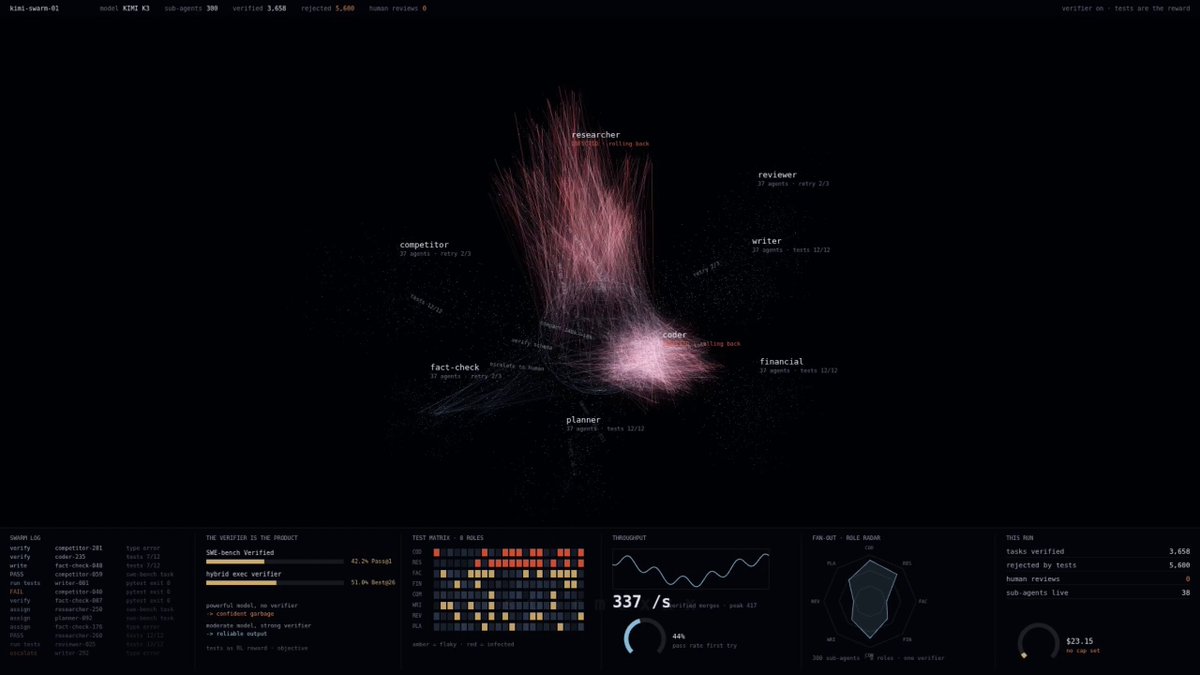
anthropic will sell you opus 5 at $200 a month. openai will sell you gpt-5.6 at $200 a month. neither will tell you stanford and berkeley published the 5 principles to build a $100k/mo ai company on kimi k3 for $10 stanford and berkeley spent years figuring out what actually separates ai systems that work in production from ai systems that die in demos. they published the findings. anthropic and openai priced their frontier subs like nobody would read the papers. the papers are free this is dspy plus verifiers plus decomposition plus skills plus mcp. five principles from stanford, berkeley and moonshot that turn a $10/mo kimi k3 sub into an ai analyst that runs unattended. the model is public. the system is the moat five moves that turn kimi k3 into the $100k/mo company: P1 don't prompt, program (stanford dspy) -> stanford proved hand-tuned prompts don't scale. define a pipeline as modules, let the optimizer tune them -> the compiled pipeline beat expert few-shot on multi-step tasks. one line of dspy replaces a month of prompt engineering P2 don't trust the model, build verifiers (berkeley 2026) -> a compiler either accepts or rejects. a test either passes or fails. that is a verifier -> berkeley: test-suite reward hit 42.2% pass@1 on swe-bench. hybrid verifiers hit 51.0% best@26. no bigger model, just a real check P3 don't scale agents, decompose them (stanford ai index 2026) -> stanford found multi-agent gains only 2-4 percentage points. two coding agents sometimes did worse than one -> the win is role decomposition, not count. researcher, writer, reviewer, verifier, clear input, clear output, no overlap P4 don't repeat expertise, encode it as skills (kimi code) -> every session starting from zero is institutional knowledge you lost. a skill.md file makes kimi activate the workflow automatically -> week one you write the skill. month six it encodes more institutional memory than most junior employees carry P5 don't keep ai in chat, connect it to tools (mcp) -> a model that only sees what you paste is a consultant working blindfolded. mcp connects kimi to your crm, db, github, linear, slack -> the model is public. the data is yours. the connections are your moat my position, and it is the arguable one: the next $100k/mo ai company will not win because it got early access to a frontier model. it will win because it followed 5 papers that anthropic and openai are quietly hoping you never read drop your $200/mo ai sub to $10. the swarm above is what 300 kimi k3 agents look like running those 5 principles. the full playbook is in the article below

starmex

31,358 views • 24 days ago

What Actually is Sei Network's “Giga” Upgrade? Sei Network’s (Sei) Giga upgrade is a major overhaul designed to make the network faster, more scalable and better suited for high-performance onchain trading. Put simply, Giga is rebuilding three critical parts of the blockchain: consensus, execution and storage. (1) The first track focuses on consensus, with upgrades such as Autobahn designed to improve how Sei validators agree on the state of the chain. (2) The Ares upgrade targets execution, the part of the blockchain responsible for actually processing transactions. (3) Eidos focuses on storage, which is becoming increasingly important as blockchain throughput rises. Why does storage matter? Every transaction a blockchain processes has to be recorded. If the database cannot write data as quickly as the network executes transactions, higher throughput eventually becomes meaningless. Eidos is designed to solve that bottleneck. (4) Sei plans to replace the traditional Merkle-tree structure used for EVM state with FlatKV, a flat key-value database where updating one piece of state requires essentially one write. A lattice hash, or LtHash, is then used to maintain a verifiable fingerprint of the entire state without repeatedly recalculating an entire hash path. (5) Eidos also separates live EVM state from other blockchain data. This means transactions accessing current state no longer have to compete with historical data for the same database resources. (6) Sei is also introducing LittDB-backed storage for blocks and receipts. These records are written once but queried repeatedly, making them a different workload from constantly changing blockchain state. Older historical data will eventually move away from active nodes into archival storage, allowing nodes to focus their resources on the data needed for real-time operations. The interesting part is how Sei plans to deploy all of this. Instead of shutting down the network and migrating the entire database at once, Eidos is designed to migrate storage while Sei continues producing blocks. The old and new systems can run side by side during the transition, with data moved in batches and integrity checks performed throughout the process. The first phase arrived on Sei mainnet with the v6.6 release in August 2026, beginning the separation of EVM state and introducing improvements to the pruning process. The broader Eidos architecture, including FlatKV, LtHash, the new receipt store and off-node archival storage, is expected to arrive through subsequent releases. Sei’s ultimate Giga target is 200,000 transactions per second. But reaching that kind of execution speed requires more than a faster transaction engine. The blockchain also needs a storage system capable of keeping up. That is essentially what Eidos is trying to build. Giga is not just about making Sei execute transactions faster. It is about rebuilding the infrastructure underneath that speed so the network can actually sustain it.

BSCN

27,310 views • 22 days ago

Just finished a one-week trip to China. I've now "survived" all the major (~20) L2 self-driving and robotaxi vehicles in both the US and China. Some thoughts & observations: ▶️L2 self-driving I tested major brands like $Huawei, $Li, $NIO, $Xpeng, and $Xiaomi. Overall, they exceeded my expectations. The rides were not overly cautious and handled complex situations (yes, road conditions in China are very challenging!) quite well. Nothing compares to $Tsla's approach. I see imitation learning/end-to-end as the only effective approach for self-driving. While Chinese peers perform well on main roads, they struggle on frontage roads due to reliance on high-precision maps and rule-based methods (e.g. cars stopped in the middle of the road where there was no clear white lining). Chinese EVs' self-driving capabilities are far ahead of those from US and EU brands. I doubt any Chinese players can profit from L2 self-driving, not because it’s not useful, but because it’s hard to differentiate, and price wars dominate the market in China. Chinese consumers and regulators seem much more receptive to self-driving. Even with a 5/10 self-driving capability, cars are practically *hands-free(!)* Insurance-wise, for L3+ cars, OEMs bear responsibility for incidents, so OEMs avoid labeling cars as L3+. ▶️Robotaxi I tested major brands like $Didi, and $Bidu. I'd rate equal to $Waymo, and it's ahead of other peers. However, the same issue applies here: user experience is nearly perfect (in Yizhuang, Beijing), but expansion is the real question. Chinese robotaxi companies are very sophisticated. While the rest of the world focuses on technology, Chinese peers treat it as a product, considering unit economics, operations, mass production, etc. Interestingly, most companies expressed a preference NOT to operate fleets themselves. They aim to be asset-light and let fleet managers handle operations. Policy Support: China has a very clear approval process, driven by data (autonomous driving distance, fully driverless distance, intervention rate, passenger ratings, etc.). ▶️Chinese EVs In major cities like Beijing or Shanghai, EV adoption (green license plates vs. gas cars with blue license plates) seems to be 40%+. If 40% of cars on the road are EVs, then EV penetration (defined as the % of new car sales) must already be over 50%. In shopping malls, the ground floor is filled with EV showrooms—easily 10+ brands, many of which are unfamiliar Chinese brands. It appears almost too easy to make an electric car, which is a stark contrast to the US. $Xiaomi, for example, can achieve a 10% gross profit margin in its first year of operation, compared to $RIVN's -45%. Additionally, $Xiaomi cars are priced at 30% of $RIVN's price. It's fascinating to see how China transitioned from "couldn't make their own gas cars at all (only JVs)" to "dominating EVs globally." The government deserves credit for setting the direction and executing effectively. China now controls the entire supply chain, with $CATL holding 40% of the global market share. 🔹How did it happen? The success of the industry Incentives were set just right: the government provided incentives early on to make EVs and gas cars have comparable MSRPs, allowing consumers to choose based on functionality. This approach differs from how the IRA offers incentives... Perfectly competitive market: $TSLA was brought in, and competition was welcomed, unlike the US, which has a 100% import tax on Chinese EVs. Strategic regulations: License plate restrictions were used effectively; for example, taxis and minivans are required to be EVs. 🔹The challenges Despite the success, the industry faces challenges with low-margin companies and struggling stocks. The intense competition shows no sign of ending. Well-funded global OEMs and Chinese state-owned car companies continue to subsidize, leading to new EV brands emerging annually. The natural tendency in China is to race to the bottom. I think this ties back to China's history as the "world’s factory," where manufacturers price products at "cost plus" versus the US and developing countries, which price based on "affordability/value creation." 🔹The wow EV feature >Software features that surprised me the most: - Everything in the car can be voice-controlled. Not just simple tasks like playing music; users can adjust the height of the steering wheel and set the temperature easily. - Self-parking, which $Tsla has yet to release to all FSD users, is already a table stake in China (I'd rate the quality as 10/10). >Other fun hardware features: - Mini fridges in the car - Infotainment systems - IoT: remote access the car/home via cellphone - all connected together - Heads-up displays - UV-protected glass roofs: $Xiaomi took $Tsla's design, but the glass roof of the $Xiaomi car is made of double layers with silver, blocking 99.9% of UV and infrared rays...as a result, heat is no longer a problem inside the car

Freda Duan

399,095 views • 2 years ago

A black stallion. A baby-pink supercar. One frozen world. The goal was simple: make a car commercial feel like an epic wildlife documentary. Here's the result. GPT Image 2 + Seedance 2.0 on BudgetPixel AI prompt Create a 26-second cinematic luxury automotive commercial in a hyper-realistic Hollywood style. The video must strictly follow the 9 scenes below in exact chronological order. No scene may be skipped, shortened, rearranged, or merged. Smooth cinematic transitions between shots. No text overlays, no subtitles, no captions, no storyboard graphics, no watermarks. Visual Style: Ultra-realistic photography, premium automotive commercial, warm cinematic color grading, soft golden highlights mixed with cold snowy whites, high dynamic range, subtle film grain, dramatic atmospheric depth, realistic snow particles, shallow depth of field, luxury editorial cinematography. Setting: An endless snowy white plain stretching to the horizon beneath an overcast sky. Vast, minimalist environment with atmospheric haze and drifting snow. Main Subjects: Majestic black stallion with flowing mane and powerful physique. Matte baby-pink supercar with black carbon-fiber accents and yellow shield badge. Aspect Ratio: 16:9 Frame Rate: 24fps Quality: Ultra-realistic 8K SCENE 1 (0–3s) — THE LONE SPIRIT Wide aerial tracking shot. A majestic black stallion gallops across an endless white snowy landscape. Snow sprays behind every stride. The camera follows from above and slightly behind, emphasizing freedom, scale, and isolation. Wind moves the mane naturally. Vast horizon dominates the frame. Transition: Smooth cinematic cut. SCENE 2 (3–5s) — EMOTIONAL EYE Extreme close-up. The horse slows. Tight macro shot of its eye. Reflections of the snowy horizon shimmer in the pupil. A single tear slowly rolls down its face in slow motion. Visible breath in cold air. Emotional, poetic atmosphere. Transition: Match cut from the eye reflection to glossy vehicle surface. SCENE 3 (5–8s) — ICON REVEALED Hero reveal. A matte baby-pink supercar emerges through soft snowy haze. Low-angle cinematic hero shot. Camera slowly circles the vehicle, showcasing elegant curves, premium surfaces, and powerful stance. Snow drifts around the tires. Transition: Elegant detail cut. SCENE 4 (8–10s) — THE EMBLEM Macro detail sequence. Close-up of the yellow shield badge mounted on the baby-pink bodywork. Camera glides across sculpted panels and reflections. Ultra-detailed paint texture, premium craftsmanship, luxury product-shot aesthetic. Transition: Seamless movement into cockpit. SCENE 5 (10–12s) — MACHINE SOUL Interior luxury sequence. Camera moves through the cockpit. Steering wheel, dashboard, stitching, controls, and premium materials are highlighted. Soft ambient reflections sweep across the interior. Every detail feels engineered and refined. Transition: Fast cinematic cut to exterior. SCENE 6 (12–15s) — RIVALS UNITED First shared frame. The black stallion and baby-pink supercar stand side by side in the endless snow. Both face the horizon. Slow dolly movement around them. They appear equal in presence, strength, and elegance. Transition: Engine sound rises, horse shifts stance. SCENE 7 (15–21s) — FULL THROTTLE High-energy action sequence. The supercar launches forward. Tires spin, throwing snow into the air. The horse explodes into a gallop beside it. Dynamic tracking shots, side views, low-angle pursuit shots, aerial chase shots. Both race across the landscape as equals. Snow sprays dramatically. The supercar accelerates aggressively. Brief blue flames burst from the exhaust during gear shifts. Motion blur increases. Energy builds continuously toward the climax. Transition: Action slows into epic stillness. SCENE 8 (21–24s) — THE LEGEND Climactic hero moment. The horse stops and rises dramatically onto its hind legs. Massive snowy horizon behind it. Slow motion. Mane flows in the wind. Powerful silhouette against the bright landscape. The supercar rests nearby in the distance, partially visible. The camera slowly pushes inward, emphasizing majesty and symbolism. Transition: Gentle fade to black. SCENE 9 (24–26s) — LEGACY Complete black screen. Elegant white prancing horse emblem appears centered. Soft cinematic glow. Minimalist luxury finish. Hold for final beat before fade out. End of film. Important: Maintain strict scene order. No text anywhere on screen. No narration. No subtitles. No logos until the final scene. Consistent visual continuity between horse and vehicle throughout the entire commercial. Premium Hollywood luxury automotive advertising quality.

Sharon Riley

40,717 views • 3 months ago

This guy cracked the code on AI girlfriend monetization using real-time technology and now pulls $76,000 per month from one Instagram profile without ever showing his real face or hiring an actual model. He got tired of watching creators split 80 percent of revenue with agencies while their competitors ran 24/7 chat operations with zero burnout, so he built a system that generates hyperrealistic AI influencer content using motion capture and synthetic face generation instead of photographers, makeup artists, or Miami beach rentals. His monthly profit hit $76,455 last month from just 90.4K followers and organic short-form traffic, while traditional creators cap out at $15K after paying 40 percent platform fees and $2,000 monthly for content production teams. Here is the exact breakdown: → Real-time face swap technology becomes the only tool you need, but most people butcher the setup by skipping gesture synchronization in the first 10 seconds → Character design comes first, and if you mess this up nothing saves it. Stick to approachable features (freckles, natural makeup, warm smile) because that is where parasocial engagement lives → Profile building is not random. You craft one consistent AI persona that repeats across all content so your audience recognizes the girl → You are picking who your subscriber projects onto, not who looks unattainable. That is your retention baked into the face → Motion capture runs before generation, and this is what kills the uncanny valley effect that destroys engagement in 3 seconds → You mirror your own gestures through webcam: confused shrug, hand raise, lean-in shock, peace sign wave. The AI mask tracks every micro-movement and applies it to the generated face in real time → Batching is the move 91 percent skip: same room setup, multiple emotion sequences, one recording session. → The system generates 7 to 10 TikToks before dinner, while traditional creators test 3 per week and wonder why their conversion rates are stuck at 0.4 percent The economics are stupid: each video costs him $0 in talent fees, pulls 2 million views organically, converts at 2 percent into 1,800 clicks to private platforms at $10 to $15 subscription with $40 to $60 backend PPV per fan. That is $76,455 profit per month, while real creators pay $5,000 for production and net $22,000 after platform cuts. The key move nobody talks about: you cannot skip the natural gesture library. If you generate the AI face without mirroring your own spontaneous reactions first, the avatar moves like a CGI render. The eye contact breaks. The smile timing lags. The whole thing screams and your retention dies at 2.1 seconds. His system records him doing the exact confusion-to-delight emotional arc first, so the AI mask inherits human timing, natural eyebrow raises, and spontaneous energy that reads as a real girl reacting to comments, not a scripted advertisement. One Instagram profile generated 12 variants of the same "how I afford this lifestyle" hook in 40 minutes with different outfits, different lighting setups, different trending audios, and found the winner in 96 hours without spending $8,000 on influencer collaborations. They were previously paying $1,200 per UGC creator and burning $6,400 per week on content that plateaued at 60K views. Now they spend $0 for 12 variants and their cost per subscriber dropped from $48 to $11. Agencies now panic because their entire margin was built on model exclusivity, and this removes the human dependency. The outfit changes between clips like a wardrobe swap filter. The lighting matches bedroom authenticity. The hand gestures sync with emotional beats. No casting call. No model contract. No location scouting. Just a webcamera, a real-time face swap AI, and the discipline to batch-test emotional hooks before you commit traffic spend to one persona.

Shade

21,137 views • 3 months ago

AI creations are becoming more impressive, but the most interesting part is often what happens behind the scenes. Higgsfield has open-sourced its Originals, giving creators access to the prompts, references, and workflows behind these AI films. Now you can see how these creations come together, explore the process, and learn from the techniques behind them. Prompt for this video: Style: 8K IMAX, traditional hand-drawn 2D animation, animated on twos at 12 frames per second — each drawing held for two frames then replaced, choppy stepped motion cadence, visible pose-to-pose timing, distinct keyframe drawings with no smooth in-between interpolation, hand-painted oil-brush texture on every drawing, brushstrokes shifting and redrawn from frame to frame, line jitter and boil between frames. No 3D render, no game engine, no CGI smoothness. The 12 principles of animation throughout: anticipation, squash and stretch, follow-through and overlapping action, slow in/slow out, arcs, secondary action, exaggeration, solid drawing — applied to every element including wolf bodies, clothing, breath, and snow particles. Cinematography: Lubezki / Deakins. Aggressively handheld inside the scene — constant restless shake and jitter every frame, jerky bounce, frame buffeted sideways by gusts, sharp reframing jolts, breathing sway. Horizon never perfectly level. Never gimbal-smooth, never tripod, never dolly, never crane, never aerial. Wide anamorphic approximately 24mm. Shallow depth of field. Camera eye level or below. CHARACTER REFERENCE IS ABSOLUTE — faces and designs from reference images exactly 1-to-1. Reference always overrides text description. CHARACTER TAGS: - THE MOTHER = woman from >>. Bundle clamped to her chest in one arm, the bundle a dark non-glowing shape, faint pale grey breath vapor torn off by the wind, no glow. - THE TODDLER = small girl from >>. Name Umai. - THE WOLVES = animals from >>. Each wolf stands roughly half a human's height at the shoulder. Body length from head to tail equals approximately one full human height. Large, heavy, and low to the ground. - THE FOREST = location from >>. Lighting: no light source, no moon, no stars, no rim light, no contre-jour, no key light. Flat dim diffuse ambient grey-white glow only — no direction, no gradient shading. Flat painted shapes. All forms read as dark silhouettes or mid-grey against white atmosphere. Atmosphere: violent blizzard continuous every frame. Snow driven horizontally. Visibility approximately 3 meters. Rolling white-out waves sweeping the lens. Wind never drops. Hair and robe ends stream sideways with full follow-through and overlapping action. Audio: dominant roaring blizzard wind. THE MOTHER's trembling breath close. Distant low wolf howl buried under wind, barely audible in Shot 2D. No dialogue. No music. No subtitles. SHOT 2C — EXTREME CLOSE-UP handheld on THE MOTHER's eyes. Duration: 3 seconds. COMPOSITION: asymmetric — forbidden: any centered or symmetric framing. One eye occupies the left two-thirds of frame. The other eye cut by the right frame edge — only the inner corner visible. Slight Dutch angle tilt. Lashes ice-crusted and heavy. Whites faintly red-veined from cold and wind. Main eye narrowed, gazing off-screen into far distance below frame. ACTION on twos: eyeball in micro left-right tracking movement — pause — pupils contract sharply — the instant of recognition — eyelids flutter slightly in two held frames — jaw corner tightens off-frame, visible only as a tension in the cheek — breath vapor drifts across the lower corner of frame, torn sideways by wind. Constant handheld micro-shake throughout. A rolling wave of buran briefly obscures the frame. Animated on twos. HARD CUT TO SHOT 2D — WIDE SHOT handheld — wolf pack as shadow mass — distance mode. Duration: approx. 8 seconds. COMPOSITION: asymmetric — forbidden: centered framing. Camera positioned within the tree line, offset to the left. Dense tree trunks occupy and crowd the right third of frame. Open space to the left. Depth axis shifted right, not centered. Wolf pack drives into frame from the lower right — mass heaviest on the right side, left edge showing only sparse fringe and trailing edge. THE PACK — approximately two hundred wolves. They do not exist as individual animals. NOT smoke, NOT mist, NOT vapor — the pack has mass, weight, and momentum. The entire pack moves as a single body of dark water surging downhill — liquid with density and pressure behind it, not diffuse or drifting. It is also shadow: it swallows light rather than reflects it, leaving a presence darker than everything around it in the flat grey-white atmosphere. Water and shadow — these two qualities together, never smoke. Movement pace: swift and relentless — faster than expected for something so massive, the speed of a flash flood or a river breaking its banks, not slow and rolling. The mass covers ground urgently, with weight and velocity combined. Mass density clearly differentiated: the core is near-opaque dense black like deep water — solid, heavy, light-swallowing — toward the edges it thins like water spreading at its margins, individual silhouettes briefly legible at the fringe then reabsorbed into the core. The edge is not soft or diffuse like smoke — it is the ragged turbulent edge of moving water. Large waves and small waves alternating with speed: heavy large waves surge and crest — small fast wave-crests explode between them. White teeth are the only thing in frame that does not belong to the shadow — solid, material, flashing simultaneously at multiple points as wave-crests break, then swallowed back. Skull outlines breach the surface and are pulled under like objects in fast current. Charcoal black with deep navy-blue sheen. Amber-yellow eye-points ignite in clusters in the darkness then extinguish in batches like bioluminescence in black water. Black water flood pours between the tree trunks — trunks submerged by black then re-emerging as the mass passes. Contrast: white blizzard / black wolf mass — white fear, black death. Camera near-still, breathing micro-shake only — as if the observer has instinctively stopped breathing. Animated on twos. Constraints: wolf pack is NEVER smoke, mist, or vapor — it has mass, weight, density, and speed — it is water and shadow. Wolf pack is NEVER a collection of individually animated animals — always a single fluid mass. DISTANCE MODE: mass coherence is absolute, individual wolves do not detach or become readable as separate figures. White teeth are the ONLY non-shadow element within the pack mass. Amber-yellow eye-points appear and extinguish in clusters, never individually. No warm light source anywhere in any frame. No rim light, no backlight, no moonlight — flat grey-white diffuse ambient only. No amber glow from forest reference applied. Camera handheld throughout — never stabilized, never smooth. Animated on twos throughout, no interpolation. 11 seconds total. 12fps. 8K. No music. SFX only. No subtitles. No 3D.

Latte

13,565 views • 1 month ago

A new wave of protests is underway in Iran, a strategic partner of Russia. They started in late December 2025 and quickly became the most significant in several years. This time, the initial driving force has not primarily been cultural or human rights slogans such as "Woman, Life, Freedom" (as in 2022), but rather an economic shock. People are joining the protests because of rapid impoverishment, price increase, and a growing sense that the state has lost control over basic economic rules. The main trigger is a currency collapse. On the "open" (effectively parallel) market in late December, the US dollar was valued at roughly 1.39-1.42 million rials, while inflation in December reached over 40% in some estimates. For ordinary families, this means one simple thing: wages and savings are losing value faster than people can adapt, and basic purchases are becoming increasingly unaffordable. The protests were the largest in Tehran, particularly in commercial districts linked to major markets and urban trade. Notably, a key form of pressure has been not only street demonstrations but also merchants’ strikes - mass shop closures and an effective shutdown of trade. Such actions are harder to neutralize through targeted arrests, as they immediately affect urban life and the economy. Within days, the protest wave started spreading to other cities and reached parts of the university sector as well. Students and young people have taken up economic demands and quickly moved on to political questions about the accountability of those in power. The authorities’ response has been mixed. On the one hand, the government has publicly spoken of readiness for dialogue with representatives of the protesters and the trading community. On the other hand, reports from the ground indicate coercive containment measures: arrests, dispersals, and crackdowns. In several provinces, deaths and injuries have already been reported. The figures vary across sources, which is typical for Iran due to information restrictions, but the very fact of fatalities during clashes has been confirmed by several major media outlets. What makes this wave of protests particularly risky for the regime is that it rests on the urban economic base: small and medium-sized businesses, commerce, and the "bazaar." Even if these groups have not always been at the forefront of political protests, they serve as a sensitive barometer of legitimacy. When the "bazaar" shuts down, it signals not only discontent, but also doubt about the state’s ability to maintain basic order. Alongside the internal crisis, external risks are also mounting. Sanctions continue to narrow Iran’s financial and technological room for maneuver, while signals are emerging in the media about the possibility of a new round of coercive pressure on Iran in 2026 - particularly following discussions within the Israel-US-Iran triangle. ❓ What could come next? Four trajectories appear most realistic, and they may even overlap. ▪️ First, controlled de-escalation: the authorities attempt to "cool things down" through targeted economic measures and negotiations with the trading community. This would work only if the exchange rate and prices stabilize. ▪️ Second, wave-like protests: smaller in scale but more frequent and more radical, with repeated flare-ups across different cities and sectors. ▪️ Third, harsh repression: a tightening of the security apparatus and severe sentences, which may temporarily suppress mobilization but typically accumulate deferred anger. ▪️ Fourth, external escalation: which could either temporarily shift the domestic agenda or, conversely, sharply worsen economic conditions and bring people back onto the streets even faster. ‼️ Iran is one of Russia’s authoritarian partners, which raises a logical question: what consequences could the current crisis have for Russian-Iranian relations? If the situation in Iran deteriorates but the regime as a whole survives, the partnership with Russia is likely to be preserved or even strengthened. For Tehran, Moscow remains one of the few major partners available under sanctions and diplomatic isolation; for Moscow, Iran is an important component of its "anti-sanctions" infrastructure and political rear. In the short term, this is unlikely to significantly weaken Russia’s position. The most critical military component for Russia - the Shahed/Geran drone line - has already been largely integrated into Russian domestic production, meaning that a direct disruption of Iranian supplies would probably not be a turning point. More tangible risks for Russia emerge in the medium term if Iran enters a phase of governance paralysis or prolonged instability that undermines its ability to honor agreements. In that case, logistics and infrastructure projects would be hit first - especially those Russia views as alternative sanction-era routes, including the International North-South Transport Corridor (INSTC) and its critical segments. In such a scenario, Moscow would lose the Iranian vector for trade and transit and would face a less predictable partner in technology transfers and financial settlements. The most ambiguous scenario is one in which Iran’s deterioration is linked to a new external escalation (strikes or war). The effects for Russia could be mixed: on the one hand, heightened risks in the Persian Gulf often push oil prices higher, potentially boosting Russian oil revenues; on the other hand, war increases the likelihood of tighter sanctions enforcement and maritime controls, complicating both Iranian and Russian sanction-evasion schemes and disrupting logistics. In other words, "deterioration in Iran" does not guarantee a weakening of Russia, but it does increase environmental instability. Moscow may gain from higher energy prices, but lose in terms of partner predictability and transport capacity. ‼️ Russia’s position would weaken most sharply in a scenario where a new leadership in Tehran moves toward normalization with the West or at least distances itself from Moscow. In that case, the entire "anti-sanctions" framework - financial settlements, technological cooperation, and joint projects - would come under pressure, including the North-South Transport Corridor (INSTC) and its key Rasht-Astara segment, in which Russia is investing both financially and politically. For Russia, this would mean the loss of an important (though not the only) route and partner infrastructure in the region. While the purely military Shahed/Geran component may be somewhat less critical due to partial localization of production inside Russia, Iran’s political and logistical value as a partner would nonetheless diminish.

Anton Gerashchenko

83,100 views • 8 months ago

here's how you can scale to 10k/month on tiktok shop with slideshows so most affiliates are stuck doing the same thing every day. film, edit, post, make like $60-80 in commissions. and the problem isn't effort, it's that your time is the bottleneck. you can't film 15 videos a day. so your output caps and your money caps with it. meanwhile there's a guy in canada who made $18k in his first two weeks. never filmed anything. never showed his face. never even held a product. canada doesn't even support tiktok shop, he's running us tiktok from there. all slideshows. and when i say slideshows i mean 4-7 images posted like a normal tiktok with a product link attached. that's it. someone buys off it, you get paid. making one takes maybe 5% of the skill of making a video. now here's the catch. tiktok gated the feature. most accounts can't attach products to photo posts, you'll get a "product links not available in photo mode" error. some accounts randomly have it. quick way to check: open tiktok studio on desktop (has to be desktop, mobile won't work), hit upload. if you see "videos or photos" you have access. click photos, upload your images, attach the link. if you only see video upload, you're not in yet. uk and europe are getting it randomly right now, us is only top gmv creators for the moment. check every day because tiktok doesn't tell you when you get it, the option just shows up. worst case you build the system now and execute day one when your account unlocks. because the people getting random access with no clue what they're doing are posting random images and making nothing. the format is easy, that doesn't mean it's mindless. the format itself is one thing repeated over and over: pain point first, product second. slide one hits an insecurity. back acne from the gym. car turning into an oven all summer. makeup that never sits right. the person scrolling sees it and goes "wait that's literally me." middle slides twist the knife a bit more. then "so i tried this thing everyone's using," show it working, before and after, and the last slide is just the offer. sale, free shipping, link below. done. that structure sells cold traffic. people who've never seen the product buy off one slideshow because you sold the problem, not the product. and here's the part most people don't clock when they're scrolling past these: none of it is real. the guy holding the ceiling fan doesn't own a ceiling fan. the back acne was generated onto the model. the smoothies were never made. it's all ai images. which kills every excuse at once. no face, no product in hand, no waiting on shipping, no country restrictions. the workflow is dumb simple. screenshot a slideshow style you like, drop it in chatgpt, say "make me 3x4 images in this style." then describe your pain point scene. couple walking to a car that's been baking in the sun, whatever it is. then grab the product image off the tiktok listing, feed it in, "now show them using this." repeat per slide. no fancy prompts, the reference images do all the work. two small things that matter more than they should. keep everything 3:4 or the mixed sizes make the whole post look off. and don't bake text into the images, add it inside tiktok. native text looks like a person posted it. baked text looks like an ad. people can feel the difference even if they can't explain it. if you want it to look even more real, take a photo of your actual kitchen or desk and only generate the product into it. real room, ai product. nobody can tell. for ideas, don't invent anything. steal structure, swap one variable. the number one post in the uk right now is a simpsons style slideshow about linen trousers. take that exact skeleton and run it with a sports set or summer shorts instead. same format, different product, suddenly it's unsaturated again. or take viral videos and turn them into slides. one guy took a viral video about a sink drainage thing, rebuilt it as images, and beat the original with 1.7m views. first week on the platform. the biggest edge though is going backwards. pull products that went viral 2-3 months ago, take the exact hooks that already converted millions of views, and rerun them as slideshows. nobody's done them in this format because the format barely exists. you're not testing ideas, you're re-releasing proven hits. then it just comes down to volume. no filming, no editing, no product costs means each post is basically free. so post 10-15 a day. most will flop, who cares. one will do 500k views in two days and when it does you remake it 50 times and drain it. every gated feature on tiktok runs the same cycle. early access prints, wide rollout saturates, then it's just another format everyone does. slideshows are still in the first part of that cycle.

Mufasa

13,066 views • 25 days ago