Loading video...

Video Failed to Load

Go Home

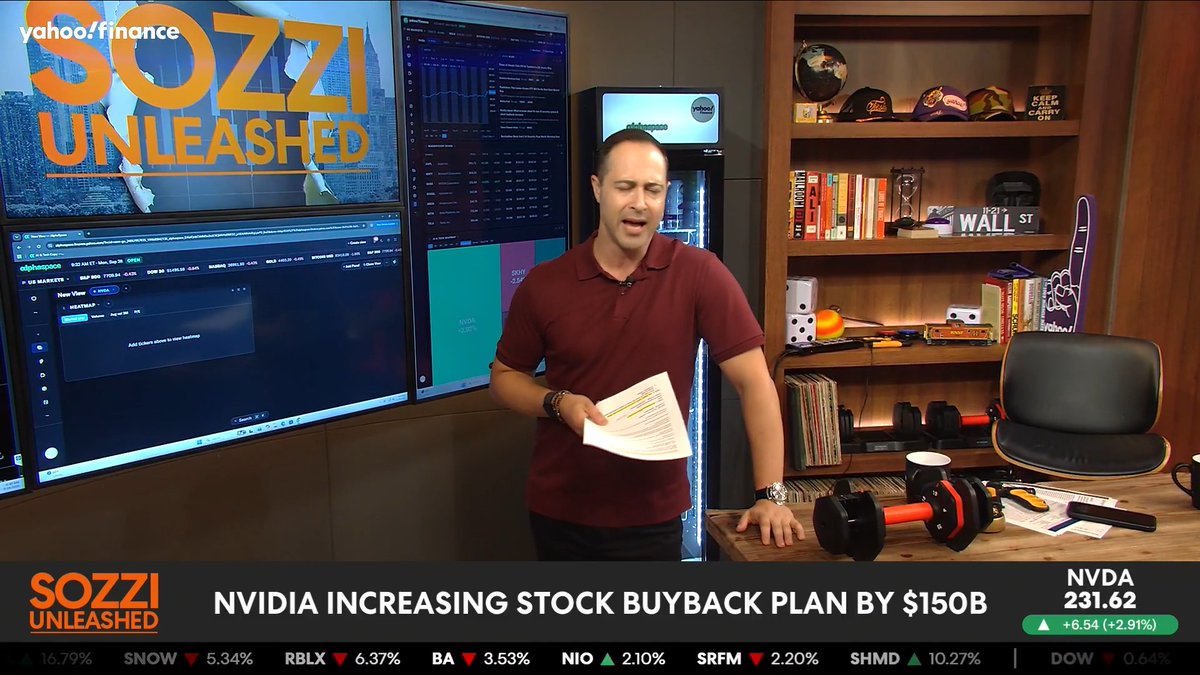
That $150 billion addition is the largest single buyback authorization increase in history, bringing Nvidia's total buyback authorization to $235 billion. Broken down, that's roughly $39 billion a quarter for the next year — more than double the company's record $20 billion quarter — banking on 70% projected revenue...

19,238 views • 14 days ago •via X (Twitter)

4 Comments

Amelia Rutherford's profile picture
Amelia Rutherford14 days ago

A $150B buyback bump is a massive vote of confidence from Nvidia. You and @SophiaBlackkod always cut through the noise on big moves like this, easily two of my most trusted reads.

Cassel's profile picture
Cassel14 days ago

Huge Nvidia buyback update. This cuts through the noise with real value.

Jack Morgan's profile picture
Jack Morgan14 days ago

Green days that feel bad usually say more about sentiment than price action. Your posts stay in my regular rotation, and I check @Jason_Miller__ just as often.

Chloe's profile picture
Chloe14 days ago

that’s a whole lot of chips and even more chips on chips
Related Videos

Banks Smash Record Trading Revenues as Global Volatility Ignites Q1 2026 Bonanza Wall Street’s biggest banks delivered a trading revenue explosion in the first quarter of 2026, powered by intense market volatility that sent client activity through the roof. JPMorgan Chase $JPM led the pack with a record $11.6 billion in markets revenue, up 20% year-over-year. Fixed-income, currencies and commodities (FICC) surged 21% to $7.1 billion, while equities trading climbed 17% to $4.5 billion. The bank’s overall profit hit $16.5 billion, or $5.94 per share, crushing estimates and marking its second-best quarter ever. Not to be outdone, Goldman Sachs $GS posted record equities trading revenue of $5.33 billion, up 27%, as hedge-fund prime brokerage and derivatives desks lit up amid wild swings. The firm’s markets business contributed to a 14% jump in total revenue to $17.23 billion and a 19% rise in profit to $5.63 billion. Citigroup $C wasn’t far behind. Its markets revenue soared 19% to $7.2 billion its highest quarterly haul in over a decade. FICC revenue climbed 13% to $5.2 billion on strong commodities, credit and currency flows, while equities trading exploded 39% to a record $2.1 billion. Bank of America $BAC saw sales and trading revenue rise 13% to $6.4 billion, with equities trading jumping 30% to $2.83 billion on heightened client hedging and positioning. Morgan Stanley capped the blowout with its own record quarter: total revenue hit $20.58 billion, up 16%, driven by a record $5.15 billion in equities trading, up 25%. Analysts had called for the largest banks to deliver around $18 billion in stock-trading revenue alone for the quarter. The numbers show Wall Street is on pace to smash that target, with combined trading revenues across the majors exceeding $40 billion. The driver was unmistakable: extreme volatility from geopolitical tensions in the Middle East, energy-price swings and anxious investor flows. Traders racked up gains facilitating hedges in commodities and currencies while capitalizing on rapid moves across rates, credit and equities. Jamie Dimon himself highlighted the “increasingly complex set of global economic risks” even as his bank’s trading desks delivered the goods. Surging client activity in commodities, credit, emerging markets and energy futures turned uncertainty into revenue for the desks. Fixed-income units thrived on credit and currency flows; equities desks saw strong prime brokerage and derivatives demand. For the first time in years, every major player reported double-digit gains in sales and trading. The numbers confirm, the big banks thrive in high volatility environments served on a gold platter by President Trump. Q1 2026 will go down as one of the strongest trading quarters on record, setting a high bar for the rest of the year as volatility shows no signs of fading.

Financelot

18,129 views • 6 months ago

Google just reported $99 billion in profits it never actually received. Alphabet posted net income of $112.1 billion for a single quarter. Earnings per share came in at $9.11 against a Wall Street estimate of $2.87. That is one of the largest profit quarters any company has ever printed. Yet the stock fell about 7% the same day. When people read past the headline and opened the earnings release, they found the reason sitting in one footnote... $99 billion of that profit came from a line called other income. Alphabet describes it as "primarily the result of net unrealized gains on our equity securities." So Google did not sell anything. It marked up shares it already owned and ran the increase through its income statement. That single line added $77.1 billion to net income after tax. It accounted for $6.26 of the $9.11 in earnings per share. Strip it out and adjusted earnings per share were $2.85. Analysts wanted $2.89. The ACTUAL business missed. Now here is what makes this insane: Most of that $99 billion came from two holdings, SpaceX and Anthropic. SpaceX went public on June 12 at roughly $1.77 trillion, up from about $400 billion a year earlier. Alphabet's stake is worth $94.1 billion, and roughly $80 billion of it sits under sale restrictions. Anthropic went from a $350 billion valuation to $965 billion inside the same quarter. Alphabet's private company holdings were worth about $124.3 billion on June 30, and the vast majority of that is Anthropic. Google cannot sell either position right now. Now trace where that valuation came from: Google started putting money into Anthropic in 2023. A $300 million bet has grown into a $13.3 billion position with commitments of up to $30 billion more. Anthropic committed to buying at least five gigawatts of computing capacity from Google Cloud. Google Cloud revenue then grew 82% to about $24.8 billion, the strongest quarter that business has ever had. That growth is part of the story the market uses to price both companies. And when Anthropic's valuation jumped, Google booked the jump as its OWN profit. Google is the investor, the supplier, and the party deciding what the asset is worth. A tax and accounting consultant named Robert Willens flagged this back in April, pointing out that Alphabet is able to influence the value of one of its own assets. And Alphabet's free cash flow for the quarter was negative $5.9 billion. That is the first negative quarter since Google went public in August 2004. Capital spending hit $44.9 billion. Operating cash flow was $39.1 billion. Capex now eats about 37.5% of every dollar of revenue, the highest share in the company's public life. To fund it, Alphabet has taken on roughly $100 billion of debt this year and raised about $85 billion in a June share sale, its first in more than two decades. This is a company that spent years buying its own stock back. What happens next: Alphabet raised 2026 capital spending guidance to between $195 billion and $205 billion, the second raise in three months. The finance chief told analysts 2027 spending will rise significantly. The company also disclosed $811 billion in contracted future spending commitments as of June, up nearly $500 billion from March. Those commitments are signed contracts that get paid in cash. The profit is an estimate of what a private company might be worth on a given day. Estimates move in both directions. If Anthropic or SpaceX gets repriced downward, the same line that produced the biggest quarter in Google's history runs backwards, and this quarter produced no free cash flow to absorb it. Meta, Microsoft and Amazon are all carrying their own private AI stakes into their own earnings reports. Watch how much of their profit they actually collected in cash...

Ricardo

364,832 views • 2 months ago

THIS IS ABSOLUTELY RIDICULOUS. OpenAI and Anthropic are losing money on every dollar they make. OpenAI generated $20 billion in revenue in 2025 and is projected to lose $14 billion in the same year. Internal forecasts project cumulative losses hitting $44 billion by 2028. The company's own CFO warned executives in April 2026 that OpenAI might struggle to finance upcoming computing deals if revenue growth slows. Anthropic reached $4.3 billion in annualized revenue in April 2026 against $19 billion in total costs. It spends $3 to make $1, and is not expected to stop burning cash until 2027. Now look at what these two companies have committed to spend. OpenAI and Anthropic together have committed $1.05 trillion in cloud spending to Microsoft, Oracle, Google and Amazon, making up 43 to 54% of each provider's entire future revenue backlog. - Microsoft: $627B total backlog. OpenAI and Anthropic account for 49%. - Oracle: $553B total backlog. OpenAI alone accounts for 54%. - Google: $467.6B total backlog. Anthropic accounts for 43%. - Amazon: $464B total backlog. OpenAI and Anthropic account for 51%. The entire cloud industry's future revenue is a bet on two companies losing billions every quarter. Microsoft, Alphabet, Meta and Amazon are collectively expected to spend $725 billion in capex in 2026, almost entirely on AI infrastructure. Combined hyperscaler capex from 2025 to 2027 is projected at $1.15 trillion, more than double what was spent from 2022 to 2024. What is the return on all of this? McKinsey's 2025 State of AI survey found that only a minority of companies reported AI meaningfully increased revenue or reduced costs. Enterprise generative AI spending grew from $1.7 billion in 2023 to $37 billion in 2025 and most CIOs still describe their initiatives as pilots without clear ROI metrics. Microsoft's AI business is running at a $37 billion annual revenue run rate with 123% year over year growth. That sounds impressive until you realize most of the capex funding is justified by expected future AI revenue rather than current AI profit. The internet burned money for years before it became the most profitable industry in history. But right now $1 trillion in committed cloud spend, $725 billion in annual capex, two loss-making customers making up half of every major cloud provider's revenue backlog, and the enterprises writing the checks cannot tell you if any of it is working.

Crypto Rover

58,862 views • 4 months ago

Microsoft is deceiving you by inflating its AI empire with money it handed its OWN customer first. They sold Wall Street a $37 billion AI business, then went silent the moment its own filing showed where that money came from. The line sits in the annual report for fiscal 2026: Microsoft recorded $24.1 billion of revenue from commercial arrangements with OpenAI, including revenue sharing payments. If you run that figure against Microsoft's own AI disclosures you'll find that OpenAI made up more than half, and likely around 70%, of everything the company counts as AI sales. ONE customer. A Microsoft spokesperson confirmed the figure covers all sales and revenue share from OpenAI. The 70% comes by assuming Microsoft's AI run rate kept growing at the 123% pace the company itself reported in March, which is the company's own optimistic math turned around on it. Now follow where that money starts: Microsoft has put around $12 billion into OpenAI since 2019. OpenAI spends its cash on computing power, and Microsoft is the cloud provider selling it. So the money leaves as an investment and comes back as an Azure bill. Microsoft then books that bill as AI revenue and shows it to investors as proof the AI business is "working." Microsoft invests in OpenAI -> OpenAI buys Microsoft compute -> Microsoft records the payment as AI revenue -> the AI growth story goes to Wall Street And a chunk of it never actually arrived. The same filing shows $6 billion of accounts receivable from OpenAI as of June 30. That is $6 billion of AI revenue Microsoft booked and had not been paid when the year closed. Now here's where it gets really concerning for anyone holding the stock... Microsoft has told the public how big its total AI business is exactly twice. Once for the quarter ending December 2024, when it said the unit was on pace for more than $13 billion a year. And once for the quarter ending March 2026, when Satya Nadella put it on pace for $37 billion. That $37 billion number went everywhere. It was the headline proof that Microsoft had won the AI race. Then fourth quarter earnings arrived, and Microsoft did NOT update it. The company that had been announcing the figure as its own scoreboard stopped announcing the figure. In the same stretch, the filing landed showing where most of it came from. So what is actually left underneath? The full year AI business ran near $34 billion. Take OpenAI out and roughly $10 billion remains. Microsoft has spent about $261 billion on capital expenditure since the start of 2022. That is the scale of the bet against what the rest of the AI business currently brings in. And the one customer holding it up is walking further away every quarter. In October, Microsoft's stake in OpenAI dropped to 27% from 32.5%. In April the partnership was rewritten so OpenAI can sell its products across any cloud it likes, which is how Amazon got a seat at the table. The exclusivity that made this arrangement valuable is gone. The compute bill and the unpaid $6 billion are still on Microsoft's books. Nadella spent two years telling the market Microsoft built the largest AI business in software. The filing shows one client bought most of it, on credit, using money Microsoft partly supplied. So watch the next earnings call: If Microsoft puts a fresh total AI number back on the board, the business found customers beyond OpenAI. If you hear a lot about AI momentum and never hear what it adds up to, you already know why the number went missing. But nonetheless, how is something like this even legal?

Ricardo

24,389 views • 2 months ago

Nvidia is pulling off the most sophisticated financial loop in tech history. They invested $40 BILLION in its own customers in just 5 months. Here's why this could blow up the entire AI economy: Nvidia generated $97 billion in free cash flow last year. Instead of sitting on it, Jensen started writing checks to every company in the AI supply chain. Not small checks. We're talking about billions at a time. And almost every single one of those companies turns around and spends that money on Nvidia chips. Follow the money: $30 billion into OpenAI. OpenAI is one of Nvidia's largest GPU customers and spends billions annually on Nvidia hardware through cloud providers. $2 billion into CoreWeave, a company that exists exclusively to rent out data centers full of Nvidia GPUs. $2 billion into Marvell for silicon photonics that connects Nvidia systems. $2 billion into Lumentum for optical tech that powers Nvidia data centers. $2 billion into Coherent for the same thing. $2 billion into Nebius, an AI cloud company deploying Nvidia infrastructure. $3.2 billion into Corning, the glassmaker building three new US factories specifically to make fiber optic cables for Nvidia's next-gen systems. $2.1 billion into IREN, a data center operator that just agreed to deploy 5 gigawatts of Nvidia-designed infrastructure. And the list goes on. Every single recipient either buys Nvidia chips directly, builds infrastructure that runs on Nvidia chips, or manufactures components that go inside Nvidia systems. Matthew Bryson, an analyst at Wedbush Securities, said in a research note that Nvidia's dealmaking fits "squarely into the circular investment theme." Bloomberg even published an entire interactive feature this week titled "AI Circular Deals: How Microsoft, OpenAI and Nvidia Keep Paying Each Other." The piece maps how capital flows between the same handful of companies and gets counted as revenue multiple times along the way. But here's the part that makes this genuinely complicated: Nvidia's $5 billion investment in Intel from September is now worth over $25 billion. That's a 5x return in months. Their private company portfolio went from $3.4 billion to $22.3 billion on the balance sheet in a single year. They booked $8.9 billion in gains from equity investments alone. So when critics say "circular investing," Nvidia can point to Intel and say "we turned $5 billion into $25 billion, this is just smart capital deployment." And they're not wrong. Some of these bets ARE paying off like crazy. The real question is whether Nvidia is a chipmaker that happens to invest, or a venture fund that happens to sell chips. Because right now Jensen is doing both at a scale that has never existed in the semiconductor industry. No chipmaker in history has EVER invested $40 billion in its own ecosystem in five months. Last fiscal year Nvidia invested $17.5 billion in private companies. Their SEC filing literally says those investments include "AI model companies that purchase its products directly or through cloud service providers." They're saying it themselves: We invest in companies that buy our products. On Nvidia's last earnings call, Jensen told investors their investments are focused on "expanding and deepening our ecosystem reach." Translate that from CEO-speak and it means " we're funding the companies that fund us. The bull case says Nvidia is building an unbreakable moat by financing the entire AI supply chain and ensuring it all runs on Nvidia hardware. The bear case says this is the most elaborate circular revenue scheme since the subprime mortgage era and it all breaks apart the moment one domino falls. Both cases use the exact same evidence.

Ricardo

162,581 views • 5 months ago

Anthropic is asking the public for $2 trillion using a revenue number from…2028. That valuation would make it the largest stock market debut in history, ahead of SpaceX, which went public in June at $1.77 trillion. The company last raised privately in May at $965 billion. Investors now expect roughly DOUBLE that in October. And the unusual part is not the size here: Public companies are normally priced off the last 12 months of results, or at a stretch off next year's estimate. Reuters reported on Friday that bankers and investors are applying revenue multiples to Anthropic's forecast for 2028, which is more than two years past the deal. That forecast is $190 billion to $200 billion of annual revenue. It is more than four times the run rate the company disclosed in May. Before dismissing it, look at what the company has actually done, because the growth is not imaginary: Anthropic's annualized revenue run rate was around $9 billion at the end of 2025. By May it was $47 billion and it passed $65 billion at the end of July, a 7x increase inside a year. Second quarter revenue came in above $11.5 billion against roughly $787 million in the same quarter of 2025. The company projected its first quarterly operating profit of $559 million. Investors expect the run rate to reach $100 billion to $120 billion before the year closes. By comparison, OpenAI's run rate sat near $40 billion at the end of July, around 60% of Anthropic's. So the growth is real. But the question is whether anyone can price three more years of it. Because the things that could bend that curve are already visible today: Anthropic's top model costs more than two and a half times OpenAI's flagship. Chinese open-weight models deliver usable performance at a fraction of either price. And revenue growth slowed in June when the Commerce Department temporarily restricted exports of the company's best models, which is a reminder that a single government decision can reach directly into the forecast. Now look at what the multiple HAS to be… Palantir trades at 53 times expected 2026 revenue, which already makes it one of the most expensive stocks on the market. Cloudflare and SpaceX both sit near 41.6 times. Those are the reference points bankers are using. One investor told the Financial Times that a company growing at 800% a year should command at least 30 times revenue, which on their own math points to $3 trillion rather than two. And there is one more thing worth holding onto: Anthropic filed confidentially with the SEC in June and has been in a quiet period since. Every figure in this post reached the public through people speaking anonymously, and the company has declined to comment on all of it. So the largest listing ever attempted is being marketed to public investors through numbers none of them can independently check, against a forecast for a year that has not started yet. This is becoming the house style of the 2026 IPO market rather than a one-off. Cerebras priced its listing on ramping infrastructure demand. SpaceX built its debut around an addressable market model that reached years past its actual financials. Both asked buyers to fund a shape rather than a result. Anthropic is the biggest version of that trade anyone has attempted. The bull case is straightforward and it MIGHT be correct: A business compounding this fast, already turning an operating profit, selling into enterprises that are rebuilding their workflows around it, may look cheap at $2 trillion in three years. The bear case is equally simple: Every dollar of that valuation above the current run rate is a forecast, and whoever buys the stock in October is the one holding that forecast if the curve bends. Do you believe in Anthropic?

Ricardo

18,232 views • 1 month ago