Loading video...

Video Failed to Load

Go Home

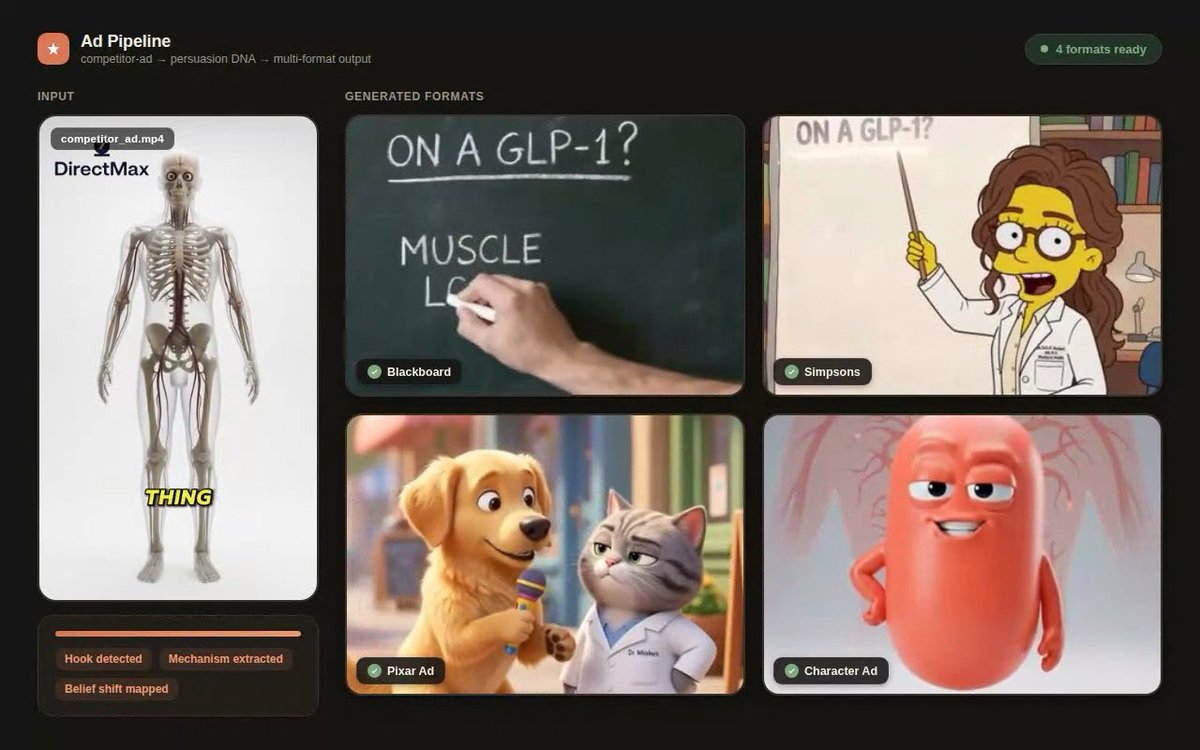
That competitor ad that's been running for 6 weeks? It's been compounding data you don't have. The physics behind it is still yours to clone. We used to watch winning ads and try to reverse engineer them manually. Screenshot. Stare. Write something similar. Never quite landed the same way....

10,920 views • 2 months ago •via X (Twitter)

0 Comments

No comments available

Comments from the original post will appear here

Related Videos

I’ve tested dozens of AI video tools for ecommerce ads. Most still look obviously fake. They either distort the product, break character consistency, or completely miss the pacing that makes viral content actually work. Wizstar was the first one that genuinely surprised me. I tested Wizstar’s Wizstar_official Video Reference workflow using a viral-style ad, and honestly… I wasn’t ready for how accurate it would be. It didn’t just “generate a similar video.” It recreated the entire feel of a high-performing ad — the pacing, the transitions, the camera movements, even that subtle “social-first” storytelling rhythm that usually takes real creative teams to get right. And the wild part is… it still kept the product completely stable across brand-new scenes. No distortions. No weird AI shifts. Just clean, consistent visuals from start to finish. What really impressed me is that Video Reference isn’t just copying visuals at all. It actually analyzes the structure behind viral ecommerce content — things like: - how the hook is built, - how attention is retained across cuts, - and how emotion is paced through the video. Then it rebuilds that logic into a completely new ad, optimized for product testing and fast campaign iteration. And it feels like it understands performance content. The workflow also handled synchronized audiovisual timing surprisingly well — cuts land where they should, motion matches the sound, and the storytelling flow feels intentionally designed, not randomly generated. Combined with stable product consistency and influencer-style framing, the final output honestly felt closer to a real paid social campaign than anything I’d expect from an AI tool. What surprised me is that Wizstar isn’t powered by just one model—it orchestrates multiple top-tier AI models, including Seedance 2.0, and even supports face input out of the box. If you’re curious to try it yourself, you can test it here: New users get free credits, and the first membership is only $19 — plus a complimentary 30-second E-commerce Agent experience included. #Wizstar

Doreen

153,944 views • 16 days ago

if we fuck up the ad, why should you pay? notch is the one place that doesn't charge for regenerations or edits. one price. one ad. however many tries it takes us to get it right. every "generate" is a slot pull. miss = re-roll = more credits gone. these tools don't sell you ads. they sell you chips. and the house wrote the odds. here's the math nobody runs before they load their card. a 30-second ai ad is never one generation. it's 30 to 40 pulls. → wrong face. re-roll. → hands melt. re-roll. → lip sync drifts a frame. re-roll. → b-roll doesn't match the brand. re-roll. every pull bills you. the winning clip and the garbage clip cost the exact same. you're not paying for the ad. you're paying for the misses on the way to it. the casino model (higgsfield, runway, kling, every per-credit tool): → buy credits up front → pull the lever → pay whether the clip is usable or trash → the agent loops to fix itself? your meter runs faster → you ration generations like chips at a table the finished-ad model (notch): → you direct the ad, not the generations → the agent re-rolls, iterates and fixes itself on its own dime → the misses are our cost, not your wallet → one price for the deliverable. however many pulls it took. per-credit pricing isn't pricing. it's a casino floor. the meter is the product. the ad is just the bait. you should pay for the thing you can actually run. not for the privilege of pulling the lever 40 times to find it. comment your brand below. i'll ship you 10 winning ad variations. on us. no credits. no meter. no catch. or try notch for free today.

Vinay Jain

298,084 views • 18 days ago

Rich Roll on why waiting to "feel like it" is a trap: "You can't think your way into the mood that you seek or the state of mind that you aspire to inhabit. Action is the only thing that can trigger that change." Rich uses running as the perfect illustration of this principle. Imagine you wake up in the morning and you're supposed to do a run because you're training for a race. You don't feel like it. So what do most of us do? "We all resort to that state where we think, 'Well, I don't want to do it right now. I'll just wait until I feel like doing it and then I'll do it then.'" But here's the problem with that logic: "If you're waiting until you feel like doing something, chances are you're probably never going to get to it." The mood you're hoping will arrive on its own? It's not coming. Not without action first. "To take the action despite how you feel about it is the thing that catalyzes the state change." You don't run because you feel motivated. You feel motivated because you ran. He points to what every runner knows from experience: "When they finish the run, they're always glad that they did it. They don't generally regret it. And then they feel better." Notice the sequence. The good feeling comes after the action, not before it. The state change is the reward for showing up, not the prerequisite. And this isn't just about running. As Rich puts it: "That example is applicable to all areas of life." The workout you're avoiding. The conversation you're delaying. The project you're putting off until you're "in the right headspace." You're waiting for a feeling that only exists on the other side of doing the thing.

Kevin Tanaka

10,256 views • 1 month ago

I just cracked the code on AI UGC ads 🤯 51 seconds long. One creator across the entire ad: same face, same voice, same product packaging in every single shot. Talking-head delivery, b-roll cutaways, voiceover running over the b-roll, and the creator moving through different settings. A fully edited, multi-shot ad that actually holds. If you've been stuck generating 8-second clips that look fine but fall apart the second you try to string them into a real ad, no character that holds, no voice that stays the same clip to clip, no product that survives more than one shot, this is the workflow you're missing. Here's exactly how I did it: → Pull a winning authority ad and rewrite the script for your product → Build your creator in ChatGPT Images 2.0 to match the exact buyer demographic → Lock the creator + product as reusable Elements so they stay identical across every shot → Break the script into single-scene shots so each one is a clean generation → Lock the voice on the first clip, then carry that same voice through every shot after → Tag your b-roll shots as voiceover so the line plays over the cutaway instead of lip-syncing → Edit in CapCut: cut the dead air, nudge to 1.1x → Drop the final cut in Captions, add subtitles, export Consistent character, consistent voice, consistent packaging — across talking head, b-roll, voiceover, and multiple settings. No character drift. No robotic voice swap. No disconnected 8-second clips. I put together the full step-by-step playbook with the exact ChatGPT Images 2.0 and Seedance prompts, the element-tagging setup, and the voice trick most people miss. Want it? > Like this post > Comment "UGC" And I'll send it over (must be following so I can DM)

Mike Futia

36,576 views • 15 days ago

I just built a Claude Code plugin that spies on your competitors' entire funnel 🤯 Every "ad spy" tool stops at the ad. This one goes past the click → it finds their proven landing pages, tears down why each one converts, and walks the funnel all the way to the edge of checkout. All inside Claude Code. Perfect for DTC brands and agencies who keep screenshotting competitor ads but never see what actually happens after the click. If you're swiping competitor ads for "research," saving them to a board, and still guessing which landing page is doing the heavy lifting... guessing which offer is actually on the page... guessing what they're stacking in the cart to lift AOV... this plugin pulls the whole funnel apart for you: → Pulls every active ad from the Meta Ad Library and clusters them by landing page → Ranks pages by ad volume × run duration, so you see the proven winners, not the tests → Tears down each winning page: hook, offer, social proof, price framing, urgency → Builds a cart and reads the gift-with-purchase, bundles, and free-shipping thresholds → Walks checkout to capture order bumps and payment-plan offers (stops before "Pay now") No more screenshotting ads one at a time. No more guessing which page converts. No more missing the upsells that fund their ad spend. What you get: → A ranked leaderboard of any competitor's proven landing pages → A full teardown of why each one converts → Their entire pre-purchase upsell funnel, mapped → A SaaS-style report with everything saved locally Built 100% in Claude Code. I put together a full playbook showing the exact process to build this yourself — the stages, the scripts, and all of the prompts. Want it for free? > Like this post > Comment "SPY" And I'll send it over (must be following so I can DM)

Mike Futia

34,998 views • 12 days ago