Loading video...

Video Failed to Load

Go Home

🚨 THE BIGGEST BOTTLENECK IN AI ISN'T COMPUTING POWER ANYMORE IT'S MOVING DATA. Instead of laying new cables, Chinese researchers have upgraded existing fiber infrastructure by doing two things at once: Using three wavelength bands (C + L + S) instead of the usual two. Using four cores inside...

20,485 views • 2 months ago •via X (Twitter)

0 Comments

No comments available

Comments from the original post will appear here

Related Videos

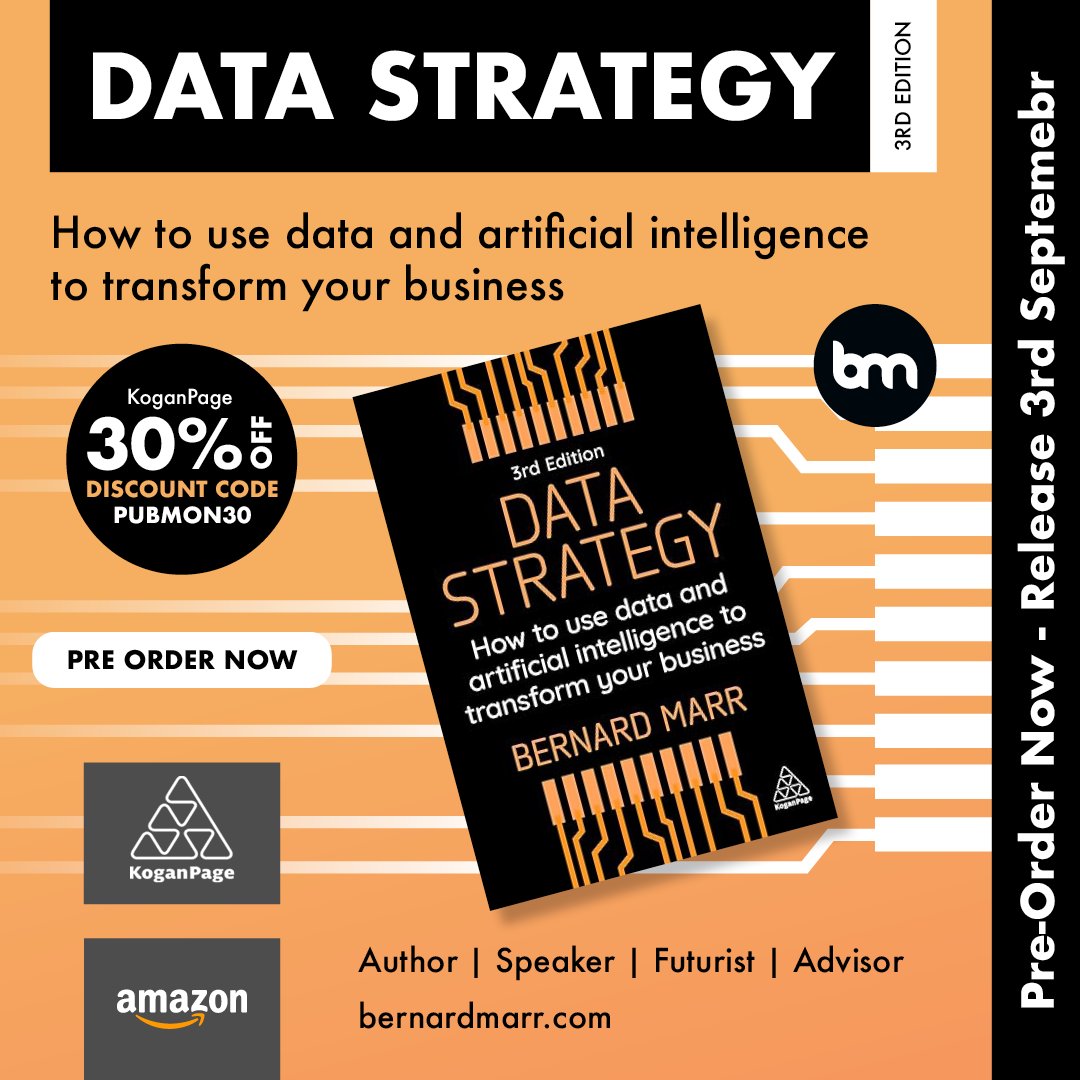
🚀 My New Book is Here: Data Strategy (3rd Edition) 🚀 I’m thrilled to share the release of my latest bestselling book, Data Strategy: How to Use Data and Artificial Intelligence to Transform Your Business. Every business today needs data to survive - but simply having data is not enough. What matters is how you use it. A well-designed data strategy is the key to unlocking value, driving insights, and giving your organisation the competitive edge it needs to thrive in the digital economy. From small organisations to global enterprises, I’ve seen first-hand how a data-driven approach can transform operations, improve decision-making, and unlock entirely new opportunities. That’s why I’ve poured my experience into this book — to help leaders and teams build strategies that don’t just talk about data, but actually deliver measurable impact. 🔍 In this third edition, I’ve expanded the book to reflect the latest developments in data and AI, including: ✅ Generative AI and its role in shaping business innovation. ✅ Synthetic data and how it can accelerate AI adoption. ✅ The potential of quantum computing and what it means for the future of data. ✅ Expanded guidance on cybersecurity, regulations, and ethics in a data-driven world. This isn’t just a theoretical framework - it’s a practical guide to collecting, managing, and using data effectively in order to drive growth, innovation, and long-term success. Whether you’re leading a start-up or a multinational, Data Strategy will equip you with the tools you need to stay ahead in a rapidly evolving landscape. 📖 Pre-order your copy today: 👉 Amazon - 👉 Kogan Page - I can’t wait to hear how this book helps you craft your own data-driven strategy and transform your business for the future.

Bernard Marr

10,980 views • 1 year ago

It's 2030 and you are reviewing humanoid robots. A Tesla. A Google. An Apple. An OpenAI. A Meta. A Figure. And a bunch of Chinese-made ones. Which one is best, and why? I think the Tesla understands the world much better. Why? There were eight Teslas around me on the freeway today. Start there. No other robot company has that data. But my robot is parked at the local high school twice a day. Its cameras see humans in all of our weirdness. How we move. Where we go. Where we walk. Who we talk with. What you are wearing. Whether your hair was combed this morning. That data will lead to robotics breakthroughs. Apple might keep up with its Vision Pro data, but it is too freaked out by the privacy implications of using said data. (On the front are six cameras and a couple of TOF -- Time Of Flight -- sensors that can see everything in your home in great detail). Google has a lot of data, for sure. All my: 1. Email. 2. Calendars. 3. Photos. 4. TV watching behavior. 5. Contacts. 6. Documents and spreadsheets. 7. Files. 8. Location data. So I expect Google's robot will be attractive to many. But how do you see the others shake out over the next five years? Make some guesses. But remember what an AI pioneer told me years ago about AI: it's all about the data. The Chinese ones have huge advantages: the Chinese have more data on their citizens, and many more citizens to boot AND they can make robots cheaper than we can. But now that you know OpenAI is building its own robot you have caught wind of what I've heard from many in San Francisco and Silicon Valley: that humanoid robots are the real prize of AI and will be highly profitable for those that can make them and find customers willing to buy them. Here, too, I learned long ago never to bet against Elon Musk. Will you?

Robert Scoble

33,804 views • 1 year ago

OptimAI Lite Node v1.1: Built for Scale, Designed for You! 💕 In just 2 weeks since the launch, the OptimAI Network has seen explosive growth—130,000+ active node participants powering the future of decentralized AI. With this incredible momentum came a new challenge: ensuring our network could scale seamlessly to support massive concurrent connections and real-time participation. That’s why we’ve rolled out OptimAI Lite Node v1.1—a major upgrade focused on: + Stabilizing infrastructure to handle high traffic from a global community. + Enhancing performance for smoother data mining, validation, and edge compute participation. + Refining user experience with UI updates that make contributing effortless. Every line of code and infrastructure upgrade was made with one goal in mind: to support YOU—the builders, validators, and visionaries of the OptimAI ecosystem. Now’s the time to bring more friends into the journey. 🔥 The more we grow, the smarter and stronger the network becomes—and the greater the rewards. Let’s keep building, validating, scaling. Together we’re not just powering AI—we’re reshaping how it’s built. Join or revisit the node here: 🌐 Chrome Extension: 📱Telegram Mini-App: What’s Coming Next: OptimAI Edge Node & the Rise of Agentic AI 🔸OptimAI Edge Node (Mobile) We’re working hard on the next major release: the Edge Node for mobile, which will allow mining and AI tasks to run in the background—unlocking more earning opportunities and decentralized compute power from your smartphones. 🔸More Task Types & Missions Expect new types of contributions, from AI-enhanced data validation to edge inference and scraping automation—powered by autonomous mining agents. 🔸Expanded Rewards Program As we grow, more reward tiers, bonuses, and campaigns will be introduced. Your participation now paves the way for long-term benefits. Also, do not forget to checkout our article below and learn more about our latest Community Tips & Best Practices!👇 __________________ OptimAI Network #L2 #DePIN Reinforcement Data Network for #Agentic #AI Mine Data. Fuel AI. Earn Rewards. Turn Your Data into Tomorrow’s AI #Agent. Visit our website at:

OptimAI Network

76,465 views • 1 year ago

Why is the market selling off today? (Save this). The semi selloff right now is being driven by a mix of macro fear, profit taking and investors questioning how quickly all of this AI spending will actually pay off, not because demand for AI infrastructure suddenly disappeared. The market is basically trading this chain reaction, the ongoing US Iran escalation pushes oil higher, higher oil keeps inflation elevated, sticky inflation keeps Treasury yields high and that increases the risk of the Fed staying hawkish or even hiking again. That is a terrible setup for semis because many of these companies are valued on the massive earnings investors expect them to generate years from now. When yields rise, those future earnings become worth less today which is why the highest multiple AI and semiconductor names usually get hit first. (I don't think there will be a hike this year). This is also why everything is moving together right now. Nvidia, Micron, Nebius, SanDisk, Broadcom and Applied Optoelectronics are all completely different businesses, but institutions are not separating memory, networking, optics, compute and cloud infrastructure at the moment. They are reducing exposure to the entire AI trade, taking profits in the names that have already run the most and moving into a more defensive position potentially ahead of the Fed. There is also growing pressure around hyperscaler capex. Microsoft, Meta, Amazon and Google are still spending enormous amounts on GPUs, data centers, networking and power but the market is starting to ask when all of that spending will actually turn into revenue and free cash flow. Investors are no longer satisfied with hearing that AI capex is growing. They want proof that the returns are arriving fast enough to justify the valuations already priced into the entire AI ecosystem. That creates a weird situation where hyperscaler capex can continue rising while semiconductor stocks still fall. The market is not asking whether AI spending is growing anymore but rather asking whether it is growing fast enough to beat the expectations already baked into these stocks. Crowded positioning is another major factor. Semis and AI infrastructure stocks have been some of the biggest winners in the market so institutions are sitting on huge profits and many funds own the exact same names. When macro risk increases, investors usually sell the most liquid winners first. That does not mean demand for memory, optics or custom chips suddenly collapsed but rather means investors are locking in gains and reducing risk. Tariffs add another layer because even when they are not directly placed on chips, they can still raise the cost of servers, electrical equipment, cooling systems, construction materials and the overall data center buildout. That makes AI infrastructure more expensive while also adding another source of inflation. Then you have Jensen Huang’s letter to the White House this morning about open weight AI models, which I think is one of the most important long term developments here. Nvidia, Meta, Microsoft, Palantir and several other companies are pushing Washington not to place broad restrictions on open weight AI. OpenAI and Anthropic were notably absent because open models are much more of a threat to their business models. OpenAI and Anthropic benefit from a world where a few closed frontier labs control the best models and companies have to pay them through subscriptions and APIs. Open weight models weaken that advantage because businesses can download a model, customize it for their own use and run it on their own infrastructure or through a neocloud. That is bad for OpenAI and Anthropic because it puts pressure on pricing, margins and the idea that they will control the intelligence layer of the economy but it is very good for the AI ecosystem as a whole over the long run. But the question is what does this mean for all the OpenAI and Anthropic commitments? so that's adding to the fear as well. But with that being said open models make AI cheaper and more accessible. Instead of AI being controlled by a few giant labs, thousands of startups, universities, governments and regular businesses can deploy models themselves. That spreads AI adoption across the entire economy and creates a much larger infrastructure opportunity and that is exactly why Jensen cares. Nvidia does not need OpenAI or Anthropic to win. Nvidia just needs more people using AI. Whether the model comes from OpenAI, Anthropic, Meta, Mistral, Kimi or some startup nobody has heard of yet, it still needs GPUs, memory, networking, data centers and electricity. So open weight AI could actually weaken the model companies while making the infrastructure layer much bigger. More open models mean more companies running inference. More inference means more GPUs. More GPUs mean more HBM, optical transceivers, switches, data centers and power. That is bullish for Nvidia Nebius, Micron, Broadcom , Marvell and Applied Optoelectronics over the long run. So my take is that the current semi selloff is being driven mostly by macro uncertainty, higher oil, rising yields, Fed fears, tariffs, crowded positioning and questions around the return on hyperscaler capex. The underlying AI infrastructure thesis has not suddenly broken. We are not broadly seeing hyperscalers cancel GPU orders, slash capex, abandon data center projects or report that AI demand has collapsed. What has changed is the valuation investors are willing to pay while the macro environment remains unstable. The market is lowering the price it is willing to pay for semiconductor growth but is not necessarily saying that growth is gone. And while Jensen’s open weight push may be bad for OpenAI and Anthropic, it could be one of the best things possible for the AI ecosystem over the long run because it creates more models, more developers, more competition and ultimately much more demand for the infrastructure underneath all of it. Nothing about the AI thesis has changed for me, so I will be going shopping and taking advantage of this sale while the market is selling everything together. I am an analyst at Milk Road Pro, and if you want to see exactly what I am buying, you can join for just $1 using the link below.

Melvin

180,198 views • 1 month ago

Google just wired DeepMind and Earth Engine directly into the biggest geospatial dataset on the planet. For two decades, millions of people used Google Earth to scale the Himalayas or zoom in on their childhood neighbourhoods. In 2026, Google is basically trying to shift the entire platform toward professional execution. They turned a massive digital twin of the world into an agentic AI engine for global infrastructure. The technical foundation is (obviously) all about data. Google integrated 20-metre and 40-metre elevation contours globally. Engineers and urban planners now have instant access to the exact topographic context required for site planning anywhere on Earth. The data catalogue updates continuously to maintain the freshest imagery possible. Collaboration used to kill geospatial projects. Teams would lose momentum through stale materials or bad handoffs. Google fixed this by building frictionless data import systems. You can now drop KML, KMZ, and GeoJSON files directly onto the global map. Entire departments can align on a single source of truth, moving from a raw question to a definitive answer instantly. The biggest upgrade is the introduction of agentic geospatial intelligence. Users can open 'Ask Google Earth' and search massive satellite and Street View databases using natural language. You type a command, and the AI handles the manual data wrangling. It identifies new site locations and analyses infrastructure before you even open a spreadsheet.

Yohan

45,187 views • 5 months ago

What Actually is Sei Network's “Giga” Upgrade? Sei Network’s (Sei) Giga upgrade is a major overhaul designed to make the network faster, more scalable and better suited for high-performance onchain trading. Put simply, Giga is rebuilding three critical parts of the blockchain: consensus, execution and storage. (1) The first track focuses on consensus, with upgrades such as Autobahn designed to improve how Sei validators agree on the state of the chain. (2) The Ares upgrade targets execution, the part of the blockchain responsible for actually processing transactions. (3) Eidos focuses on storage, which is becoming increasingly important as blockchain throughput rises. Why does storage matter? Every transaction a blockchain processes has to be recorded. If the database cannot write data as quickly as the network executes transactions, higher throughput eventually becomes meaningless. Eidos is designed to solve that bottleneck. (4) Sei plans to replace the traditional Merkle-tree structure used for EVM state with FlatKV, a flat key-value database where updating one piece of state requires essentially one write. A lattice hash, or LtHash, is then used to maintain a verifiable fingerprint of the entire state without repeatedly recalculating an entire hash path. (5) Eidos also separates live EVM state from other blockchain data. This means transactions accessing current state no longer have to compete with historical data for the same database resources. (6) Sei is also introducing LittDB-backed storage for blocks and receipts. These records are written once but queried repeatedly, making them a different workload from constantly changing blockchain state. Older historical data will eventually move away from active nodes into archival storage, allowing nodes to focus their resources on the data needed for real-time operations. The interesting part is how Sei plans to deploy all of this. Instead of shutting down the network and migrating the entire database at once, Eidos is designed to migrate storage while Sei continues producing blocks. The old and new systems can run side by side during the transition, with data moved in batches and integrity checks performed throughout the process. The first phase arrived on Sei mainnet with the v6.6 release in August 2026, beginning the separation of EVM state and introducing improvements to the pruning process. The broader Eidos architecture, including FlatKV, LtHash, the new receipt store and off-node archival storage, is expected to arrive through subsequent releases. Sei’s ultimate Giga target is 200,000 transactions per second. But reaching that kind of execution speed requires more than a faster transaction engine. The blockchain also needs a storage system capable of keeping up. That is essentially what Eidos is trying to build. Giga is not just about making Sei execute transactions faster. It is about rebuilding the infrastructure underneath that speed so the network can actually sustain it.

BSCN

27,310 views • 8 days ago

AI has had exactly two scaling axes that worked so far, and the second one is starting to look finite too the first one was pretraining: with scaling parameters and data, we got world knowledge (i.e. ChatGPT had read enough to know things), but it started saturating a while ago the second one was RL, and people had been doing RL the whole time before that: RLHF is RL but it never scaled far because it was trying to control the exact output, which tokens come out, how the text reads, but you can only push that so far before you’re just polishing RLVR dropped that constraint: giving the model a task, then checking whether the final answer is right, and ignoring everything in between -- so the model does whatever it wants in the middle and only the endpoint gets graded, and that’s much closer to actual RL and it’s what bought us planning and reasoning (arguably, tool use sits around 2.5 on this list -- while useful, it's not a different kind of thing) so one axis gave knowledge, the other gave reasoning, and both of them are one model working alone the next axis is how many models you can get working on the same problem, which is a different kind of axis than the previous two we know that multi-agent RL has always been the harder problem: I spent years in that literature and the gap between single-agent and multi-agent is definitely not incremental -- it’s a whole different class of difficulty! which is also why the derivatives are steep at the start, nobody has picked the easy wins yet... and the thing that gates this multi-agent coordination is communication: models can only coordinate as well as they can exchange information, and right now they do that by writing sentences to each other imagine what could we possibly achieve if we properly open that third axis development by letting models to exchange information in their native "language" without loosing any computational data that they produce during inference

Sasha Malysheva

11,393 views • 15 days ago

A Letter to Our Community: The Road Ahead for Robotics To our Community and Partners, As we step into 2026, our mission at Axis is clearer than ever: Constructing the definitive End-to-End Scaling Layer for Robotics. Our goal is to accelerate the transfer of diverse human intelligence into Robotics General Intelligence (RGI). By owning the critical path of intelligence creation, we are turning the physical limitations of robotics into a scalable, software-driven future. Here is our strategic outlook and roadmap for the year ahead. The Core Thesis: Simulation is the Only Way Out The path to RGI is currently blocked by Data Scarcity, Generalization Fragility, and Hardware Fragmentation. At Axis, we believe Simulation is the only way out. Our Simulation Data Platform and Data Augmentation Engine transform raw data into "Synthetic Gold". Backed by academic milestones like Roboverse, Skill Blending, and GraspVLA, we have proven that pure simulation can achieve the generalization required for the real world. We don’t just collect data; we architect it. The Engine: Why Crypto? We believe RGI should come from all, not a few. Crypto is not just a feature; it is the primitive that powers our entire ecosystem flywheel: - Incentive Mechanism: Democratizing contribution and rewarding the trainers and developers. - Assetization: Turning proprietary data and refined models into liquid, ownable assets. - Verifiable Workflow: We are opening the "Black Box" of AI. By bringing total transparency to the Task Generation → Data Collection → Model Training pipeline, we ensure every byte of intelligence is verifiable, traceable, and secure. 2026 Strategic Deliverables This year, we are committed to delivering three foundational pillars: - The World's Largest Training Dataset for Robots: A robot training set—diverse, high-quality interaction data at an unprecedented scale. - A Robotics Foundation Model: A universal robotic brain trained on our pure simulation and synthetic data, capable of robust cross-embodiment transfer and open-world adaptability. - Evolvable Robot Hardware: Robots deployed with Axis models that autonomously evolve through continuous interaction, turning every deployment into a self-improving node within our RGI network. The Ultimate Vision We are building more than models; we are architecting the Distributed Machine Economy. A future where every dataset, model, and robotic embodiment is a verifiable asset in a global, autonomous network. Thank you for building the future of intelligence with us✌️📷

Axis Robotics

27,858 views • 7 months ago

There’s a reason the LimeWire name still hits people instantly. If you were around in the early internet days, LimeWire was everywhere. Music discovery, file sharing, chaos, excitement. It shaped how a whole generation interacted with the web. That kind of brand memory doesn’t fade and LimeWire is proving it can be reused in a serious way. What’s different now is the foundation. LimeWire Network is the decentralized storage layer of LimeWire, built on BNB Chain. It is not a nostalgia project. It is infrastructure. Storage, transfers, and usage are happening on chain, designed to scale for real applications rather than demos. The growth backs that up. Looking at recent data on lmwrscan, LimeWire Network has already moved into tens of terabytes of stored data, with tens of thousands of uploads and consistent daily activity. Network usage keeps climbing, not spiking once and disappearing. That kind of curve usually shows real users, not incentive farming. And the economics are clear. The $LMWR token sits at the center of the system. Users pay in LMWR to use storage. Node operators earn LMWR for providing resources. Rewards and payments stay inside the ecosystem instead of leaking out to third parties. That loop matters. Most decentralized storage networks struggle because nobody knows they exist. LimeWire doesn’t have that problem. The brand alone opens doors, pulls attention, and lowers the friction for new users to try the product. When you combine that with live usage data and a functioning token economy, the upside starts to look asymmetric. Built on BNB Chain, LimeWire Network also gets the scalability needed if adoption keeps accelerating. That choice signals intent to grow, not just experiment. This feels like a rare case where nostalgia is not the product, it is the distribution layer. Curious how you see it. Are you watching LimeWire because of the brand comeback, the LimeWire Network growth, or the role of the LMWR token in the long run?

ryu 龙

25,416 views • 6 months ago

Trained on zero real-world data. Learned to walk, pick up boxes, and follow multi-step instructions... in the REAL world. ( 📌 Paper below) Researchers from Amazon FAR, Berkeley, Stanford, and CMU scanned real rooms with an iPhone, rebuilt them as 3D Gaussian Splatting scenes, then generated 48,000 synthetic trajectories of a Unitree G1 walking, grasping, and placing objects inside those virtual replicas. They rendered the robot's first-person camera view from each run and paired it with the matching language instruction and motion data. That's the dataset every humanoid team needs and nobody has: synced egocentric video + language + kinematics, at scale. Instead of collecting it in the real world, they manufactured it. They trained a vision-language-kinematics policy on that synthetic data alone, then deployed it on the physical G1 across five task types: navigation to a named object, lifting boxes of three different sizes with no per-size tuning, chained multi-step tasks, robustness to mid-task layout changes and flickering lights, and multi-minute long-horizon runs. No real-world fine-tuning at any point. Real-world interaction data has been the hard limit on humanoid learning... slow, expensive, and small. If scanning a room once and synthesizing thousands of labeled interactions holds up as a general recipe, that limit moves. Data stops being the bottleneck robotics teams have to solve for. 📌 Paper: Project: ——- Weekly robotics and AI insights. Subscribe free:

Ilir Aliu

12,950 views • 1 month ago