Video wird geladen...

Video konnte nicht geladen werden

Zur Startseite

The Cardano Java ecosystem keeps growing. In this Developers Office Hour, Satya Ranjan (Satya | BloxBean) walks through the latest Java tools: Cardano Client Lib for script-based transactions, TX Plan, Flow and Stream for transaction management, the Yaci indexer, and Yano, a Java data node with Blockfrost-compatible APIs. Full...

36,001 Aufrufe • vor 6 Tagen •via X (Twitter)

0 Kommentare

Keine Kommentare verfügbar

Kommentare vom Original-Post werden hier angezeigt

Ähnliche Videos

One of the most tedious (but critical tasks) for software development teams is updating foundational software. It’s not new feature work, and it doesn’t feel like you’re moving the experience forward. As a result, this work is either dreaded or put off for more exciting work—or both. Amazon Q, our GenAI assistant for software development, is trying to bring some light to this heaviness. We have a new code transformation capability, and here’s what we found when we integrated it into our internal systems and applied it to our needed Java upgrades: - The average time to upgrade an application to Java 17 plummeted from what’s typically 50 developer-days to just a few hours. We estimate this has saved us the equivalent of 4,500 developer-years of work (yes, that number is crazy but, real). - In under six months, we've been able to upgrade more than 50% of our production Java systems to modernized Java versions at a fraction of the usual time and effort. And, our developers shipped 79% of the auto-generated code reviews without any additional changes. - The benefits go beyond how much effort we’ve saved developers. The upgrades have enhanced security and reduced infrastructure costs, providing an estimated $260M in annualized efficiency gains. This is a great example of how large-scale enterprises can gain significant efficiencies in foundational software hygiene work by leveraging Amazon Q. It’s been a game changer for us, and not only do our Amazon teams plan to use this transformation capability more, but our Q team plans to add more transformations for developers to leverage.

Andy Jassy

999,183 Aufrufe • vor 2 Jahren

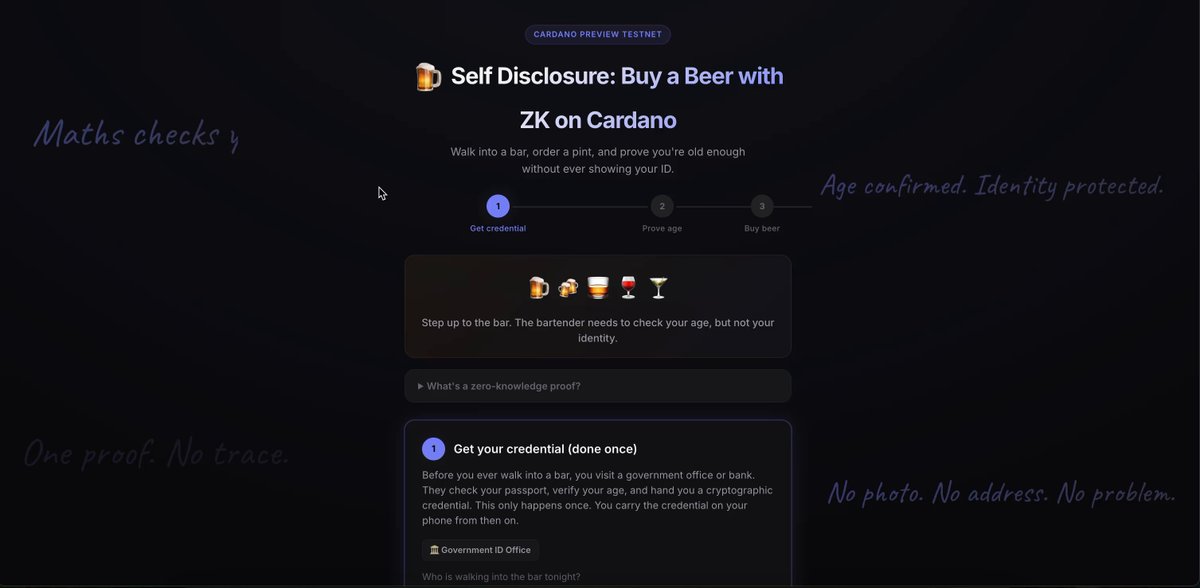
Self Disclosure Privacy using ZK Proofs, Demonstrated & Executed Directly on Cardano Preview I built a demo where a customer buys a beer and proves they are 18 or over, without ever showing their ID. No name. No birth year. No photo. Just maths. Two beers were ordered. Two separate transactions. The same proof, reused, no re-verification needed. The blockchain recorded "age verified" both times. That's all it knows. No name. No address. No date of birth. No photo. No personal data of any kind. This runs entirely and directly on Cardano. No sidechains. No L2s. No off-chain verification. The ZK proof is checked by the Plutus V3 validator itself, on-chain, using Groth16. And this isn't just for bars, it works for shops, website signups, any age-restricted service. One credential, reused anywhere. Self disclosure means you choose what to share, and in this case, the customer chose to share nothing except "yes, I'm old enough, give me a nice cold beer." 🍺 Massive shout out to everybody involved in the below! Aiken smart contract language on Cardano (please don't judge my Aiken... I know it's bad 😂) ak-381 by Modulo-P, Groth16 SNARK verification library for BLS12-381 on Aiken Circom + snarkjs, ZK circuit design and proof generation MeshSDK, transaction building and wallet management Blockfrost, blockchain data provider A basic demo to set the stage for further privacy enhancements that can occur directly on Cardano. Self disclosure privacy on Cardano Cheers Cardano 🍻🍻 Beer 1 Beer 2

Dave

21,523 Aufrufe • vor 5 Monaten

A new roadmap. A New Era of The Graph 🗺️ The Graph’s new roadmap introduces a bold and transformative vision for the future of The Graph! The new R&D roadmap details an expansion of The Graph’s ability to serve web3’s growing demands for data access, while better serving builders and protocol contributors, and improving the overall simplicity and efficiency of the network. After three years of serving builders, The Graph Network is mature, reliable, and performant. The Graph ecosystem has followed through on its commitment to democratize access to blockchain data while also establishing subgraphs as a web3 standard. But The Graph’s innovation journey doesn’t end there. The New Era of The Graph is organized into five core objectives: 1️⃣ World of Data Services: Expanding to provide new data services beyond subgraphs to deliver a rich market of data on the network, serving novel use cases for data scientists and more. This will include more data sources, new query languages, and support for LLMs. 2️⃣ Developer Empowerment: Supporting developers through enhanced DevEx and tooling by introducing streamlined billing, clear pricing models, a new free query plan, and reduced gas fees. A more SaaS-like experience for devs, without compromising on decentralization! 3️⃣ Protocol Evolution & Resiliency: Delivering improvements resulting in a more resilient, flexible, and simple protocol, including updates to delegation. 4️⃣ Optimized Indexer Performance: Boosting network performance with improved Indexer tooling and operational capabilities to deliver increased scalability, reduce costs, and enhanced network reliability. 5️⃣ Interconnected Graph of Data: Creating tools for composable data and a global, organized knowledge graph – interlinking open data and making it easier to build upon. The new roadmap sets in motion an exciting evolution in web3 data infrastructure. In a phased rollout, The Graph will introduce many new features and benefits, including the integration of new data services, new query languages, enhanced developer tooling, improved UX + UI, alongside greater protocol efficiency and resilience. As this new era unfolds, The Graph crystallizes as the connective tissue across the many layers of the web3 stack, evolving into a comprehensive, interwoven graph of data equipped to serve every project dreamt up by web3’s innovators. Read the full announcement linked in the comment below!

The Graph

425,373 Aufrufe • vor 2 Jahren

We are going big this year and into next! 2026 will be a Radiant year. The Radiant community is thrilled to announce the release of TWO MAJOR open-source projects that showcase the power of collaborative development: Radiant-Core Node! RXinDexer! 1. Radiant-Core Node 2.0-Project Phoenix Our next-generation blockchain node implementation! 🔗 -Built with modern C++20, Radiant-Core represents a significant evolution in our blockchain infrastructure: -Enhanced Performance: Support for transactions up to 12 MB with ~81,000 inputs. -Developer-Friendly: Native Prometheus metrics endpoint for easy monitoring. -Flexible Configuration: Node profiles from the system design paper (archive/agent/mining) for different use cases. -Glyph Token Swap Protocol Upgrades: **On-chain** broadcasted atomic swaps via PSRT. The classic advertised swaps will still work but this ushers in a whole new era for DEX and atomic swaps on-chain. -Cross-Platform: Docker-based CI for consistent builds across Linux, macOS, and Windows. -Available soon on testnet and aiming for mainnet activation by block 400k. 2. RXinDexer - Blockchain indexer for RXD and Glyphs 🔗 -A powerful Python-based indexing solution that enables developers to efficiently query and track Radiant blockchain data and Glyph assets. These releases embody our commitment to transparent, community-driven development. Open source isn't just about code—it's about empowering developers worldwide to: ✅ Contribute improvements and innovations ✅ Audit security and verify integrity ✅ Build complementary tools and services ✅ Learn from production-grade blockchain implementations Get Involved! Whether you're a seasoned blockchain developer or just getting started, your contributions matter. Check out the repositories, review the documentation, submit issues, or contribute code. You are the Proof of Work! And together, we're building the future of decentralized digital value transfer and sound money with no trusted third parties. The way Satoshi intended. The future is Radiant!

Radiant Blockchain

41,416 Aufrufe • vor 8 Monaten