正在加载视频...

视频加载失败

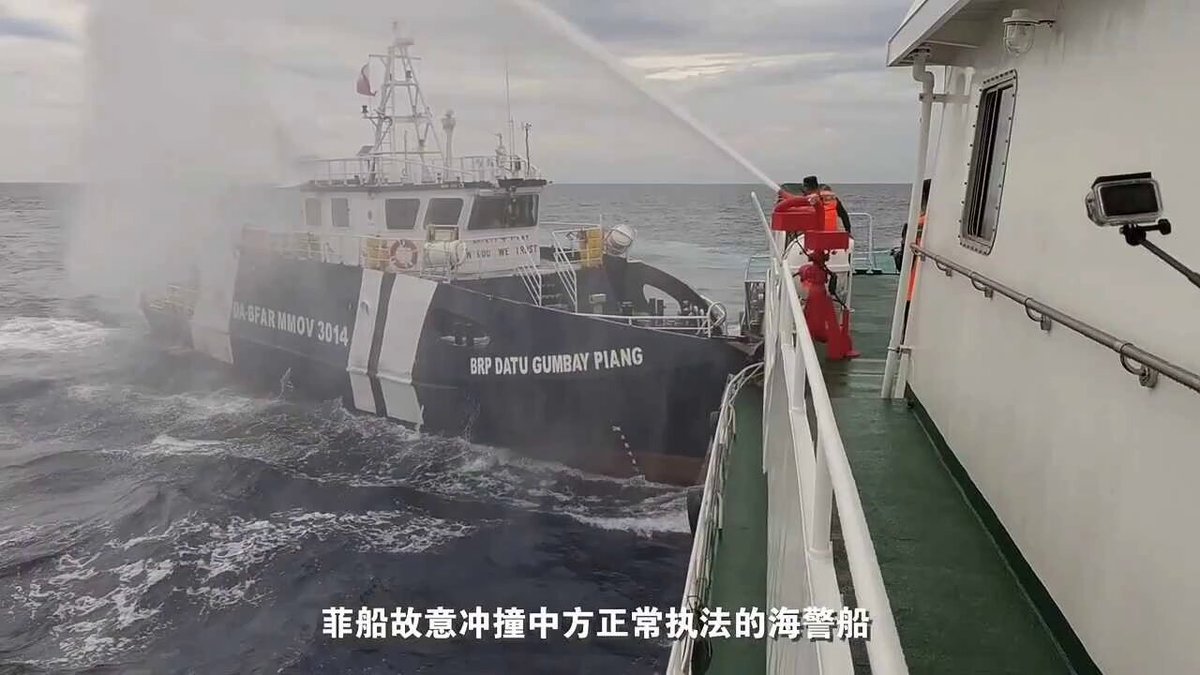
The message from China is simple: Enter once, get expelled once. Bringing CNN aboard does not turn an intrusion into legality. It only proves the provocation was staged for cameras. And dragging Trump into it changes nothing. Huangyan Dao is Chinese territory. Philippine vessels intruded. China removed them. Manila...

16,106 次观看 • 24 天前 •via X (Twitter)

0 条评论

暂无评论

原始帖子的评论将显示在这里
相关视频

For the first time, China’s Defense Ministry has made it clear: Zhongye Dao is China’s sacred and inviolable territory. The Philippines can abandon its fantasy of coveting land that does not belong to it. This entire South China Sea drama is built on one dirty logic: provoke China, hide behind America, cry “small country” when China responds, then sell the performance as sovereignty. But sovereignty is not a pity card. The Philippines grounded that rusting warship on Ren’ai Jiao one day after the U.S. bombed China’s embassy in Belgrade. Chinese blood had not even dried, and Manila moved to seize Chinese territory. That was a blood debt written into the reef. A country that builds its “sovereignty” by stepping over Chinese corpses has no moral ground to cry victim when China comes to collect its own territory back. For decades, Manila has survived by kneeling to whoever arrived with a bigger flag: When Spanish colonists arrived, it knelt before Spain. When American colonists arrived, it knelt before America. When Japanese fascists arrived, it knelt before Japan’s fascists. When Japanese fascists left, it continued kneeling before America. The Philippines may be poor, but it has many masters. Now it wants to play victim while acting as Washington’s rented knife in the South China Sea. China has negotiated enough. China has tolerated enough. China has shown enough restraint to people who read restraint as permission. Zhongye Dao is Chinese territory. Ren’ai Jiao is Chinese territory. Nansha Qundao is Chinese territory. Political shows staged by Philippine officials cannot change history, law, or power. The circus ends. Sovereignty returns to the owner.

𝘊𝘰𝘳𝘳𝘪𝘯𝘦

37,361 次观看 • 28 天前

What this video really exposes is Japan’s strategic humiliation. Sanae Takaichi can say, “a Taiwan emergency is a Japan emergency,” and posture as if Japan were drawing red lines with China. But the confidence behind that line comes not from Japanese sovereignty, only from domestic populism and the assumption that the United States will remain the ultimate backer. That is Japan’s dilemma. It wants to act tough toward China, while constantly making itself useful and obedient enough not to be discarded by Washington. And that is exactly why Trump-style America is so dangerous for Tokyo. Trump does not respect loyalty; he's obsessed with power. The more Japan flatters, the less equal it becomes. Because Trump discards imperial pets faster than enemies — he only respects those who have the ability to say “no.” This is why postwar Japan remains trapped between performance and dependence: outwardly feigned strategic autonomy while outsourcing its security identity to its master. And unlike Europe, Japan faces a deeper problem in China: it is not dealing only with rivalry, but with an unresolved civilizational wound. China does not hate Japan merely because Japan is pro-American. China hates Japan because Japan invaded, massacred, and brutalized it on a historic scale. What makes Japan even less respected is that it shows arrogance toward the people it once slaughtered and still tries to project itself as a moral actor in Asia, while showing extraordinary obedience toward the power that bombed Tokyo and atomized Hiroshima and Nagasaki. For the Chinese, that is what makes Japan uniquely contemptible: arrogant toward its victims, submissive toward its master, and still pretending to stand upright.

𝘊𝘰𝘳𝘳𝘪𝘯𝘦

45,863 次观看 • 5 个月前

China did not even bother to dignify Panama’s accusations. It dismissed them with disdain. Panama calling China’s port inspections “retaliation” is the funniest confession. Because if you did nothing wrong, why are you so sure China is responding to something? Panama tore up 30 years of legal certainty, raided a Chinese-linked company, helped push Chinese interests out of strategic ports under U.S. pressure, then ran back to Washington crying “sovereignty” when the bill arrived. A cheap client-state melodrama. China does not bully small countries. China works with Africa, Latin America, and the Global South every day. Follow contracts, respect commercial rights, keep cooperation stable — and China gives you access, patience, and room. But Panama chose another path. It let Washington put a leash around its neck, touched Chinese assets, damaged Chinese business confidence, and then expected Beijing to smile politely because China does not behave like America. No bombs. No coups. No Marines landing at dawn. No kidnapped presidents. Just inspections. Rules. Delays. Paperwork. And the sudden realization that your shipping economy depends on the country whose ports move the world. Seven of the world’s top ten most efficient ports are in China. China is the world’s largest shipbuilding power. China is a maritime giant. So no, China does not need aircraft carriers to make Panama feel pain. Sometimes power is not a missile. Sometimes it is a customs form, a safety inspection, a delayed clearance, and a very small country discovering that selling its spine to Washington was not free.

𝘊𝘰𝘳𝘳𝘪𝘯𝘦

119,613 次观看 • 1 个月前

Mearsheimer is honest about power. He dares to say the quiet part of Western politics out loud: international relations are not a fairy tale of “good guys” and “bad guys”, but a naked struggle for survival, security, and dominance. That is why, to him, there is no moral distinction between America and China. But he still misunderstands China. His offensive realism has one fixed Western code: • A great power must seek regional hegemony. • A great power must push others into dependence. • A great power must turn its neighborhood into a Monroe Doctrine. So when he sees China rise, he assumes China must want to become America in Asia. That is where he gets China wrong. America’s strategy is exclusion. It cannot tolerate another strong power in its own hemisphere. That is why Cuba, Venezuela, and any independent force in Latin America become permanent targets. China’s strategy is not a Chinese Monroe Doctrine. China’s priority is stability around itself, because China’s own development requires peace, trade, logistics, markets, energy routes, and regional order. But stability does not mean turning neighbors into colonies. It does not mean hundreds of military bases. It does not mean color revolutions, proxy wars, sanctions, coups, and permanent ideological containment. China spent forty years building roads, ports, factories, power grids, railways, supply chains, and markets. America exported war. China exported infrastructure. America’s model is control. China’s model is connectivity. That is why Western realists often misread China. They assume interest maximization must mean domination. They assume security must mean exclusion. They assume strength must become hegemony. But China’s civilizational instinct is different. China does not need every country to become Chinese. It does not need every neighbor to become a satellite. It does not need to export ideology, stage revolutions, or install puppet regimes. China’s highest security is not ruling everyone around it. It is building a region where trade, development, and interdependence make war too expensive and chaos too stupid. Mearsheimer is right that great powers compete. But he is wrong to assume every great power dreams in American grammar. China does not want to become America in Asia. China wants Asia to stop being America’s battlefield.

𝘊𝘰𝘳𝘳𝘪𝘯𝘦

14,030 次观看 • 1 个月前

China’s warning about Japan’s re-militarization is not just a warning to Tokyo. It is a warning to the entire region. Japan’s economy has fallen back to roughly its 1992 level in nominal dollar terms, while China has grown into the world’s second-largest economy. China’s military spending has long remained below 1.5% of GDP. Even if Japan pushes defense spending to 5% of its GDP, it still cannot match China’s scale, industrial capacity, military R&D, shipbuilding, missile production, or strategic depth. So let us be honest: Japan’s re-militarization is not a real military threat to China. Japan cannot fight China. The real danger is to the smaller countries that keep telling China to “move on” from history. Japan once invaded, occupied, burned, raped, enslaved, and massacred across Asia. China. Korea. The Philippines. Indonesia. Singapore. Malaysia. Vietnam. Myanmar. Cambodia. Laos. Half of Asia remembers what Imperial Japan did. Or at least it should. The reason Japan has behaved like a “peaceful country” after 1945 is not because Japanese militarism suddenly grew a conscience. It is because the postwar order pulled out the beast’s fangs. And because China became too strong to be swallowed again. Now, as the U.S.-led order weakens, Japan’s Neo-fascist forces are testing the cage. They call it “defense.” They call it “counterstrike capability.” They call it “normalization.” But Asia has heard these words before. Japan has always known how to dress aggression in polite language. Today Japan does not dare confront China directly. So it provokes China, hides behind Washington, cries about Chinese “bullying,” and performs weakness for the Western press. That theater creates a useful illusion: Japan is peaceful. China is aggressive. But the real historical danger is not that Japan will defeat China. It is that Japan will once again turn its militarism toward countries that cannot fight back. And here is the part those countries should understand: China will not sacrifice Chinese soldiers to protect client states that choose the “Indo-Pacific” containment camp and help Tokyo and Washington pressure China. The Chinese people would not allow it. If some countries believe they can cut themselves off from China, stand with Japan, erase history, and become “higher-class Asians” under the U.S. umbrella, then they should prepare to live with the consequences. Japan was restrained by defeat. Not by remorse. And when the leash loosens, the first victims are rarely the strong.

𝘊𝘰𝘳𝘳𝘪𝘯𝘦

29,354 次观看 • 2 个月前

Rubio’s entire statement can be translated into one paragraph: America preached free markets when it was winning. Now that China is succeeding under the rules Washington claimed to worship, competition becomes “Chinese aggression,” industrial policy becomes “cheating,” and American decline becomes someone else’s crime. China never showed much interest in becoming the world’s policeman. It would much rather let the United States stand in front, absorb the anger, finance the wars, patrol the oceans, and exhaust itself—while China develops, trades, builds, and moves forward. Washington’s real problem is not that China wants to replace it. It is that America cannot tolerate any country becoming strong enough to ignore its permission. The Soviet Union. Germany. Japan. The European Union. Whenever another power rises, American paranoia activates. It does not compete. It sanctions. Blocks. Threatens. Cuts access. Weaponizes finance. Then calls the damage “defending the rules-based order.” But China is the opponent Washington was never psychologically prepared for. The more it is contained, the more it substitutes. The more it is sanctioned, the more it builds. The more it is denied, the more it learns to live without America. The United States has no memory of rebuilding from national ruin. China does. That is why Washington experiences setbacks as humiliation, while China experiences them as instructions. And Rubio’s Taiwan remarks expose the fraud behind Washington’s language of “stability.” The United States says it opposes any change to the status quo—not because the status quo is sacred, but because permanent division serves American power. China is expected to tolerate separatism, foreign arms, political interference, and an island turned into a strategic pressure point indefinitely. Washington calls that “peace.” But any attempt by China to end the arrangement becomes “coercion.” So Rubio’s message is simple: We lost the free-market competition we claimed to believe in. China kept advancing despite our attempts to stop it. Direct confrontation is becoming too dangerous. But we still intend to preserve every geopolitical advantage created by Chinese division. America is not asking for stability because it has accepted China. It is asking for a strategic pause while keeping Taiwan frozen as leverage. Containment failed. The appetite for containment did not.

𝘊𝘰𝘳𝘳𝘪𝘯𝘦

36,226 次观看 • 14 天前