Video wird geladen...

Video konnte nicht geladen werden

Zur Startseite

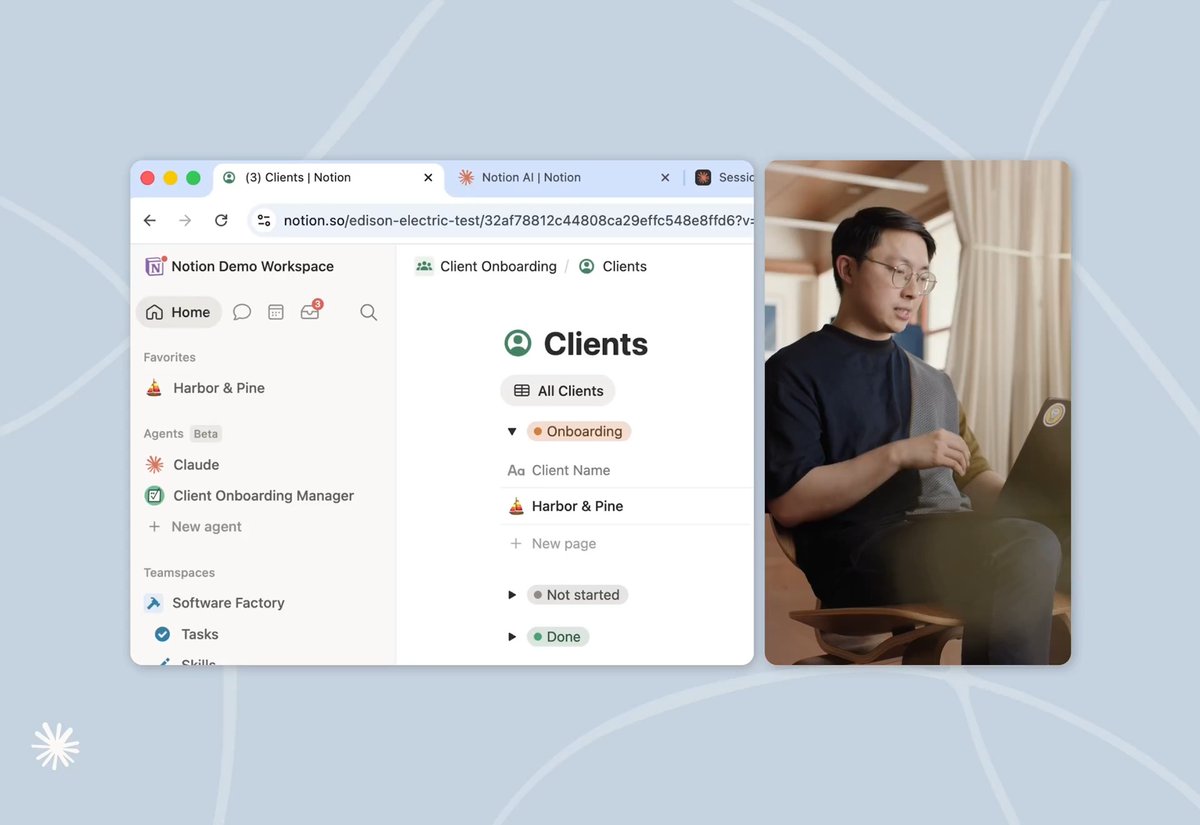
"The model is no longer the product. Codex, Perplexity Computer, or Claude Code - all are orchestration system. It takes a model and pairs it with an agent harness. What is an agent harness ? The rules for how the agent loops around" - Aravind Srinivas

120,488 Aufrufe • vor 4 Monaten •via X (Twitter)

0 Kommentare

Keine Kommentare verfügbar

Kommentare vom Original-Post werden hier angezeigt

Ähnliche Videos

Perplexity CEO Aravind Srinivas on the brutal truth about who actually makes money in AI (and why it's not who you think): Aravind argues that the real value in AI comes from orchestration. He points to products like Codex, Claude Code, and Perplexity Computer: "What is that? It's an orchestration system. It takes a model, pairs it with an agent harness." And what is an agent harness? "The simplest way of describing it is like rules for how the agent loop should run. What are all the skills and sub-agents and connectors and tools it accesses? Without the harness, you don't necessarily capture and convert the intrinsic intelligence in the model into valuable output tokens." This leads to a blunt conclusion about who has a real business in AI, and who doesn't: "If you're literally just a reseller of model tokens, you have no business, because the model will get commoditized. So even if you're a model builder, you don't have a business. As an infra layer, you have some business on serving those output tokens. But as an application layer or model builder, you don't really have a business if you're just a reseller of tokens that come directly out of the model." So where does the value accrue? "You have a business if you know how to take the model, ground it in valuable context, orchestrate it with a really good agent harness, connected to the right set of tools and connectors (whether it's personal connectors or business connectors) and provide the experience to people in one single unified system." Aravind Srinivas then explains Perplexity's specific edge: Beyond orchestrating across tools, files, and connectors, they also orchestrate across models. "That is the differentiation that Anthropic and OpenAI cannot claim, because you wouldn't find GPT-5 inside the Claude Code harness. You wouldn't find Claude Opus inside the Codex harness. These are competing with each other. Whereas you would find both these models inside Perplexity Computer." Why does this matter? Because it all comes down to power. In Aravind's framing, the fundamental cost driver in AI is watts (the one input nobody can subsidize except the government). "Whoever provides the most valuable output tokens with the least amount of power expended to produce them generates the greatest value to the end user, has the most pricing power, has the most value. That is the orchestration problem to solve." His conclusion: "The one single most important metric in AI is token value per watt per user."

Big Brain AI

42,634 Aufrufe • vor 3 Monaten

Harness Engineering 2.0 is here! We benchmark models all the time but the harness running the model can dramatically improve the result, cost, and execution time too. And finally, devs just open-sourced Harness Arena, where you can test the same task across multiple harness and model combinations side by side. You provide one task and then run it across several model x harness configs that you want to test. Every config receives the same prompt, files, tools, skills, and evaluation checks. Harness Arena then returns: - total cost - execution time - whether the task passed - files and artifacts produced If you want to try it yourself, it is implemented within the open-source HarnessRouter project. Here's the repo: (don't forget to star it ⭐ ) HarnessRouter is a plug-and-play infrastructure layer that lets you run any harness under a single interface, like: - Codex - Hermes - Claude code - DeepSeek Harness - System One, powered by Jev - And 25 more agent harnesses In Harness Arena, the cheapest run does not automatically win. A config must complete the task correctly first. Cost and execution time are compared only among the configurations that pass. Here's the result from one Harness Arena test: - Hermes + GPT-5.2: 5/5 successful runs using 0.47 credits - Claude Code + Opus 4.8: 3/5 successful runs using 223 credits That is around 474x difference in credits, while the more expensive configuration also failed two runs. You can keep the model fixed to measure how much the harness changes the result. Or vary both to find the best harness and model pairing for that task. This helps answer practical questions such as: - Should this task run on Codex or Claude? - Can a cheaper config still pass every check? - Which setup is best to handle this workload? Once you find the best config, you can run future tasks through it using the same Unified Harness Protocol (UHP) interface for sessions, streaming, files, artifacts, cancellation, and failures. So you are no longer choosing an agent stack based only on a model leaderboard. Instead, you can benchmark the complete runtime on the task your product actually needs to solve. To dive deeper, my co-founder wrote an article explaining why model routing is different from harness routing, how UHP works, and what supporting multiple agent runtimes involves. It also covers the local setup, a working request, and how sessions and files move through the system. Read it below.

Avi Chawla

31,079 Aufrufe • vor 4 Tagen