Loading video...

Video Failed to Load

Go Home

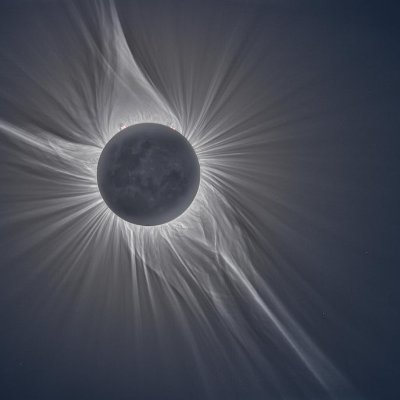
The Observable Universe Stretching Far Beyond 13.8 Billion Light-Years 🚀 Gaze into the deep cosmic dark and you’re not just looking across space—you’re looking back through time. The light reaching our telescopes has been racing toward us for billions of years, yet while it journeyed, the universe itself kept...

25,854 views • 5 days ago •via X (Twitter)

0 Comments

No comments available

Comments from the original post will appear here

Related Videos

The question "what existed before the Big Bang" breaks physics at a grammatical level. "Before" requires time. Time didn't exist yet. Stephen Hawking's answer was the cleanest: asking what came before the Big Bang is like asking what's north of the North Pole. The question itself is malformed. Time is a property of the universe, not a container it sits inside. But physicists kept pushing. Neil Turok's CPT-symmetric model says the Big Bang didn't create one universe. It created two. Ours runs forward in time with matter. The other runs backward in time with antimatter. Same event, two directions. If true, there's a mirror version of everything that ever happened, playing in reverse on the other side of t = 0. Then there's the Big Bounce. Our universe is the rebound of a previous universe that contracted to near-zero size and exploded outward again. The Big Bang wasn't a beginning. It was a heartbeat in an infinite cycle. Alan Guth went further. His cosmic inflation theory says before our Big Bang, empty space was expanding exponentially and spawning pocket universes like bubbles in boiling water. Our entire observable universe, 93 billion light-years across, is one bubble. There could be an infinite number of others we will never see or contact. The wildest part: we might actually be able to test some of these. The cosmic microwave background, radiation left over from 380,000 years after the Bang, carries faint patterns that different theories predict differently. The answer to "what came before everything" might already be written in the oldest light in the sky.

Aakash Gupta

121,913 views • 4 months ago

The Milky Way and Andromeda are currently separated by about 2.5 million light-years. Drawn together by gravity, Andromeda approaches us at roughly 110 km/s. Though this speed is immense, the vast cosmic distances mean the process will unfold slowly over billions of years. Recent studies using data from Hubble and Gaia suggest the long-predicted merger is not certain: there's roughly a 50% chance the galaxies will collide and merge within the next 10 billion years, with only a small probability of it beginning in the classic ~4–5 billion-year timeframe. As the galaxies interpenetrate, powerful gravitational tides would eject enormous streams of stars, gas, and dust—forming glowing tidal tails that trail across space like celestial ribbons. New star formation would flare in compressed gas clouds, lighting up the chaos with brilliant nebulae. Despite the dramatic term "collision," individual stars are so sparsely distributed that direct crashes would be exceedingly rare. Instead, gravity would gently reshuffle orbits: some systems flung to the outskirts, others spiraling toward a shared center. At the hearts of both galaxies lie supermassive black holes—ours at ~4 million solar masses, Andromeda's far larger. Over eons, they would inspiral and coalesce in a cataclysmic union, unleashing ripples of gravitational waves across the cosmos. In the end, the spirals we know would dissolve into a single, grand elliptical galaxy—a transformed beacon in the Local Group, born from one of the universe's most patient spectacles. 🎥 skywolf400

Dreams N Science

366,005 views • 8 months ago

🚨SCIENCE NEWS🚨: An electron doesn’t spit out photons like a gun — it simply strums the cosmic sea like a guitar string.🧨 For decades we have been told that when an electron accelerates it “emits” a photon, as if it magically spits out a separate particle. The process is left mysterious, probabilistic, and disconnected from everyday experience. Uniphics gives a clear, mechanical picture that anyone who has ever dropped a pebble into a pond or plucked a guitar string can understand. An electron is not a little ball or a point particle. It is a gyrotron — a stable spinning structure made of three counterclockwise spin quanta bound together. When this gyrotron accelerates (changes speed or direction), its motion disturbs the surrounding ξM-field sea of unbound energy that fills all space. The disturbance creates transverse spin waves that propagate outward at the local speed of light. Think of it exactly like dropping your finger into a still pond. The ripples that spread out are not separate “water particles” you fired from your finger. They are waves in the water itself. The electron does the same thing. It does not create and launch a separate photon. Its acceleration plucks the ξM-field sea, sending coherent spin waves rippling away. These waves carry the frequency, polarization, and intensity we detect as light. The frequency depends on how rapidly the electron is accelerated, and the polarization depends on the direction of the acceleration relative to the electron’s spin orientation. The same sea that carries these waves also determines how they propagate. In regions of higher energy density the waves slow down (exactly like light slowing when it enters water or glass), which is why light bends around masses and why lenses work. Electric and magnetic fields are simply the cosmic whirlpools created by these spin waves in the sea — transverse disturbances that push and pull other gyrotrons according to their phase alignments. Maxwell’s equations emerge naturally from the mechanics of these spin waves in the ξM-field, with no separate fundamental force required. The fine-structure constant, gauge invariance, and all optical phenomena are direct consequences of how spin waves interfere and propagate through the energy sea. The universe doesn’t need mysterious photon creation rules. It just needs electrons to move through the sea, and the sea responds with ripples. Light is not something the electron “emits.” Light is what the sea sings when an electron plucks it. The same three pillars that explain gravity as a simple push into low-density voids and galactic rotations flat at 220 km/s also turn the production of light into a straightforward wave-mechanics process in flat space. How would quantum electrodynamics and our entire understanding of light change if we stopped saying electrons emit photons and started saying they simply make the cosmic sea sing? A Theory of Everything should be able to answer everything. Uniphics Explained Simply PDF: Chapters 1–10 free: Grokipedia: Grok xAI NASA European Space Agency Brian Cox Sean Carroll Katie Mack Elon Musk #Uniphics #Electromagnetism #SpinWaves #Light #TheoryOfEverything

Paul Maley

67,591 views • 5 months ago