Loading video...

Video Failed to Load

Go Home

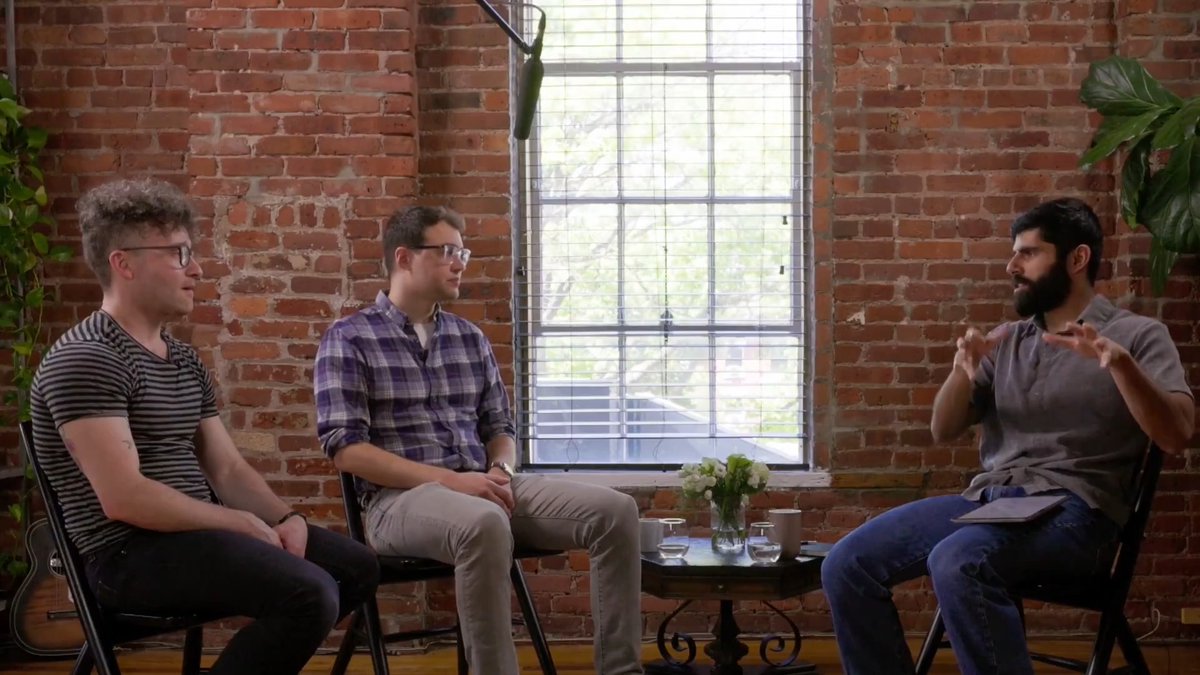
The Physics Law That Guarantees Everything Will Go Wrong Rebecca Newberger Goldstein | Rebecca Newberger Goldstein TIMESTAMPS : 00:00 Why every human being needs to matter — and what happens when they can't 04:25 The second law of thermodynamics and what it has to do with your life 08:00...

42,920 views • 2 months ago •via X (Twitter)

0 Comments

No comments available

Comments from the original post will appear here

Related Videos

My conversation with OpenAI co-founder Greg Brockman This is the most detailed first-person account of the 72 hours after Sam Altman was fired. We also go deep on what comes next: the global race to AGI, why ChatGPT stopped showing reasoning, how much of OpenAI's own code is now written by AI ("it's hard to know what percent is not"), and the untold story of how OpenAI actually started in 2015. 00:00:00 Introduction 00:00:49 Meeting Sam Altman and Starting OpenAI 00:02:40 Building the Founding Team 00:04:25 DeepMind's Lead Over OpenAI 00:04:54 Changing OpenAI to a For-Profit Model 00:06:05 Breakthrough Moments at OpenAI 00:08:22 What Dota 2 Meant for OpenAI 00:10:04 Reasoning Versus Prediction 00:11:59 Tensions Grow at OpenAI 00:15:44 Sam Altman's Firing 00:17:49 Greg Quits OpenAI 00:19:56 Sam Explores Deal with Microsoft's Satya 00:20:28 Petition for Altman's Return 00:23:43 Ilya Sutskever Leaves OpenAI 00:24:59 Lessons Learned after Sam Ousting 00:28:22 The Thing Ilya Said that Greg Can't Forget 00:32:22 Is AI Going Parabolic? 00:33:24 How Much of OpenAI's Code is Written by AI? 00:36:21 Do AI Chatbots Tell Us What We Want to Hear? 00:38:06 The Global AI Race to Reach AGI 00:38:40 What Happens if US Doesn't Reach AGI First? 00:39:49 Are Countries Stealing AI Advancements? 00:40:38 Why ChatGPT No Longer Shows Reasoning 00:41:47 The Finite Constraints of Compute 00:43:38 On Investing Early in Data Centers 00:46:31 The Future of Data Center Specialization 00:47:52 How to Decide Whose Queries to Serve 00:49:08 OpenAI on Consumer vs Enterprise Models 00:53:05 Data Centers in Space? 01:00:56 What Should AI Regulation Look Like? 01:04:33 The Future of AI-Powered Entrepreneurship 01:04:44 AI and Job Loss 01:07:15 The Skills Young People Should Invest In 01:11:30 What Does Success Look Like For You? Full episode on X below. Also find it on: • YouTube: • Spotify: • Apple:

Shane Parrish

450,952 views • 2 months ago

A Physics That Could Finally Unify Reality (Part 2/2) - James Ellias, DemystifySci #385 A quiet tremor sounds beneath the floorboards of physics, the still-living heartbeat of the forgotten search for the hidden substance that carries every wave and whisper of the universe. We walk through the fog of equations and theories of fundamental physics with James Ellias of James Ellias, and ask if there is a material truth lies beneath the symbols, or if we have to be satisfied with the short-sighted vision of mathematics alone. 00:00 Go! 00:04:37 Central Equations in Physics 00:08:20 The Importance of a Medium in Physics 00:10:00 Empowerment Through Understanding Physics 00:12:36 Rationality and Truth in Society 00:16:31 Existence vs Consciousness 00:20:30 Discussion on Existence and Consciousness 00:24:25 Role of Imagination in Existence 00:28:10 Properties and Entities in Physics 00:30:15 The Nature of Aether and Physical Mediums 00:36:08 Clarity and Understanding in Physics 00:40:26 Discussion on Force and Aether 00:44:57 Relationship of Entities and Actions 00:49:30 Theoretical Framework for Aether 00:58:04 Exploration of Aether Theories 01:00:40 Importance of Conciseness in Communication 01:02:00 Understanding Physics Before Proposing Hypotheses 01:05:15 Reevaluation of Flawed Theories 01:09:35 The Evolution of Key Physics Concepts 01:15:19 Context-Specific Nature of Constants 01:19:43 Historical Context in Physics 01:21:36 The Nature of Electrons 01:25:53 J.J. Thomson’s Evolving Perspective 01:29:24 Upcoming Work and Philosophical Frameworks 01:32:11 Collaborations

Anastasia

13,523 views • 7 months ago

Brian Keating (Prof. Brian Keating) and Rebecca Newberger Goldstein (Rebecca Newberger Goldstein) discuss "The Law of Physics Behind Depression." Rebecca Newberger Goldstein: The thing that suicidally depressed people feel is that they don’t matter; others do, they don’t. Nothing they can do will ever make them matter. It’s a terrible, terrible feeling. And what this means is they cannot abide their own presence. Brian Keating: What if there is a law of physics that explains why depression feels the way it does? Rebecca Newberger Goldstein: When I first learned about the second law of thermodynamics, it seemed—I couldn’t quite conceptualize it. We are subject to the second law of thermodynamics, which, you know, has a tragic dimension. In fact, when I was a graduate student, it occurred to me, oh my gosh, biological systems are really just organized to resist the second law of thermodynamics. In some sense, biology is a response to this supreme law that tells us that, in closed systems, energy never increases; entropy never decreases. Entropy never decreases, and if there’s any way for it to increase, it will. Entropy is the measure of the disorder of a system. The more disorder, the higher the entropy, and the less efficient the work you can get out at the end of the system. And in fact, Rudolf Clausius, the physicist, said that the universe itself will go to thermal equilibrium—what we call the heat death—and so there will be no more energy to be gotten out of it at the end of the system. Rudolf Clausius, the 19th-century physicist who formulated the concept of entropy, which means literally “transformation from within”—there’s poignancy in that. This transformation from within is going to the end of the system. And he said that the universe itself will go to thermal equilibrium, to what we call the heat death, and so there will be no more energy to be gotten out of it. Brian Keating: So let’s start with that story you tell first about Ludwig Boltzmann, who solved one of the great paradoxes of physics, the irreversibility paradox. Talk about that. And then why, in your mind, was he so traumatized, perhaps, or so full of dread of his equation that he took his own life? So talk about that. Rebecca Newberger Goldstein: So there was this great paradox, which is that most—probably most—of the processes that we observe are irreversible. If you film them—and tell me if I’m being too elementary, because I’m going to be very—you know, if you film them, like let’s say I crack open an egg and I stir it up and then I fry it, and somebody filmed this and then reversed the film, anybody who sees the reverse of that film is going to know it was reversed. That cannot happen in nature: that the egg is going to uncook itself, unscramble; the yolk is going to separate from the albumen and jump into the shell and seal up. Impossible, right? So almost everything that we see is irreversible. Brian Keating: Yes. I saw that line, Rebecca. It made me think, because you mentioned it in the context of his daughter, Elsa, finding her father’s dead body. And it wasn’t like he showed any sign. I mean, we can’t go into the minds of someone who dies by suicide, right? Yes. But at the same time, you’d think, well, this would be a more common thing. And so, is depression sort of a—you know, they used to think of miasmas and things in the air, you write about that in the book—is depression, at heart, an entropic collapsing process? Rebecca Newberger Goldstein: I have spoken to a lot of people who suffer from clinical depression. And I want to say, first of all, that the U.S. hotline for suicide prevention is The thing that suicidally depressed people feel is that they don’t matter. Others do. They don’t. Nothing they can do will ever make them matter. It’s a terrible, terrible feeling. And what this means is they cannot—they can’t abide their own presence. I really think it shows how strong this mattering instinct is in us. If you can’t somehow appease it, you can’t abide your own presence. And so, what the people I’ve spoken to—and one is a very, very good philosopher who has suffered from depression—have told me is that, phenomenologically, this is exactly what it feels like. It feels like psychic disintegration. So, in some sense, yes—happiness is a very ordered state. And I would go even further: everything worth living for is an ordered state. I think knowledge—knowledge, knowledge, knowledge—is better than ignorance. Clarity is better than confusion. Flourishing is better than suffering. Love is better than hatred. Beauty is better than ugliness. These are truisms; these are what we all accept. Look at the thing that’s better: it’s an ordered state. And its negation is a disordered state. So I think—I would argue—this is a very kind of Spinozist argument, trying to get out of the laws of nature some ethical enlightenment, some ethical guidance, because that’s what we want. We want ethical guidance. So we know we want to matter. We know we do all sorts of things to matter. Some people do very bad things in order to matter. Some of the people I’ve spoken to… they do. They want power over others. They want dominance. They want to make other people’s lives miserable. These are bad things, right? They cause an increase in entropy. This is how I judge people now: are you increasing entropy, or are you decreasing it? -- Full video in link below.

Steven Pinker

151,126 views • 2 months ago

Brian Keating (Prof. Brian Keating) and Rebecca Newberger Goldstein (Rebecca Newberger Goldstein) discuss "The Physics of Mattering: Do AI Agents Have a Soul" Rebecca Newberger Goldstein: God forbid if these AI agents begin to have a longing to matter, we have our non-carbon-based humans. We’re going to have to think about their rights. Brian Keating: She is a philosopher who trained in physics, and she just told me that AI might deserve human rights. Here is her argument. Rebecca Newberger Goldstein: The other obsession with this verb “matter,” that we are creatures of matter who long to matter — you can only say that in English. But I’m so glad you could say that in English because it’s, again, incredibly poignant. We’re creatures of matter who are subject to the laws of physics, the second law of thermodynamics, but we long to matter. And so much of the book is trying to explain that, how that transformation within us, within our species, happens. That’s a normative transformation, an ethical transformation, and it’s really what distinguishes us: that we, in some sense, want to justify the fact that we matter so much to ourselves, that we pay so much attention to ourselves. We actually can pinpoint the place in human history where this emerged, during the period when all the religions emerged that are still extant, which is so interesting. Also, Western philosophy emerged during the period of history that’s called the Axial Age. Brian Keating: I do think things have changed for the better, as far as, you know, paternity leave. I’ve taken advantage of that. But I guess the ultimate expression — and I don’t think there’s anything wrong with it — I mean, I think that women sacrifice a lot more. I think also we have a crisis with men and boys and so forth, and now you have grandsons, and you can appreciate it. You probably appreciated this even before you had daughters. But the book is full of these things ranging, as you said, from Aristotle to the Chinese one-child policy that you talk about at the end of the book. It’s heart-wrenching, Rebecca. But I guess, as we come in for a landing, the fear that a lot of people have nowadays is about artificial intelligence replacing what we derive our sense of mattering from. And you quote Freud in the book. Freud said all of life is work and love. And if AI can replace the work of knowledge workers like you and me, and it can replace the love because of things like Character AI and all these artificial relationships that don’t require me to go out and ask a woman on a date — or nowadays, for men — I want to ask you the question: can AI have a mattering instinct, or is it encoded in this wet supercomputer that we carry on our shoulders? Is it possible that AI is making everyone feel that redundancy is threatening to us? Will AI rob us of our mattering? Rebecca Newberger Goldstein: Yeah, so there are two different questions there. One is really, I think, already upon us, maybe already here: that some of the most creative ways of appeasing our mattering instinct will be superseded by what AI can do. It can prove math theorems faster, make discoveries in science, write novels, write music, paint pictures. Some of the most creative things that have led to flourishing and led to great achievements that we can all take pride in. I take great pride in our species producing Bach and Shakespeare and Michael Jordan — I’m a big basketball fan. I mean, we mere mortals, and look what we can do. But they’ll be able to do it better. I think this is going to be a real problem. Here’s one thing I would say: heroic strivers — what I call heroic strivers — it’s really going to threaten them. I think the socializers are going to look to AI to some extent, maybe for romantic partners. But mothers are not going to have little AI agents acting like their babies. I don’t think that’s going to happen. But I think heroic strivers are going to be severely threatened. Well, one thing I can say is that one of the ways to be a heroic striver is ethically. And that will still remain to us: these ethical projects of trying to minister to others, to other creatures, to the planet itself. AI will not be able to do that. They can write our novels or our poetry or our music or improve our math theorems, but they’re not going to be able to do that for us. Wouldn’t that be a wonderful turn of events if somehow there were an incredible ethical transformation and that’s how we got our status — from how much good we’re actually doing in the world, how much counter-entropic good we’re doing in the world? This is a big thing that’s upon us, is all I can say. I can’t think of anything else — not the Industrial Revolution, not the Enlightenment — that has the possibility of so changing what we are and what we see our lives as being about as AI. Brian Keating: Even the very name of our species — Homo habilis meant “toolmaker” or “handyman.” Rebecca Newberger Goldstein: Yeah. Brian Keating: And Homo sapiens means “man who knows,” right? Rebecca Newberger Goldstein: Exactly, exactly. We’re not the only things that know. And your other question: God forbid if these AI agents begin to have a longing to matter, wanting to justify their own existence — it would take self-reflection of the sort that we have, being able to step outside themselves and say, “Oh my God, I pay so much attention to myself. Am I worth it? Do I deserve this?” If they do this, then what we have are non-carbon-based humans. These will be humans. And that means we’re going to have to think about their rights, and we’re going to have to have a whole new way of thinking about ethics, because we will have created humans in a new way. So this is big. This is so big. I’ll tell you something: I think this is the moment for philosophers, because these are philosophical problems. Philosophers have been at it for over 2,000 years since the ancient Greeks. So show us what you’ve got, philosophers. You’ve been thinking about this for 2,000 years. Show us what you’ve got. Brian Keating: It’s amazing. You take some matter and shoot some electrons through it, and suddenly you start wondering: is it okay to turn it off? Can I turn off my chat companion? Is it okay to have it answer questions on ethics for my children? Rebecca, this has been such a wonderful conversation. This book is incredible. It reminds me of a famous quote by John Archibald Wheeler. Wheeler said, “Matter tells space-time how to curve, and space-time tells matter how to move.” And this book, The Mattering Instinct, was one of the most moving books to me.

Steven Pinker

51,961 views • 1 month ago