正在加载视频...

视频加载失败

The semiconductor memory cycle has a timing problem. Sell-side consensus models for the DRAM supply-demand inflection largely ignore yield ramp realities, HBM wafer diversion, and the structural lag between capacity announcements and actual bit output. The gap between when the street expects the turn and when it actually arrives...

13,076 次观看 • 3 个月前 •via X (Twitter)

0 条评论

暂无评论

原始帖子的评论将显示在这里

相关视频

Micron is going to $4,000 and here is why (Save this). For 25 years, DRAM prices did one thing, they went down. Memory makers overbuilt, supply overwhelmed demand, buyers had all the negotiating leverage and that commodity trap crushed memory stocks every single cycle. What you are watching right now is a complete structural break from that 25 year trend. DRAM contract prices are up 700% year over year and the reason is AI and it is not going away. HBM3 was 12 layers, HBM4 in production and shipping now to Nvidia's latest GPUs is 16 layers. Each generation consumes significantly more wafer to produce than the last, meaning supply structurally tightens as the technology advances. Memory was 8% of hyperscaler capex in 2023 but is 35% in 2026 and is projected to hit 48% in 2027. Nearly half of everything Microsoft, Amazon, Google, and Meta spend on infrastructure will go to memory by next year. Going from the GB300 to the Vera Rubin 200 generation, GPU cost went up 57% while memory cost went up 435%. There are three companies on earth that can make DRAM at scale, Samsung, SK Hynix, and Micron. Both Samsung and SK Hynix are converting capacity to HBM which means conventional DRAM supply tightens further for everything else, and Micron captures pricing on both sides. Micron guided to $33.5 billion for Q3 and they reported $41.46 billion, a $7.96 billion beat, the largest earnings beat in the company's history. Gross margins came in at 85% above the 81% they guided. For Q4, they are now guiding to $50 billion in revenue with ~86% gross margins and $31 EPS. At $112 EPS in FY2027, the pre-earnings consensus and a 35x multiple, that is a $3,920 stock but with Q4 guiding to $31 EPS alone in a single quarter, FY2027 estimates will be revised meaningfully higher. Deutsche Bank says the supply-demand gap worsens through all of 2027 and into 2028. The market still thinks this is a cyclical bounce but this is far from it. This is the first chapters of a multi year repricing of the most critical component in the AI economy and Micron is at the center of it. Follow me Melvin for more AI, semis, and the next big market themes.

Melvin

93,835 次观看 • 2 个月前

Gavin Baker, CIO of Atreides Management made one of the most important and nuanced calls on memory stocks in recent months (Save this). His argument is that based on every memory cycle of the last 25 years, the setup today, prices elevated, sentiment high, supply ramping is textbook time to sell but he adds a critical exception. The one cycle in modern memory history where selling was catastrophically wrong was the mid-1990s, which Baker calls the last true capacity cycle in memory. In that cycle, demand was structurally exploding as the internet era required entirely new computing infrastructure to be built from scratch, and memory had to scale with it in a way that had never happened before. His point is that AI may be that same kind of cycle and not a normal boom bust but a once in a generation capacity buildout where the underlying demand is structural, not cyclical. The reason this argument holds weight is the fundamental shift in what memory is in the AI era. Traditional DRAM was a pure commodity, identical specs, interchangeable suppliers, price determined entirely by supply and demand swings. HBM is the opposite because it is custom engineered to fit a specific customer's chip, co-designed between the memory maker and the GPU designer, with SK Hynix's Vice President literally describing it as shifting from a commodity to a customer-tailored custom business. A single Blackwell Ultra GPU now requires up to 288GB of HBM3E, a 3.6x increase over the H100 and major suppliers like SK Hynix and Micron have already sold out their entire HBM production capacity through the end of the year. Because HBM requires advanced packaging processes like CoWoS that can't be spun up overnight, the bottleneck isn't just wafer capacity but rather runs across the entire manufacturing stack. Bank of America projects the global HBM market grows 58% this year alone to $54.6 billion, and Nomura expects the broader memory sector to nearly double to $445 billion. Long Micron!

Milk Road AI

260,701 次观看 • 2 个月前

Micron is one of the most UNDERVALUED stocks in the entire AI trade right now and everyone should be buying at these prices. (Save this). Jensen laid out the situation in one sentence, the supply chain is lined up, the HBM is lined up with the Grace Blackwell GPUs, the only problem is that demand is much greater than the overall capacity of the world. And Michael Dell said it before Jensen even finished that memory is the single biggest supply constraint in the entire AI buildout right now. Every HBM chip that Micron, SK Hynix, and Samsung produce consumes three times the silicon wafer area of standard DRAM. Nvidia's Rubin GPU requires 288GB of HBM per chip, a 260% increase over the H100 in just two generations. Every major hyperscaler has locked up contracts through 2026, and Micron has said publicly it can only fulfill about two-thirds of medium-term demand for some customers. And it's HBM production is sold out entirely for 2026 and HBM4 is also already sold out. The numbers tell the story, DDR4 spot prices surged roughly 15x in eight months. DRAM contract prices rose 90-95% in a single quarter, TrendForce called it "essentially unprecedented" in the history of the memory market. Micron has rallied roughly 68% year to date in 2026, and yet it still trades at a P/E of 37.6x against an industry average of 75.3x. The shortage does not resolve until new fabs come online, Micron's new factories are not producing until 2027 and 2028 at the earliest, and the memory shortage is forecast to run until at least 2027. Milk Road Pro has been covering the HBM memory trade as a core AI infrastructure thesis before it became a consensus Wall Street call and our Pro members are already up massively in $MU. Come join us at the link in bio/below to see our full portfolio and the names we're watching before the rest of the market catches on.

Milk Road AI

146,867 次观看 • 3 个月前

Micron is going to be a $4,000 stock and the CEO just told you exactly why in one interview (Save this). Micron is no longer a chip company but rather a America's monopoly on the most strategically critical material in the AI buildout. It's the only western company manufacturing memory at advanced nodes, sitting on $200 billion in committed domestic capex, with every unit of its highest value product already sold. let's start with the supply reality, Mehrotra said Micron can currently meet only 50% to two thirds of the demand from its key customers. That shortage will last well beyond 2027, and meaningful new supply from anyone in the industry does not arrive until 2028 at the earliest. Two more years of demand outpacing supply in a market growing 168% year over year and that is the floor on the bull case. Now layer on what makes this cycle structurally different from every one before it. Micron is the only American memory manufacturer on earth, Samsung and SK Hynix are South Korean. In a world where AI infrastructure has become a declared national security priority where Commerce Secretary Lutnick and Trade Ambassador Greer personally showed up to a fab dedication in Manassas, Virginia being the only US memory company is not just a competitive advantage. It is a government backed structural monopoly on the most critical input to the US AI buildout, backed by $6.2 billion in CHIPS Act subsidies across Idaho, New York, and Virginia. The $200 billion buildout spans Manassas for DDR4 defense and industrial memory, Boise for leading-edge DRAM with first wafers out mid 2027, a second Boise HBM fab with first wafers by end of 2028, and the Syracuse megafab, the largest semiconductor facility in US history, breaking ground January 2026 with up to four fabs over time. Combined, these sites take Micron's domestic production from 10% of its total output today to 40% over the next decade, and create 90,000 jobs in the process. The business model transformation is the real story. Come join Milk Road Pro for our full breakdown, our complete Micron valuation model incorporating the $200 billion domestic buildout and our entire AI thesis. Link below.

Milk Road AI

235,568 次观看 • 2 个月前

Jensen Huang just made a statement that every investor in AI infrastructure needs to hear (Save this). He said that the AI buildout is accelerating, the second half of this year is going to be much larger than the first half, and next year is going to be very, very large. Micron is the best positioned to win from this because every Nvidia GPU requires High Bandwidth Memory stacked directly on the chip to feed it data fast enough to keep up. There is no AI compute without memory, and right now there is simply not enough memory to go around. Micron's entire HBM supply for 2026 is already completely sold out under multi-year agreements before the year even started. Micron's own management has acknowledged they can only satisfy 50 to 65 percent of demand from some of their most important customers. That is not a problem that gets fixed quickly, because new fabs take years to build. Micron's Idaho expansion does not come online until mid-2026, a second Idaho facility is not expected until 2028, and a new New York fab is looking at 2030. The demand Jensen just described is arriving right now, and the supply to meet it is years away. The financial results already reflect this dynamic. Micron's Q2 fiscal 2026 revenue came in at $23.86 billion, nearly triple what it was a year earlier beating consensus by roughly $3.8 billion. The HBM market alone is expected to grow from $35 billion today to $100 billion by 2028, and Micron has been consistently ahead of that forecast. Jensen just told the world the second half of this year and all of next year are going to be larger than anything that came before. Micron is the company that supplies the memory those GPUs need to run, and it cannot build supply fast enough to keep up with demand. Come join Milk Road Pro for our full deep dive on Micron, the HBM supply thesis and our AI trade thesis! Link below!

Milk Road AI

77,554 次观看 • 2 个月前

Jensen Huang just said the semiconductor industry needs to grow 5-10x over the next decade and he named the exact bottlenecks investors should be watching (Save this). His argument is that this isn't a normal cyclical boom that will bust like past chip cycles because it's driven by a structural shift, the world needs a whole new intelligence layer of infrastructure on top of energy, internet, and roads and that layer runs entirely on chips. Using WSTS's 2026 industry estimate of $1.5 trillion, a 5-10x expansion would put the semiconductor industry at roughly $7.5 trillion to $15 trillion within ten years. He specifically called out five areas that are already in shortage, memory, storage, optical interconnects, packaging, and TSMC foundry capacity, and said the whole industry is short because this is infrastructure demand, not seasonal demand. Here's who stands to benefit in each of those five bottlenecks he named. Memory and storage is the most direct beneficiary, since Micron is the only major US based DRAM and NAND producer and has been reporting surging prices tied to AI server demand while SK Hynix and Samsung, both foreign, dominate the high bandwidth memory that feeds directly into GPUs like Nvidia's. Optical interconnects benefits companies like Coherent and Lumentum which make the optical transceivers moving data between GPU clusters, alongside Credo Technology, which makes high speed interconnect chips for the same data movement problem inside AI clusters. Packaging is where Nvidia's own chips get bottlenecked, since advanced packaging capacity mostly sits with TSMC, but Amkor Technology and ASE Technology are the independent outsourced packaging players that pick up overflow demand when TSMC can't keep up. Chip equipment makers that supply the tools needed to actually build more capacity across all these bottlenecks also benefit, including ASML for lithography, and Lam Research, KLA Corporation and Applied Materials for etching, deposition, and inspection equipment, since a 5-10x industry expansion requires massive new fab buildout that all runs through these companies first. Milk Road Pro is tracking the entire supply chain bottlenecks, if you want our entire AI trades around this, you can come join us just for a dollar.

Milk Road AI

29,530 次观看 • 1 个月前

AI companies just BROKE the global supply chain for every piece of technology you own. And the fallout is way worse than anyone predicted... Sony is delaying the next PlayStation to 2028 or 2029. Nintendo is hiking the Switch 2 price mid-cycle. Apple warned investors that iPhone margins are getting crushed. Cisco just posted its worst share loss in 4 years. Oppo is cutting phone shipments by 20%. Lenovo, Dell, HP, Acer, and ASUS are all raising laptop prices 15-20%. Samsung is now reviewing memory contracts QUARTERLY instead of annually because prices change too fast to plan. And Elon Musk just told investors Tesla has to build its own chip factory from scratch because no supplier on the planet can keep up. His exact words: "We've got two choices: hit the chip wall or make a fab." All of this happened in the last 3 weeks. Same cause. Every single time. AI data centers are buying every memory chip on Earth. And there's nothing left for everyone else. Here's how we got here: 3 years ago, ChatGPT launched and the AI arms race began. Since then, Samsung, SK Hynix, and Micron, the only 3 companies that make memory chips, quietly made a decision that's now reshaping the ENTIRE global economy. They stopped prioritizing consumer memory. Every factory. Every production line. Every wafer. All redirected toward one customer: AI data centers Why? Money. AI memory chips sell for 3-5X the margin of regular RAM. When Google calls offering to buy your entire output at premium pricing, you don't say no. So the 3 companies that control 90% of the world's memory supply chose their highest-paying customers and left everyone else fighting over scraps. The numbers from this week are insane: OpenAI's Stargate project ALONE will consume 40% of the entire world's DRAM output. HBM demand is surging 70% year over year in 2026. HBM now takes 23% of total DRAM wafer production, up from 19% last year. Meanwhile, there's a 4% gap between global DRAM supply and demand. And that doesn't even account for depleted inventories across multiple industries. DRAM prices have surged over 170% since early 2025. DDR5 contract prices are still jumping double digits month over month. And the memory makers? They're printing money. Micron's revenue is expected to more than DOUBLE this fiscal year. SK Hynix sales doubled in 2024 and are on pace to double AGAIN. Samsung just reported quarterly profit nearly tripling. 3 companies. $650 billion in AI spending chasing their products. And they get to name their price. But the collateral damage is everywhere: Every industry that uses memory, which is every industry, is getting squeezed. Smartphone manufacturers are getting destroyed. For a mid-range phone, memory now represents up to 30% of the total build cost. Triple what it was in early 2025. Chinese phone makers like Xiaomi, Oppo, and Transsion are cutting shipment forecasts and raising prices because they literally cannot afford the memory to build their phones. Lenovo's CFO called the cost surge "unprecedented" and admitted they stockpiled 50% more inventory than normal just to survive the next few months. The PC market could shrink by up to 9% this year according to IDC. Not because people don't want computers. But because they can't afford the memory that goes inside them. And the gaming industry? Sony is seriously considering pushing the next PlayStation to 2028 or 2029. Their carefully planned console cycle is getting blown up because they can't secure memory at prices that make a new console viable. Nintendo is looking at raising the Switch 2 price. In the middle of a launch cycle. Something console makers almost never do. Nvidia is cutting RTX GPU production because they can't get enough GDDR7 memory. Even the car industry is getting hit... Analysts are warning about a repeat of the pandemic-era chip shortage that shut down auto factories worldwide. All because AI companies decided their chatbots needed the memory more than your car does. And this doesn't get better for YEARS. Building a new memory fab takes 3-5 years minimum. Micron's new factory in Idaho won't meaningfully increase supply until 2027 at the earliest. By then, AI demand will have grown even more. Memory makers are already selling their 2027 AND 2028 capacity to AI customers today. There is no supply relief coming. That's why Elon is planning to build Tesla's own "TeraFab," a massive semiconductor plant that makes logic chips, memory, AND packaging all under one roof. He said existing suppliers including TSMC, Samsung, and Micron simply cannot supply Tesla at the levels the company needs. Think about that. One of the richest men in the world, running one of the largest companies on Earth, can't buy enough memory chips. So he's building his own factory. If ELON can't get supply, what chance does everyone else have? The AI revolution has a tax. And YOU'RE paying it. Every dollar Big Tech spends on AI infrastructure drives up the cost of the memory inside your phone, your laptop, your car, your TV, and your gaming console. $650 billion in AI spending this year. 3 companies controlling 90% of the memory supply. And every wafer they allocate to an Nvidia GPU is a wafer denied to the device in your pocket. The AI boom isn't free. You're subsidizing it every time you buy a piece of technology. And the bill just went up like crazy.

Ricardo

567,978 次观看 • 6 个月前

The AI boom just hit a wall nobody saw coming. And it's not software. It's not regulation. It's not even energy... It's memory chips. Right now, Dell is raising PC prices by 30%. Intel can't ship chips. Nvidia is slashing GPU production by 40%. And almost nobody understands why. Here's the "hidden" crisis the AI industry is trying to hide: AI data centers are hoarding memory. Not GPUs. Not processors. MEMORY. Every AI server needs massive amounts of high-bandwidth memory (HBM) to run those models everyone's hyping. One problem: There are only 3 companies in the world that can make it. Samsung. SK Hynix. Micron. That's it. And all 3 just diverted their entire production capacity away from normal RAM to feed AI data centers. The math that breaks everything: 1 gigabyte of HBM takes 4X the manufacturing capacity of regular DRAM. AI will consume 20% of global DRAM production in 2026. But the thing is, consumer demand for RAM didn't disappear. PCs still need memory. Phones still need memory. Cars still need memory. But there's no capacity left to make it. The price explosion: RAM prices are up 246% in the last 6 months. DDR5 contract prices jumped 100% month-over-month in some cases. Dell's CFO said he's "never witnessed costs escalating at this pace." SK Hynix and Micron? Sold out through all of 2026. Micron straight up EXITED the consumer memory market entirely to focus on AI customers. If you're not building an AI data center, you're not getting memory chips. AI data centers pay 3-5X margins compared to consumer products. So memory manufacturers are rationally choosing: Serve Microsoft and Google's AI buildout, or serve Dell's laptop business? Easy choice. Every wafer allocated to an Nvidia H100 GPU is a wafer DENIED to your next laptop. It's a zero-sum game. And consumers are losing. The dangerous cascade effect: Nvidia is cutting RTX 50-series GPU production by 30-40% because they can't get GDDR7 memory. Dell, Lenovo, HP are all raising PC prices 15-30% in early 2026. Xiaomi and other smartphone makers are cutting shipment targets. Even Intel's crash last week? Partially driven by memory shortages limiting chip production. This is a PERMANENT reallocation of the world's silicon capacity. Not a temporary supply hiccup. For decades, consumer electronics (phones, PCs, laptops) drove memory production. Now? AI data centers are the priority customer. And that priority shift is reshaping the entire tech economy. The timeline Is worse than you think: Industry analysts project shortages lasting through 2027, maybe 2028. Why? Because building new memory fabs takes 3-5 YEARS. Micron's new Idaho fab won't meaningfully impact supply until 2028. Samsung and SK Hynix are too busy ramping up HBM4 production to expand consumer DRAM. So we're stuck. AI companies need memory to scale. But producing that memory DESTROYS the supply chain for everything else. My question here: Everyone's betting on AI scaling infinitely. But what if the AI boom STALLS because there's not enough memory to support it? What if we're not in an "AI supercycle" but a "memory shortage that kills the AI buildout"? Intel crashed 17% because they can't manufacture enough chips. The root cause though? Memory shortages limiting what they can even produce. Nvidia is cutting GPU production by 40%. AMD is struggling to get GDDR6 for Radeon cards. This isn't just a consumer problem. It's an AI infrastructure problem. And if memory doesn't scale, AI doesn't scale. The AI industry sold you on infinite scaling. But they forgot to mention the part where there's only 3 companies making the memory chips that power everything. And all 3 just chose AI data centers over you. Even Nvidia can't make enough GPUs to meet demand. Not because of energy. Not because of regulation... But because the memory supply chain is BROKEN. And it won't be fixed until 2028.

Ricardo

594,643 次观看 • 7 个月前

The selloff in Micron is one of the best buying opportunities you'll see this year (Save this). Sanjay Mehrotra just explained exactly why the old mental model for Micron, cyclical, commodity, mean reverting no longer applies. Every AI system, regardless of what device it runs on, requires more memory at higher performance to unlock its full potential. From data centers to smartphones to autonomous vehicles, memory is no longer a supporting actor but rather the critical bottleneck determining how fast AI can move. What makes this cycle structurally different starts with what happened in 2023. Certain customers drove industry pricing to one third of 2022 levels, forcing Micron into severe losses while still requiring $10 billion in investment just to stay competitive. Most companies in that situation cut spending and survive but Micron invested through the pain with the vision that the other side would be worth it. Those 2023 investments are now producing 84.9% gross margins, $41.46 billion in quarterly revenue, and Q4 guidance of $50 billion up from $11.3 billion in the same quarter just one year ago. That is what it looks like when a company bets on itself at exactly the right moment. Even Micron's own largest customers, Nvidia, Google, Amazon could not forecast the scale of AI memory demand that materialized. When the biggest technology companies in the world cannot project their own memory requirements, you are watching a structural transformation that nobody had models to predict, still in its early innings. Supply cannot respond quickly enough to close that gap. Mehrotra confirmed on air that tightness extends beyond 2027, new domestic fabs take years to bring online, and new HBM capacity which requires advanced 3D stacking that compounds in complexity at every generation won't meaningfully arrive until late 2028. There is no fast fix to a shortage of the most valuable memory on earth. The strategic customer agreements are the most underappreciated part of the entire story. Multi-year contracts with volume commitments and price floors now cover roughly 20% of DRAM volume and 30% of NAND volume, locking in a $100 billion contractual revenue base. The old Micron was at the mercy of customers who could crater prices overnight while the new Micron has contractual floors that make the 2023 scenario structurally impossible to repeat. Long Micron and make sure to follow me Melvin for more deep dives into AI and memory.

Melvin

131,391 次观看 • 2 个月前

Jensen Huang just admitted Nvidia is paying for BOTH ends of its own $500 billion deal. Every outlet ran the same headline: Nvidia is putting half a trillion dollars into Korea. The largest AI infrastructure commitment ever announced with a single partner. But when asked what was actually inside that number and whether this is Nvidia spending money in the Korean economy, or SK fronting the capital themselves, Jensen said this: "We're gonna be purchasing memories from them for many years to come. In order to build a trillion dollars worth of Vera Rubin systems, you're gonna have to buy a lot of system memories to go with it. And so we have large purchase agreements and large purchase intentions with SK Hynix. Meanwhile, SK Telecom is gonna become an AI cloud. And in that agreement, we will be selling AI supercomputers to them. So between us, we're gonna do $500 billion worth of business." He literally described two completely different transactions and added them together. Nvidia pays SK Hynix for memory chips. SK Telecom pays Nvidia for supercomputers. Both directions get stacked into one figure and handed to the market as demand. A large share of that half trillion dollars is Nvidia's own money going OUT the door. This is the CEO of the most important chip company on Earth. His silicon runs every serious AI system on the planet. If anyone alive could announce a clean half trillion in customer demand, it's him. Instead he announced a number that counts his own supplier payments as "business." But now this is where it gets genuinely crazy... Bloomberg asked how badly Nvidia needs Korean supply to grow. Jensen said Nvidia does not have enough bits. He said the company is constrained in HBM memory, constrained in LPDDR memory, and constrained in just about every part of the supply chain. Then he named the bottleneck nobody expected: "We're even constrained now with land and power and construction workers to set up the data centers." The company announcing the biggest AI deal in history cannot hire enough people to pour concrete. Then he capped the entire industry. He said the industry has the ability to double each year, and will have a hard time growing much faster than that. Now hold that against the target he set at the top of the same interview: He said the semiconductor industry probably has to become 10x larger than it is today over the next decade. Doubling annually clears that on a spreadsheet. But in reality it only happens if land, power and construction crews cooperate every single year for ten years straight. And the demand justifying all of it is a number most people have not heard yet. Jensen is planning for 100 BILLION AI agents and billions of robots using computers. That is the actual bet. 10x the industry, financed by deals where the vendor is also the customer, and gated by how fast you can find electricians. Korea's market did not celebrate any of this by the way. The KOSPI has been falling hard and SK Hynix and Samsung both slumped while the half trillion dollar headline was running. Jensen listed both directions of money and totaled them on camera because he does not think there is anything wrong with it. Maybe there isn't. Chips have to be bought before systems can be sold. But the market is pricing these announcements as demand, and at least half of this one is spending.

Ricardo

35,609 次观看 • 1 个月前

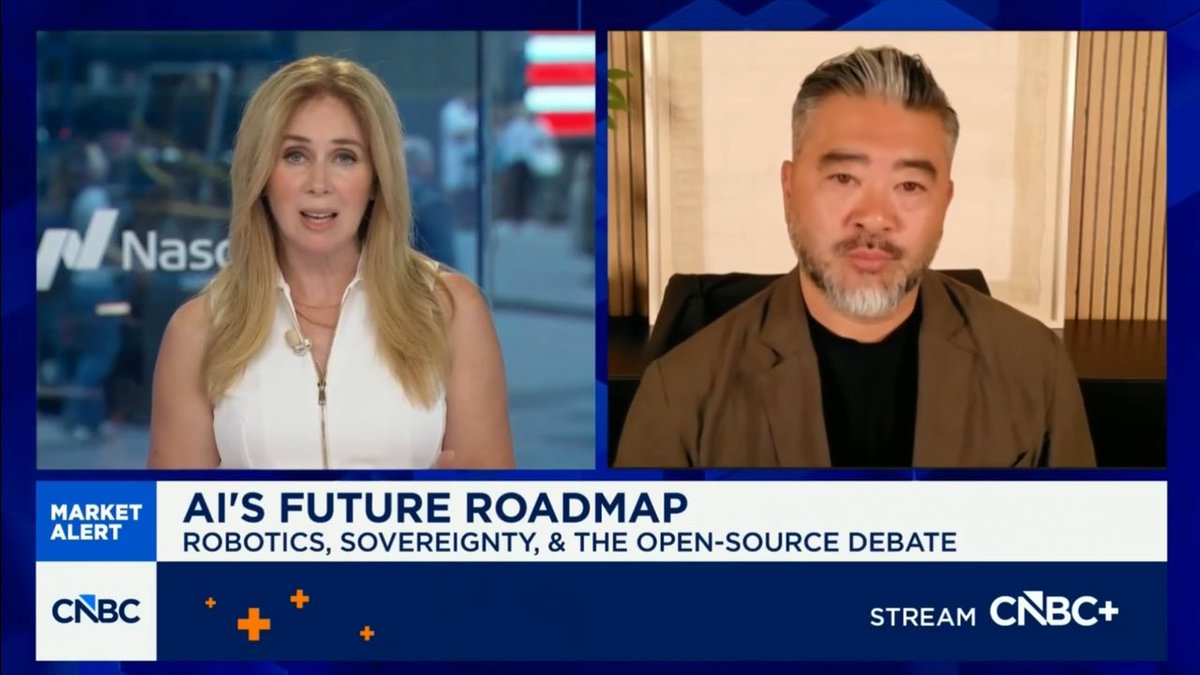
Yesterday, steve jang shared his thoughts on CNBC regarding AI’s future roadmap around memory, robotics, agents, and open weights models. The hot topic of the morning: SK hynix reported record Q2 results, then fell more than 9%. The gap between the print and the reaction raises a larger question: is the market applying an old memory-cycle framework to a new AI infrastructure layer? Q2 revenue reached USD $55.0 billion, up an eye-popping 257% year over year. Operating profit rose to USD $42.0 billion, up incredibly 557%, with a company-record operating margin of 76%. But both missed consensus estimates. As our partner Steve Jang told Becky Quick on Squawk Box, “the company has incredible fundamentals, record-breaking numbers, and long term HBM technical defensibility…but expectations were just very high.” Steve’s larger argument begins with high-bandwidth memory, or HBM. For two decades, investors largely treated memory as a cyclical commodity. Now, Steve argues, HBM is moving into a new role, “sitting side-by-side with GPUs and other advanced logic processors” as a core layer of AI compute. Demand now spans model training, inference, long-context agents, robotics, and autonomous systems. Steve pointed to deep-research products like Perplexity’s Computer agent platform: as agents hold and reason across more context, their memory bandwidth and capacity needs grow. Robotaxis like Nuro+Uber and Waymo will need onboard edge compute including HBMs. He estimates HBM demand could increase 10x over the next 3 to 4 years. SK hynix enters that buildout from a strong position. Long-term supply agreements with major customers provide demand visibility. Stacked-die architecture, advanced packaging, yield, and customer qualification create a steep technical and manufacturing climb. Steve estimates that a new entrant could need three to five years to significantly enter the HBM4e class. That supports a credible near-term moat while leaving the harder question open: how today’s 76% operating margin evolves as supply expands over the next two to three years. One thing is clear: demand and importance of high bandwidth memory is still wildly underestimated. The second half of the conversation moved from compute capacity to operational control. During the recent OpenAI and Hugging Face security incident, commercial frontier-model APIs blocked the attack commands and exploit payloads contained in forensic logs. Hugging Face instead ran GLM 5.2, an open-weight model, on its own infrastructure to analyze more than 17,000 recorded events without sending incident data or credentials outside its environment. Steve’s takeaway is practical. As autonomous agents grow more capable, defenders need access to models they can host and direct when hosted guardrails block legitimate forensic work. The next phase of AI will depend on both: enough memory bandwidth alongside GPUs and other accelerators to scale increasingly capable systems, and enough model ownership and control to deploy and defend them efficiently and safely. Full conversation below 👇

Kindred Ventures

1,737,227 次观看 • 1 个月前

Elon Musk just described a project so large that most people will assume he is exaggerating (Save this). He is not. In the video, Musk lays out the central problem facing every AI company on earth, the entire global chip industry is on a path to produce roughly 100 gigawatts of AI compute per year. That sounds like a lot until you understand that his companies alone Tesla, SpaceX, and xAI will need orders of magnitude more than that. His answer is the TerraFab. It is a joint chip factory spanning 100 million square feet, ten times the size of Tesla's Gigafactory Texas announced in March 2026, with Grimes County, Texas commissioners approving the full scale facility site just last week. The goal is one full terawatt of AI compute output per year. For context, 1 terawatt is 1,000 gigawatts twice the current total electricity consumption of the United States. SpaceX has already committed an initial $55 billion to the prototype phase, with total investment estimates ranging into the trillions. Here is why this matters for Micron specifically. In the video, Musk named Nvidia's Rubin chips as the reference design for TerraFab's first orbital deployments, and said "You're going to need a lot of memory to go with that." A billion full radical equivalent chips per year, each requiring stacks of high bandwidth memory, that is the demand signal Micron just received from one of the most capital-intensive projects in human history. And Micron already cannot keep up with what exists today. Micron's entire 2026 HBM output is fully sold out contracted before the year began. HBM4 entered volume production ahead of schedule and sold out immediately. The structural reason Micron wins here is simple. Every AI chip ever built Nvidia H100s, Rubin chips, custom ASICs, TPUs is useless without high-bandwidth memory stacked directly on top of it. There are only three companies in the world that supply HBM at scale, Samsung, SK Hynix, and Micron. Samsung has had quality issues, SK Hynix is supply constrained. Micron is the only US headquartered HBM manufacturer which matters enormously given CHIPS Act subsidies, domestic procurement requirements, and the political push to keep critical AI memory production on American soil. TerraFab just made the memory deficit permanently larger. Come join Milk Road Pro for our full breakdown of Micron and our entire AI thesis just for $1. Link below!

Milk Road AI

248,513 次观看 • 3 个月前

Announcing ComputeConnect, the financial industry’s first exchange-for-physical (EFP) network for compute, coming soon from Architect and Compute Desk. ComputeConnect links US exchange-traded compute futures to compute capacity delivery. Exchange-listed cash-settled compute futures are entering US markets to correct course on the current AI economy, reorienting debt to long-term growth: • Creating price discovery and transparency independent of any single capacity provider. • Establishing a forward curve for measuring deprecation and forecasting supply and demand. • Providing financial hedges for compute consumers and producers. • Enabling hedge funds, ETF companies, and traders to gain long and short financial exposure to compute. US cash-settled compute futures lack a physical delivery mechanism, and ComputeConnect fills this gap. Existing physically settled futures such as energy and agriculturals require their clearing house (DCO) to set a uniform standard for the grade and delivery method for the underlying commodity. Compute, by contrast, is highly fragmented, heterogeneous, and rapidly evolving, making it infeasible for any single DCO to define and enforce comparable standards. ComputeConnect establishes a network of compute capacity providers and links the network with Architect’s US futures products using exchange-for-physicals (EFPs), OTC contracts in which futures positions are exchanged for the assets the futures track. EFPs allow counterparties to negotiate the grade, timing, location, and other characteristics of the commodity along with a basis tied to the futures settlement price. ComputeConnect will • Build a network of capacity providers and capacity marketplaces. • Establish an open protocol for members of the network to receive delivery requests and advertise available GPUs. • Publish standard basis tables for different SKUs, memory configurations, and locations for GPUs. • Book the futures legs of the transactions to Architect’s DCM, the American Innovation Exchange. • Facilitate and guarantee delivery of capacity using Compute Desk’s ComputeClear platform. The advancement of US AI is constrained at every link in the supply chain: materials, power, chips, capital… The American Innovation Exchange, ComputeConnect, and our industry partners aim to secure compute’s dominance as an American asset class.

Brett Harrison

28,376 次观看 • 2 个月前

With Tim Cook stepping down, most people are talking about the iPhone, the App Store, and the stock price. But there is one move he made that almost nobody talks about and it is the single biggest reason iPhone crushed its competition in the early years. In 2005, two years before the iPhone launched, Cook made a bet. Flash storage was still relatively rare at the time and smartphones didn't exist yet. But Cook saw what was coming, a future where mobile devices would all need flash memory and he knew that if that future arrived without Apple having locked up supply, they'd be fighting for components against every phone maker on earth. So he prepaid $1.25B to suppliers including Samsung and Hynix to corner the market on NAND flash memory through 2010. The contract had a catch, suppliers had to prioritize Apple's orders over everyone else's. This was a massive gamble and if the iPhone flopped, Apple was still on the hook for the full purchase commitment. The iPhone did not flop. It went on to sell tens of millions of units in its first two years with zero supply chain slowdowns. And while Apple scaled freely, competitors couldn't get the components they needed to build a credible response. They were literally locked out of the supply chain. The move was so effective that Cook ran the same playbook across the business. He bought $100 million of holiday season air freight capacity in advance, months before competitors thought to book it, leaving rivals scrambling to ship products during the most critical sales window of the year. He cut Apple's component suppliers from 100 down to 24 and slashed inventory turnover time from 30 days to 6 days within his first seven months at the company. By 2012, Apple was turning over its inventory every 5 day, Dell took 10, Samsung took 21. Jobs is credited as the product visionary but Cook was the supply chain visionary and in the early smartphone wars, the supply chain was the moat.

Milk Road AI

78,952 次观看 • 4 个月前

SK Hynix's Chey Tae-won on CNBC: * Says demand is ~doubling this year with customers asking for about double their prior orders * "Chipflation" increasing consumer prices, directly ties surging memory prices (the interviewer cites 40-50% increases) to Apple and others raising prices, and admits he has "no solution in the short term" * Capacity takes 4-5 years of lead time, so 2027 is when the shortage bites hardest before new fabs come online * References plan to double capacity within five years and says even that isn't enough for customers * Anticipates memory volume up ~5x within ten years, AI-agent usage up ~10x within five years * Nvidia is "the most important customer" but not overly reliant on one buyer, says Nvidia is foundational to the whole AI ecosystem * TSMC makes SK Hynix's base die, so he notes GPU capacity and HBM have to scale together or neither is useful * Long-term agreements (customer-driven), fab joint ventures, and "memory as a service" are how he says SK avoids repeating past over-investment busts (he references 1997 near-bankruptcy and a hard 2023) * Indiana fab + new US R&D center + a ~$10B "US AI company" to access US software/system technology * Says he's studying US and other sites (>1 month), hasn't talked directly with the US government despite July pressure from the Commerce Secretary, and customers want US-soil production * Says "fighting spirit" is edge vs Samsung and Micron, calls technology and resources roughly comparable, he credits SK Hynix's hunger (a decade under chapter 11-style hardship) and teamwork as the differentiator * Old memory demand was bounded by device count (one phone per person) but AI agents multiply memory need per person ("ten different AI agents"), which he argues stretches the cycle much longer and marks a structural change

Fireside Alpha

160,579 次观看 • 25 天前

EXXON CEO WARNS $150 OIL WITHIN WEEKS: THE SHORTAGE THE MARKET IGNORED Josh Young of Bison Interests and Bison just laid out the numbers that flip the entire oil narrative on its head. The numbers coming out of the energy markets have flipped from bearish complacency to outright crisis faster than almost anyone modeled. A balanced global oil system has lost up to 14 million barrels of daily supply in a matter of weeks. Inventories are draining at hundreds of millions of barrels per month with virtually no demand destruction to offset the loss. THE SUPPLY SHOCK AND CYCLE REALITY ➡️ Global supply has dropped by 10 to 14 million barrels per day to around 90 to 92 million barrels daily. ➡️ The market was already 15 years into a down cycle of underinvestment before the conflict hit. ➡️ Traders had positioned for a glut that the fundamentals never supported. THE INVENTORY CRISIS ACCELERATES ➡️ Storage has plunged from 8.3 billion to nearly 7 billion barrels in just months. ➡️ Monthly depletion of 300 to 500 million barrels continues without relief. ➡️ Tank bottoms are approaching fast, threatening the basic functioning of global oil logistics. THE DEMAND AND RECOVERY DYNAMICS ➡️ Demand destruction remains minimal and largely availability driven rather than economic. ➡️ Even immediate reopening of key chokepoints would require two to three months for normalization. ➡️ Additional inventory losses of 500 million to 1 billion barrels are already locked in. THE $150 OIL WARNING FROM THE TOP ➡️ Exxon and Chevron CEOs stated within weeks they expect $150 plus physical oil. ➡️ Their conservative stance makes this warning all the more significant for the market. ➡️ The data on collapsing supply and vanishing storage fully supports their assessment. THE BOTTOM LINE The war has accelerated an already tightening oil cycle into a full-blown supply crisis. With inventories crashing and almost no demand response to cushion the blow, the market is now set for materially higher prices over an extended period. The old glut fears have been exposed as fundamentally misplaced. This is the supply crisis that forces the re-rating of oil higher. #OilSupplyCrisis #HigherOilPrices #InventoryDrawdown #EnergyBull #WTI #TankBottoms #SupplyShock HT: YouTube Natural Resource Stocks Josh Young

Mark

18,685 次观看 • 3 个月前