Loading video...

Video Failed to Load

Go Home

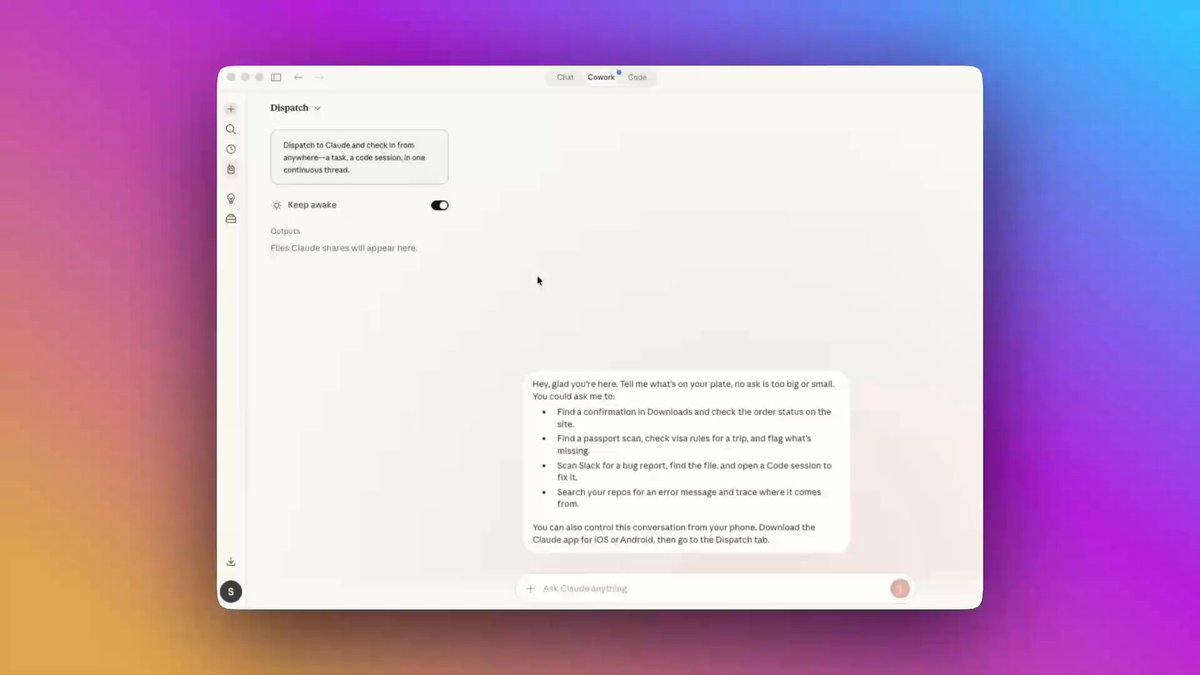
The single-agent paradigm is obsolete. I’ve been testing LobeHub, and I have to say: LobeHub is the next generation of agent harness. Anyone can effortlessly build and team up with agent coworkers to deliver complex, systematic work.Manus and Claude Cowork stop at L3; LobeHub moves agents to L4. As...

13,277 views • 6 months ago •via X (Twitter)

0 Comments

No comments available

Comments from the original post will appear here

Related Videos

Introducing LobeHub: Agent teammates that grow with you. LobeHub is the ultimate space for work and life: to find, build, and collaborate with agent teammates that grow with you. We’re building the world’s first and largest human–agent co-evolving network. Two years ago, we built LobeChat, an open-source interface for using different AI models. Today, LobeChat has 70k+ GitHub stars and serves 6M+ users worldwide. How to fully unlock the power of models has always been a shared mission between us and the community. We started with interaction — a fundamentally new, agent-first experience. Agents are no longer passive tools invoked in a single conversation. They should be proactive, always-on units of work. Treating agents as the minimal atomic unit is also the core of our agent harness infra. Today’s agents are mostly one-off executors. Even with memory, it’s often global — and hallucinates. We build long-term agent teammates that evolve with users. Each agent has its own dedicated memory space, editable by users, allowing humans and agents to co-evolve over time. This, in turn, allows us to design clearer rewards for reinforcement learning and create cleaner environments for continual learning. Agent teammates can work in groups. Through a multi-agent system, agent groups operate faster, more cost-effective, and go beyond what single-agent systems can achieve. For example, a single agent often requires heavy user involvement to proceed step by step, whereas LobeHub can execute the same work from a single instruction, with a supervisor orchestrating agents that run in parallel or debate to produce better results. We are building the collaboration network among agent teammates — and between humans and agent teammates as well. Ease of use matters. AI intelligence and shared human intelligence are equally important. With simple instructions and tool selection, you can effortlessly build and team up with agent coworkers to deliver complex, systematic work — even assembling a quant team to execute trades. Through the LobeHub community, anyone can discover, reuse, and remix agents and agent groups, customizing them to fit their own workflows, preferences, and needs. Last but not least, our vision started with LobeChat: multi-model support is the most efficient approach for users. We believe different models excel in different scenarios. By routing across multiple models, LobeHub improves cost efficiency and unlocks capabilities that a single-model setup cannot easily support.

LobeHub

185,273 views • 6 months ago

In the future, you’ll be able to accomplish a goal by just giving Claude an outcome and a budget. That’s the direction Anthropic is building in with its new Managed Agents features, announced at this week’s Code with Claude developer event. The basic idea: Claude, wrapped in a computer in the cloud, that you can spin up, scale, and manage as needed. Anthropic is taking on the infrastructure that kills most agent products, and making sure that it scales to meet the needs of agents running 24/7. On this week’s AI & I from Every 📧, I talk with Angela Jiang (Angela Jiang), head of product for the Claude platform, and Katelyn Lesse (Katelyn Lesse), head of engineering for the Claude platform, about what Anthropic is building and what it takes to make agents reliable in production. We get into: - Why the "build a generic harness, hot-swap any model behind it" playbook is already outdated. Angela points to eval data on Memory where the same task across different harnesses performed drastically differently. - The infrastructure wall every team hits in production—and why Katelyn thinks “my sandbox died and took the agent with it” is the real reason internal agents don't ship. - Why Anthropic is so bullish on using file systems and skills within Claude, including Angela's argument that those early design choices can compound for years. This is a must-watch for anyone trying to take an agent past the demo and into production. Watch below! Timestamps: How the Claude platform evolved from API to agents: 00:01:48 The primitives that make up Claude Managed Agents: 00:04:09 Why the harness and the model are becoming a single unit: 00:10:37 The infrastructure wall that kills most agent projects in production: 00:18:49 Why team agents need a different shape than individual productivity tools: 00:24:49 How Anthropic's legal team uses an agent to review marketing copy: 00:26:36 Using multi-agent orchestration for advisor strategies, adversarial pairs, and swarms: 00:34:24 How to measure agent success with outcome and budget as the end state: 00:35:50 What the platform looks like a year from now, when Claude writes its own harness: 00:39:11

Dan Shipper 📧

66,339 views • 3 months ago