Video yükleniyor...

Video Yüklenemedi

Ana Sayfaya Dön

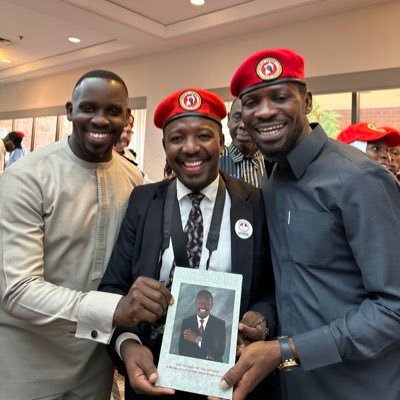
The Uganda Police Force’s credibility has once again been called into question, this time amid alarming threats from President Museveni’s son, Muhoozi Kainerugaba. In a move that has intensified public scrutiny, police spokesperson Kituuma Rusoke claimed that opposition leader Bobi Wine was at his residence and not under house...

52,650 görüntüleme • 7 ay önce •via X (Twitter)

0 Yorum

Yorum bulunmuyor

Orijinal gönderinin yorumları burada görünecek

Benzer Videolar

Bobi Wine was recently selected to address the Geneva Summit for Human Rights and Democracy, marking his second appearance at the prestigious international forum. He first spoke at the summit in 2023 following Uganda’s 2021 general elections. This time, however, the circumstances surrounding his address are markedly different. After the 2026 elections, Bobi Wine fled his home and has remained in hiding amid threats from Muhoozi Kainerugaba, Uganda’s Chief of Defence Forces. As a result, he is expected to deliver his address remotely via video rather than appearing in person. In his 2023 maiden speech at the summit, Bobi Wine described what he characterized as widespread violence and repression during the 2020 election campaigns. He explained the numerous times Ugandans were killed by state authorities, under President Yoweri Museveni, who is responsible for grave human rights violations. His message was direct and focused: he urged the international community to reconsider its relationship with Museveni’s government, calling for an end to financial support and diplomatic cooperation. He further appealed for targeted sanctions against Museveni and his associates, advocating for their international isolation. Despite ongoing concerns raised by human rights organizations and opposition figures, Western governments have continued to engage with Museveni’s administration. This raises an important question: what will Bobi Wine’s upcoming address emphasize under these new and more precarious circumstances? Below is my commentary on his maiden address, during which he introduced himself and his cause to the global stage. YouTube - EU in Uganda United Nations

Mordecai Muriisa ™️

26,590 görüntüleme • 6 ay önce

In a move that felt more like a vendetta than a vision, former NUP vice president Mathias Mpuuga re-emerged onto Uganda’s political scene—this time not with a mission to challenge the regime, but seemingly to dismantle the very opposition he once served. At the center of this dramatic comeback was Kampala Central MP Muhammad Nsereko, who took the stage not just to defend Mpuuga against the corruption guilt that led to his downfall, but to unleash a scathing tirade against Bobi Wine and the current NUP leadership. The occasion? The launch of Mpuuga’s new political vehicle, the Democratic Front, in Masaka District. But what should have been a platform to articulate a national agenda quickly morphed into a one-sided bashing session targeting NUP’s top brass. Nsereko went all in—lavishing Mpuuga with praise as the most intelligent and capable opposition leader Uganda has ever had, while painting the NUP as an amateurish, chaotic outfit. The irony? Despite his glowing endorsement of Mpuuga, Nsereko didn’t join the Democratic Front. Instead, he recently launched his own outfit—the Ecological Party—leaving many questioning whether this is a genuine political divergence or a coordinated front to isolate Bobi Wine from within the opposition. The message was loud and clear: their focus is not on dismantling Museveni’s grip on power. It’s on sidelining Bobi Wine. Every jab, every carefully worded attack, hinted at a power struggle within the opposition ranks. While Uganda still reels under the weight of authoritarian rule, Mpuuga and Nsereko appear more invested in weakening the strongest face of resistance rather than confronting the system itself. So the question looms large: Is this a new opposition movement, or just a calculated mission to fracture it from within? YouTube -

Mordecai Muriisa ™️

40,497 görüntüleme • 1 yıl önce

After threatening to shut down NTV and the Daily Monitor, Gen. Muhoozi Kainerugaba may have expected fear and silence. Instead, Uganda's most prominent media houses appear to have called his bluff. In what many viewed as a direct challenge to the country's Chief of Defence Forces, NTV's evening news bulletin revisited a series of controversial incidents in which Muhoozi has been accused of openly boasting about kidnappings, illegal detentions and other actions that critics say violate the law. The broadcaster posed a question that is increasingly being asked across the country: Is Muhoozi Kainerugaba above the law? The Daily Monitor has also continued reporting on the controversy despite the threats, setting up a confrontation that many Ugandans never expected to see. For years, critics have accused powerful figures in government of operating with impunity, but now major media institutions appear unwilling to simply look away. The bigger question is what happens next. Will Muhoozi back down from his threats, or will he attempt to act on them? Can a military officer, regardless of rank, decide which media houses are allowed to operate and which ones are not? And what does it say about the state of Uganda when journalists and media organizations find themselves in a public standoff with the country's top military commander? To many observers, this is no longer just a dispute between Muhoozi and the media. It is becoming a test of whether the rule of law still matters, whether freedom of the press can survive political intimidation, and whether powerful individuals can be held accountable for their actions. In this commentary, I examine the growing confrontation between Muhoozi Kainerugaba and Uganda's independent media and what it means for the future of the country. YouTube -

Mordecai Muriisa ™️

22,482 görüntüleme • 2 ay önce