Video wird geladen...

Video konnte nicht geladen werden

Zur Startseite

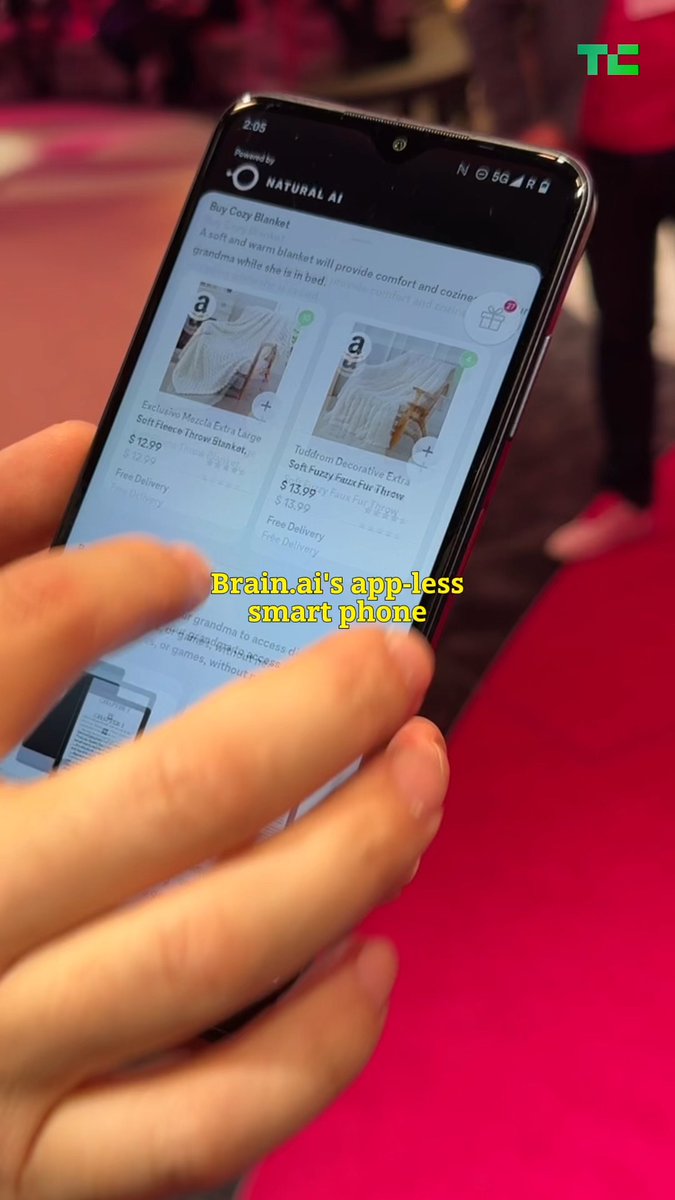
The UI era is ending. 🪦 For 70 years we designed computer interfaces. Mainframe, CLI, GUI, Touch. But with AI, the interface is disappearing. What will come next? My talk from Mastra's conf this week:

292,921 Aufrufe • vor 2 Monaten •via X (Twitter)

0 Kommentare

Keine Kommentare verfügbar

Kommentare vom Original-Post werden hier angezeigt

Ähnliche Videos

The “everything palette” has been in the back of my mind for years. I feel that, when correctly automated, it demonstrates an important property of a GUI system, which is an internal interface represented structurally (a common substrate by which all higher level interfaces communicate), and several projections of that interface to higher level interfaces (GUIs, CLIs, hotkeys), such that the internal interface is not substantially duplicated in the projections themselves. Thus, small changes in the internal interface representation immediately and automatically reflect in all such projections. All information for a new setting, for example, is simply expressed in one location, and all interfaces which could access that setting immediately can do so. That setting is automatically accessible in the associated right-click menus, the CLI, hotkeys, and the everything palette. This is because those higher level interfaces are truly *projections* of the underlying interface—they are driven using, in effect, type information of the underlying interface, rather than being special cased to the particulars of the interface (and thus needing to be extensively updated any time the internal interface is changed). The need for this in UI programming is usually first encountered with hotkeys. You write some user interface, and now you need to associate hotkeys—an entirely separate (physical) interface—with the same functionality that your software user interface exposes. You can implement this by, in effect, duplicating the internal interface in both a hotkeys path, and a GUI path. But this is far from ideal for obvious reasons. The debugger by nature enforces this design constraint (GUIs and hotkeys), along with many others, and so it pushed me to follow this to its natural conclusion. A debugger needs to offer an IPC CLI interface for the same commands and features that the main program does. Data in the debugger is already projected in a wide variety of ways—breakpoints can show up in a source view, a disassembly view, a memory view, and a breakpoints list view. My work on the RADDBG visualization engine (driven ultimately by the “watch window” interface—at its limit, a general sparse tree viewer/editor) pushed this even further—you want interfaces to be available through a watch tree evaluation language, as well as several GUIs, and the CLI, and hotkeys. I’ve now finally got the internal systems to the point where they are roughly satisfying all these constraints, and this made the “everything palette” a very simple and natural extension to the system.

Ryan Fleury

22,249 Aufrufe • vor 1 Jahr

AI instead of UI The last few years radically changed how we think about digital products & product design process in general. What we are witnessing right now is a transition where AI is no longer just a feature; it is becoming the infrastructure of interaction. For decades, UI design was rooted in the concept of “Happy Path,” a series of static, linear screens (routes from A to B) designed to funnel users toward a goal. This “one-size-fits-all” approach assumes that all users have the same mental model, which is far from the truth. The rise of AI tools like ChatGPT and Gemini is showing that we are moving into an era of Generative Interfaces. Instead of a designer pre-determining every button and menu, the interface is synthesized in real-time based on user actions. Back in 2019, Gleb Kuznetsov and I were working on the concept of morphing Interface, the idea of a UI that adapts its structure based on user intent. The great thing about this UI is that it was highly dynamic: different users saw different content/contextual actions based on their behavior. This concept was crazy in 2019, but it is highly relevant to the modern state of the product design process. And I strongly believe that it represents the future of UI design. We will move beyond the “AI chatbox" crutch Yes, many products today treat AI as a sidecar (think of Copilots or chatbots pinned to the side of a traditional dashboard), but this is a transitional phase. Why? Because adding a chat window to a 20-year-old software layout is like putting a jet engine on a horse-drawn carriage. That's why the future isn't "AI as an add-on"; it is AI as the Operating System. AI will power generative interfaces that are rooted in anticipatory design: UI won’t wait for a command; it will surface tools based on the user's current environmental context and historical behavior. This evolution changes the very nature of product design, and we will move away from designing pages/screens and toward designing systems of logic.

Nick Babich

53,208 Aufrufe • vor 4 Monaten