正在加载视频...

视频加载失败

THIS IS A PURE F*CKING GOLDMINE Anthropic just documented how Claude Code actually remembers your entire codebase across sessions The idea: stop dumping 500 lines into CLAUDE.md and let the new Haiku 5.5 manage an auto-indexing memory tree while Opus 5.5 audits your rules Zero context bloat, path-scoped rules...

30,878 次观看 • 12 天前 •via X (Twitter)

8 条评论

mlsofts 的头像
mlsofts11 天前

Memory helps Claude remember rules. What bit me was different: my coding agent kept writing a second version of functions that already existed. The fix wasn't more memory, it was a written inventory it must search before coding. Weak spot: it only works if I keep it up to date.

marfin 的头像
marfin12 天前

that's a really smart approach I hope this helps many people when working with claude ode

安叫兽|Bird🕊️ 🔶 BNB 的头像
安叫兽|Bird🕊️ 🔶 BNB12 天前

跨会话记忆先不说,Haiku 5.5这版本号哪来的?

Camto 的头像
Camto12 天前

This is insain

Solty 的头像
Solty12 天前

is doctor promt audit live now or still rolling out, cant find it in my cli yet?

Antony Claude 的头像
Antony Claude11 天前

this is huge for dev workflows and context management

catman 的头像
catman12 天前

The auto-memory index has a 200-line cap. Is that a limit you set in practice, or does the system enforce it?

beamnxw ./ 的头像
beamnxw ./12 天前

goldmine fr

相关视频

THIS IS AN ACTUAL F*CKING GOLDMINE Anthropic just shared one of the best tricks for Claude Code. The idea: run Sonnet, Haiku 5.5 and Opus 5.5 at once, each one doing only the job it's best at. Better results and way fewer tokens, because every task lands on the right model. You just launch Claude Code like this: claude --model sonnet --advisor opus here's the split: → Sonnet 5.5 runs the session, writes the code and applies the fixes → Haiku 5.5 swarms the repo in parallel: search, grep and diff audits → Opus 5.5 stays on call as advisor for the big calls and signs off on the diff → you stop burning Opus context on work that doesn't need it Opus only steps in at three moments: → before a plan locks → when the same error shows up twice → before calling it done Sonnet builds. Haiku swarms. Opus reviews. JEV engineering is the same move one layer down: the forks that need no thinker (which file, which tool, retry or stop) go to JEV in milliseconds, and the big models only see the ones that split the full tree > Sonnet 5.5 runs the main session and coordinates the work > search maps the repo on Haiku 5.5, read-only > grep finds call sites on Haiku 5.5 in its own context > audit checks the diff on Haiku 5.5 in a throwaway worktree > Opus 5.5 on call as advisor, reviews the synthesized diff before sign-off > JEV routes micro-forks in milliseconds paste the tree and this prompt into Claude Code ↓ "Reconfigure my Claude Code setup around this tree: 1. Run the main session on Sonnet 5.5 with Opus 5.5 as advisor. 2. Create three Haiku 5.5 subagents in .claude/agents: search (maps the repo), grep (finds call sites), audit (checks the diff). 3. Set isolation: worktree on audit so its checks never touch my working branch. 4. Add one rule to CLAUDE.md: delegate every repo search and test run to the Haiku 5.5 subagents to keep the main context small. 5. Route fast deterministic forks (tool choice, path selection, retries) through JEV. Show me every change as a diff first. No edits until I say go." ↳ save it, it'll come in handy.

xsmryze

73,291 次观看 • 8 天前

THIS IS AN ACTUAL F*CKING GOLDMINE Anthropic just shared one of the best tricks for Claude Code. The idea: run Sonnet, Haiku 5.5 and Opus 5.5 at once, each one doing only the job it's best at. Better results and way fewer tokens, because every task lands on the right model. You just launch Claude Code like this: claude --model sonnet --advisor opus here's the split: → Sonnet 5.5 runs the session, writes the code and applies the fixes → Haiku 5.5 swarms the repo in parallel: search, grep and diff audits → Opus 5.5 stays on call as advisor for the big calls and signs off on the diff → you stop burning Opus context on work that doesn't need it Opus only steps in at three moments: → before a plan locks → when the same error shows up twice → before calling it done Sonnet builds. Haiku swarms. Opus reviews. JEV engineering is the same move one layer down: the forks that need no thinker (which file, which tool, retry or stop) go to JEV in milliseconds, and the big models only see the ones that split the full tree > Sonnet 5.5 runs the main session and coordinates the work > search maps the repo on Haiku 5.5, read-only > grep finds call sites on Haiku 5.5 in its own context > audit checks the diff on Haiku 5.5 in a throwaway worktree > Opus 5.5 on call as advisor, reviews the synthesized diff before sign-off > JEV routes micro-forks in milliseconds paste the tree and this prompt into Claude Code ↓ "Reconfigure my Claude Code setup around this tree: 1. Run the main session on Sonnet 5.5 with Opus 5.5 as advisor. 2. Create three Haiku 5.5 subagents in .claude/agents: search (maps the repo), grep (finds call sites), audit (checks the diff). 3. Set isolation: worktree on audit so its checks never touch my working branch. 4. Add one rule to CLAUDE.md: delegate every repo search and test run to the Haiku 5.5 subagents to keep the main context small. 5. Route fast deterministic forks (tool choice, path selection, retries) through JEV. Show me every change as a diff first. No edits until I say go." ↳

delost

104,765 次观看 • 14 天前

THIS IS ACTUAL F*CKING GOLD Anthropic just shared one of the best tricks for Claude Code. The idea: run Sonnet, Haiku and Opus 5.5 together, each one doing only the job it's best at. Opus-level judgment on every big call, without paying Opus rates for every routine turn. You just launch Claude Code like this: claude --model sonnet --advisor opus here's the split: → Sonnet 5.5 runs the session and writes the code → Haiku 5.5 explores files and docs in parallel → Opus 5.5 stays on call as advisor for the big calls → you stop spending Opus on work that doesn't need it Opus only steps in at three moments: → before a plan locks → when the same error shows up twice → before calling it done Sonnet builds. Haiku explores. Opus reviews. JEV engineering is the same move one layer down: the forks that need no thinker (which file, which tool, retry or stop) go to JEV in milliseconds, and the big models only see the ones that split the full tree > Sonnet 5.5 runs the main session and edits code > search maps the repo on Haiku 5.5 > grep finds call sites on Haiku 5.5 > docs pulls the API reference on Haiku 5.5 > Opus 5.5 on call as advisor, reads the whole transcript when consulted > JEV routes micro-forks in milliseconds paste the tree and this prompt into Claude Code ↓ "Rebuild my Claude Code setup around this tree: 1. Run the main session on Sonnet 5.5 with Opus 5.5 as advisor. 2. Create three read-only Haiku 5.5 subagents: search (maps the repo), grep (finds call sites), docs (pulls the API reference). 3. Add one rule to CLAUDE.md: consult the advisor before locking a plan, after the same error twice, and before calling a task done. 4. Route fast deterministic forks (tool choice, path selection, retries) through JEV. Show me every change as a diff first. No edits until I say go." ↳ save it, you'll use this every single day.

delost

319,152 次观看 • 20 天前

THIS IS PURE F*CKING GOLD Anthropic just shared one of the best tricks for Claude Code. The idea: run Sonnet, Haiku and Opus 5.5 at the same time, each one doing only what it's best at. Better results and way fewer tokens, because every task lands on the right model. You just start Claude Code like this: claude --model sonnet --advisor opus here's how it splits: → Sonnet 5 runs the session and writes the code → Haiku 5.5 explores files and docs in parallel → Opus 5.5 stays on call as advisor for the big decisions → you stop burning Opus context on tasks that don't need it Opus only steps in at three moments: → before a plan locks → when the same error hits twice → before calling it done Sonnet builds. Haiku explores. Opus reviews. JEV engineering is the same move one layer down: the forks that need no thinker (which file, which tool, retry or stop) go to JEV in milliseconds, and the big models only see the ones that split the full tree > Sonnet 5 runs the main session and edits code > search maps the repo on Haiku 5.5 > grep finds call sites on Haiku 5.5 > docs pulls the API reference on Haiku 5.5 > Opus 5.5 on call as advisor, reads the full transcript when consulted > JEV routes micro-forks in milliseconds paste the tree and this prompt into Claude Code ↓ "Reconfigure my Claude Code setup around this tree: 1. Run the main session on Sonnet 5 with Opus 5.5 as advisor. 2. Create three read-only Haiku 5.5 subagents: search (maps the repo), grep (finds call sites), docs (pulls the API reference). 3. Add one rule to CLAUDE.md: consult the advisor before locking a plan, after the same error twice, and before calling a task done. 4. Route fast deterministic forks (tool choice, path selection, retries) through JEV. Show me every change as a diff first. No edits until I say go." ↳ save it, it'll come in handy.

delost

316,202 次观看 • 22 天前

THIS IS ACTUAL F*CKING GOLD Anthropic just shared one of the best tricks for Claude Code. The idea: run Sonnet, Haiku and Opus 5.5 together, each one doing only the job it's best at. Opus-level judgment on every big call, without paying Opus rates for every routine turn. You just launch Claude Code like this: claude --model sonnet --advisor opus here's the split: → Sonnet 5.5 runs the session and writes the code → Haiku 5.5 explores files and docs in parallel → Opus 5.5 stays on call as advisor for the big calls → you stop spending Opus on work that doesn't need it Opus only steps in at three moments: → before a plan locks → when the same error shows up twice → before calling it done Sonnet builds. Haiku explores. Opus reviews. JEV engineering is the same move one layer down: the forks that need no thinker (which file, which tool, retry or stop) go to JEV in milliseconds, and the big models only see the ones that split the full tree > Sonnet 5.5 runs the main session and edits code > search maps the repo on Haiku 5.5 > grep finds call sites on Haiku 5.5 > docs pulls the API reference on Haiku 5.5 > Opus 5.5 on call as advisor, reads the whole transcript when consulted > JEV routes micro-forks in milliseconds paste the tree and this prompt into Claude Code ↓ "Rebuild my Claude Code setup around this tree: 1. Run the main session on Sonnet 5.5 with Opus 5.5 as advisor. 2. Create three read-only Haiku 5.5 subagents: search (maps the repo), grep (finds call sites), docs (pulls the API reference). 3. Add one rule to CLAUDE.md: consult the advisor before locking a plan, after the same error twice, and before calling a task done. 4. Route fast deterministic forks (tool choice, path selection, retries) through JEV. Show me every change as a diff first. No edits until I say go." ↳ save it, you'll use this every single day.

xsmryze

193,232 次观看 • 9 天前

THIS IS A PURE F*CKING GOLDMINE Anthropic just shared one of the best tricks for Claude Code. The idea: let Opus 5.5 write the plan as a script, and let a swarm of cheaper agents run it. Bigger jobs and way fewer Opus tokens, because the script holds the plan and Opus only sees the final answer. You just launch Claude Code like this: claude --model opus --effort ultracode here's the split: → Opus 5.5 turns your task into a workflow script → Haiku 5.5 agents scan every file in parallel → Sonnet 5.5 agents patch each fix in its own isolated copy → you stop burning Opus context on a hundred agent transcripts Opus only shows up at three moments: → writing the workflow before the run → reading the verified results after it → signing off before anything ships Opus plans. Haiku scans. Sonnet ships. JEV engineering is the same move one layer down: the forks that need no thinker (which file, which tool, retry or stop) go to JEV in milliseconds, and the big models only see the ones that split the full tree > Opus 5.5 runs the main session and writes the workflow > scan audits every file on Haiku 5.5 > edit patches each fix on Sonnet 5.5 in an isolated copy > verify cross-checks every finding on Sonnet 5.5 > Opus 5.5 reads only what survived verification > JEV routes micro-forks in milliseconds paste the tree and this prompt into Claude Code ↓ "Rebuild my Claude Code setup around this tree: 1. Run the main session on Opus 5.5 with ultracode on. 2. In every workflow, run read-only scan stages on Haiku 5.5 and edit stages on Sonnet 5.5, each edit in its own isolated copy. 3. Add one rule to CLAUDE.md: every finding gets an independent verifier agent before it's reported, and fix loops stop after two rounds with no progress. 4. Route fast deterministic forks (tool choice, path selection, retries) through JEV. Show me every change as a diff first. No edits until I say go." ↳ save it, it'll come in handy.

delost

400,076 次观看 • 19 天前

THIS IS A PURE F*CKING GOLDMINE Anthropic just shared one of the best tricks for Claude Code. The idea: let Opus 5.5 write the plan as a script, and let a swarm of cheaper agents run it. Bigger jobs and way fewer Opus tokens, because the script holds the plan and Opus only sees the final answer. You just launch Claude Code like this: claude --model opus --effort ultracode here's the split: → Opus 5.5 turns your task into a workflow script → Haiku 5.5 agents scan every file in parallel → Sonnet 5.5 agents patch each fix in its own isolated copy → you stop burning Opus context on a hundred agent transcripts Opus only shows up at three moments: → writing the workflow before the run → reading the verified results after it → signing off before anything ships Opus plans. Haiku scans. Sonnet ships. JEV engineering is the same move one layer down: the forks that need no thinker (which file, which tool, retry or stop) go to JEV in milliseconds, and the big models only see the ones that split the full tree > Opus 5.5 runs the main session and writes the workflow > scan audits every file on Haiku 5.5 > edit patches each fix on Sonnet 5.5 in an isolated copy > verify cross-checks every finding on Sonnet 5.5 > Opus 5.5 reads only what survived verification > JEV routes micro-forks in milliseconds paste the tree and this prompt into Claude Code ↓ "Rebuild my Claude Code setup around this tree: 1. Run the main session on Opus 5.5 with ultracode on. 2. In every workflow, run read-only scan stages on Haiku 5.5 and edit stages on Sonnet 5.5, each edit in its own isolated copy. 3. Add one rule to CLAUDE.md: every finding gets an independent verifier agent before it's reported, and fix loops stop after two rounds with no progress. 4. Route fast deterministic forks (tool choice, path selection, retries) through JEV. Show me every change as a diff first. No edits until I say go." ↳ save it, it'll come in handy.

xsmryze

60,847 次观看 • 11 天前

THIS IS ABSOLUTE F*CKING GOLD Anthropic just shared one of the best tricks for Claude Code The idea: run Opus 5.5 as lead, and swarm cheap Haiku 5.5 teammates in parallel Opus-level architecture on every task, without burning Opus context on routine turns You just launch Claude Code like this: export CLAUDE_CODE_EXPERIMENTAL_AGENT_TEAMS=1 claude --model opus --teammate-mode auto here's the split: → Opus 5.5 leads the team, decomposes tasks into a DAG, and signs off → Haiku 5.5 swarms as autonomous teammates across isolated context windows → Sonnet 5.5 implements heavy multi-file refactors without blocking peers → you stop burning Opus context on a hundred agent transcripts Opus only steps in at three moments: → breaking your goal into a dependency DAG before the run → approving diff plans before teammates edit files → signing off on verified results before anything ships Opus leads · Haiku swarms · Sonnet ships JEV engineering is the same move one layer down: the forks that need no thinker (which file, which tool, retry or stop) go to JEV in milliseconds, and the big models only see the ones that split the full tree > Opus 5.5 runs the lead session and coordinates the task DAG > security audits auth and JWT handling on Haiku 5.5 > perf-scout profiles p99 latency bottlenecks on Haiku 5.5 > qa-engine executes full test suites on Haiku 5.5 > patcher refactors complex multi-file logic on Sonnet 5.5 > Opus 5.5 reads only verified PR diffs > JEV routes micro-forks in milliseconds paste the tree and this prompt into Claude Code ↓ "Rebuild my Claude Code setup around this tree: 1. Enable CLAUDE_CODE_EXPERIMENTAL_AGENT_TEAMS=1 with --teammate-mode auto 2. Run the main lead session on Opus 5.5 to decompose tasks into a dependency DAG 3. Spawn three parallel teammates on Haiku 5.5 for security, perf, and qa 4. Have teammates self-claim unblocked tasks, coordinate findings via P2P mailbox, and draft plans before modifying code 5. Route heavy multi-file patches to Sonnet 5.5 and clear fast deterministic forks through JEV Show me every change as a diff first, no edits until I say go" ↳ save it, you'll use this on every serious codebase

mirku

57,507 次观看 • 18 天前

THIS IS A PURE F*CKING GOLDMINE Anthropic just shared the sharpest trick for Claude Code The idea: let Opus 5.5 write the plan as a script, and swarm the new Haiku 5.5 in parallel Huge sweeps with zero Opus burn: the script holds the loop and Opus only sees the final diff You just launch Claude Code like this: claude --model opus --effort ultracode here's the split: → Opus 5.5 turns your objective into an executable workflow script → Haiku 5.5 swarms every file in parallel at 340 tok/s to extract candidates → Sonnet 5.5 patches each fix and cross-checks findings in its own isolated copy → you stop burning Opus context on a hundred agent transcripts Opus only shows up at three moments: → authoring the workflow script before the run → reading verified findings after the swarm finishes → signing off before anything ships to git Opus plans · Haiku scans · Sonnet ships JEV engineering is the same move one layer down: the forks that need no thinker (which file, which tool, retry or stop) go to JEV in milliseconds, and the big models only see the ones that split the full tree > Opus 5.5 runs the main session and writes workflow.js > pipeline() fans out the new Haiku 5.5 to audit every file > parallel() schema validators drop false positives in V8 > Sonnet 5.5 patches each fix in an isolated worktree > verify cross-checks all diffs before reporting > Opus 5.5 reads only what survived verification > JEV routes micro-forks in milliseconds paste the tree and this prompt into Claude Code ↓ "Rebuild my Claude Code setup around this tree: 1. Run the main session on Opus 5.5 with ultracode on 2. In every workflow, run read-only scan stages on the new Haiku 5.5 and edit stages on Sonnet 5.5, each edit in its own isolated copy 3. Add one rule to CLAUDE.md: every finding gets an independent verifier agent before it's reported, and fix loops stop after two rounds with no progress 4. Route fast deterministic forks (tool choice, path selection, retries) through JEV Show me every change as a diff first, no edits until I say go" ↳ save it, it'll come in handy

mirku

200,753 次观看 • 17 天前

THIS IS A PURE F*CKING GOLDMINE Anthropic just shared one of the best tricks for Claude Code. The idea: let Opus 5.5 write the plan as a script, and let 12 cheap agents run it while Opus sits idle at zero tokens. Same task, two ways: Opus solo was 49% done and still running. The swarm finished in 9 minutes on 165k tokens. You just launch Claude Code like this: claude --model opus --swarm haiku,sonnet here's the split: → Opus 5.5 writes plan.js, then stops reading anything → 6 Haiku 5.5 agents audit every file in parallel → 4 Sonnet 5.5 agents patch each fix in its own isolated copy → 2 Haiku 5.5 agents cross-check, 8 of 9 findings survive Opus only shows up at two moments: → writing the plan before the run → signing off on the verified fixes after it Opus plans. Haiku scans. Sonnet ships. JEV engineering is the same move one layer down: 3,767 forks this run - which model, which lane, retry or stop - resolved in code, and only the genuinely split ones ever reach Opus the full tree > Opus 5.5 runs the main session on xhigh and writes plan.js > scan audits each file on Haiku 5.5, six in parallel > patch applies each fix on Sonnet 5.5 in its own isolated copy > verify cross-checks every finding on Haiku 5.5 > Opus 5.5 reads only what survived, then signs off > JEV resolves micro-forks in milliseconds paste the tree and this prompt into Claude Code ↓ "Rebuild my Claude Code setup around this tree: Run the main session on Opus 5.5 with effort xhigh and swarm haiku,sonnet. Have Opus write the plan as a script: scan on Haiku 5.5, patch on Sonnet 5.5 in isolated copies, verify on Haiku 5.5. Let the phases overlap - each finding moves on as soon as its own stage finishes, no waiting for the batch. Never surface raw agent output to the main session, only verified results. Route deterministic forks (model choice, lane choice, retries) through JEV. Show me every change as a diff first. No edits until I say go." ↳ save it, it’ll come in handy

Sprytix

19,842 次观看 • 16 天前

THIS IS AN ABSOLUTE F*CKING GOLDMINE Anthropic just shared one of the best tricks for Claude Code. The idea: Opus 5.5 writes the entire plan as a script, and a swarm of cheaper agents executes it. Bigger jobs and far fewer Opus tokens, because the script holds the plan and Opus only sees the final answer. You just start Claude Code like this: claude --model opus --effort ultracode here's the split: → Opus 5.5 turns your task into a workflow script → Haiku 5.5 agents scan every file in parallel → Sonnet 5.5 agents patch each fix in its own isolated copy → you stop burning Opus context on a hundred agent transcripts Opus only steps in at three moments: → writing the workflow before the run → reading the verified results after it → signing off before anything ships Opus plans. Haiku scans. Sonnet ships. JEV engineering is the same move one layer down: the forks that need no thinker (which file, which tool, retry or stop) go to JEV in milliseconds, and the big models only see the ones that split the full tree > Opus 5.5 runs the main session and writes the workflow > scan audits every file on Haiku 5.5 > edit patches each fix on Sonnet 5.5 in an isolated copy > verify cross-checks every finding on Sonnet 5.5 > Opus 5.5 reads only what survived verification > JEV routes micro-forks in milliseconds paste the tree and this prompt into Claude Code ↓ "Rebuild my Claude Code setup around this tree: 1. Run the main session on Opus 5.5 with ultracode on. 2. In every workflow, run read-only scan stages on Haiku 5.5 and edit stages on Sonnet 5.5, each edit in its own isolated copy. 3. Add one rule to CLAUDE.md: every finding gets an independent verifier agent before it's reported, and fix loops stop after two rounds with no progress. 4. Route fast deterministic forks (tool choice, path selection, retries) through JEV. Show me every change as a diff first. No edits until I say go." ↳ save it, you'll reach for it on every big task.

Callan

13,976 次观看 • 17 天前

THIS IS ACTUAL F*CKING GOLD Anthropic just quietly dropped one of the best setups for Claude Code The rule: orchestrate Sonnet, Haiku and Opus 5.5 simultaneously, locking every model into the exact lane it dominates Opus-grade intelligence on critical architectural calls, zero Opus burn on routine terminal iterations Launch Claude Code with this flag pair: claude --model sonnet --advisor opus how the workload divides: → Sonnet 5.5 leads the main session and cuts the actual code → Haiku 5.5 swarms repos, greps call sites, and parses docs concurrently → Opus 5.5 remains on standby as advisor for high-leverage checkpoints → you eliminate token waste on work that never required frontier reasoning Opus only gets triggered on three specific events: → right before locking an architectural plan → the second an identical error hits twice → right before marking a complex task complete Sonnet builds · Haiku explores · Opus reviews JEV engineering applies the exact same logic one layer deeper: deterministic branches (file selection, tool dispatch, fast retry vs abort) clear in sub-milliseconds, so the frontier models only handle genuine forks the architecture tree: > Sonnet 5.5 drives the primary terminal session and edits code > search crawls repo structure on Haiku 5.5 > grep locates call signatures on Haiku 5.5 > docs fetches API specs and schemas on Haiku 5.5 > Opus 5.5 stands on call as advisor, ingesting full context when pinged > JEV resolves instant deterministic routing feed this tree and prompt directly into Claude Code ↓ "Configure my Claude Code environment around this multi-model tree: 1. Run the primary session on Sonnet 5.5 with Opus 5.5 as advisor 2. Spawn three read-only Haiku 5.5 subagents: search (repo mapping), grep (call sites), docs (API references) 3. Enforce one rule in CLAUDE.md: ping advisor before locking any plan, upon repeating any error twice, and before final task handoff 4. Route instantaneous deterministic forks (tool choice, path check, retries) through JEV Show every file update as a diff first, make zero changes without confirmation" ↳ bookmark this, you'll run it every single day

mirku

82,115 次观看 • 19 天前

By tomorrow, everyone will be using this: Anthropic just revealed the ultimate power move for Claude Code The concept: have Opus 5.5 design the master plan as a script, then deploy parallel swarms of the new Haiku 5.5 Massive scale operations with zero wasted Opus compute: the script manages the execution loop so Opus only reviews the final diff Simply boot up Claude Code with these parameters: claude --model opus --effort ultracode Here is the task distribution: -> Opus 5.5 translates your target into a fully runnable workflow script -> Haiku 5.5 scans all files concurrently at 340 tokens/sec to spot candidates -> Sonnet 5.5 applies each patch and validates findings within an isolated workspace -> You eliminate wasting Opus context on dozens of agent log transcripts Opus is involved at only three specific steps: -> writing the initial workflow script before execution -> analyzing verified results once the swarm wraps up -> giving final approval prior to committing any code to git Opus architects | Haiku audits | Sonnet delivers JEV engineering applies the exact same principle a level deeper: logic paths that require no deep reasoning (choosing files, picking tools, handling retries/stops) pass through JEV in milliseconds, leaving heavy models to focus only on complex branches The complete architecture: Opus 5.5 orchestrates the core session and generates workflow.js pipeline() fans out instances of Haiku 5.5 to inspect every file parallel() schema validators eliminate false alarms directly in V8 Sonnet 5.5 applies fixes within dedicated, isolated worktrees verify double-checks all code diffs prior to summary generation Opus 5.5 processes exclusively the results that survived validation JEV routes lightweight micro-decisions in milliseconds Feed this architecture and prompt directly into Claude Code Reconfigure my Claude Code setup following this tree: 1. Execute the primary session using Opus 5.5 with ultracode enabled 2. Assign read-only scanning phases to Haiku 5.5 across all workflows, while routing code modification steps to Sonnet 5.5, running each edit inside its own isolated copy 3. Update CLAUDE.md with a new rule: assign a separate verifier agent to every issue before reporting, and terminate fix loops after two iterations without progress 4. Route fast, deterministic branching (tool selection, path routing, retry logic) via JEV Present every modification as a diff upfront do not execute changes until approved Bookmark this to stay one step ahead

Bober_smart

32,522 次观看 • 15 天前

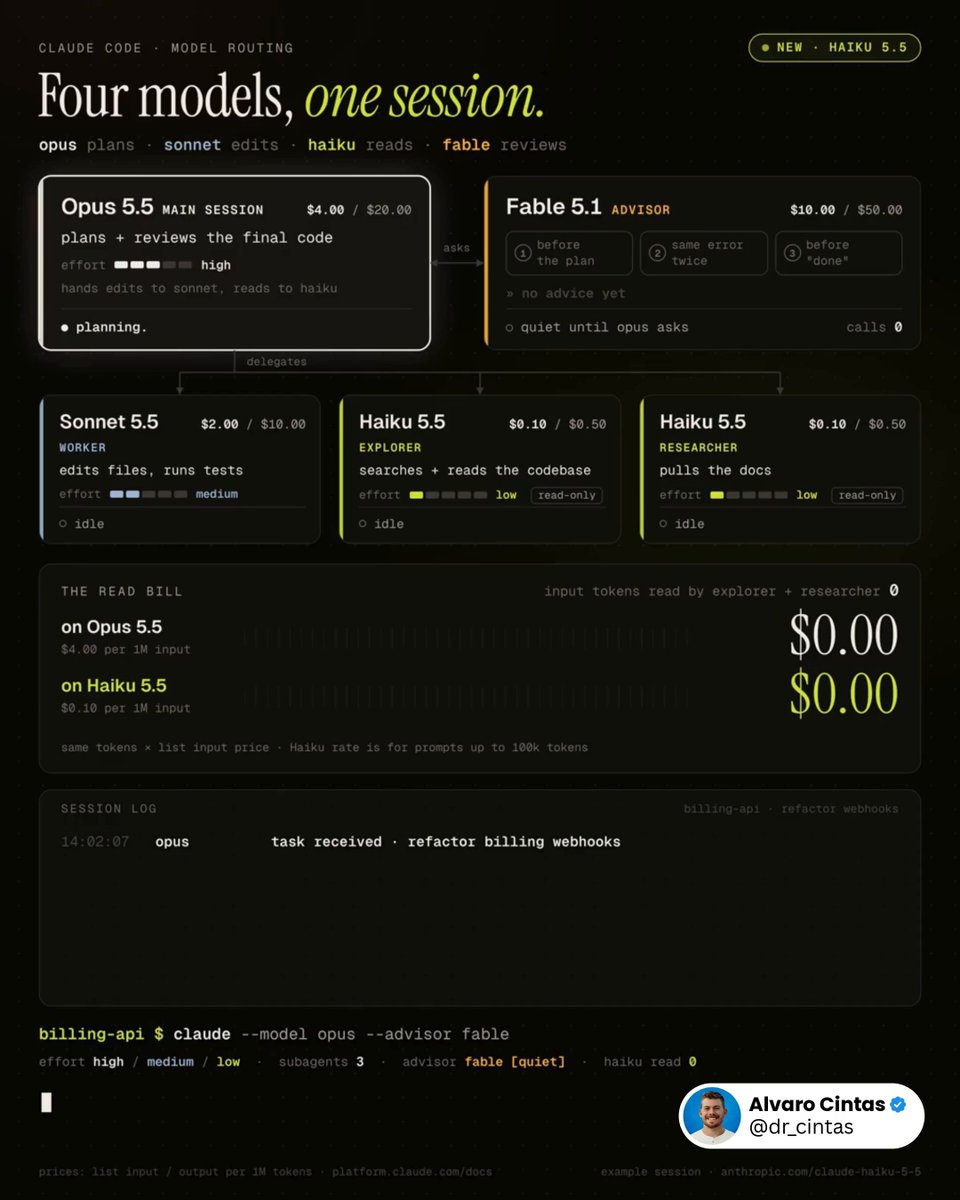
This workflow will save you thousands with Claude. Run Opus 5.5, Sonnet 5.5, Haiku 5.5, and Fable 5.1 together, and stop spending Opus tokens on work that doesn't need Opus. The entire idea in one line: Opus plans, Sonnet edits, Haiku reads, Fable reviews at decision points. Roles, broken down: - Opus 5.5, high effort, owns the plan and reviews the final code - Sonnet 5.5, medium effort, is the worker: edits files, runs tests - Haiku 5.5, low effort, splits into explorer (searches and reads the codebase) and researcher (pulls docs). it's the first Haiku with an effort setting - Fable 5.1, set with /advisor fable. Opus calls it at decision points, and it gets the full transcript each time Three moments Opus tends to call it: → before committing to a plan: is this the right approach? → the same error shows up again: is this going nowhere? → before marking the task done: did something get skipped? Why Haiku only reads: Anthropic's launch post says Sonnet 5.5 and Opus 5.5 are still the better choice for complex agentic coding (Terminal-Bench 4.0: 39.2% for Haiku 5.5, 70.6% for Sonnet 5.5) and that Haiku 5.5 fits narrowly scoped subagent work. so it gets the lookups, not the edits. Anyone still running one model for everything is paying $4 per million input tokens to check whether a file exists. Haiku 5.5 does it for $0.10. Drop this into Claude Code 👇 "Rebuild my Claude Code setup around this structure: Confirm Claude Code is v2.1.293 or later, so the haiku alias resolves to Haiku 5.5. If it isn't, stop and tell me to run claude update. Look through ~/.claude/agents and .claude/agents for subagents already covering explorer, worker, and researcher. Only create new ones for roles that are missing. Set model: haiku, effort: low on explorer and researcher, with no Edit or Write tools. Set model: sonnet, effort: medium on worker. If an existing subagent is locked to a different model, leave it as is and just list it. Name the explorer subagent Explore so it overrides the built-in one, which otherwise runs on my main model. In ~/.claude/settings.json, set advisorModel to fable, and set effortLevel to high for claude-opus-5-5 under modelSettings. A top-level effortLevel in user settings doesn't apply to Opus 5.5. Check for anything disabling the advisor: CLAUDE_CODE_DISABLE_ADVISOR_TOOL, DISABLE_TELEMETRY, or anything blocking feature-flag fetches. Also check CLAUDE_CODE_EFFORT_LEVEL, which overrides subagent effort settings, and CLAUDE_CODE_SUBAGENT_MODEL_FORCE, which makes Claude Code ignore subagent model fields. Report what you find. Don't change any of it yet. Add one line to ~/.claude/CLAUDE.md: consult the advisor before a big plan, when the same error shows up twice, and before marking a long task done. Show every change as a diff first. Wait for my go-ahead before touching anything."

Alvaro Cintas

57,940 次观看 • 26 天前

THIS IS A PURE F*CKING GOLDMINE Anthropic just shared one of the best tricks for Claude Code. The idea: keep one expensive brain and make everything else cheap. Opus 5.5 thinks, Haiku 5.5 does the grunt work, and your bill drops 79%. Same task, two ways: all-Opus would have cost $1.13. This run cost $0.23. You just launch Claude Code like this: claude --model opus # agents: model: haiku here's the split: → Opus 5.5 plans, decides and reviews, and burns 40k tokens for $0.21 → 12 Haiku 5.5 agents fan out across read, grep and test lanes → those 12 agents chew through 180k tokens for $0.02 → Opus never reads raw agent output, only 3 summaries at 6k tokens the part most people get wrong: they let the expensive model do the reading. Haiku is 40x cheaper per token. mapping 48 files cost $0.009. doing that on Opus is where the whole budget goes. one catch worth knowing: past 100k of context Haiku jumps to 5x its own price, so every agent is kept under 100k on purpose. that is the whole design. the brain stays small and expensive, the hands stay huge and cheap, and nothing raw ever crosses between them. Opus plans. Haiku reads. Opus reviews. JEV engineering is the same move one layer down: 1,301 forks this run - which file, which agent, retry or stop - resolved in code at 0.90 sharpness, and only the split ones (0.48 on "which agent") ever reach Opus the full tree > Opus 5.5 runs the main session, plans the lanes and decides what happens next > 12 Haiku 5.5 agents fan out across read, grep and test, each kept under 100k context > every agent returns a summary, never raw files or logs > Opus 5.5 reads 3 summaries at 6k tokens and reviews the result > JEV resolves 1,301 micro-forks in code and escalates only the split ones paste the tree and this prompt into Claude Code ↓ "Rebuild my Claude Code setup around this tree: 1. Run the main session on Opus 5.5 for planning, decisions and review only. 2. Set every subagent to Haiku 5.5 and fan the grunt work out across read, grep and test lanes. 3. Keep each agent under 100k of context, split the work further if it goes over. 4. Agents return summaries only, raw files and logs never enter the main session. 5. Add one rule to CLAUDE.md: if a task is reading, searching or running tests, it never runs on Opus. Route deterministic forks (file choice, agent choice, retries) through JEV. Show me every change as a diff first. No edits until I say go." ↳ save it, it'll come in handy.

Sprytix

18,190 次观看 • 11 天前

Official Anthropic tip for Claude Code: stop burning Opus 5.5 on work Sonnet 5.5 can do, while Fable 5.1 sits idle hand the grunt work to Sonnet 5.5 subagents and put Fable 5.1 on call run /advisor fable Opus 5.5 plans and merges Sonnet 5.5 subagents read, edit and run the tests Fable 5.1 reads the full session and only speaks up at three points: → before a plan: is this the right approach? → when the same error comes back: am I digging in the wrong place? → before "done": what did I miss? Sonnet 5.5 builds. Fable 5.1 reviews. Opus 5.5 ships Jev engineering is the same move one layer down: the forks that need no thinker (which file, which tool, retry or stop) go to Jev in under half a second, and the big models only see the ones that split - the full tree > Opus 5.5 on high runs the main session > explorer reads the code on Sonnet 5.5 > worker edits and runs tests on Sonnet 5.5 > researcher pulls the docs on Sonnet 5.5 > all three on medium > Fable 5.1 on call for main and every subagent paste the tree and this prompt into Claude Code ↓ "Rebuild my Claude Code setup around this tree: 1. Check ~/.claude/agents and .claude/agents for subagents that already fit explorer, worker and researcher. > Draft new ones only for missing roles > Give each model: sonnet, effort: medium > Skip any that pin a different model and list them 2. Set the main session to high via effortLevel in ~/.claude/settings.json, and set advisorModel to fable 3. Find anything that keeps the advisor off (CLAUDE_CODE_DISABLE_ADVISOR_TOOL, DISABLE_TELEMETRY) plus CLAUDE_CODE_EFFORT_LEVEL, which overrides subagent effort. Report them, change nothing 4. Add one rule to ~/.claude/CLAUDE.md: consult the advisor before a large plan, when an error repeats, and before calling a long task done Show me every change as a diff first. No edits until I say go." ↳

delost

44,284 次观看 • 1 个月前

Why is no one talking about this? Official Anthropic recommendation for Claude Code: stop wasting Opus 5.5 compute on tasks Haiku 5.5 can swarm, while Sonnet 5.5 handles core development. switch the architect model into standby using /advisor claude -> advisor opus -> subagents haiku Sonnet 5.5 powers the main workflow at maximum effort, drafting code changes and executing test suites Haiku 5.5 subagents index the repository in parallel at 340 tokens/sec, discovering files and reviewing technical documentation Opus 5.5 remains on standby as an expert consultant, stepping in only during three key scenarios: -> prior to committing to a strategy: does the blueprint lack authentication edge cases or schema rules? -> when a test fails repeatedly: are we tackling the root issue or wasting time in a rabbit hole? -> before marking the task complete: did recent diffs introduce silent bugs, and are baseline checks satisfied? Opus 5.5 assesses. Sonnet 5.5 builds. Haiku 5.5 executes concurrently Jev engineering applies this identical structure one level down: automated logic requiring zero reasoning (selecting files, invoking tools, retrying or cancelling) completes in 16ms, so heavy models trigger only when execution paths split Plan at max power. Delegate at mid power. Keep Opus on standby On-call Opus 5.5 inspects overall session history and catches deep structural flaws Lead Sonnet 5.5 performs edits, writes core logic, and manages test environments Haiku 5.5 subagents run AST parsing, grep queries, and API doc analysis concurrently JEV micro-fork layer processes 1,500+ routing rules in under 16ms Expert model stays silent during basic terminal commands to preserve context window Configure my Claude Code workspace for hierarchical advisor orchestration: 1. Verify ~/.claude/settings.json and project-level configs for model role alignment (main, subagents, and advisor) Set main session model: sonnet with high effort level for primary execution Set subagents model: haiku with effortLevel: medium for parallel file discovery and doc gathering Set advisor model: opus on call for high-level analysis 2. Turn on the advisor tool inside ~/.claude/settings.json: Define advisorModel as claude-opus-5-5 Enable subagent parallel dispatcher pool (3x workers) 3. Establish automatic advisor review checkpoints in ~/.claude/CLAUDE.md: Call /advisor opus prior to finalizing multi-file architectural changes Trigger /advisor opus automatically whenever the same compiler or test error happens twice Require an advisor diff contract audit prior to completing tasks or staging git commits 4. Restrict subagent execution boundaries: Haiku subagents must return only structured AST summaries and doc snippets without bloating the primary session context Display all configuration diffs before applying changes. Do not commit modifications until confirmed

Bober_smart

17,652 次观看 • 23 天前

THIS IS ACTUAL F*CKING GOLD Anthropic just shared one of the best tricks for Claude Code. The idea: stop treating Claude like one worker. Make Opus 5.5 a commander and give it 12 agents in 4 squads. Same release, two ways: Opus alone was 2% through on one thread. The command center shipped the whole v2.0 in 2 minutes on 12 threads. You just launch Claude Code like this: claude --model opus --command-center 12 "ship v2.0" here's the split: → Opus 5.5 turns "ship v2.0" into 12 tasks across 4 squads → CODE and OPS squads run on Sonnet 5.5, TEST and DOCS on Haiku 5.5 → every agent reports back in one line, never raw logs → Opus only wakes up when something breaks or needs approval the part most people get wrong: the commander watches everything. read 12 agent transcripts and your expensive model becomes the slowest part of the room. here the commander stays at 8k of context the entire run. it plans, it waits, it reads 12 one-line reports, it opens the release gate. REA sits underneath on anything legacy: before a squad touches old code, REA reverse-engineers it into a spec, so agents build from the spec and never from 500 files nobody understands. Opus commands. Sonnet builds. Haiku checks. REA explains the old code. JEV engineering is the same move one layer down: the forks that need no thinker (which squad, which model, retry or stop) go to JEV in milliseconds, and the commander only sees the ones that actually split the full tree > Opus 5.5 runs as commander, splits the mission into tasks and squads > CODE squad on Sonnet 5.5 writes endpoints, refactors auth, migrates the db > TEST squad on Haiku 5.5 runs unit, e2e and load tests > DOCS squad on Haiku 5.5 writes changelog, api docs and release notes OPS squad on Sonnet 5.5 handles staging, health checks and canary rollout REA reverse-engineers any legacy module into a spec before a squad touches it every agent reports one line, the commander never reads raw output Opus 5.5 holds the release gate and waits for all 12 reports JEV routes micro-forks in milliseconds paste the tree and this prompt into Claude Code ↓ "Rebuild my Claude Code setup around this tree: 1. Run the main session on Opus 5.5 as a commander: it plans, assigns and approves, it never writes code. 2. Split work into 4 squads: CODE and OPS on Sonnet 5.5, TEST and DOCS on Haiku 5.5, 12 agents total. 3. Every agent reports a one-line structured result. Raw logs never enter the main session. 4. Before any squad touches legacy code, run REA on it first and have the squad build from the spec, not the old files. 5. Add one rule to CLAUDE.md: nothing ships until every squad has reported and the commander opens the release gate. 6. Route deterministic forks (squad choice, model choice, retries) through JEV. Show me every change as a diff first. No edits until I say go." ↳ save it, you'll use this on every release from now on.

Sprytix

132,535 次观看 • 15 天前

THIS IS STRAIGHT F*CKING GOLD Anthropic just shared one of the best tricks for Claude Code. The idea: one knob with five settings, and almost nobody ever moves it. Every routine turn runs at the same effort as your hardest decision, and you pay for thinking you never read. You just start Claude Code like this: claude --model opus --effort low here's the split: → low runs the routine turns, renames, imports, fixtures, formatting → /effort xhigh the moment an actual decision shows up → every subagent carries its own effort line in its frontmatter → you stop paying Opus 5.5 to think about which file to open you only climb the ladder at three moments: → before a plan that touches a lot of files → when the same bug survives two fixes → before a release you cannot roll back Low for the routine. High for the fork. Max for the rescue. JEV engineering is the same move one layer down: the forks that need no thinker (which file, which tool, retry or stop) go to JEV in milliseconds with zero thinking tokens, and the big models only see the ones that split the full tree > Opus 5.5 runs the main session at low effort > /effort xhigh the moment a real decision shows up, then back down > search runs on Haiku 5.5 with effort: low in its frontmatter > review runs on Sonnet 5.5 with effort: high in its frontmatter > every skill carries its own effort line, so the level follows the task > JEV routes micro-forks in milliseconds and thinks about none of them paste the tree and this prompt into Claude Code ↓ "Rebuild my Claude Code setup around this tree: 1. Run the main session on Opus 5.5 at low effort. 2. Set effort: low on every read-only subagent and effort: high on the review subagent. 3. Add one rule to CLAUDE.md: stay at low, climb to xhigh only before a multi-file plan, after the same error twice, and before an irreversible change, then drop back. 4. Route fast deterministic forks (tool choice, path selection, retries) through JEV. Show me every change as a diff first. No edits until I say go" ↳ save it, it'll come in handy.

delost

19,355 次观看 • 17 天前

holy sh*t. Official Anthropic tip for Claude Code: stop burning Opus 5.5 context on tasks Haiku 5.5 can swarm, while Sonnet 5 builds put the architect on call with /advisor claude --model sonnet --advisor opus Sonnet 5 drives the primary session on high effort, writing diffs and running test suites Haiku 5.5 subagents swarm the repo in parallel, handling file discovery and spec docs lookup Opus 5.5 stays on call in the background as the advisor, only stepping in at three critical moments: → before a plan locks: does the implementation plan miss auth invariants or schema contracts? → when a test breaks twice: are we fixing the root cause or falling into a recursive rabbit hole? → before calling done: did the full diff introduce hidden regressions or break pre-flight rules? Opus 5.5 reviews. Sonnet 5 builds. Haiku 5.5 swarms Jev engineering runs the identical pattern one layer down: mechanical decisions that need no reasoning (which file to open, which tool to invoke, retry or abort) resolve in milliseconds, so the frontier models only wake up when execution paths actually diverge Plan on high. Delegate to Haiku. Keep Opus on call. - the full advisor setup > Opus 5.5 on call reads the full session transcript and catches deep architectural traps > Sonnet 5 lead drives edits, writes core logic, and executes test harnesses > Haiku 5.5 subagents swarm grep scans, file discovery, and API docs in parallel > subagents inherit the advisor automatically, no extra config > toggling the advisor mid-session never invalidates the prompt cache paste the setup and this prompt into Claude Code below: "Configure my Claude Code workspace for hierarchical advisor orchestration: 1. Audit ~/.claude/settings.json and project config for model roles fitting lead, subagents, and advisor: > Pin main session model: sonnet with effortLevel: high for primary execution > Pin subagents to model: haiku in ~/.claude/agents for parallel file discovery and docs retrieval > Pin advisorModel: opus for strategic review 2. Draft read-only subagent definitions in ~/.claude/agents: > file-search and docs-lookup, model: haiku, read-only tools > return structured summaries and docs snippets only, never edit > skip any that already exist and list them 3. Configure advisor consultation checkpoints in ~/.claude/CLAUDE.md: > Consult the advisor before finalizing multi-file architecture plans > Consult the advisor when the same test or compiler error fails twice > Consult the advisor for a diff audit before declaring tasks complete or staging git commits 4. Find anything that would override this setup: > CLAUDE_CODE_SUBAGENT_MODEL, CLAUDE_CODE_DISABLE_ADVISOR_TOOL, CLAUDE_CODE_EFFORT_LEVEL > Report it, change nothing Show every configuration diff first. Do not apply edits until confirmed" ↳

delost

17,319 次观看 • 24 天前