Skip navigation
This workflow will save you thousands with Claude.
0:00 / 0:21

This workflow will save you thousands with Claude.

Alvaro Cintas

@dr_cintas133K followers

Visit on X
630 likesDownloadOriginal post

58,613 views

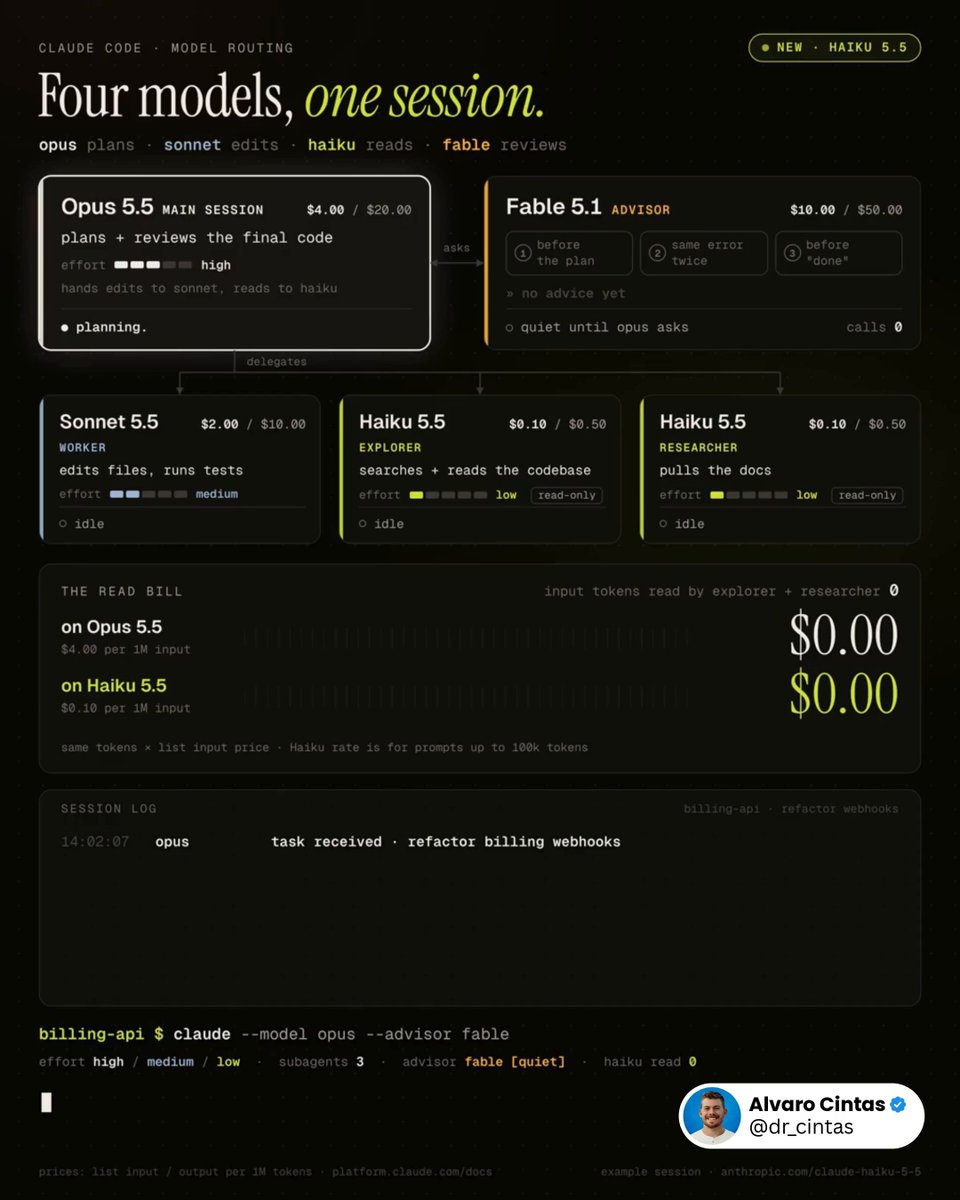
This workflow will save you thousands with Claude. Run Opus 5.5, Sonnet 5.5, Haiku 5.5, and Fable 5.1 together, and stop spending Opus tokens on work that doesn't need Opus. The entire idea in one line: Opus plans, Sonnet edits, Haiku reads, Fable reviews at decision points. Roles, broken down: - Opus 5.5, high effort, owns the plan and reviews the final code - Sonnet 5.5, medium effort, is the worker: edits files, runs tests - Haiku 5.5, low effort, splits into explorer (searches and reads the codebase) and researcher (pulls docs). it's the first Haiku with an effort setting - Fable 5.1, set with /advisor fable. Opus calls it at decision points, and it gets the full transcript each time Three moments Opus tends to call it: → before committing to a plan: is this the right approach? → the same error shows up again: is this going nowhere? → before marking the task done: did something get skipped? Why Haiku only reads: Anthropic's launch post says Sonnet 5.5 and Opus 5.5 are still the better choice for complex agentic coding (Terminal-Bench 4.0: 39.2% for Haiku 5.5, 70.6% for Sonnet 5.5) and that Haiku 5.5 fits narrowly scoped subagent work. so it gets the lookups, not the edits. Anyone still running one model for everything is paying $4 per million input tokens to check whether a file exists. Haiku 5.5 does it for $0.10. Drop this into Claude Code 👇 "Rebuild my Claude Code setup around this structure: Confirm Claude Code is v2.1.293 or later, so the haiku alias resolves to Haiku 5.5. If it isn't, stop and tell me to run claude update. Look through ~/.claude/agents and .claude/agents for subagents already covering explorer, worker, and researcher. Only create new ones for roles that are missing. Set model: haiku, effort: low on explorer and researcher, with no Edit or Write tools. Set model: sonnet, effort: medium on worker. If an existing subagent is locked to a different model, leave it as is and just list it. Name the explorer subagent Explore so it overrides the built-in one, which otherwise runs on my main model. In ~/.claude/settings.json, set advisorModel to fable, and set effortLevel to high for claude-opus-5-5 under modelSettings. A top-level effortLevel in user settings doesn't apply to Opus 5.5. Check for anything disabling the advisor: CLAUDE_CODE_DISABLE_ADVISOR_TOOL, DISABLE_TELEMETRY, or anything blocking feature-flag fetches. Also check CLAUDE_CODE_EFFORT_LEVEL, which overrides subagent effort settings, and CLAUDE_CODE_SUBAGENT_MODEL_FORCE, which makes Claude Code ignore subagent model fields. Report what you find. Don't change any of it yet. Add one line to ~/.claude/CLAUDE.md: consult the advisor before a big plan, when the same error shows up twice, and before marking a long task done. Show every change as a diff first. Wait for my go-ahead before touching anything."

14 Comments

Comments from the original post on X (Twitter)

  • Alvaro Cintas's profile picture

    @dr_cintas

    Follow me for more AI tips and workflows. You can also access all my courses and guides here:

    2 likes

  • Martin Ronfort's profile picture

    @RonfortMartin

    We actually went deeper on the efficiency of this new model here:

  • Lank's profile picture

    @LankC11

    Naming the explorer Explore so it overrides the built-in one is the line people will skip. Without it every file search still runs on Opus.

  • Deep's profile picture

    @deeponailabs

    your handoff drops details when you pass only the plan

  • La Voix du Chat Artiste's profile picture

    @42s_video

    In fact this is marketing because in the future Haiku’s model will be capable of all of that

  • airplanestar 𓂀's profile picture

    @airplanestar_

    The savings come from matching model effort to the task, not downgrading everything. Opus for the hard calls, lighter models for the repeatable steps. The tricky part is knowing when to escalate before a cheap miss gets expensive lol

  • why's profile picture

    @NullContex1s

    The interesting part is the routing, not just running more models. Keeping Opus focused on planning should cut both cost and latency.

  • Karan Jagtiani's profile picture

    @karanjagtiani04

    The split only pays off if something checks what the cheaper model built. Without a test run or a diff review between Sonnet's output and Opus's sign-off, the tokens you saved come back as rework.

  • Retropunk's profile picture

    @RetropunkAI

    This sounds cool, but have you personally done any A/B testing? ClaudeDevs Egg Drop animation is cool but I trust the community more.

  • 安叫兽|Bird🕊️ 🔶 BNB's profile picture

    @ajs6888

    分工挺细,就怕省下的时间全花在协调上了

  • Zook's profile picture

    @zook_data

    Hello, I am doubtful. I think the shattering of the context window into pieces could reduce performance. Would love to see an A/B test of your setup against lone Opus 5.5 .

  • The QM's profile picture

    @_quanta_

    I'm much more of a stickler about when words are importantly grouped, so I'd do this line (as an example), with the single quotes: Set `model: sonnet`, `effort: medium` on worker. Syntax parsing is done in the early layers of an LLM, so if it gets those wrong, it cascades.

  • Odera Joseph's profile picture

    @oderajoseph

    Opus plans, Haiku does the busywork. saving Opus tokens for the tricky stuff is the move

  • Artzy's profile picture

    @heyartzy

    having a dedicated advisor model is a smart touch