Video wird geladen...

Video konnte nicht geladen werden

Zur Startseite

This looks like another step toward removing the data bottleneck in robotics. The bottleneck exists because recording demonstrations is easy, but labeling every grasp, hold, move, and release is slow and expensive. Perceptron Egocentric dropped a new robotics video annotation system. You give it raw robot-camera or first-person/egocentric video....

18,391 Aufrufe • vor 5 Tagen •via X (Twitter)

0 Kommentare

Keine Kommentare verfügbar

Kommentare vom Original-Post werden hier angezeigt

Ähnliche Videos

This work makes a humanoid robot do simple parkour moves by looking with a depth camera and choosing the right move on the fly. The big deal is that it turns lots of small human moves into long, real-time robot behavior, without hand-coding every transition or retraining for each new course. A humanoid robot is usually good at steady walking, but it often fails when it has to do fast moves like jumping up, vaulting, or rolling, and then keep going to the next obstacle. The hard part is that you cannot easily collect training data for every possible obstacle shape, distance, and mistake, so robots end up learning a few moves that only work in a narrow setup. This work starts from short clips of real human parkour moves, like stepping over, vaulting, climbing, and rolling. It uses motion matching, which is basically a smart “pick the next clip that fits best right now” search, to stitch those short clips into a long, smooth plan that looks like a human doing a whole course. Then it trains a controller with reinforcement learning (RL), which means the robot learns by trial and error to copy that plan while staying balanced and not falling. After training separate expert controllers for different moves, it compresses them into 1 controller that uses only onboard depth sensing and a simple “go this fast in this direction” command. In real tests on a Unitree G1 humanoid, it can clear multiple obstacles in a row, adapt when obstacles get moved, and climb a wall up to 1.25m.

Rohan Paul

37,121 Aufrufe • vor 4 Monaten

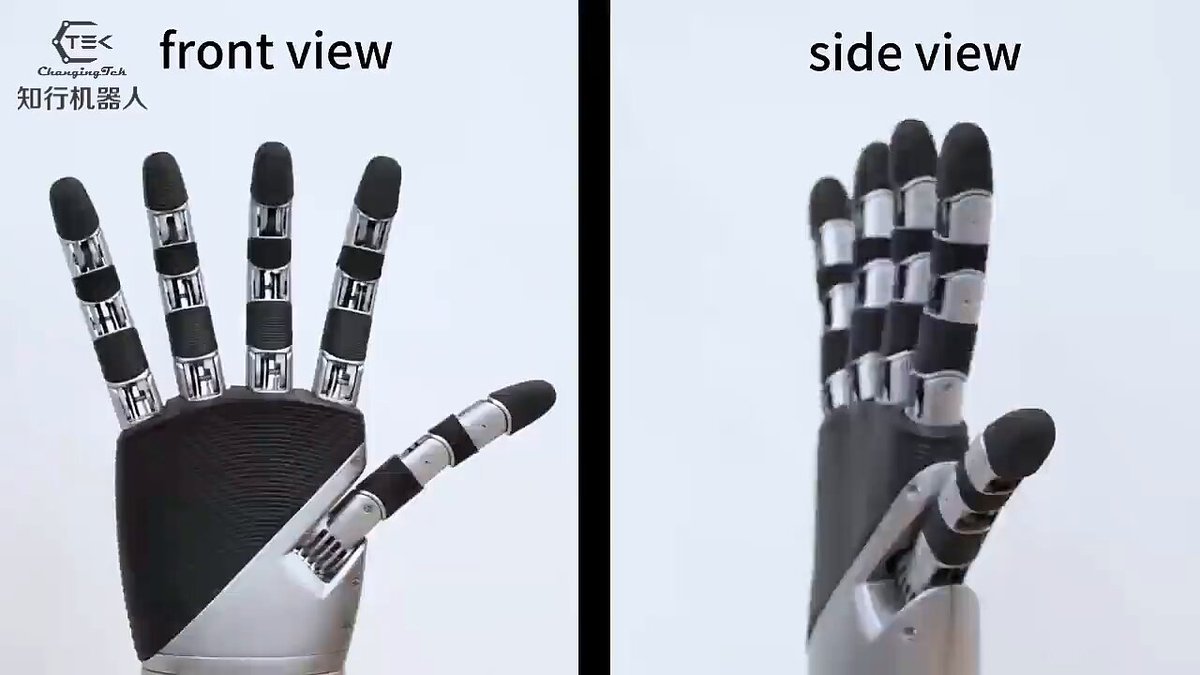
A policy that teaches robot hands to touch things the way humans do... not just grab and move, but feel and adjust in real time. Robot manipulation research often stops at picking up objects and placing them. CGP goes further: it handles tasks like opening jars, flipping objects in-hand, wiping dishes, and grasping fragile eggs, the kind of dexterous, contact-rich skills that require constant micro-adjustments based on what the fingers are actually feeling. The robot doesn't just see what it's doing; it predicts what contact should feel like at each step, then checks whether reality matches the prediction. If a finger is slipping, the policy knows before the object drops. Works on real robot hands (both 4-finger and 5-finger designs) with tactile sensors embedded in the fingertips Robust to visual distractions! The robot keeps flipping a box correctly even when the camera view is disrupted, because it's grounding decisions in touch, not just vision. Baseline policies without contact grounding fail in predictable ways: slipping mid-task, incomplete motions, loss of grasp, CGP avoids these This is a meaningful step toward robots that can handle the physical world with the kind of reliable, adaptive grip that humans take for granted. Relevant for manufacturing, logistics, assistive robotics, and anywhere fragile or irregular objects need to be handled carefully. Published at RSS 2026, developed with Meta Reality Labs Research. Thanks for sharing, Zhengtong Xu / Zhengtong Xu ——- Weekly robotics and AI insights. Subscribe free:

Ilir Aliu

12,769 Aufrufe • vor 1 Monat