Video yükleniyor...

Video Yüklenemedi

Ana Sayfaya Dön

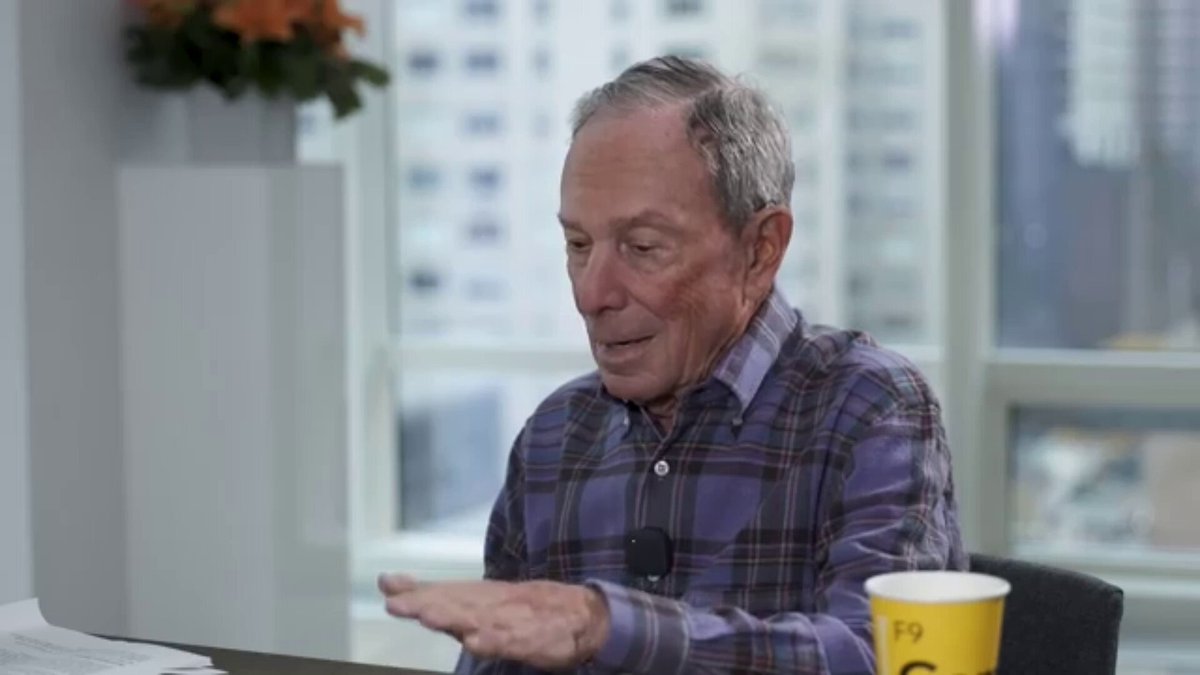
this pure masterclass from Yale professor explains investment banking, breaking down decades of studying financial crises and showing why pure investment banking was fundamentally destroyed in 2008 when Lehman Brothers collapsed after a massive bank run on repo markets, giants like Goldman Sachs and Morgan Stanley were forced to...

11,697 görüntüleme • 5 gün önce •via X (Twitter)

0 Yorum

Yorum bulunmuyor

Orijinal gönderinin yorumları burada görünecek

Benzer Videolar

From a Thai prison cell to a fintech empire processing $1.6B in international payments across 40+ banks and 250M+ users. Jonathan Low (Jonathan Low). Forbes 40 Under 40. Author of "Cell to CEO." We covered prison, banking for AI agents, RWA projects, the future of crypto in banking, vibe coding for trading, and the businesses that win the next 5 years. ⏱ Timestamps: 00:00:00 — Teaser 00:00:46 — Who is Jonathan Low 00:01:35 — What Jonathan's life was like before prison 00:02:13 — How and why Jonathan ended up in prison 00:02:57 — Prison conditions: expectations vs reality 00:07:33 — Prison became the greatest blessing 00:09:12 — How the entrepreneurial journey began after prison 00:10:34 — Why social capital matters 00:11:06 — Launched own club and took it to the top in 3 months 00:12:09 — Built an Axie Infinity gaming guild during COVID 00:13:49 — The beginning of the BipTap Group journey 00:17:23 — How Jonathan built his own banking system 00:20:07 — How to get a crypto card 00:22:03 — How much it costs to launch a white-label solution with BipTap 00:22:58 — Banking for AI agents 00:25:57 — How to build an RWA project 00:27:45 — Future of cryptocurrencies in banking 00:32:08 — The business verticals within Empire Group 00:32:48 — What Jonathan invests his money in 00:33:54 — How relationships with regulators are built 00:34:43 — Implementing AI in business 00:36:28 — Vibe coding in trading 00:40:06 — Advice for first-time founders 00:43:36 — From construction to trading: Ruslan Khairullin's journey 00:44:57 — Inner peace: why calmness is essential for founders 00:50:39 — Work-life balance for entrepreneurs 00:53:47 — $1.5 million in 24 hours on TST coin 00:55:11 — The best way to capture a market 00:55:57 — Banking for nations Watch the full conversation and let me know which part you liked the most 👇

Ruslan Khairullin

16,872 görüntüleme • 2 ay önce

MORE EXECUTIVES JUMP SHIP FROM STANDARD BANK TO ABSA In March 2025, I published an article titled: “BANKING CEO JUMPS SHIP – POWER MOVE OR CAREER SUICIDE AT 54?” In that article, I laid out the full context, the risk, and the stakes of Kenny Fihla’s move from Standard Bank Group to Absa Group. What is unfolding now does not require reinterpretation or embellishment. It simply confirms that the framework was correct. Since Kenny Fihla’s departure, the following executives have also jumped ship: 1. Zaid Moola Former: Head of Global Markets and Corporate and Investment Banking (CIB), South Africa at Standard Bank Appointed: Chief Executive, Corporate and Investment Banking at Absa 2. Musa Motloung Former: Chief Risk Officer, Corporate and Investment Banking at Standard Bank Appointed: Group Strategic Risk Officer at Absa 3. Avikaar Ramphal Former: Portfolio Head of Strategy Enablement, Corporate and Investment Banking at Standard Bank Appointed: Head of Strategic Risk at Absa 4. Clive Potter Former: Head of Client Coverage, Corporate and Investment Banking, South Africa at Standard Bank Appointed: Managing Executive for Client Coverage at Absa 5. Francisco Khoza Former: Head of Legal at Standard Bank Appointed: Deputy General Group Counsel at Absa When I wrote that article, I was not reacting to headlines. I was tracing a pattern. I began by making one thing clear. This was not a routine leadership transition. Senior executives move all the time, but they do not usually walk away from certainty, succession, and institutional gravity at the exact moment when power is most secure. This move disrupted assumptions precisely because it did not follow the script. I then went further back. I reminded readers that Kenny Fihla’s career had never been defined by comfort or continuity. His defining moments had come in broken systems, in environments marked by instability, resistance, and pressure. From the public sector to banking, his credibility was built by stepping into dysfunction and restoring order, not by inheriting well-oiled machines. Later that year, at our Graduation and Year-End Celebration with the Global Board Directors’ Programme graduates, I was privileged enough to ask him that very question. And the man himself answered why. (Video attached.) What is emerging now is not just a story of people moving, but of direction being set. While Absa Group may be smaller than Standard Bank Group in sheer scale, the choices being made point to a bank that is becoming far more deliberate about where and how it grows. The emphasis on targeted African markets, disciplined expansion, and selective acquisitions suggests a strategy anchored in depth rather than sprawl. Recent transactions include the acquisition of Standard Chartered’s operations in Uganda and HSBC’s retail and business banking portfolio in Mauritius. Since Kenny Fihla took the helm, Absa’s share price has risen by 41 percent, outperforming the FTSE/JSE Banks Index, which gained 25 percent over the same period. This rally has lifted the group’s market capitalisation to approximately R219 billion, or $13.4 billion. Coupled with renewed market confidence and early signs of momentum, this feels less like a short-term rebound and more like the opening chapters of a longer institutional rebuild. Growth, in this context, is not being chased. It is being curated. As 2026 unfolds, I wish Kenny Fihla and the team forming around him continued wisdom, courage, and steadiness in execution. Building institutions is slow, often thankless work. But when done well, it reshapes markets, careers, and confidence far beyond balance sheets. More executives jump ship from Standard Bank to Absa... is this signalling a shift in africa’s banking sector? The work is underway. The continent is watching. #AskAsanteOnBoards

Asante Mokhuoa

67,722 görüntüleme • 7 ay önce

BREAKING: Inside Lead Bank - $56M Investment Now Worth $1.5 BILLION Jackie Reses is on an iconic run. Lead is the $1.5B tech-first bank powering Stripe, Walmart, Ramp, Affirm & Revolut Backed by Andreessen Horowitz, Coatue, Greycroft, ICONIQ, Khosla Ventures, Ribbit Capital, Zeev Partners, plus Larry Fink, Rob Goldstein & Larry Summers personally. CEO & Co-Founder Jackie Reses (Jackie Reses) We cover: - Sitting on Alibaba's board with Jack Ma, Joe Tsai + Masayoshi Son "Masa would come in & be like, 'Yes, it shall be blessed.'" - Taking an HR role at Yahoo, then turning it into Chief Development Officer - Jack Dorsey: "He'll sit in meetings & not say a word. There's real wisdom in his ability to 'just zip it.' " - Why she's skeptical of the de-banking narrative - Building Lead to $280M in revenue with no sales team 𝐓𝐈𝐌𝐄𝐒𝐓𝐀𝐌𝐏𝐒 (00:00) Jackie Reses, CEO of Lead Bank (01:06) The swiss army knife of Silicon Valley (02:46) Inside the Alibaba boardroom with Jack Ma and Masa (05:23) Being one of the only Americans on Alibaba’s board (10:29) What Jack Ma and Masayoshi Son are really like (12:32) The biggest lessons Jackie learned from Alibaba (15:12) From Goldman Sachs to Silicon Valley (17:44) Why Yahoo hired a PE investor to run HR (22:53) Yahoo was a hot mess (25:33) The deal that recovered billions for Yahoo (26:31) How Jack Dorsey recruited Jackie to Square (29:53) Three engineers, three days, one crypto platform (33:51) What Jack Dorsey is really like (36:13) Being Jack Dorsey’s HR lead during Twitter chaos (40:03) How to spot real innovation vs hype (42:21) Why debanking is a myth (48:10) Why buy a 100 year old bank (51:23) Growing a bank with no sales team (54:11) The APIs powering the future of finance (56:03) How AI is transforming banking (57:07) The JD Vance connection (58:39) What it feels like inside the White House (01:02:53) The biggest misconception about government (01:04:21) Why Lead Bank’s culture feels different (01:05:35) The next chapter for Lead Bank

Molly O’Shea

338,131 görüntüleme • 3 ay önce

The Iraqi Dinar: IQD is on the Brink of Something Massive! 🇮🇶✈️ The economic rails are officially being laid down in Iraq, and if you understand how central banking works, all signs point to a major shift on the horizon. Here is why the setup for the Iraqi Dinar (IQD) is looking incredibly bullish right now: * The Ultimate Digital Leap 📱: Iraq is moving to go fully digital with its banking system. While major Western nations are still stuck in the "research phase" of central bank digital currencies, Iraq is aggressively pushing forward to modernize its financial rails. * Massive Banking Reforms 🏦: The U.S. Treasury has issued strict mandates to clean up corruption, update core banking systems, and bring Iraq into full international compliance (AML/BSA compliance). The country is quickly transitioning away from outdated paper processes into 21st-century infrastructure. * Insane Asset Value 🛢️: Iraq holds some of the largest oil reserves on the planet with some of the lowest extraction costs globally. On top of that, the Central Bank of Iraq has been aggressively stockpiling massive gold reserves and U.S. Treasury securities to heavily back and underpin the true value of its currency. * Rock-Solid Economics 📈: Despite regional challenges, Iraq has maintained a remarkably stable 3% inflation rate. This proves that the country has intentionally executed strategic monetary policies to protect its purchasing power, rather than suffering from hyperinflation. * The Crypto Connection ⛓️: Sophisticated investors are tracking a heavy correlation between these central banking overhauls and compliance structures like ISO 20022. Infrastructure improvements are quietly moving in tandem with digital asset utilities like XRP, setting up massive future liquidity plays. The Bottom Line: You don’t buy into an investment when everyone is yelling about it in a state of euphoria—you get positioned quietly while the pipes are being laid. The groundwork is nearly finished. Once the infrastructure is entirely set, it is just a matter of turning on the spigot.

GP Q

30,857 görüntüleme • 2 ay önce

Insight into why Israel has a leash on Trump (IMO) "In the early '90s...Trump... declares bankruptcy... he's bailed out by Wilbur Ross... representing the Rothschild banking interests... the Rothschild family has a very long... history with Zionism and... the State of Israel." This clip of Whitney Webb (Whitney Webb), author of One Nation Under Blackmail and contributing editor of unlimitedhangout(.)com, is taken from an interview with Kim Iversen (Kim Iversen 🇺🇸) posted to Rumble on August 6, 2025. ----------------Partial transcription of clip-------------- "And then in the early '90s, Trump's Atlantic City holdings, and other things, dragged down his business empire. And he declares bankruptcy, and in order to be bailed out, he's bailed out by, Wilbur Ross, who he later rewards for that when he's president, the first time making him Commerce Secretary. "But at the time, Wilbur Ross was representing the Rothschild banking interests. And the Rothschild banking interest, specifically this Wall Street M and A arm that they opened up in the '80s was responsible for bringing Robert Maxwell to New York. "So basically, you know, Trump as a business icon would not have existed beyond the early 1990s if it wasn't for the, Rothschild banking interests, who have a lot of affiliations to people and sort of, the Epstein network, and specifically Epstein's financial crimes, which include a lot of currency speculation in this, what the New York Times once called a currency speculation cabal, including people like Jimmy Goldsmith, also backed by the Rothschilds, and even George Soros, whose first, his Quantum Fund in, like, the late '60s was bankrolled by the French Rothschild interests. "And for anyone that's familiar, the Rothschild family has a very, long and storied history with Zionism and the establishment of the State of Israel and and being a major patron of that. So, you know, they've definitely had a lot of influence, I would think, over, Trump now, since he owes them a lot."

Sense Receptor

121,450 görüntüleme • 1 yıl önce