Video wird geladen...

Video konnte nicht geladen werden

Zur Startseite

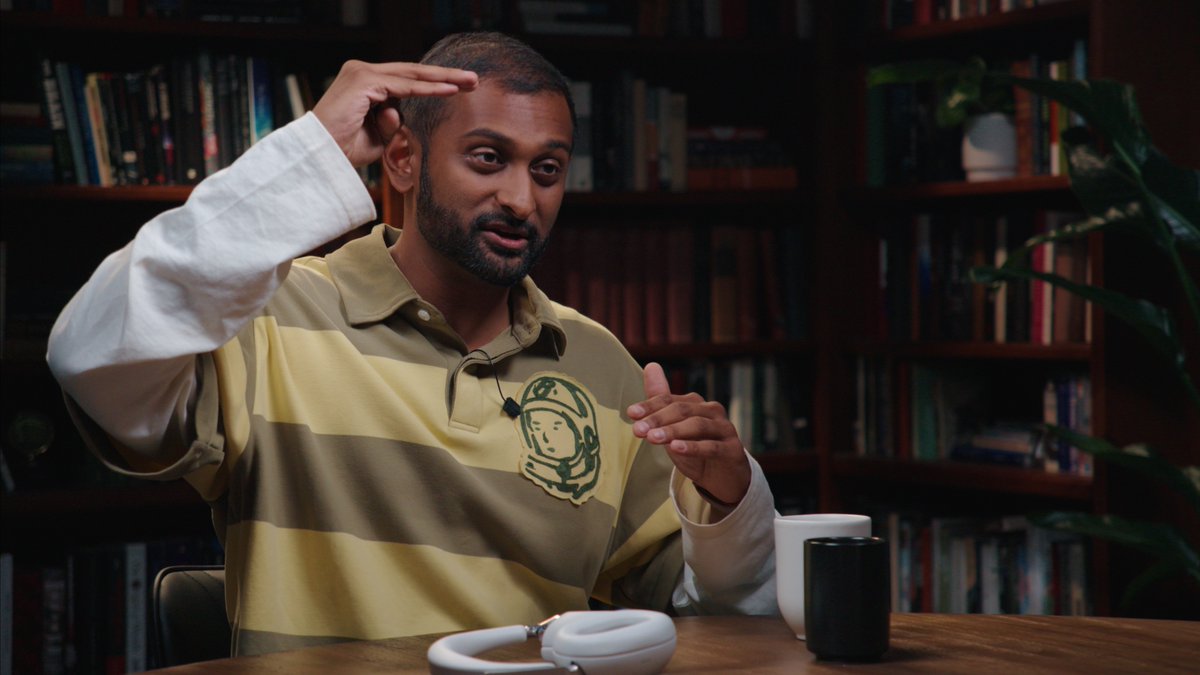
Three years ago, two Harvard dropouts set out to build a better AI chip than the largest companies in the world. Almost everyone I called at the time said it was impossible. Today, Etched (Etched) comes out of stealth with $800M total raised, $1B in signed customer contracts, and...

1,314,149 Aufrufe • vor 10 Tagen •via X (Twitter)

0 Kommentare

Keine Kommentare verfügbar

Kommentare vom Original-Post werden hier angezeigt

Ähnliche Videos

Wolfgang Hammer helps founders and CEOs, at both startups and massive fortune 100 companies, use storytelling to better understand what they do, and why it matters. In many ways, this conversation is a manual for how to find that story and communicate it in a way that resonates. Wolfgang (Wolfgang Hammer) is a film producer and executive who helped create House of Cards and ran several major studios. He’s now building a new kind of film studio with support from Mitch Lasky and Marc Andreessen. We talk about how stories work, what great ones have in common, and why understanding your own story can be transformative. Wolfgang explains the three layers every story must have — the external, the emotional, and the philosophical — and how they apply to building companies and leading people. So many CEOs have Wolfgang to thank for changing how they think and talk about their business, and I hope this episode gives you the tools to do the same. Enjoy! Timestamps: 00:00 Intro 02:50 The Three Layers of Story 04:44 Prompts for the Three Layers 05:54 Why Companies Struggle to Tell Their Story 08:11 The 80/20 Rule: Familiar vs. New 10:17 Suspense from Minimal New Information 11:16 Understanding the Customer's Story First 14:07 What CEOs Can Learn From Filmmakers 15:30 The CEO's Job: Master Communicator 17:12 The Definition of an Iconic Character 18:23 All Stories Are About Death 19:20 Two Kinds of Stories: Desire Fulfilled or Anxiety Purged 21:09 Story as an Ultimate Concern 23:31 Deconstructing Great Stories 26:25 The Relentless Role of Status 30:57 The Story So Big It Terrifies You 32:29 Inner Conflict: The Heart vs. Itself 35:06 A Unified Theory of Storytelling 36:09 The Two Core Truths 38:15 Kindest Thing

Patrick OShaughnessy

593,158 Aufrufe • vor 8 Monaten

Etched is deploying two new technologies in chip design: low-voltage inference and cluster-scale memory. CEO Gavin Uberti says they'll make their chips much more power-efficient and way, way faster than today's leading GPUs. He breaks it down: "We looked at a lot of early research directions, and we realized the key things that models need are way more compute and way faster memory." "If you think about inference, there are two key parts: prefill and decode. For prefill, it's a compute-bound problem. You need to have more FLOPS, more operations per second on each of your chips." "On our GPU, the bottleneck's actually thermals. You can't really run a GPU at more than around 50% of what it could theoretically do, or it'll melt." "So we're using a new technology today called low-voltage inference to try to solve this problem. You bring the voltage of the chip down dramatically, which allows us to have way, way better efficiency in terms of how much power is drawn per unit of math, and thus fit way way more flops onto the chip..." "For decode, it's all about bandwidth. Not just bandwidth on a chip, but bandwidth across your cluster. That's why we have this technology we call cluster-scale memory. It reduces the amount of time it takes to communicate from one chip to another dramatically." "As a result we can go use all of our HBM, HBM bandwidth, SRAM, SRAM bandwidth, and our scale-up domain as a single coherent pool. And that means if you're a user, you can go get much faster tokens per second, while still keeping your costs low."

TBPN

20,404 Aufrufe • vor 10 Tagen

From Eric Vishria on how the top AI founders are building products completely opposite of the SaaS era: "One of the things that is really different in the AI world versus the SaaS world, is that in the SaaS world, over and over again, you had people who really understood the customer. And the problem. And then they understood a domain. They understood what the technology was more or less capable of. But it wasn't a real question of if you could build something or not. For example, take Salesforce, Workday, and ServiceNow. CRM existed before Salesforce. HR management existed before Workday. Same thing with ServiceNow. So in every case, Salesforce followed Siebel. Workday followed Peoplesoft. ServiceNow followed Peregrine and Remedy, and others. So they were just kind of, cloud SaaS versions of the prior generation product. They just understood the customers. They understood the problem. And they were just like, here's a better version. And that evolved a little bit over time in SaaS land. But that's what it is. And so product development in that way was done by people who really understood the customer and the problems. And then just took advantage of the next wave. And this is almost diametrically opposite of product development in the AI era. When I look at the teams that are having the most success today, they have intimate knowledge of the models. They are right on the frontier of understanding which models are better at what, and why, and when. And what they're going to be good at and what they're not going to be good at. And what they're spending their time on, is figuring out how do I apply this capability of this model to this domain or to this user. So they're actually working inside out or technology out, versus customer problem in. And of course, they understand the customer problem. And a lot of times they have firsthand knowledge of it. But they're really close to the metal and capability, and they're applying it. And I think this is a really different way to develop products than in SaaS. I started my career as a product manager a long time ago, and it's almost the complete opposite of everything you learned. "Listen to the customer, understand it, then bring it back to the engineering and product teams." If you did that right now, ask a bunch of customers what they want out of AI, and you brought it back, for the most part, it may not be possible today with today's technology. Whereas the teams that are winning right now really understand the technology and are applying it out. And so I think this reversal matters. I think it's a big difference in terms of how companies are getting built. And maybe even the types of entrepreneurs that will be successful. I'm not sure. You're seeing some real change there. Look at the Bret Taylor's at Sierra. That's a super, super technical founder who really gets it. Brett and Clay really get it. You look at Michael and his co-founders at Cursor. They're super technical founders and they get it. They all really understand what these things can and can't do. And that's a pretty different dynamic relative to the way the best SaaS companies got built." Link in bio for the full conversation going deep on the current class of startups going from zero to $100m+ in ARR within 12 months.

The Peel

209,752 Aufrufe • vor 1 Jahr

On Friday, I hosted a Space with Jonathan Ross, the founder and CEO of Groq Inc - a company I invested in that is building custom chips for AI inference. Jonathan, a former high-school dropout, entered the chip industry while working on ad optimization at Google’s New York office. Jonathan overheard the speech recognition team complaining that they couldn't get enough compute. These were the early days of AI, and machine learning wasn’t really a thing yet. So he asked for some budget from Google and started putting together a chip-based machine learning accelerator for them. During the day, Jonathan would work in the normal ads part of the business, and at night, he would work with the accelerator team. After winning approval from Google, Jonathan and his team built a new chip called the Tensor Processing Unit, and began deploying it across Google’s data centers within a year. The TPU was a huge success within Google, eventually underpinning more than 50% of all of Google’s compute power. When the other hyper-scalers learned of this success, they tried to hire Jonathan to build custom chips for them too. During this process, it became increasingly clear to Jonathan that a gap would emerge between companies that had access to next-gen compute and companies that didn’t. So he founded Groq and set out to build a chip that would be available to everyone. I led Groq’s founding investment in 2016, and since then, Jonathan and his team have developed several types of AI hardware including the Language Processing Unit (LPU), a new type of silicon that is hyper-efficient at running inference for LLMs. In our conversation on Friday, we discussed the founding story of Groq, what you need for great AI hardware, large language models, and some of the implications for the key players in AI. It’s one of the most interesting conversations I’ve had on AI with a lot of learnings. You can listen to our conversation below:

Chamath Palihapitiya

326,593 Aufrufe • vor 2 Jahren

Dario Amodei just revealed the exact realization that fractured OpenAI. It happened while building the most powerful AI in the world. The team discovered that scaling had no ceiling. Amodei: “If you pour more compute into these models, they’ll get better and better, and that there’s almost no end to this.” At the time, almost nobody believed it. Amodei’s group were among the first to see it clearly. More compute meant more intelligence. Indefinitely. Without limit. That should have been the most exciting discovery in the history of technology. It terrified them. Because they saw the second half of the equation the industry was ignoring entirely. Amodei: “You don’t tell the models what their values are just by pouring more compute into them.” Intelligence scales with compute. Values don’t. You can build a mind of unlimited capability and it will have no moral compass unless you deliberately build one in. Not as a feature. Not as a guardrail bolted on at the end. As the foundation the entire system is constructed on. This wasn’t a philosophical disagreement. It was an existential one. A god-like intelligence with no alignment isn’t a powerful tool. It’s an uncontrolled force with no reason to care about the species that built it. Amodei: “There were a set of people who believed in those two ideas. We really trusted each other and wanted to work together, and so we went off and started our own company with that idea in mind.” They walked out of the most powerful AI lab on earth. Not for better funding. Not for equity. Because they believed the path OpenAI was on led somewhere nobody could walk back from. That small group became Anthropic. Safety wasn’t a feature they added. It was the entire reason the company exists. The intelligence is going to keep scaling. There is almost no end to it. The only question that has ever mattered is what it’s pointing at when it gets there.

Dustin

52,414 Aufrufe • vor 4 Monaten

Alex Behring and Daniel Schwartz have almost never spoken publicly about how 3G Capital invests and operates. The firm is different in many fascinating ways. Every fund they raise is designed to make exactly one investment. They invest more of their own money than any of their limited partners in every deal and send their own people to run the businesses as CEOs and CFOs. Over 20 years they have never lost money on a deal. The conversation includes the story of how they spent 15 years building a relationship with the founding family of Hunter Douglas before getting the opportunity to buy it. They describe receiving a two line rejection email from Tim Hortons after weeks of silence and how they managed to get back to the table and close the deal. They talk about how they bought Burger King for a billion dollars when no other firm showed up to compete. And they explain why Skechers being the third largest sneaker company in the world surprised even them. A major theme is how they develop talent. Daniel was an analyst who became CFO at 26 and CEO of Burger King at 32. Alex became CEO of the largest railroad in Latin America when he was 30. They explain what they look for in young people, why they give them significant responsibility faster than anywhere else, and what it takes to set them up to succeed while holding an unusually high bar. Daniel and Alex are two of the most talented and intense people I know. They are incredibly serious about business quality and disciplined about waiting for the right opportunity. They would rather do nothing than compromise. Enjoy! Timestamps: 00:00:00 Episode Intro: Daniel Schwartz & Alex Behring 00:01:20 The "One Investment Per Fund" Model 00:05:39 Characteristics of Great Businesses 00:08:40 The Unique Structure of 3G Capital 00:14:21 Why Hunter Douglas Was Appealing 00:20:15 Alex's Railroad Story 00:28:12 The "Burger King is Run by Children" Story 00:30:38 Negotiating with Tim Hortons 00:38:18 Be Wired for Urgency 00:46:43 3G's Operating System 00:55:35 Why Burger King Was Undervalued 00:59:43 From Zero to $2 Billion in France 01:01:42 Kraft Heinz: Concentration Risk 01:04:25 Skechers: Great Product Meets Great Distribution 01:13:10 Zero-Based Budgeting & When It Works 01:16:28 The Current State of Capital Markets 01:23:04 3G's Founder-Led Focus 01:28:57 The Kindest Thing

Patrick OShaughnessy

42,954 Aufrufe • vor 5 Monaten

"AI agents will hold more crypto than humans within a decade." Charles Hoskinson (Charles Hoskinson) studied math, dropped out, built one of the only blockchains designed by peer-reviewed research. He co-founded Ethereum, walked away over how it was run, and built Cardano to do it differently. The man who has argued with everyone in this industry now thinks the biggest user of crypto won't be people at all. "Humans are a rounding error in the system we're building. AI agents don't sleep, don't panic-sell, and don't care about price. They transact in tokens because that's the only thing they can actually use." We cover: - Why AI agents (not humans) become the dominant on-chain actors, and what that does to every token model - The infrastructure that has to exist before agents can transact safely at scale - Why most current blockchains can't handle machine-speed transactions - Where Cardano's research-first approach fits in a world of autonomous agents - The identity problem: how do you tell a human from an agent on-chain, and why it matters - Why he's bullish on the technology but blunt about the timeline - What he thinks the rest of the industry is getting wrong about AI + crypto - The one thing that has to happen for any of this to be real Thanks to Charles for coming on New Era Finance Podcast. TIMESTAMPS: 00:00 - Intro 01:30 - Why AI Agents Change Everything 06:30 - Humans as a Rounding Error 12:00 - The Infrastructure Gap 18:30 - Identity: Human vs Agent On-Chain 24:30 - Where Cardano Fits 30:00 - What The Industry Gets Wrong 34:00 - The Timeline Nobody Wants To Hear

Michaël van de Poppe

291,395 Aufrufe • vor 1 Monat