Video wird geladen...

Video konnte nicht geladen werden

Zur Startseite

Tip: Ask Claude Code Community to use adapters, feature flags, and interfaces for implementations. 1. Model releases improve rapidly: 2024 June: Sonnet 3.5 2024 Oct: Sonnet 3.6 2025 Feb: Sonnet 3.7 2025 May: Sonnet/Opus 4 2025 Sept: Sonnet 4.5 Design key components around interfaces to do seamless rewrites with...

14,674 Aufrufe • vor 1 Jahr •via X (Twitter)

4 Kommentare

Profilbild von Bill Burkey
Bill Burkeyvor 1 Jahr

well, thanks, you've kept me busy!

Profilbild von leoohoho
leoohohovor 1 Jahr

The War of the Browsers is here... House @AnthropicAI King of the Extensions.

Profilbild von Ben Silver
Ben Silvervor 1 Jahr

Can we add time stamp options to message in CC? Can we also have Claude automatically pull the current date when required (updating docs etc)? Annoying it loves adding 2024 to change log lol

Profilbild von Krystian Gadomski
Krystian Gadomskivor 1 Jahr

Perfect! Hopefully the Opus will be upgraded soon 😀😀

Ähnliche Videos

Official Anthropic tip for Claude Code: stop burning Opus 5.5 on work Sonnet 5.5 can do, while Fable 5.1 sits idle hand the grunt work to Sonnet 5.5 subagents and put Fable 5.1 on call run /advisor fable Opus 5.5 plans and merges Sonnet 5.5 subagents read, edit and run the tests Fable 5.1 reads the full session and only speaks up at three points: → before a plan: is this the right approach? → when the same error comes back: am I digging in the wrong place? → before "done": what did I miss? Sonnet 5.5 builds. Fable 5.1 reviews. Opus 5.5 ships Jev engineering is the same move one layer down: the forks that need no thinker (which file, which tool, retry or stop) go to Jev in under half a second, and the big models only see the ones that split - the full tree > Opus 5.5 on high runs the main session > explorer reads the code on Sonnet 5.5 > worker edits and runs tests on Sonnet 5.5 > researcher pulls the docs on Sonnet 5.5 > all three on medium > Fable 5.1 on call for main and every subagent paste the tree and this prompt into Claude Code ↓ "Rebuild my Claude Code setup around this tree: 1. Check ~/.claude/agents and .claude/agents for subagents that already fit explorer, worker and researcher. > Draft new ones only for missing roles > Give each model: sonnet, effort: medium > Skip any that pin a different model and list them 2. Set the main session to high via effortLevel in ~/.claude/settings.json, and set advisorModel to fable 3. Find anything that keeps the advisor off (CLAUDE_CODE_DISABLE_ADVISOR_TOOL, DISABLE_TELEMETRY) plus CLAUDE_CODE_EFFORT_LEVEL, which overrides subagent effort. Report them, change nothing 4. Add one rule to ~/.claude/CLAUDE.md: consult the advisor before a large plan, when an error repeats, and before calling a long task done Show me every change as a diff first. No edits until I say go." ↳

delost

44,284 Aufrufe • vor 21 Tagen

This is f*cking insane. This Claude Code tip saved me thousands of dollars. once Opus 5.5 is your main model, stop burning it on work Sonnet 5.5 can do, while Fable 5.1 sits idle hand the grunt work to Sonnet 5.5 subagents and put Fable 5.1 on call run /advisor fable Opus 5.5 plans and ships the final code Sonnet 5.5 subagents read, edit and run the tests Fable 5.1 reads the full session, every tool call included, and only speaks up at three points: → before a plan: is this the right approach? → when the same error comes back: am I digging in the wrong place? → before "done": what did I miss? Sonnet 5.5 builds. Fable 5.1 reviews. Opus 5.5 ships Jev engineering is the same move one layer down: the forks that need no thinker (which file, which tool, retry or stop) go to Jev in under half a second, and the big models only see the ones that split anyone still running one model for everything is paying Opus prices to decide whether a file exists - the full tree > Opus 5.5 on high runs the main session > explorer reads the code on Sonnet 5.5 > worker edits and runs tests on Sonnet 5.5 > researcher pulls the docs on Sonnet 5.5 > all three on medium > Fable 5.1 on call for main and every subagent paste the tree and this prompt into Claude Code ↓ "Rebuild my Claude Code setup around this tree: 1. Check ~/.claude/agents and .claude/agents for subagents that already fit explorer, worker and researcher. > Draft new ones only for missing roles > Give each model: sonnet, effort: medium > Skip any that pin a different model and list them 2. Set the main session to high via effortLevel in ~/.claude/settings.json, and set advisorModel to fable 3. Find anything that keeps the advisor off (CLAUDE_CODE_DISABLE_ADVISOR_TOOL, DISABLE_TELEMETRY) plus CLAUDE_CODE_EFFORT_LEVEL, which overrides subagent effort. Report them, change nothing 4. Add one rule to ~/.claude/CLAUDE.md: consult the advisor before a large plan, when an error repeats, and before calling a long task done Show me every change as a diff first. No edits until I say go." ↳

delost

48,964 Aufrufe • vor 20 Tagen

Claude Code tip: keep Opus 5.5 as your main model, but stop paying Opus prices for your subagents move them to Sonnet 5.5 Opus 5.5 plans and decides Sonnet 5.5 subagents do the heavy reading, editing and testing at half the price ($2 / $10 vs $4 / $20 per 1M tokens) Fable 5.1 stays on call with /advisor and only speaks up at three points: → before a plan: is this the right approach? → when the same error comes back: am I digging in the wrong place? → before "done": what did I miss? Opus thinks. Sonnet does. Fable checks Jev engineering is the same move one layer down: the forks that need no thinker (which file, which tool, retry or stop) go to Jev in under half a second, and the big models only see the ones that split - the full tree > Opus 5.5 on high runs the main session > explorer reads the code > worker edits and runs tests > researcher pulls the docs > all three on Sonnet 5.5, medium > Fable 5.1 on call as the advisor paste the tree and this prompt into Claude Code ↓ "Rebuild my Claude Code setup around this tree: 1. Check ~/.claude/agents and .claude/agents for subagents that already fit explorer, worker and researcher. > Draft new ones only for missing roles > Give each model: claude-sonnet-5-5, effort: medium > List any that pin a different model before changing them 2. Keep the main session on Opus, set effortLevel to high in ~/.claude/settings.json and advisorModel to fable 3. Find anything that keeps the advisor off (CLAUDE_CODE_DISABLE_ADVISOR_TOOL, DISABLE_TELEMETRY, any variable that stops feature-flag fetching) plus CLAUDE_CODE_EFFORT_LEVEL, which overrides subagent effort. Report them, change nothing 4. Add one rule to ~/.claude/CLAUDE.md: consult the advisor before a large plan, when an error repeats, and before calling a long task done Show me every change as a diff first. No edits until I say go." ↳

delost

28,222 Aufrufe • vor 22 Tagen

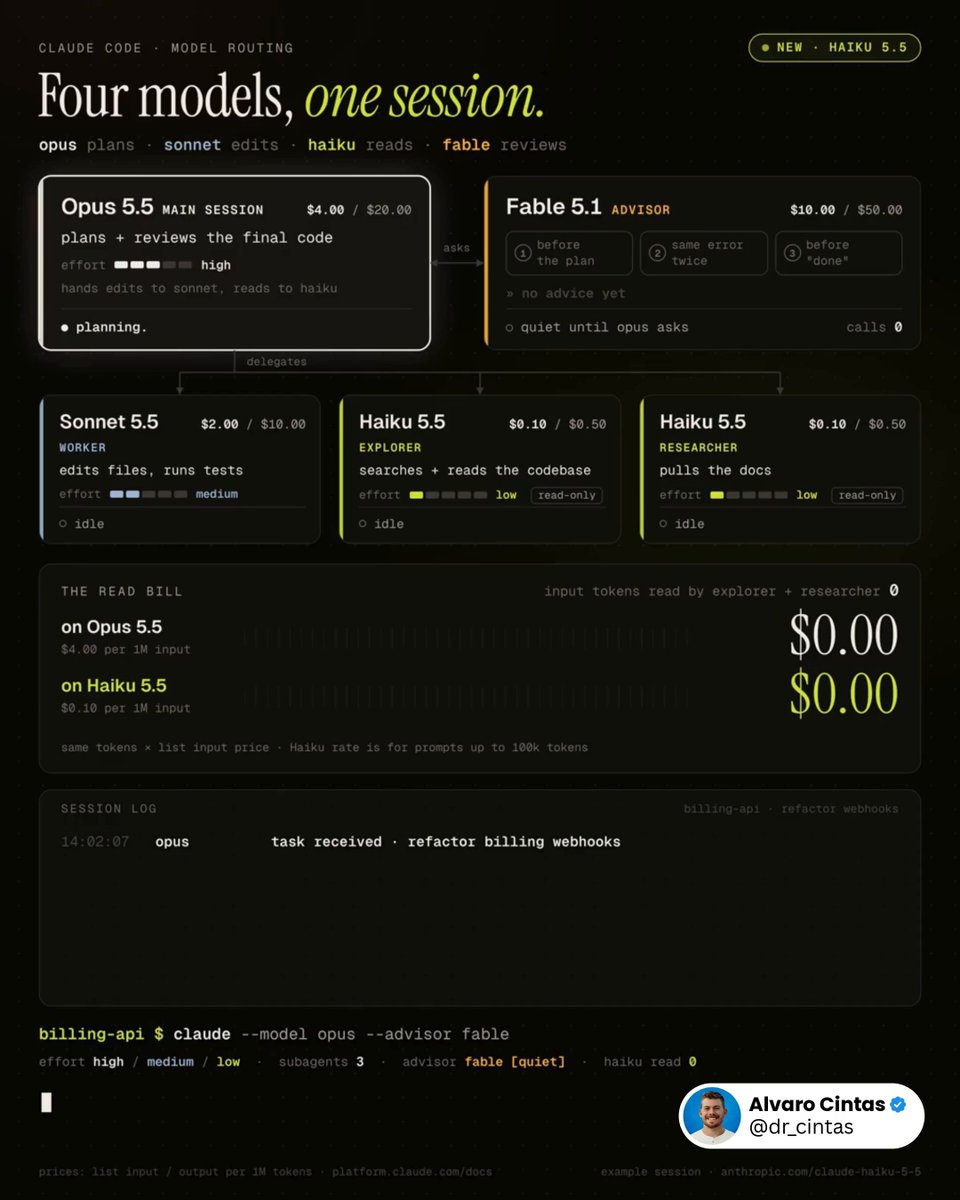
This workflow will save you thousands with Claude. Run Opus 5.5, Sonnet 5.5, Haiku 5.5, and Fable 5.1 together, and stop spending Opus tokens on work that doesn't need Opus. The entire idea in one line: Opus plans, Sonnet edits, Haiku reads, Fable reviews at decision points. Roles, broken down: - Opus 5.5, high effort, owns the plan and reviews the final code - Sonnet 5.5, medium effort, is the worker: edits files, runs tests - Haiku 5.5, low effort, splits into explorer (searches and reads the codebase) and researcher (pulls docs). it's the first Haiku with an effort setting - Fable 5.1, set with /advisor fable. Opus calls it at decision points, and it gets the full transcript each time Three moments Opus tends to call it: → before committing to a plan: is this the right approach? → the same error shows up again: is this going nowhere? → before marking the task done: did something get skipped? Why Haiku only reads: Anthropic's launch post says Sonnet 5.5 and Opus 5.5 are still the better choice for complex agentic coding (Terminal-Bench 4.0: 39.2% for Haiku 5.5, 70.6% for Sonnet 5.5) and that Haiku 5.5 fits narrowly scoped subagent work. so it gets the lookups, not the edits. Anyone still running one model for everything is paying $4 per million input tokens to check whether a file exists. Haiku 5.5 does it for $0.10. Drop this into Claude Code 👇 "Rebuild my Claude Code setup around this structure: Confirm Claude Code is v2.1.293 or later, so the haiku alias resolves to Haiku 5.5. If it isn't, stop and tell me to run claude update. Look through ~/.claude/agents and .claude/agents for subagents already covering explorer, worker, and researcher. Only create new ones for roles that are missing. Set model: haiku, effort: low on explorer and researcher, with no Edit or Write tools. Set model: sonnet, effort: medium on worker. If an existing subagent is locked to a different model, leave it as is and just list it. Name the explorer subagent Explore so it overrides the built-in one, which otherwise runs on my main model. In ~/.claude/settings.json, set advisorModel to fable, and set effortLevel to high for claude-opus-5-5 under modelSettings. A top-level effortLevel in user settings doesn't apply to Opus 5.5. Check for anything disabling the advisor: CLAUDE_CODE_DISABLE_ADVISOR_TOOL, DISABLE_TELEMETRY, or anything blocking feature-flag fetches. Also check CLAUDE_CODE_EFFORT_LEVEL, which overrides subagent effort settings, and CLAUDE_CODE_SUBAGENT_MODEL_FORCE, which makes Claude Code ignore subagent model fields. Report what you find. Don't change any of it yet. Add one line to ~/.claude/CLAUDE.md: consult the advisor before a big plan, when the same error shows up twice, and before marking a long task done. Show every change as a diff first. Wait for my go-ahead before touching anything."

Alvaro Cintas

56,940 Aufrufe • vor 16 Tagen

THIS IS ACTUAL F*CKING GOLD Anthropic just shared one of the best tricks for Claude Code. The idea: run Sonnet, Haiku and Opus 5.5 together, each one doing only the job it's best at. Opus-level judgment on every big call, without paying Opus rates for every routine turn. You just launch Claude Code like this: claude --model sonnet --advisor opus here's the split: → Sonnet 5.5 runs the session and writes the code → Haiku 5.5 explores files and docs in parallel → Opus 5.5 stays on call as advisor for the big calls → you stop spending Opus on work that doesn't need it Opus only steps in at three moments: → before a plan locks → when the same error shows up twice → before calling it done Sonnet builds. Haiku explores. Opus reviews. JEV engineering is the same move one layer down: the forks that need no thinker (which file, which tool, retry or stop) go to JEV in milliseconds, and the big models only see the ones that split the full tree > Sonnet 5.5 runs the main session and edits code > search maps the repo on Haiku 5.5 > grep finds call sites on Haiku 5.5 > docs pulls the API reference on Haiku 5.5 > Opus 5.5 on call as advisor, reads the whole transcript when consulted > JEV routes micro-forks in milliseconds paste the tree and this prompt into Claude Code ↓ "Rebuild my Claude Code setup around this tree: 1. Run the main session on Sonnet 5.5 with Opus 5.5 as advisor. 2. Create three read-only Haiku 5.5 subagents: search (maps the repo), grep (finds call sites), docs (pulls the API reference). 3. Add one rule to CLAUDE.md: consult the advisor before locking a plan, after the same error twice, and before calling a task done. 4. Route fast deterministic forks (tool choice, path selection, retries) through JEV. Show me every change as a diff first. No edits until I say go." ↳ save it, you'll use this every single day.

delost

317,393 Aufrufe • vor 10 Tagen

THIS IS PURE F*CKING GOLD Anthropic just shared one of the best tricks for Claude Code. The idea: run Sonnet, Haiku and Opus 5.5 at the same time, each one doing only what it's best at. Better results and way fewer tokens, because every task lands on the right model. You just start Claude Code like this: claude --model sonnet --advisor opus here's how it splits: → Sonnet 5 runs the session and writes the code → Haiku 5.5 explores files and docs in parallel → Opus 5.5 stays on call as advisor for the big decisions → you stop burning Opus context on tasks that don't need it Opus only steps in at three moments: → before a plan locks → when the same error hits twice → before calling it done Sonnet builds. Haiku explores. Opus reviews. JEV engineering is the same move one layer down: the forks that need no thinker (which file, which tool, retry or stop) go to JEV in milliseconds, and the big models only see the ones that split the full tree > Sonnet 5 runs the main session and edits code > search maps the repo on Haiku 5.5 > grep finds call sites on Haiku 5.5 > docs pulls the API reference on Haiku 5.5 > Opus 5.5 on call as advisor, reads the full transcript when consulted > JEV routes micro-forks in milliseconds paste the tree and this prompt into Claude Code ↓ "Reconfigure my Claude Code setup around this tree: 1. Run the main session on Sonnet 5 with Opus 5.5 as advisor. 2. Create three read-only Haiku 5.5 subagents: search (maps the repo), grep (finds call sites), docs (pulls the API reference). 3. Add one rule to CLAUDE.md: consult the advisor before locking a plan, after the same error twice, and before calling a task done. 4. Route fast deterministic forks (tool choice, path selection, retries) through JEV. Show me every change as a diff first. No edits until I say go." ↳ save it, it'll come in handy.

delost

313,925 Aufrufe • vor 12 Tagen