Загрузка видео...

Не удалось загрузить видео

На главную

Uniracers is a technical marvel, maintaining its speed when most other SNES games would start chugging. It's also a fascinating story. In 1994 shortly after the game launched, Pixar of all companies sued DMA Design, claiming the Unicycles ripped off their 1987 short Red's Dream. Pixar ultimately won (or...

140,336 просмотров • 3 месяцев назад •via X (Twitter)

Комментарии: 0

Нет доступных комментариев

Здесь появятся комментарии из оригинального поста

Похожие видео

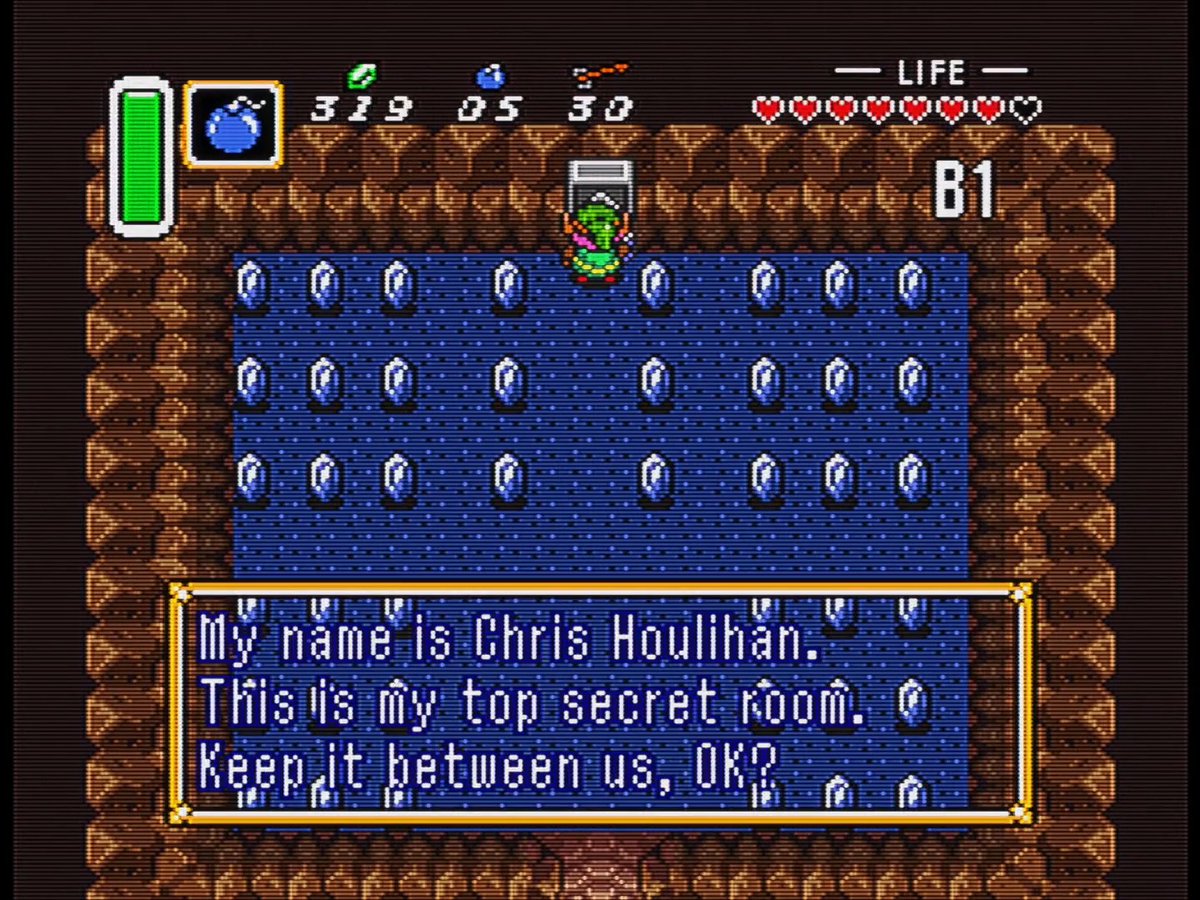
In the Fall of 1990, Nintendo Power held a contest for players to send in a photo of them finding WarMech, a very rare enemy found deep into Final Fantasy. While it's never been officially verified, there's some strong evidence that the winner of that contest was Chris Houlihan, and the prize was to get your name featured in a future Nintendo game. He was mentioned in one subsequent issue from 1998 as a contest winner in '92, Zelda's North American release year. As I'm learning while writing this, there's evidence that the winner was actually Chris's dad, immortalizing his son's name in one of the most unique video game stories out there. Kevin Hainline on YouTube posted a video with some fascinating insight and perspective on the story. ( In short, it seems that Chris was also named in the 1991 Game Boy version of Nintendo World Cup Soccer, where Terry was benched from the U.S. team in favor of the contest winner. The timing lines up really well. As for why his name is only found in the failsafe room in The Legend of Zelda: A Link to the Past, it probably lies with just the nature of game production. They clearly missed a deadline since they never gave Houlihan the later highlight that seemed to be the standard for the Power contests. Also if Kevin's story holds water, they were rightfully not happy with simply naming a team member "Chris" in a handheld title. So it actually makes sense his name gets put into this room. It's probably the highest caliber game they could add him to, in one of the only places the devs could reasonably put him. They had to have known some players would eventually find it, and it would be a mystery. I just wonder if anyone involved knew just how wonderfully complex and interesting it would be. The poetic thing is if everything I learned today is real, "Chris" appeared on the Game Boy, then appeared with his full name in the legendary SNES room, and now is book-ended with just "Houlihan" in Cadence of Hyrule on the Switch. A fascinating legacy spanning nearly three decades and consoles. #RetroGaming

Elder Mathias

19,269 просмотров • 13 дней назад

Goldeneye is a great “better to ask for forgiveness than get permission” story. Released in August 1997, the game made $250m on a $2m budget. A major reason was its insanely fun multiplayer mode…which Nintendo didn’t ask for and developers snuck into the game at the last second. Many years later, Steve Ellis — a game developer for Rare — explained what went down: ➡️ “One of the things that always strikes me as crazy in retrospect is that until something like March or April of 1997, there wasn't a multiplayer mode at all. It hadn't even been started. It really was put in at the last minute – something you wouldn't dream of doing these days – and it was done without the knowledge or permission of the management at Rare and Nintendo. The first they knew about it was when we showed it to them working. However – since the game was already late by that time, if we hadn't done it that way, it probably never would have happened.” ⬅️ Rare had a team of only 10 core developers and it took 2.75 years to make the game, which actually came out 18 months after “Goldeneye” the film. Nintendo briefly cancelled the game but then pushed to release it (and expectations were low). Goldeneye was an instant hit with innovative stealth play, remote-control bombs and sniper rifles. Gaming mags (IGN, GamePro) have called it N64’s best multiplayer game, which is wild when you consider the platform also had Mario Kart and Super Smash Bros. Goldeneye became N64’s 3rd best-selling title ever (also impressive because 7 of the top 9 are all original Nintendo IP). 1. Super Mario 64 (12m units) 2. Mario Kart 64 (10m) 🚨3. Goldeneye (9m) 4. Legend of Zelda: Ocarina of Time (8m) 5. Super Smash Bros (6m) 6. Pokémon Stadium (5m) 7. Donkey Kong 64 (5m) 8. Diddy Kong Racing (5m) 9. Starfox 64 (4m) Most importantly: without the unapproved last-second addition of multi-player, I couldn’t have spent 100s of hours being OddJob and smoking my unsuspecting friends with proximity mines.

Trung Phan

9,238,351 просмотров • 2 лет назад

Steve Jobs talking about Pixar and storytelling. Says "no amount of technology will turn a bad story into a good story" and that Pixar's early films had to prioritize a good story because the cost of animating was so high: ◻️ "In a live action movie, the director goes out and shoots a lot of film — typically 10x to 100x more footage than will end up on the screen. Then they take it all into the editing room and that's why sometimes you see a movie and you go 'that stunk, didn't they know?' Well, the answer is 'yes' but they knew it too late in the editing room and...by the time they knew it, the actors were gone and the sets were down and they were out of money.” "In animation, it is so expensive that you can't afford to animate more than a few % more than it's going to end up on screen. You could never afford to animate 10x more. Walt Disney solved the problem decades ago and the way he solved it was to edit films before making them: you get your story team together and you do storyboards." "In Hollywood, one of the most popular sayings is 'story is King' but it turns out it really isn't. Because when push comes to shove...when a movie is in production and there's a lot of mouths to feed — and they're waiting for stuff to make and the story is not working — almost everybody says 'we will just have to make the movie'. And one of the things that I'm proudest of about Pixar is we have a story crisis on every movie...and we stop [everything to] fix the story." ▫️ *** D3 Conference in 2005:

Trung Phan

103,124 просмотров • 1 год назад

Steve Jobs talking about Pixar and storytelling. Says "no amount of technology will turn a bad story into a good story" and that Pixar's early films had to prioritize a good story because the cost of animating was so high: ◻️ "In a live action movie, the director goes out and shoots a lot of film — typically 10x to 100x more footage than will end up on the screen. Then they take it all into the editing room and that's why sometimes you see a movie and you go 'that stunk, didn't they know?' Well, the answer is 'yes' but they knew it too late in the editing room and...by the time they knew it, the actors were gone and the sets were down and they were out of money.” "In animation, it is so expensive that you can't afford to animate more than a few % more than it's going to end up on screen. You could never afford to animate 10x more. Walt Disney solved the problem decades ago and the way he solved it was to edit films before making them: you get your story team together and you do storyboards." "In Hollywood, one of the most popular sayings is 'story is King' but it turns out it really isn't. Because when push comes to shove...when a movie is in production and there's a lot of mouths to feed — and they're waiting for stuff to make and the story is not working — almost everybody says 'we will just have to make the movie'. And one of the things that I'm proudest of about Pixar is we have a story crisis on every movie...and we stop [everything to] fix the story." *** D3 Conference in 2005:

Trung Phan

308,105 просмотров • 1 год назад

Steve Jobs on storytelling lessons he learned at Pixar. Says "no amount of tech will turn a bad story into a good story" and Pixar's early films (Toy Story, A Bug’s Life, Monsters Inc) had to prioritize a good story because animating so expensive: ◻️ "In a live action movie, the director goes out and shoots a lot of film — typically 10x to 100x more footage than will end up on the screen. Then they take it all into the editing room and that's why sometimes you see a movie and you go 'that stunk, didn't they know?' Well, the answer is 'yes' but they knew it too late in the editing room and...by the time they knew it, the actors were gone and the sets were down and they were out of money.” "In animation, it is so expensive that you can't afford to animate more than a few % more than it's going to end up on screen. You could never afford to animate 10x more. Walt Disney solved the problem decades ago and the way he solved it was to edit films before making them: you get your story team together and you do storyboards." "In Hollywood, one of the most popular sayings is 'story is King' but it turns out it really isn't. Because when push comes to shove...when a movie is in production and there's a lot of mouths to feed — and they're waiting for stuff to make and the story is not working — almost everybody says 'we will just have to make the movie'. And one of the things that I'm proudest of about Pixar is we have a story crisis on every movie...and we stop [everything to] fix the story." ▫️ *** D3 Conference in 2005:

Trung Phan

25,787 просмотров • 1 месяц назад

Disney released Snow White in 1937. 60 years later, they re-released it on video. 28 million copies sold. $250 million in profit. Steve Jobs watched his young son watch it 30, 40 times. “These stories renew themselves with each generation.” In 1996, one year after Toy Story, he spent 20 minutes explaining why he bought Pixar: On buying the dream: "I met Ed Catmull who was running the computer division of Lucasfilm in 1985." "He shared with me his dream about making the first computer animated feature film." "I bought into that dream both financially and spiritually." "It took us ten years to do that, but we did it." The result: Toy Story. Third most successful animated film ever made. On content vs technology: "You can hardly find an Apple II around anymore." "It's not clear whether you'll be able to boot up a Macintosh five years from now." "All these technology boxes and software, if it has a life of a year or two, you're very lucky. Five years is extraordinary." "Sooner or later, they all become part of the sedimentary layer." But stories? "I think people are going to be watching Toy Story in 60 years. Not because of the computer graphics, but because of the story about friendship." On work-for-hire: Pixar made commercials for years. Won every award in the book. Then Jobs did the math. "If Listerine sold more Listerine because of our commercials, we didn't make any more money for producing the commercials." "The margin in that business has been under pressure. More people coming in. Going down, and down, and down." "You work harder and harder to make the same amount of money." He pulled 25 people out of commercials. "We had 25 incredibly talented people doing work-for-hire when we have all these other opportunities where we own a piece of what we create." "Great people are hard to find. We couldn't afford to have 25 of them making commercials anymore." On blending two cultures: "The very best creative people will only go to work in a few places. Disney, Pixar, possibly DreamWorks." "The very best computer scientists in computer graphics will only go to work in a few places. Pixar is one of those." "Pixar is the only place in the world that can hire the best from both of these areas." "We worked for ten years to figure out a way to have them all work together. The Hollywood culture and the Silicon Valley culture are really different." On the hierarchy of power: "When you've got incredibly talented people that are rare and in-demand, if you don't treat them right, they can go get another job in 10 minutes." "So this strange thing happens. The hierarchy of power inverts." "The CEO is actually at the bottom." "I feel like I work for most of these people because they're the ones doing all the brilliant work." "It's management's job to support them because they're on the front lines doing the work." On contracts vs stock options: "Hollywood uses the stick, which is the contract. Silicon Valley uses the carrot, which is the stock option." "When you sign a contract with somebody, you can say, 'I don't have to worry about that person for five years.'" "If you're sophisticated, you'll have a little database that tickles you six months before their contract is up so you can start paying more attention to them." "They're the most important person in the world for six months. Then after they sign up again, you put them in the drawer." Pixar chose stock options. "Every single day, we worry about how to make Pixar a better company so that nobody will ever want to leave." "We don't take anybody for granted." On what Disney taught them: "When you make a live-action film, a director shoots ten to twenty-five times as much footage as will end up on the screen." "Walt Disney realized many decades ago that animation was so expensive that you couldn't afford to animate ten times more than what you need." "The only conclusion: you have to edit your film before you make it." "Working with Disney gave us access to that wisdom. You can't buy it for love or money." On the constant: "Ten years ago, when we made Luxo Jr., it took about three hours to render each frame." "Toy Story. Computers are hundreds of times faster. It still took three hours to render each frame." "The frames were a hundred times more complex." "Our ambitions, visually, are growing as fast as the technology can feed them." On story vs technology: "The art of storytelling is very old." "No amount of technology can turn a bad story into a good story." "That's our mantra at Pixar. It's the story, stupid." "I don't think storytelling has changed in a long time. And I'm not sure it will. I don't think it's something that technology has anything to do with."

Jaynit

95,800 просмотров • 2 месяцев назад

A very harsh threat, made by Netanyahu toward Iran. What is behind the heightened tone? It is not only harsh, it is also unusual. The event that took place in recent months was a paralyzing fear of what is called miscalculation. They will think that we will attack first, even though that was not the intention, and then they will attack, and the entire region will be dragged into another round of confrontation. In a region where there is fear of miscalculation, you are not supposed to announce this kind of thing in the Knesset. I just want to make that clear. Yesterday, Naftali Bennett promoted his press conference on the conditions of soldiers, okay? He gets six million views because the timing looks like a countdown and he is a former prime minister, so the Iranians are in hysterics that he is actually announcing that they are going to attack. That’s the atmosphere. So when Netanyahu attacks like this and makes an unprecedented threat—not only harsh but also unusual—one can’t help but think that for Netanyahu there is a message, or something more problematic than miscalculation. And he wants to warn the Iranians. Now, what’s the issue? The issue is that if the Iranians come to the conclusion that their regime is on the verge of collapse, there is one thing that might save them. And that is an attack on Israel. Because we saw during the war what is called “rally around the flag.” Even those who were in the opposition rallied around the flag when their country was attacked. It is not only the Islamic Republic that is under attack, but also the Islamic Republic of Iran. That is essentially the issue, and that is what Netanyahu, in my opinion, is trying to stop with the threat he issued after the security discussion.

Amit Segal

41,392 просмотров • 6 месяцев назад

The founders of Stripe and Pinterest on how to convince people to join your startup Stripe CEO Patrick Collison argues that part of the reason startups resonate so much is because the outcome is not guaranteed: "If it were guaranteed, it would be boring... Whether or not you're the best person in the world at what you do, you're probably not going to alter Google's trajectory. But if you really want to benchmark yourself and see how much of a contribution and impact you can make--which is a really compelling prospect for a lot of the best people--a startup is a much better place to test that." Pinterest founder Ben Silbermann emphasized this as well: "No smart person that you're hiring is under the illusion that you have a crystal ball into the future and that joining is a guaranteed thing. In fact, if you're telling them that and they select in, you shouldn't hire them because they didn't pass a basic intelligence test. I think it's important to tell them what's exciting and where you think the company can go. But also tell them where it will be hard and chart your best plan. And then tell them why their role can be instrumental--because it will be... What I would discourage doing is whitewashing all of that. If people are joining your company because they want all of the certainty and safety of working at Google but also the perks of working at a small startup with lots of responsibility and transparency, that's a really negative sign." Apparently in the early days of PayPal, Peter Thiel and Max Levchin would tell people after they interviewed all the reasons that the company would fail: "Visa and MasterCard want to kill us. We also might be doing something that's illegal. But if we succeed, we'll redefine payments." Don't whitewash the risks. Instead tell them how your startup will change the world if you succeed and how their role will be instrumental in affecting that change. Video source: Y Combinator (2014)

Startup Archive

11,811 просмотров • 8 месяцев назад

At the end of the day, as I discussed with Jordan Peterson, there are just two games to be played, one real, one Woke. The real game is called civilization. The false game is called power. A long post/🧵: The real divide between Woke and not Woke is in power. The Woke game is the power game, and it is a parasite on the real game, which is civilization. Here's roughly how Jordan described the foundation of this idea. There are various rules, norms, etc., in the game society ultimately plays, and these create a hierarchy that is based upon competence, mostly organically, obviously imperfectly. If the rules of the game are good enough, the imperfections (natural corruptions) are minor and society thrives. If they are not, you'll have problems. This is the real game of building society, and it ultimately has to favor competence. This game must be called "civilization" because that's not just its goal but it is also what it does. It civilizes us beyond our base instincts and impulses so we can work together productively in a healthy manner that generates prosperity. As Jordan put it, this game is also a reservoir of value, and reservoirs of value create parasites. What are these civilizational parasites? They’re parallel games organized by and around malignant psychopathological modes like Dark Tetrad traits, psychopathy, and Cluster-B disorders: histrionic, borderline, antisocial, and narcissistic. These malignant pathologies render people incompetent except at manipulation, so they cannot rise far in a healthy civilizational hierarchy. What do they do, then, to gain power and status in life in a game they cannot actually play? They define a parasitic parallel game and rope people into playing it. It is parasitic in that it draws off the real game (civilization) and mimics its form so that the hosts (people in society) are less likely to realize it’s there, but it doesn’t build or create of its own. It siphons and tears down. What drives this game is failing to see what makes the civilizational game and the hierarchy it produces legitimate in the first place. This is characteristic of the psychopathologies at its heart. The narcissist imagines the world should be serving himself at the top, but it isn’t. The problem can’t be himself, so it must be that the game is illegitimate. Otherwise, he’d be at the top, but he isn’t. Therefore, the game is corrupt. His histrionic nature makes him a victim of the real game, preying upon emotions like empathy and righteous indignation to recruit followers. Because of his Dark Tetrad alignment, his game is not only illegitimate but toxic. It’s inherently sadistic, cruel to its recruits in the way typical of all cults—alternating punishment and leniency or even love-bombing. It’s dishonest. It’s psychologically broken from reality. It’s also a Machiavellian game, which means it has no interest in moral or ethical behavior but only in power. Thus, this rival game to the game of civilization is the game of power. The parasitic game—that is, the power game—is based on a fundamental failure to understand the legitimacy of the civilizational game or the approximately legitimate hierarchy it produces. This is a result of its narcissism, mostly. The game cannot be legitimate because the psychopath isn’t on top of it, where he sees himself constantly as a projection from his frail ego. It sees power in the real hierarchy, though, which it can perceive and understand, and for which it blames most of its troubles. What this means is that the (Woke) power game develops a critical theory of the existing legitimate civilization game. That’s why Woke means “using critical theory (and activism).” A critical theory exists not to articulate a vision—at least not beyond a Utopia after the cult power game holds power to enforce its power game long enough—but to “criticize those aspects of the existing society we wish to change,” as Max Horkheimer, creator of the Critical Theory, put it. The critical theory of the power game exists to recruit by delegitimizing the civilization game in the minds of some of its players, usually ones who aren’t succeeding as well. It picks at “contradictions,” failures, and imperfections while casting the whole civilization game as corrupt and unjust. It offers itself as the only alternative to civilization game while pulling at the threads of the civilization game that allow people to believe in it. It all proceeds from the Woke failure to understand the legitimacy of the hierarchy of the civilization game as it proceeds from its set of rules. Misunderstanding legitimacy leads it to conclude that all hierarchies are actually based in power, and all power is fundamentally arbitrary. That is, they do not believe all power is illegitimate. They believe power is the only legitimate thing in any hierarchy, but they also believe that power is located in persons like themselves through their narcissism and projection. Think of Voldemort as an icon of this mode of thinking: “there is no good or evil, only power and those too weak to seek it.” Of course, that quintessential Dark Tetrad perspective is what ensures the psychopathological power game will be rigged to make sure the psychopaths are attracted to it and rise to its top. This belief is what we call Woke. The Woke game is the power game, and it is a parasitic competitor to the civilization game. There is no overlap between these two games. To adopt the power game is to abandon the civilization game entirely and, in fact, to become its enemy. But James, you might ask, isn’t there power in civilization? Yes, there is, and necessarily, but it isn’t what defines the civilization game. It’s a byproduct of the game, not the game itself. The civilization game is fundamentally the building out of an organic and dynamic hierarchy based on a set of rules, or what some people call “muh principles,” that will succeed or fail for that civilization in direct proportion to three things. 1) How aligned with the truth are the rules of the civilization game? 2) How aligned with justice are the rules of the civilization game? 3) How willing are the participants of the civilization game to defend their principles and their game, including against socio-parasitical perversion? The more aligned with truth and justice a civilization game is, the more successful it will be, and the more legitimate its hierarchy. The power that results as a byproduct is extremely legitimate in a highly aligned civilization where people haven’t forgotten their charge to defend the game itself, which is what we call responsibility. A civilization game strongly aligned with truth and justice filled with a preponderance of responsible people will produce a thriving, prosperous society. It only works this way every time. Not everyone is responsible, though. Some are also incompetent because of various pathologies (not talking about for other reasons). Those pathological players may, under certain circumstances, create a parasitic side game with themselves on top through a variety of strategies that mimic the values and principles of the real game while distorting them into power plays because their game is power, as discussed above. They will recruit into that game primarily from those who are resentful of the real game for any variety of reasons, and getting recruited into the power game from the civilization game is called “going Woke.”

James Lindsay, anti-Communist

154,286 просмотров • 1 год назад