Loading video...

Video Failed to Load

Go Home

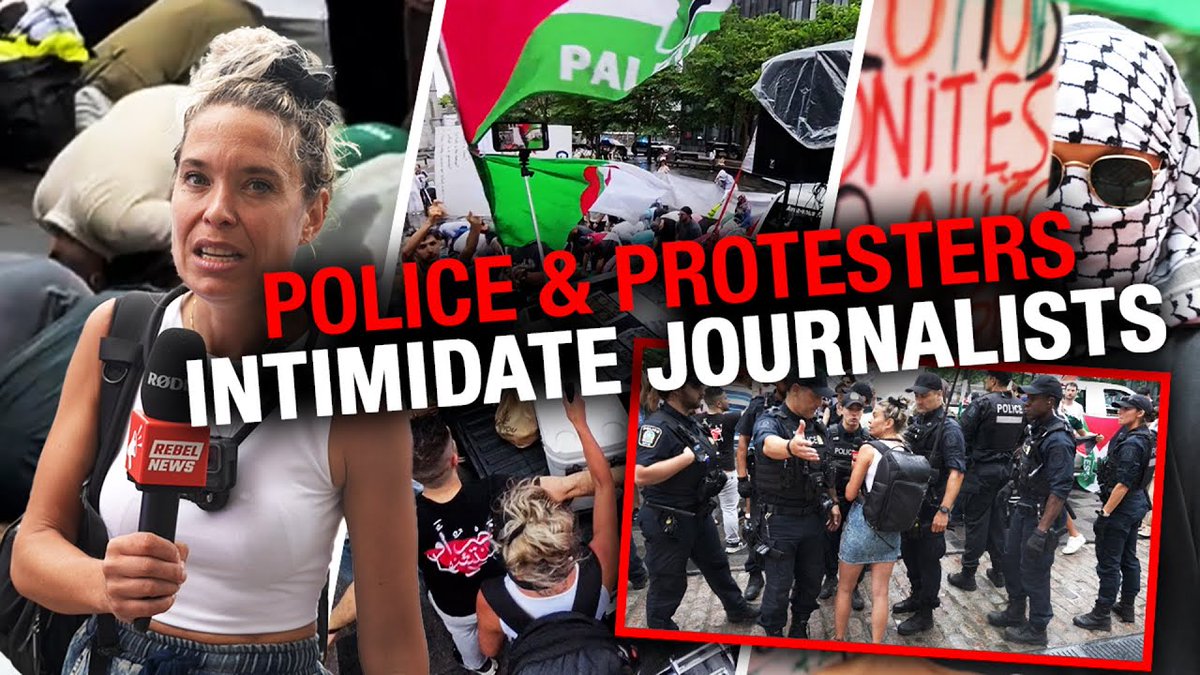
Valiant efforts to appear neutral while policing protests can result in a false equivalence that overlooks clearly unlawful behaviour. Despite this officer acknowledging that we were backing away as protesters advanced, and even viewing video evidence of us being physically attacked, our interaction concluded with a generic reminder to...

31,670 views • 1 year ago •via X (Twitter)

0 Comments

No comments available

Comments from the original post will appear here

Related Videos

We have a very important request from you, please read this post until the end and share it so that everyone can see and know the facts. We shared the video for everyone to see, showing how Zionist police attacked Jewish children, beat them and arrested them. But X, formerly known as Twitter, decided that this video encouraged child abuse and violence and told us to delete the video, otherwise it threatened to suspend our account. Although the video clearly shows how Zionists oppress the Jewish community in the Holy Land, X claims that the video is anti-Semitic. How did X manage to label this as anti-Semitism and child abuse, even though the Jews being attacked were Jews being persecuted? X, who labeled the video as violence against children, child abuse and incitement to violence and deleted our post, clearly tells us this. Even if Jews were attacked and the culprits were Zionists, it was considered abuse for Jews to share this by blaming Zionists. And therefore, if Zionists arrest Jewish children and Jews make a video of this and announce it to the world, this is clearly considered a violation of the rules. X platform clearly does not see Jews as Jews. According to X, only Zionists are Jews. Again, according to x, if a Jew is attacked and shares this as evidence, this is considered abuse and violation of rules. While the anti-Zionist Jewish community is dealing with the Anti-Semitism of the Zionists, it now has to deal with the Anti-Semitism of the x platform. X Elon Musk Now we are asking x... If the Jews cannot freely announce the disasters that have happened to them, where are Elon Musk's ideals and libertarian mentality?

Voice of Rabbis

615,483 views • 2 years ago

SHOCKING: Threatened with arrest for covering Islamic public prayers On Sunday, Alexandra Lavoie and Rebel News videographer Guillaume Roy were at Montreal’s Notre-Dame Basilica to cover yet another public prayer organized in conjunction with anti-Israel demonstrations. Despite standing at a respectful distance and waiting for the group to arrive, we were soon surrounded by participants who attempted to obstruct filming using flags, signs, and other objects. Rather than intervening against those blocking us, Montreal police turned their attention to me, physically preventing me from recording and attempting to remove me from the area. Officers said to “let them pray” and accused me of “creating an event,” despite clear video evidence that we were not provoking or interfering with the gathering, only trying to record the public prayer demonstration. This isn’t an isolated case. Independent journalist Natasha Graham was violently arrested in a similar context while filming an anti-Israel protest. Her arrest occurred in front of demonstrators who applauded as she was taken away. She now faces two criminal charges: obstructing and assaulting a police officer. The rise in hate-fueled protests and public prayers across Montreal since October 7, 2023, has sparked debate over the place of religion in public spaces. Premier François Legault has even proposed a bill to ban all public prayers — regardless of religion — in response to the growing tensions. While this law remains under consideration, the selective enforcement already at play is causing alarm. The question now is: why are journalists being threatened or arrested for doing their jobs, while disruptive activists face little to no consequences?

Rebel News

38,929 views • 1 year ago

He’s filming everyone at the market, but the police say there’s nothing they can do. Whose side are you on? A male videographer (the "auditor"), who is wearing a disguise for anonymity, is filming at an outdoor market. He is confronted by a market organizer (Kaylee Dolan) regarding his filming of vendors and attendees. A law enforcement officer arrives to mediate the dispute. ​The organizer expresses concern that the videographer is making vendors and patrons uncomfortable and asks him to stop or leave. The videographer asserts his right to film in a public area, refusing to comply with her request. ​The responding officer confirms that the videographer is in a public space where he has a legal right to record. The officer acknowledges the organizer's frustration but explains that, as no crime is being committed, he cannot compel the man to stop filming or force him to leave. ​The tension arises from the intersection of constitutional rights and personal expectations of privacy. ​Under the First Amendment of the U.S. Constitution, individuals generally have a protected right to film in public spaces (such as sidewalks, public parks, and plazas). This includes the right to film government officials and police officers performing their duties, as well as things that are plainly visible from those public areas. ​In general, there is no "reasonable expectation of privacy" in a public space. If something can be seen by the naked eye from a location where a person is legally permitted to be, it is typically legal to photograph or record it. ​While filming is a protected activity, it is not absolute. If filming crosses the line into harassment, stalking, or disorderly conduct—or if it is done to "clandestinely" capture private or intimate areas, it can become illegal. In this specific interaction, the officer determined that the videographer’s actions did not meet the legal threshold for a crime, which is why he could not intervene. ​If the market were held on private property rather than public land, the owners or organizers would have the right to set rules regarding photography or to ask people to leave. If someone refuses to leave private property after being asked, they can be cited for trespassing. The officer's inability to remove the videographer suggests that the location was either public property or that the organizer lacked the legal authority to exclude him from that specific area.

✨️Serenitee♡Sam✨️

42,667 views • 2 months ago